Ghosts to Carry, Stories to Keep

Where memory meets the page, one moment at a time.

  • Low Prices Every Day

    Codziennie niskie ceny

    Or, how Biedronka won my heart.

    Arriving in Poland in 2010, I was already familiar with the large, modern shops the country had to offer. Gliwice and Katowice boasted shopping malls that could rival anything in the UK or France. Tesco felt like being back home again — and the French store Carrefour brought back holiday memories. The layout was logical, too: wide aisles, bright lighting, and everything in its rightful place.

    But there were also the distinctly Polish shops.

    Żabka was everywhere, like a green-and-yellow punctuation mark on every street corner. Open from early morning until late at night — with staff often outside smoking or drinking coffee — it always glowed brightly and was stocked with beer, snacks, and emergency supplies. In my last apartment — yet another on the fourth floor without a lift, requiring me to haul my bike up the stairs — I lived right next door to a Żabka. I’d pop in for a couple of beers or a treat, but it never became my main shop. It was more like a convenient neighbour who didn’t mind that I was sometimes still in my pyjamas.

    Then came Społem.

    Ah, Społem. Quietly intimidating, museum-like, frozen in a 1970s future that never quite arrived. I walked past my local Społem almost every day, drawn in by its retro charm and that iconic logo. Each time I’d think, “Do I really need to go in there?” It fascinated me, but I never felt entirely ready to step inside.

    And then, finally… Biedronka.

    In the early days of living in Poland, I rarely visited the Biedronka near my hotel in Łabędy. I went three, maybe four times at most. The store overwhelmed me — cardboard trays serving as both display and design philosophy, slightly chaotic aisles bathed in fluorescent lights bright enough to illuminate the next three years of my life and possibly my past mistakes, and a disorienting mix of familiar and unfamiliar items. Feeling unsure, I usually stuck to buying the same two things: a banana and a single bułka. Only once did I buy more: a huge pile of oranges I hoped would help me fight off the flu. That was all I could bring myself to buy. I still remember staring at the biggest mountain of green grapes I had ever seen in any supermarket — a towering mound where you picked any size bunch you wanted and bagged it yourself.

    Little did I know how important that store — which I once likened to chaos with a barcode — would become to me.

    To shop at Biedronka is to accept a specific set of physical laws. The crisps exist in a state of perpetual structural crisis: half-collapsed cardboard trays stacked high-stakes-Jenga-style upon other half-collapsed trays, torn open with the frantic urgency of a person defusing a bomb. There is always one unwanted flavour overflowing in silent protest, a leaning tower of Lay’s Paprykowe defying gravity, a rogue packet resting on the lino floor pretending it lives there now, and an abandoned pallet jack blocking the coffee aisle like a medieval siege engine. Self-serve rolls are displayed with an optimistic level of trust that you won’t squeeze them, even though everyone absolutely does, while inexpensive beer sits positioned at eye level, gently whispering, “You’ll figure it out.”

    Just one person usually seems to operate the till, possessing the unshakeable willpower of someone who has seen queues form like severe weather systems. When not scanning items, they multitask at a level that should qualify them for some kind of national honour — the Order of Biedronka, First Class. You witness tank-like pallet jacks being dragged around like part of a military exercise, crates being opened, restocked, broken down, and restacked at lightning speed, while customers weave through the narrow spaces like they’re navigating a low-budget obstacle course.

    And then — that till. The single till. The sacred, glowing altar of Polish commerce.

    One person runs it like a machine gunner in an old war film, scanning items so fast the barcodes barely have time to register their own existence. You can practically hear the dramatic soundtrack building. Meanwhile, the queue behind you forms with military precision — people shifting weight, calculating angles, eyeing the competition, preparing for the moment.

    And then it happens. The shout. The call to arms. The ancient ritual cry of the Biedronka cashier:

    “OTWIERAMY DRUGĄ KASĘ!” (We’re opening the second till!)

    The reaction is instant. Not human — instinctive. Primal. People sprint like someone just announced free pierogi for life. Trolleys swing. Baskets fly. Grandmothers move with supernatural agility. It isn’t chaos; it’s pure, synchronised choreography.

    For all its chaos, cardboard trays, and pallet jacks abandoned like sleeping animals in the aisles, Biedronka won me over in the smallest, most human ways. Not through bargains or promotions, but through the quiet rituals of daily life — the ones you only notice once you’ve lived somewhere long enough to stop feeling like a visitor.

    The first ritual was the loose change.

    I began to notice that the staff in Biedronka never seemed particularly happy to accept large banknotes unless it was absolutely necessary. When they did, it came with an air of subtle disapproval — a tut, a small shake of the head, the kind of silent judgement that needs no translation. Sometimes it wasn’t silent at all; I was initially taken aback at being chastised simply for not having the exact change.

    In those early days, I was terrified of holding up the queue. Polish queues move with a strange, unstoppable momentum — fast and slow at the same time. The person (or two, or three) behind you always stands so close they could co-manage your coin counting — a level of proximity that would spark quiet outrage in any British queue. Sometimes I’d feel a trolley gently nudging the back of my legs, in sharp contrast to the polite 2-foot buffer zone you get in the UK. So there I’d be, fumbling with grosze, apologising in my very best shaky Polish, convinced I was single-handedly disrupting the country’s economic flow.

    “Przepraszam… nie mam drobnych…” (Sorry… I don’t have small change…)

    In my British English, we barely pronounce our ‘r’s, let alone roll them. That dramatic, percussive vibration at the front of the mouth felt completely alien to my tongue. A Scot could do it effortlessly, but for me, it took weeks of stubborn practice. I rehearsed it with such determination that hearing myself finally say, “Przykro mi bardzo,” along with two of my favourites — “Proszę” and “Przepraszam” — even I was impressed.

    The trill was perfect. Too perfect, in fact. Once, an older cashier challenged me, narrowing her eyes and asking why I claimed not to understand Polish when I was clearly speaking it so fluently. Sometimes, a little rehearsed knowledge is more confusing than none at all!

    I became surprisingly proficient at apologising when I didn’t have exact coins. I usually tried to pay the precise amount, but keeping a running total in my head was tough. The moment the cashier announced “czterdzieści siedem złotych osiemdziesiąt dziewięć groszy,” my brain would freeze.

    That’s when the real panic set in. If I couldn’t read the digital display, I resorted to the only solution I had left: I held out an open palm full of coins — like a child offering up treasure — and let the cashier take whatever was needed.

    My friends couldn’t believe I trusted strangers to take the correct amount, but they always did.

    Over time, once the staff recognised me, they softened. They’d pick through the coins with gentle efficiency — sometimes smiling, sometimes sighing, but never taking a grosz more than required. It was a small kindness, but it landed with real weight. It made me feel less like an outsider and more integrated into the daily rhythm of the neighbourhood.

    Then came the single-beer revelation: the moment I realised you could simply unclip one bottle from a six-pack without being tackled by security. In the UK, that felt like a criminal act. In Poland, it was entirely normal. A tiny cultural revelation that made me laugh out loud in the aisle.

    Slowly, without realising it, I became a regular. I learned to read Biedronka like an open book. I knew which cashier liked a bit of small talk, which one scanned at superhero speeds, and which one silently judged my late-night crisp selection. I knew when the bread was freshly delivered, when the bananas were at their peak, and when an abandoned pallet jack would inevitably block the coffee aisle.

    Years later, a friend asked why I didn’t just pay with a debit card back then. Looking back from today, it seems obvious. But back in 2010, Biedronka wasn’t a card-first world. Even when card terminals appeared, they were temperamental, slow, or marked with a printed sign reading “brak sieci” (no network). Cash was king — it was the rhythm of the place.

    Społem… ah, Społem.

    If Biedronka was noise, rapid movement, and daily theatre, then Społem was its quiet opposite — a peaceful time capsule I passed almost every day. It wasn’t until my final year in Poland that I finally became a regular customer there. By then, something in me had softened, or perhaps Społem had simply patiently waited me out. I grew to love its quiet charm and appreciated how it held onto a nostalgic version of Poland that was rapidly disappearing elsewhere.

    But Społem deserves its own story, its own memories, and its own dedicated entry.

    This chapter belongs entirely to Biedronka — always, to me, truly: codziennie niskie ceny.
  • Under the Dumpling

    Before I moved to Gliwice, milk bars were a footnote in my phrasebook — bar mleczny: an inexpensive cafeteria, a relic of the communist era. I had visited one in Bytom during an early trip, but it wasn’t until I lived in Gliwice, from 2010 onward, that a milk bar became part of my everyday life.

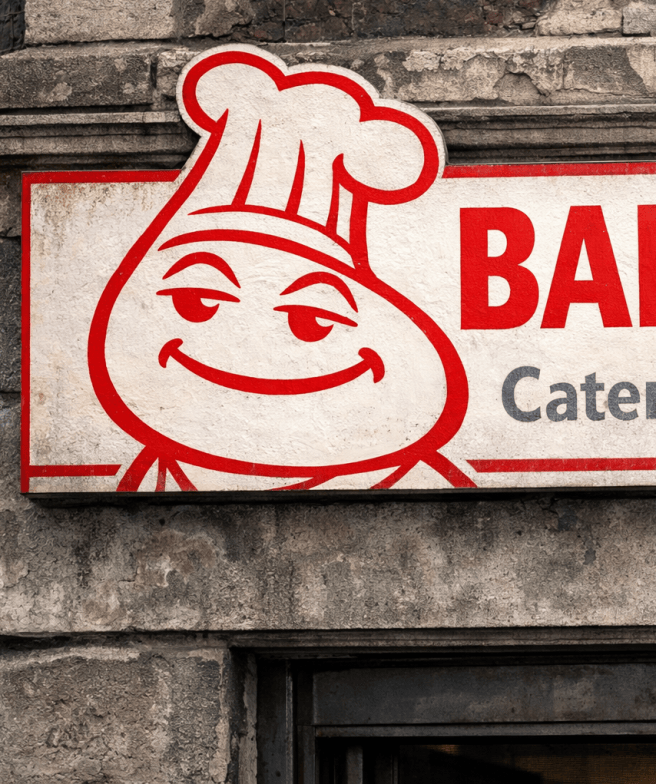
    Five minutes from my first apartment, and no more than ten from the next two, set firmly upon the busy crossroads of ulica Styczyńskiego and ulica Kozielska, was a massive, four-story corner kamienica. The ground floor was clad in chunky, decorative blocks of stone, while the upper levels switched to classic brick, framed at the edges with heavy stone corner pieces. The entrance sat neatly in the sharp angle of the intersection, tucked under two floors of balconies that seemed to be permanently judging the traffic below. Above the door hung a long sign featuring a cartoon chef — hat, moustache, and the kind of smile that suggested he knew something you didn’t. Big red letters spelled out Bar Pod Pierożkiem, and underneath, in smaller black text: Catering, organizacja imprez.

    I genuinely didn’t realise you could walk in and eat there. So I never did — not until a casual question changed that.

    Not long after I moved in, a friend and I were waiting at the pedestrian crossing outside the place. She nodded toward the door and asked, “Ever eaten there?” I said no — I didn’t even know they served food. “It’s not actually a bar?” I asked, already confused. She told me the food was supposed to be very good, especially the pierogi — practically legendary — but the dining experience was, let’s say, less legendary. Most of their business, she said, came from catering weddings and family events, the kind of occasions where good cooking mattered more than ambience or chairs that didn’t squeak. I said I’d give it a try in the next couple of days.

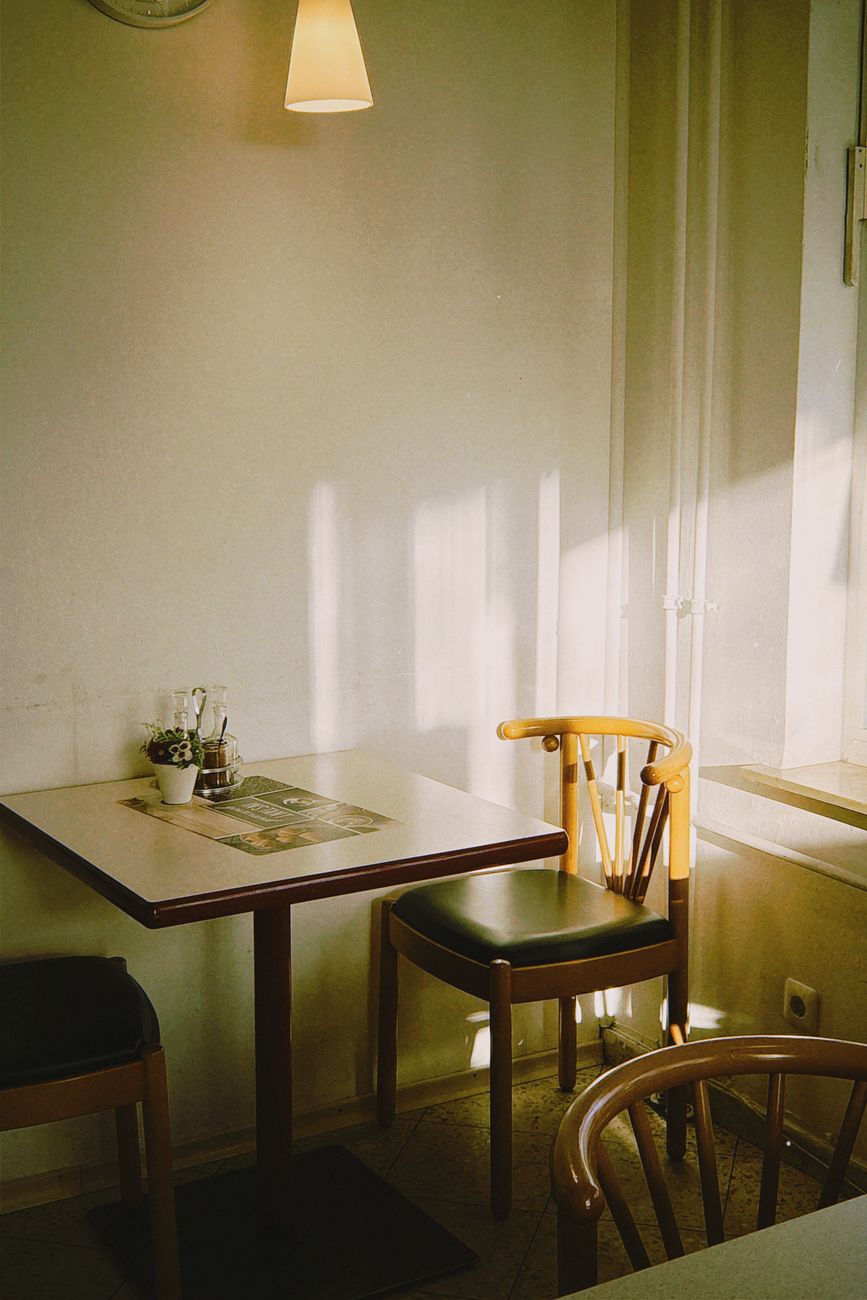
    When I finally pushed open that heavy door, the first thing that hit me was the dining room. Laminated tables, plastic chairs, high ceilings — a big, echoing space that felt like a school cafeteria that had taken a vow of silence. No music, no decorations — just the scrape of chairs and the voices drifting out of the kitchen. At the far end, a single dining-room table acted as the boundary to the kitchen — the same kind of laminated table as all the others, just pushed into place and used like a counter to mark where the dining room ended and the kitchen began. Beyond it, you could see the kitchen working away like a quiet engine, the cooks moving with the calm confidence of people who know their pierogi are famous.

    To the best of my recollection, I never saw a queue any longer than two people. One afternoon it was a grandmother and a boy I assumed was her grandson. Later, I glanced across the room and watched him tuck into a dish of pierogi ruskie whilst his gran looked on with quiet satisfaction.

    I felt slightly wary at first. Not frightened, not unwelcome — just aware of my own clumsiness. I don’t remember much about the menu now; it escapes me. There was a specials board, I think, but I rarely looked at it. The place was never busy, and that somehow made the silence heavier.

    And my friend was right. Sometimes the place felt depressing, and I hate admitting that. The cavernous room, the echoing chairs, the absence of music — it could feel like eating in a hall after everyone else had gone home. But there was one person who changed that atmosphere, even slightly: the woman who took the orders and the money, and who called out the dishes when they were ready. She seemed younger than the others, dressed more modernly, with a brisk, efficient manner that never crossed the boundary of familiarity. Direct, straightforward, not unfriendly — just someone who knew her job and did it without fuss.

    She warmed to me a little. Not in any sentimental way, but in the practical sense of someone who recognised a regular customer who struggled with ordering. I would stand there, rehearsing the words in my head, and she would wait with a kind of patient neutrality that felt like mercy. I always ordered the same thing: kotlet schabowy, frytki, and whatever surówka was being offered that day. It was a meal I genuinely enjoyed, and in a place that sometimes felt bleak, it was a small anchor of comfort.

    Out in the silence of the dining room, the real challenge began. The meal was always freshly cooked; you waited no more than ten minutes, and then your order was called.

    The meal was served on a disposable polystyrene plate, the schabowy still quietly sizzling beneath its coating of breadcrumbs. The cutlery was plastic, too. Presumably to save on washing up, once you’d finished eating, you simply dropped the plate and cutlery into a large plastic bin next to the washroom.

    However, trying to carve a thick, crisp pork cutlet with a flimsy plastic knife proved to be an exercise in extreme patience and physics. With every attempt to slice through the golden crust, the knife would bend alarmingly, threatening to snap entirely or catapult a piece of meat across the quiet room. It was a tense, absurd battle of wills — just me, a silent room, and a stubborn piece of pork holding its own against a bendy plastic toy.

    I didn’t go every day. Once a week, certainly. Twice, sometimes, if the weather was bad or I couldn’t face cooking. Each time I went for the quick, easy option — even on days when I fancied something else. I liked schabowy and frytki a great deal, and habit has a way of disguising itself as preference.

    Occasionally, when other customers were present, I noticed their eyes drifting toward my plate. Their meals were usually a simple soup or, more often, pierogi ruskie — everyday staples — while I sat there tucking into what might have looked, to some, like the height of indulgence: a Sunday dinner masquerading as a Tuesday lunch. It wasn’t envy I saw, but a kind of gentle astonishment, as though they wondered what sort of man walked into a milk bar on an ordinary afternoon and ordered a feast.

    One day I decided I would break the pattern. I would study the specials board. I would try something new. I pushed open the heavy door, rehearsing a different sentence in my head, determined to expand my horizons.

    But before the door had even closed behind me, her voice cut through the room — that familiar, brisk call from the counter, delivered with only the briefest glance in my direction:

    “SCHABOWY I FRYTKI DLA PANA!”

    And that was that. My attempt at change evaporated in the echoing hall. She had already placed me, already anticipated me, already written the script. I didn’t protest. I paid quietly, took my usual seat, and waited for the usual meal, feeling both defeated and strangely comforted. In a place where I often felt out of step, someone had recognised me — not intimately, not personally, but enough to know what I would ask for before I asked it.

    The trouble was, it happened again. And again.

    I told my friend, expecting her to share the absurdity, but she dismissed the idea with gentle certainty. “No, Gary, I don’t think so.” I was taken aback. Why wasn’t I being taken seriously? I wanted to eat something else. I wanted to prove I wasn’t trapped in a culinary loop of my own making.

    I asked her to come with me. She agreed.

    We walked in together, and before the heavy door had even swung shut, the familiar cry rang out across the cavernous room:

    “Schabowy i frytki dla pana!”

    My friend didn’t laugh. She didn’t show any obvious surprise. She was too polite, too considerate, and perhaps too attuned to the social choreography of the place to draw attention to it. She said it was her turn to pay, and that she’d be happy to explain that I wanted something other than schabowy and frytki — but I pleaded, “No, no… it’s fine. No need to mention anything.” So I sat down at the table I preferred, the one that felt least exposed in that vast, echoing hall.

    At the counter, she chatted with the woman. I had no idea what they were discussing, but they were both laughing, and the sound softened the room. My friend ordered her meal and came to join me. I thanked her for paying, and she told me what the lady had said: that she was kind, nice, and from Zabrze. That she travelled every day by tram and bus. That she longed for a job closer to home, but this was all she could find.

    It changed something. Not the routine — I still ate schabowy and frytki — but the feeling. The woman who called out my order wasn’t just efficient or modern or brisk. She was someone making a long commute, someone doing her best, someone who had noticed me enough to anticipate my meal but not enough to cross the boundary of familiarity. And somehow, that made the place feel less bleak. Not warm, not welcoming — but human.

    I don’t know when it closed. There was no moment, no final visit, no sense of an ending. Life simply shifted. I found myself getting busier, pulled toward the trendy cafés near the Rynek or the salads at Bistro Gliwice. My last apartment was closer to the city centre, and the corner of Styczyńskiego and Kozielska became a place I passed less often. It slipped out of my routine the way certain habits do when your life changes shape — gradually, almost imperceptibly.

    Years later, sitting at a desk far from Gliwice and trying to map out these memories for my blog, I decided to retrace my old steps. I opened Google Street View, dropping the digital pin onto that familiar grey corner. The sign with the chef had gone. The heavy front door and windows looked different too. Another company now occupied the space.

    For a long time, I assumed that was the end of the story. I felt a quiet, familiar pang of expat nostalgia — the assumption that the pieces of the world you leave behind inevitably vanish when you turn your back. I imagined the cavernous room permanently silent, the quiet engine of the kitchen turned off for good.

    But memory is a tricky narrator. Just recently, digging deeper into the local history of that neighbourhood, I stumbled across a detail I had missed. The place hadn’t disappeared. Pod Pierożkiem was still living.

    It wasn’t a state-subsidised milk bar, not officially, but it had lived exactly like one. And when the old corner finally closed, the owners didn’t give up — they simply moved the entire operation across the city to ul. Okopowa, right beside the train station. Same traditional recipes, same quiet purpose.

    I like knowing that. I like knowing it didn’t end in silence. That somewhere, in another part of Gliwice, the same recipes, the same rhythm carried on. It makes my memories feel less like fragments and more like part of a longer story — one I only glimpsed for a few years, but which didn’t stop when I walked away.

  • The One That Stayed / Obraz, który został
    5–8 minutes

    The One That Stayed / Obraz, który został

    I wrote this work in honour of a colleague I had the privilege of knowing through the language school where we worked. Once met, never forgotten. She was small, slight, with a sharp pixie cut and eyes that missed nothing — light, quick, with a natural grace and extraordinary intelligence that made her seem both grounded and remarkable. Sharp intelligence, quick thinking, and a presence people trusted instinctively. Her students adored her. Her friends admired her. I felt lucky to know her at all.

    The Saturday warmth settled over Gliwice like a soft veil, turning the Rynek’s brickwork honey‑gold. By early afternoon, the bar enclosure at the edge of the square was already alive — red and white everywhere, faces painted, shirts bright, the long, comic drone of vuvuzelas drifting between buildings like a stubborn summer insect that refused to leave.

    I found my friends gathered around a table, drinks sweating in the heat, everyone already half‑hoarse from practising “Polska, Biało‑Czerwoni” ahead of the crucial Czech match. There was that unmistakable Polish mixture of hope, humour, and fatalism — the sense that whatever happened, the singing would carry you through.

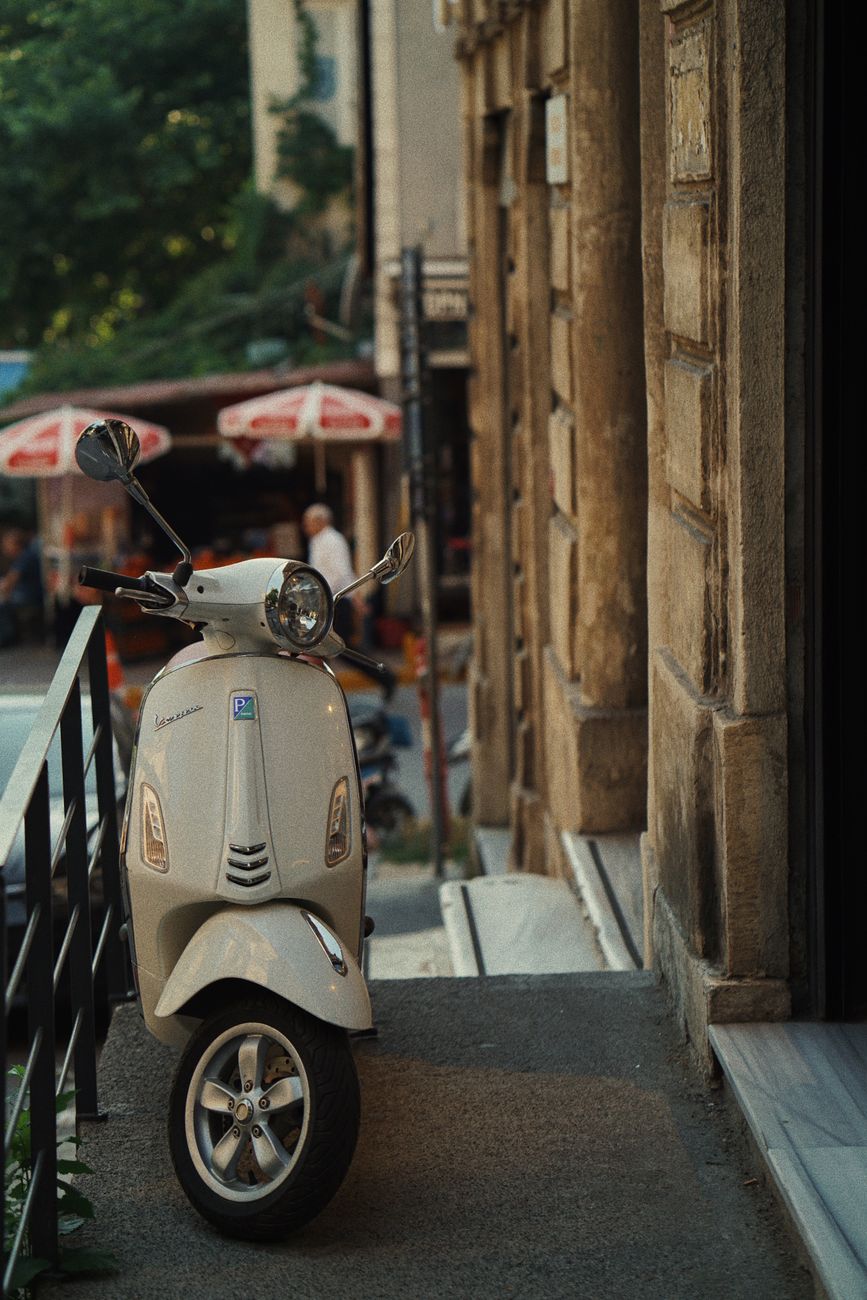
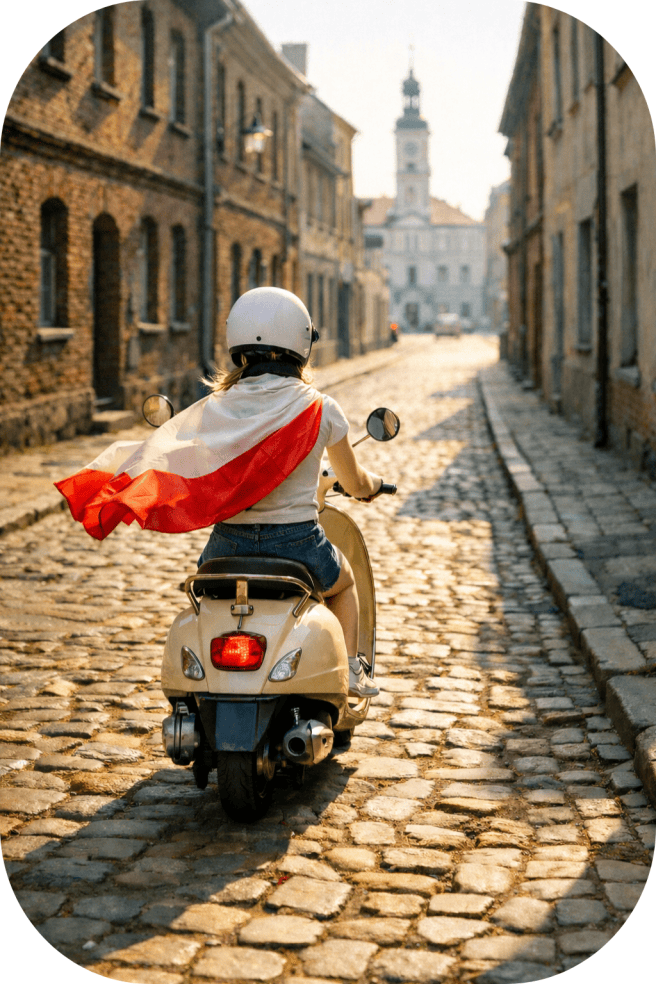
    Then came her arrival: that unmistakable deep Vespa growl, a rising pitch cutting through the noise of the Rynek. She wove confidently along the side street, the Polish flag tied around her shoulders like a cape, snapping behind her as she braked with cheerful certainty. People turned, smiled, nudged each other. She lifted her helmet, shook out her hair, and walked straight into the enclosure as if stepping into the heart of the day.

    She sat with us, flag still draped around her, and sang with full‑bodied gusto — every chant, every hopeful roar, every ironic “Nic się nie stało” when the match began to slip away. She was part of the day’s pulse, part of its humour, part of its stubborn joy.

    Hours later, after the match, after the songs had softened into conversation, I saw her one more time — flying down a sunlit street, flag still billowing behind her, as if she were carrying the day’s spirit home. She waved again, and in a moment she was gone, leaving only the warm air trembling in her wake.

    A small, perfect image. The one that stayed.

    Napisałem ten tekst na cześć koleżanki, którą miałem zaszczyt poznać w szkole językowej, gdzie razem pracowaliśmy. Kto raz ją spotkał, ten nigdy jej nie zapomni. Była drobna, lekka, z krótką fryzurą i bystrym spojrzeniem, które dostrzegało każdy szczegół — z tą naturalną gracją i niezwykłą inteligencją, które sprawiały, że wydawała się pewna siebie, a zarazem wyjątkowa. Błyskotliwa, szybka w myśleniu, miała w sobie coś, co natychmiast budziło zaufanie. Jej uczniowie ją uwielbiali. Przyjaciele podziwiali. A ja czułem się wielkim szczęściarzem, że mogłem ją znać.

    Czerwcowe ciepło osiadało nad Gliwicami jak miękki welon, zamieniając ceglaną zabudowę Rynku w miodowe złoto. Wczesnym popołudniem ogródek piwny na skraju placu już tętnił życiem — wszędzie biało‑czerwone barwy, pomalowane twarze, jasne koszulki, a długi, komiczny dźwięk wuwuzeli unosił się między kamienicami jak uparty letni owad, który nie chce odlecieć.

    Przyjaciele siedzieli już przy stole, kufle rosiły się w upale, a wszyscy byli pół‑ochrypli od ćwiczenia „Polska, Biało‑Czerwoni” przed decydującym meczem z Czechami. Ta niepowtarzalna polska mieszanka nadziei, humoru i lekkiego fatalizmu — poczucie, że cokolwiek się wydarzy, śpiew poniesie nas dalej.

    A potem jej przyjazd: to głębokie, pewne mruczenie Vespy, dźwięk przebijający się przez hałas Rynku. Jechała pewnie boczną uliczką, z polską flagą zawiązaną jak peleryna, trzepoczącą za nią, gdy hamowała z radosną pewnością. Ludzie odwracali się, uśmiechali, szturchali znajomych. Zdjęła kask, potrząsnęła włosami i weszła prosto do ogródka, jakby wchodziła w sam środek dnia.

    Usiadła z nami, flaga wciąż na ramionach, i śpiewała z pełną energii pasją — każdy okrzyk, każdy pełen nadziei doping, każde ironiczne „Nic się nie stało”, gdy mecz zaczął wymykać się z rąk. Była częścią rytmu dnia, jego humoru, jego upartej radości.

    Godziny później, po meczu, gdy śpiewy zamieniły się w rozmowy, zobaczyłem ją jeszcze raz — pędzącą słoneczną ulicą, z powiewającą flagą, jakby niosła ze sobą ducha tego dnia. Pomachała, i w jednej chwili już jej nie było, zostawiając tylko ciepłe powietrze drżące po jej przejeździe.

    Mały, doskonały obraz. Ten, który został.


    The One That Stayed

    A warm June Saturday in Gliwice,
    the kind of early‑summer gold
    that settles gently on the streets,
    quiet, generous, unforgettable.

    We sat in the bar enclosure,
    glasses misting, shirts red and white,
    singing Polska, Biało‑Czerwoni
    for the clash with the Czechs,
    with the hopeful rhythm
    of people who trust in songs —
    and in the fearless ones among them.

    Then you arrived —
    small, slight,
    with that tomboyish grace
    that made confidence look effortless,
    as if the whole town
    were simply an extension
    of your own sure stride.

    I heard you before I saw you —
    that low Vespa growl
    rising above the noise of the day,
    the sound that made me look up
    before I even knew it was you.

    You pulled up at the edge of the square,
    flag tied like a bright cape
    lifting behind you in the warm air.
    People smiled —
    not out of surprise,
    but recognition:
    of course you would arrive like this.
    Of course you would claim the day
    on your own terms.

    You joined us,
    sang with that fierce, joyful gusto
    your students adored,
    your friends trusted —
    a quiet strength you carried
    without ever naming it.

    With our songs of nic się nie stało
    the match slipped away —
    chants thinning
    into warm conversation.
    With cold beers in hand
    I saw you again —

    flying down a sunlit street,
    flag still billowing behind you,
    as if you were carrying
    the day’s spirit home.

    You waved again,
    and in a moment
    you were gone,
    leaving only the faint scent
    of scooter exhaust mingling with
    warm air trembling in your wake.

    A small, perfect image —
    the one
    that stayed.

    Obraz, który został

    Ciepła czerwcowa sobota w Gliwicach,
    pierwsze złoto lata
    osiadające na ulicach —
    ciche, hojne, niezapomniane.

    Siedzieliśmy w ogródku piwnym,
    szklanki rosiły się w chłodzie, biało‑czerwone koszulki,
    śpiewając Polska, Biało‑Czerwoni
    na starcie z Czechami,
    w rytmie nadziei,
    tych, którzy wierzą w śpiew —
    i w tych najodważniejszych między nami.

    A potem ty —
    drobna, lekka,
    z tym chłopięcym wdziękiem,
    który sprawiał, że pewność siebie
    wyglądała jak coś naturalnego,
    jakby całe miasto
    było przedłużeniem twojego kroku.

    Usłyszałem cię, zanim cię zobaczyłem —
    to niskie, pewne mruczenie Vespy,
    unoszące się ponad dźwiękami dnia,
    ten odgłos, który kazał mi spojrzeć
    zanim jeszcze wiedziałem, że to ty.

    Zatrzymałaś się na skraju rynku,
    flaga jak jasna peleryna
    unosząca się w ciepłym powietrzu.
    Ludzie się uśmiechali —
    nie ze zdziwienia,
    lecz z uśmiechu rozpoznania:
    oczywiście, że tak przyjedziesz.
    Oczywiście, że ten dzień
    będzie po twojemu.

    Usiadłaś z nami,
    śpiewałaś z tą radosną odwagą,
    którą kochali twoi uczniowie,
    której ufali twoi przyjaciele —
    cicha siła,
    którą niosłaś bez słów.

    Gdy przy naszych pieśniach nic się nie stało
    mecz wymykał się z rąk —
    śpiewy zamieniły się
    w ciepłe rozmowy.
    Z zimnym piwem w dłoni
    zobaczyłem cię znów —

    pędzącą w słońcu,
    z powiewającą flagą,
    jakbyś niosła ze sobą
    ducha tego dnia.

    Pomachałaś jeszcze raz,
    a po chwili już cię nie było,
    zostawiając jedynie lekki ślad
    zapachu spalin
    mieszający się z ciepłym powietrzem,
    które drżało po twoim przejeździe.

    Mały, doskonały obraz —
    ten, który został
    ze mną na zawsze.

    Przypis: Była jedną z tych rzadkich osób — inteligentna, pewna siebie, a jednocześnie pełna ciepła — których się nie zapomina. Czułem się szczęściarzem, że mogłem ją poznać.

    Author’s note: “Nic się nie stało” (Nothing happened / No harm done) is sung to the melody of “Guantanamera” — a chant that drifts through Polish football stadiums with equal parts humor, defiance, and resilience.

  • Memory in the Absence of Pixels

    Carrying my little iPhone 3,
    a brick‑like thing with its tiny lens
    and its endless enthusiasm,
    as if it were some beloved old Leica,
    the kind I used to dream of owning,
    snapping cups of latte art,
    street corners,
    winter light,
    the curve of a café table,
    the blur of friends laughing
    just out of focus.

    Everything felt worth capturing,
    because everything felt new.
    The everyday objects I wish I’d photographed:
    tram tickets softened at the edges,
    chipped mugs with hairline cracks,
    neon shop signs flickering into evening,
    the way the light fell across the floor in my flat
    and stayed there quietly, as if it belonged.

    They didn’t feel like moments to preserve.
    They felt like my life.

    I think now of the small rituals I never thought to capture:
    sun red and low, spilling along Jana Siemińskiego
    in that late, lingering light,
    when the traffic softened
    and the day loosened its grip.

    I would sit outside a beloved kawiarnia,
    people‑watching,
    with nowhere else to be.
    The sky wide, unhurried,
    holding the evening open just a little longer.
    That narrow entrance I’d passed a dozen times,
    its windows masked in paper,
    nothing to see but the promise of something being made,
    until one warm June morning
    the door stood open at last.

    I wandered in with my daughter,
    sunlight already filling the room,
    my voice carrying too brightly
    in a quiet Polish café,
    lifting a worn jazz sleeve,
    talking about vinyl with the kind of excitement
    that fills a room before you notice it,
    while the owner, kind and amused,
    watched an Englishman fall in love with his coffee shop.

    The record player sat there,
    needle poised —
    a small stack of records leaning slightly,
    waiting without hurry.
    Anyone could cross the room,
    lift the lid,
    decide what the afternoon would sound like.
    And I never took its picture.

    I’m realising now the photographs
    haven’t really been lost.
    They didn’t vanish.
    Only the way they are kept has changed.

    They live in the glow of café windows on winter evenings,
    in the soft blur of people moving through warm light,
    in the quiet hum of a city
    that had begun to recognise me.

    You don’t take photos of the air around you
    once it starts to feel like home.

    And there’s a soft ache
    for the images that slipped through the cracks,
    the ones I can’t find,
    the ones I never took,
    the ones that lived only for a moment
    before dissolving into the steady current of time.

    The images are still here.

    Maybe that’s the truest kind of photograph,
    the kind that develops inside you,
    slowly,
    in the dark,
    long after the moment has passed.

    Memory in the Absence of Pixels feature image

    Komentarz autora:
    Ten tekst jest o wspomnieniach, które kiedyś były zwykłe i codzienne, a dziś mają dla mnie wielką wartość. Wiele zdjęć z tamtych lat zniknęło, ale emocje i obrazy zostały w mojej pamięci. To jest mój mały hołd dla Gliwic, dla Kafo i dla chwil, które wtedy wydawały się zwyczajne, a teraz są bardzo ważne.

  • The Adventures of Gary: Cycling in Gliwice
    8–11 minutes

    A Small Silesian Tale of a Dutch Bike, Coffee, and One Unforgettable Driver

    On a bumpy‑thump street made of cobble‑stone clicks,
    Where the buildings lean sideways in Seussian tricks,
    A rider named Gary went zipping along,
    With a whizz‑whirly wheel and a ding‑doodle song.

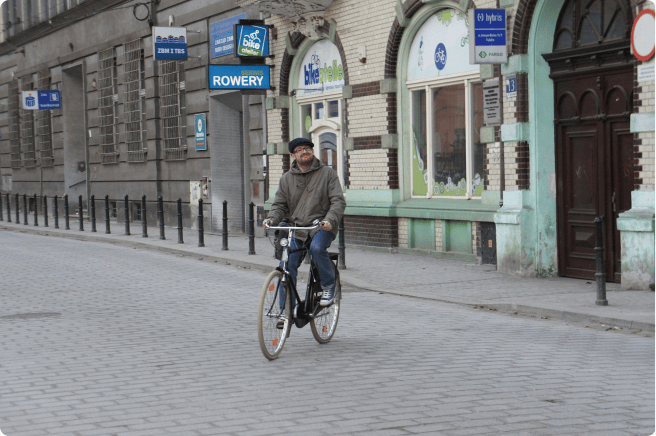
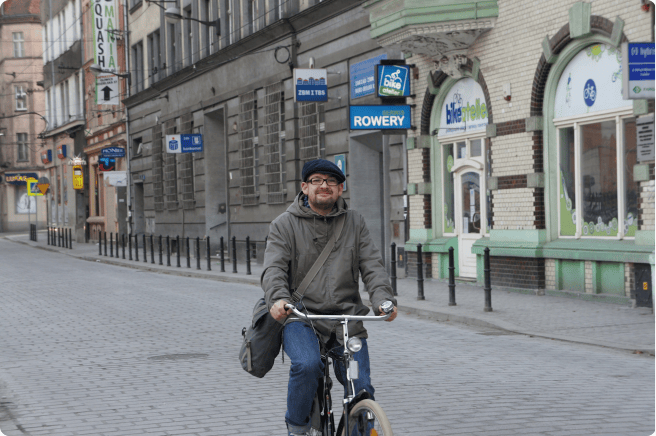
    Past the shop full of ROWERYs—oh what a sight—
    With sprockets that sparkle and tires that bite,
    He pedalled past SERWIS with marvellous speed,
    A blur of pure motion, a two‑wheeled stampede.

    Mieszkańcy mruczeli: „O rany, to Gary!
    Pędzi jak wicher — bez hałasu, bez kary!”

    But Gary just grinned as he swooshed down the lane,
    For a bike‑loving heart can’t be held by a chain.

    So if ever you wander that cobble‑stone way,
    And you hear a faint whirrumph at quarter past day,
    Znów ktoś zawoła: „To Gary, to Gary!
    Śmiga jak błysk — bez hamulców, bez miary!”

    Look quick! You might spot him—swift, bright, and merry—
    Not a wizard or legend, but trusty old Gary!
    Ten sam nauczyciel z torbami pełnymi,
    Co śmiga do pracy szosami tutejszymi.

    Ma kawę z KAFO, kierowcę pod ręką,
    A lekcje z nim nigdy nie były udręką!
    I każdy w okolicy powtórzy ci przecie:
    „Ten Anglik od kawy jest badass na świecie!”


    I treasured my bicycle and used it to get around the city whenever possible.

    Before I go any further, I should probably explain the bicycle itself — the machine that carried me across Gliwice with such improbable dignity. It was a Gazelle Tour Populair, a Dutch roadster from the 1970s, built with the kind of over‑engineering that makes you wonder whether the designers expected it to survive a minor war. Tall, upright, and impossibly smooth, it didn’t so much roll as float. Those huge wheels were perfect for the city’s level streets; even the cobbles felt softened beneath them.

    It had a three‑speed hub and a back‑pedal brake, which meant stopping was a matter of leaning back slightly, as if issuing a polite request. The chain was fully enclosed, a long metal shroud that kept my trousers clean and made the whole bike look like it had stepped out of a black‑and‑white photograph. The leather saddle was enormous — a sprung, creaking throne that absorbed every imperfection in the road and most of the imperfections in my mood.

    There was also the skirt guard stretched over the rear wheel — a practical Dutch invention to stop coats, dresses, and, I suspect, the occasional priest’s cassock from being eaten by the spokes. And the rear carrier wasn’t a rack so much as a structural beam. Friends actually sat on it. Not metaphorically. Literally sat on it, side‑saddle, as if this were the most normal thing in the world.

    It even had one of those frame‑locks bolted to the seat stays — the kind where you turn a key and a steel bar slides through the spokes with a satisfying clunk. Park, click, walk away. Utterly civilised.

    Of course, all this elegance came with a price. The rear wheel was a nightmare. Removing it required the patience of a monk and the mechanical intuition of a Dutch bicycle mechanic. I once tried to fix a puncture outside, in the cold, and ended up reading a forum post that simply said: “Rear wheel removal? Leave it to a qualified mechanic.” I should have listened.

    But despite its quirks — or perhaps because of them — the Gazelle was a head‑turner. People would stop and stare as I rolled past, as if a small piece of Amsterdam had taken a wrong turn and ended up in Silesia. An Austrian cycling enthusiast once begged me to sell it to him outside KAFO. His price went up every time I refused. I still don’t know whether he wanted the bike or the story attached to it.

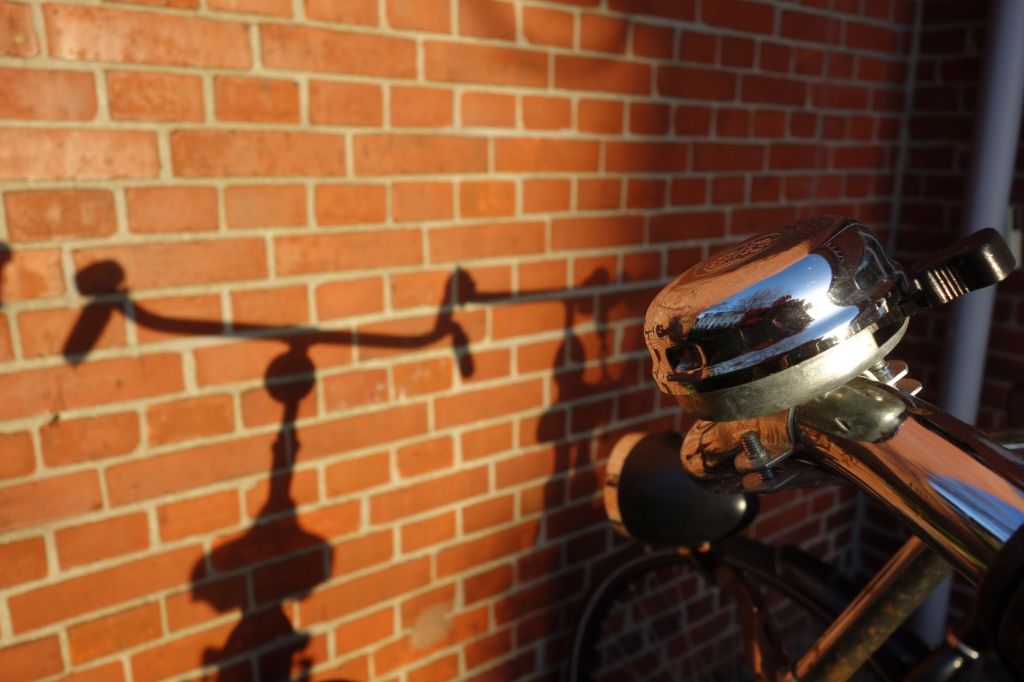
    One detail I should mention — because it was impossible to ignore — was the Dutch bell mounted proudly on the handlebars. It wasn’t a polite British ding. It was a silver dome that produced a resonant brrring you could hear half a street away. It had presence. Authority. The sort of sound that suggested the bicycle had diplomatic status.


    Gliwice no longer had trams by 2008–2009, but the tracks were still embedded in the roads, along with the overhead infrastructure and the faint memory of something that once rattled through the city. Most of the time they were harmless. Except at one particular junction — a sprawling, multi‑armed tangle of roads known locally as the Spider Junction.

    Negotiating it on a bicycle with thin Dutch tyres was an exercise in concentration and mild prayer. The tram tracks ran at just the wrong angle, perfect for swallowing a wheel whole. Locals in cars barely noticed them. Cyclists, however, treated them with the same respect one gives to a sleeping dog of uncertain temperament.

    Only once did I make the mistake of letting my front tyre slip into one of the grooves.

    For a split second, everything went silent — the bike locked into the track like it had been magnetised — and then chaos erupted. I wobbled, swore, over‑corrected, and somehow managed to free the wheel before becoming a small, British road obstacle in the middle of the Spider Junction. A driver shook his head at me in that universal Silesian way that means: “Why would you do this to yourself?”

    After that, I approached the junction with the solemnity of a pilgrim.

    Sometimes my morning routine began at the crack of dawn: leaving my apartment, trying to carry my bike down five flights of stairs as quietly as I could, and cycling through the city as early as 6:15 a.m. to meet clients of a local company for a 7 a.m. English grammar lesson.

    Even at that hour, cycling through some of the busiest junctions in Gliwice was stressful — especially when large articulated lorries pulled up beside me, often a little too close for comfort. Friends suggested I ride upon the pavements, like any other rational-thinking local would. It made complete sense; the pavements were wide and empty. I was probably being just too Gary, too British — cycling on pavements is against the highway code in the UK, actually illegal — and it was a habit I hadn’t yet learned to shed. The idea of cycling on a pavement felt unthinkable.

    After that first lesson, I’d cycle all the way back through the city, now busier with morning traffic, and out toward the industrial sector for my next class — this one for EMPIK, a large national language school that expected teachers and native speakers to “find a way” to every lesson, no matter where it was. It wasn’t unreasonable at all, but getting to a location outside of the city and on time by bike or public transport was… ambitious.

    As I began to cycle through the outskirts of the city, heading through the countryside, I usually found myself wearing a ridiculous smile — at least until my return along the same route, when I would reach the small hill I’d previously freewheeled down with sheer joy and now had to pedal back up with considerably less enthusiasm. Probably the only hill I had to use in the entire city.

    By June, the approaching summer heat made cycling this route even more of a challenge. I carried a couple of spare shirts with me — strange, but absolutely necessary. On one occasion a wild boar ran straight across my path, so suddenly I instinctively back-pedalled, the rear wheel skidding before I caught the front brake a moment later. Another time I almost fell off my bike when, just as I was entering the industrial sector, a stork — the first I had ever seen — glided silently over my head and into a nearby field. I was mesmerised; its size and wingspan were larger than anything I had ever seen back home in the UK.

    Thankfully, the school I taught at the most — Britam — was the complete opposite of EMPIK: small, kind, and consistently considerate. They provided a driver, Pan Bronek, to take the native speakers to lessons further outside Gliwice’s city centre. Officially, I was told it was a routine service. Over time, I grew to recognise it as an act of quiet guardianship and genuine warmth. They were looking out for me as a person, not just a native speaker of English. Unofficially, I suspect it was because I once boarded the wrong train, had my phone die mid‑crisis, and ended up being told — very calmly — that the train couldn’t stop, but they’d slow it down and I’d have to jump at Łabędy. Which I did. Ślązacy would probably shrug and say: „No… jak musisz, to skocz.”

    After that, Pan Bronek became part of my rhythm of working beyond Gliwice. Depending on my mood, he’d collect me from outside the Żabka store next to my apartment block, or at KAFO kawiarnia — a café I had decided was my second home. If I wasn’t ready when he arrived at KAFO, the baristas — or Paweł, the owner, who laughed with his whole face — would call out:

    “Gary! Pan Bronek is here!”

    The whole café would enjoy the moment far too much.

    I’d rush out, jump into the car, and be greeted with a cheerful, old‑fashioned “Serwus!” from a man who was rather abrupt, but friendly, slightly gruff, and entirely unafraid to tell me off for being late or for spending all my time in a kawiarnia. He was usually placated by offering him traditional Silesian boiled sweets called szkloki. I was partial to the rhubarb flavour — as he was too.

    KAFO drop‑offs were fine. Coffee was respectable.

    But on late nights, when we got back to Gliwice around 9 p.m. and if I asked to be dropped at my favourite bar instead of being delivered straight home, he’d give me that classic Silesian look — the one that says everything without saying anything:

    „Chłopie… ja cię tu zostawić? Na serio?”

    He always did, of course.

    But I think he preferred knowing the Anglik was safely delivered, not wandering off into further adventures. I always thanked him sincerely and never once took him for granted. Pan Bronek never let me down.

    So… badass? I never thought of myself as anything even close to “badass.” I first saw the comment “Gary is badass” in a detailed report written in Polish, giving feedback to Britam about my lessons with a business group. I was genuinely alarmed. I didn’t understand the rest of the sentence, and for a moment, I was convinced I’d done something terribly wrong. It took me a while to work out that it was, in fact, meant as praise — a very enthusiastic kind of praise.

    I still haven’t fully recovered. Gary… badass?— Apparently so.

    It’s still very funny.

    badass?

    A bicycle, a beginning and a quiet kindness

  • The Library of Buckwheat

    Kasza

    Gliwice felt like a small city back then, and the Rynek felt even smaller — a handful of places that became familiar simply because they were the ones that existed. My culinary map began to expand far beyond the pizza trinity. I ate widely: late-night kebabs, burgers from metal kiosks, quick lunches in the local food halls, or vibrant salads and fruit juices at Bistro Gliwice.

    Every so often, I’d drift into somewhere new. One place in particular stayed with me.

    In 2012, my corner of the Gliwice Rynek switched to a quiet rebellion against the loud, neon-lit landscape of post-communist fast food. Next door to it, my pizza haven, Dominium was still a popular but fading relic of the nineties, and a few streets away, Da Grasso remained a cacophony of shouting delivery drivers, pop radio, and grease-spotted cardboard.

    But at Rynek 3, housed in the thick, fortress-like walls of a historic tenement house, sat something very different; a restaurant called Dobra Kasza Nasza.

    Because of the old building’s bones, the layout was a cellular rabbit warren of semi-private alcoves connected by short, arched brick passages. You were never seated in a grand, echoing hall, but rather tucked away in your own low-ceilinged chamber with perhaps three other tables.

    Inside, it had a strange, hybrid feel I never quite placed at the time: something of 1950s Copenhagen in the furniture, all pale wood and clean lines, crossed with the deep-carpeted hush of a 1990s British pub chain trying to look respectable. It shouldn’t have worked. It did.

    The aesthetic was pale pine tables devoid of traditional heavy carvings, paired with upholstered chairs in muted, earthy tones that swallowed up the sound. Overhead, woven wicker pendants cast warm, intimate pools of light, keeping each table in its own private sanctuary.

    And it was quiet. Not comfortably quiet — properly, oddly quiet, the way a library is quiet. Conversations stayed low without anyone asking them to, muffled by the heavy curtains, the carpet, and the cellular walls. Staff moved like they’d been trained not to let plates clink.

    The food matched the room, now that I think of it — nothing showy, nothing that announced itself. My order rarely changed: boczek ze śliwkami suszonymi — salty, baked bacon against sweet dried plums, tossed with buckwheat and baked in a heavy, hot clay pot that sat neatly in its own wooden platter, carried out by staff who were always gentle, always kind. It felt as unmistakably Polish as anything I ate that year. It was accompanied by a horseradish salad I initially mistook for coleslaw, until the first forkful corrected me with a jolt sharp enough to make my eyes water and my colleague laugh.

    There must have been music. Some low murmur of Muzak piped in to soften the silence, the way these places always have something running under the surface. I’m fairly sure of it. But memory has a way of editing out what doesn’t fit the story it wants to tell, and mine insists, quite stubbornly, that the room was silent. I’ve stopped arguing with it.

    And somewhere between Dominium, Da Grasso, Gruby Benek, Kafo, the milk bars, and those quiet bowls of kasza, I realised I wasn’t just eating in Gliwice any more. I was eating as someone who was happy to live there.

    Twelve years on, Dominium has gone, its familiar red-and-cream world swallowed by the global Domino’s machine. It now wears the unmistakable blue glow of an international chain — bright menus, delivery counters, and an interior shaped for students, hurried orders, and travellers who recognise the brand from far away. It’s efficient, recognisable, and entirely different.

    Next door, the old “Kasza Nasza” has shed its name and become simply Dobra, trading heavy curtains for linen cloud lamps and hanging green plants. Yet the bones of the building remain, and in the hush of those thick stone walls, aromas — possibly baked buckwheat or sharp horseradish — probably still linger.

    And so, in 2026, I find myself walking the Rynek again — not in reminiscence, but in a Google Street View frame from around 18:35 on a September evening in 2025. Eleven years have passed since I was last there. The light is soft, the air warm, and people are sitting out on benches, under awnings and parasols, in ogródki — the fenced-off summer terraces that bloom each year outside Polish restaurants — eating, talking, leaning back in their chairs as if they’re reluctant to let the day slip away. I drift past them and see which places are busy, witnessing the quiet happiness of an ordinary evening unfolding. And then, at the corner where Dominium once stood, my gaze settles on Domino’s ogródek — empty. Just a still doorway in a square full of life. Memory doesn’t always choose the important moments. It’s nothing dramatic. Nothing symbolic. Just the truth of that moment.

    And somehow, that’s the perfect way to leave it.

  • In Crust We Trust: Da Pizza

    Part 2: Da Grasso

    And then life shifted.

    I was no longer a visitor with open-ended afternoons; I was a teacher with a timetable, living in Gliwice and establishing new, rapid-fire routines. It changed everything about how I ate. I often met a colleague for obiad somewhere close to the school, driven by the shared, urgent need for something fast before classes began.

    Our rotation was modest: my two favourite bary mleczne — milk bars — or a superb salad bar on Daszyńskiego, fresh, colourful, vibrant and healthy; grab a sandwich and cake in KAFO, or even a kebab from Ali Baba’s on Zwycięstwa. It had to be close, it had to be fast, and it had to be something we could eat without feeling half-asleep before classes began.

    And in the middle of all that everyday eating, another pizza place entered my life: Da Grasso.

    One day I suggested Dominium — my old favourite, my Rynek ritual — but she smiled and shook her head. “Good, yes. But expensive. And not really a pre-lesson place. Have you tried Da Grasso?”

    Da Grasso. The name alone sounded questionable. I’d walked past it once or twice, and it looked like the opposite of Dominium — louder, brasher, more chaotic. But it was only a hop, skip and jump from the school, and convenience wins when you’re teaching. So we went.

    The moment I opened the door, I realised I’d stepped into a different universe. Loud radio music blasted across the room, unapologetic and energetic. The place was alive — not cosy, not atmospheric, but alive. Downstairs were booths, a high counter, and behind it a huge pizza oven glowing like a furnace. The guys working there moved with frantic confidence, shouting orders, laughing, slapping dough, sliding pizzas in and out of the heat with the speed of people who knew exactly what they were doing. It was chaos, but it was competent chaos.

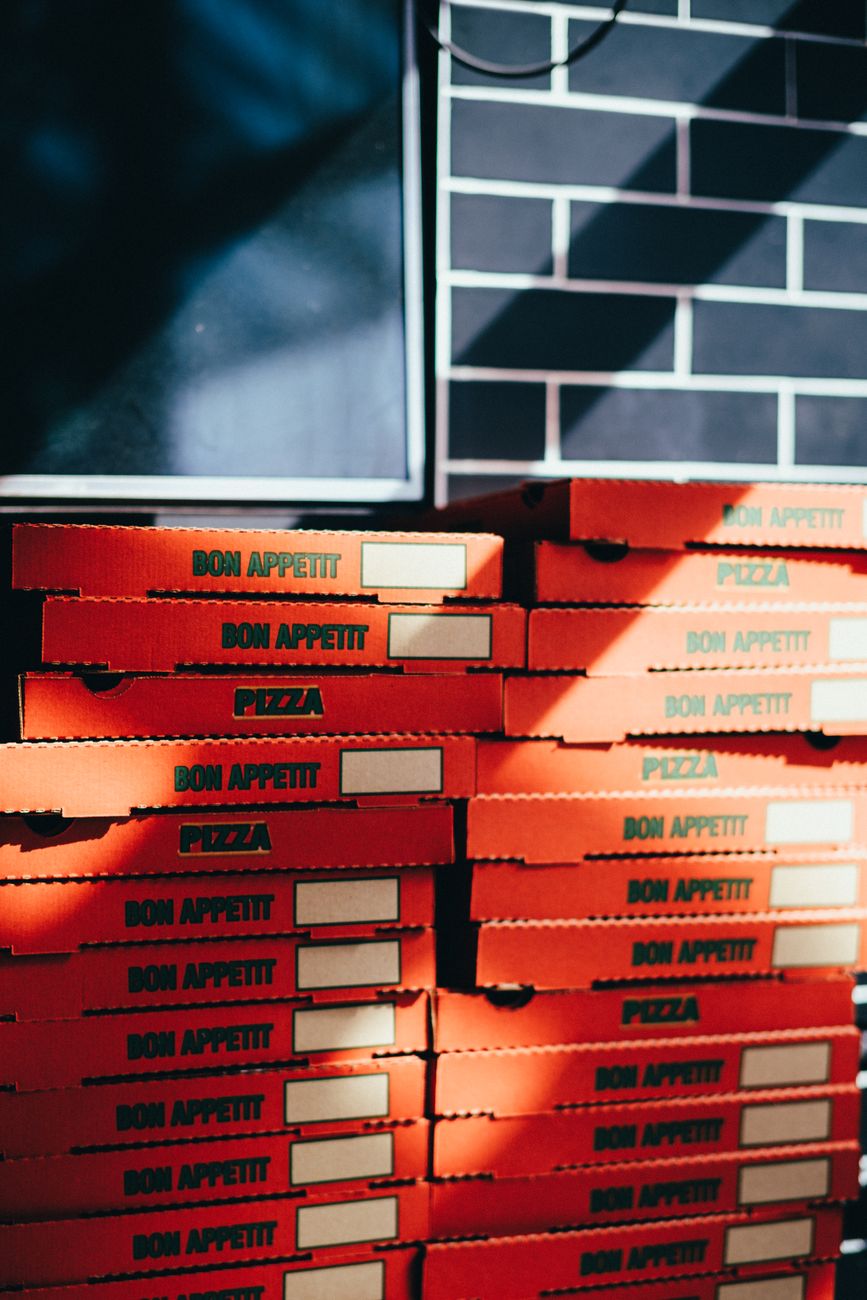
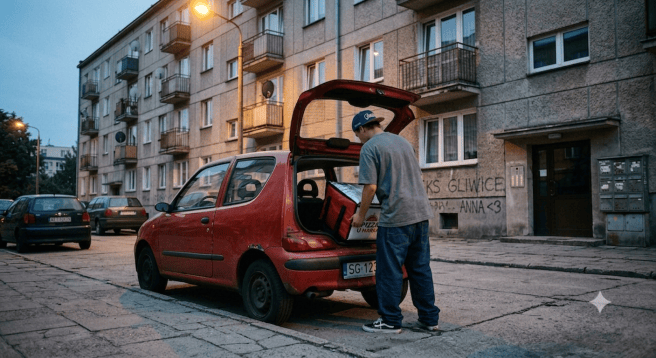
    Young lads hovered near the back door, clearly trying to earn a few złoty delivering pizzas in what looked like their own cars. They’d grab enormous boxes — truly huge, almost comically oversized — bag them up, and vanish into the street like pizza-couriers on a mission.

    And the pizza? Another surprise. Different to Dominium, but great — fast, fresh, satisfying. A proper pre-lesson pizza. And yes, you got sos too. Because in Poland, pizza without sos is like a sentence without a verb — technically possible, but deeply wrong.

    Dominium had been my revelation. Da Grasso became my routine. And she — my colleague, my good friend — was the one who ushered me into it, laughing at my surprise as if she’d known all along that I’d love it.

    It quickly became a weekly anchor in the chaos of teaching life. And when you go somewhere every week — especially when you’re a foreigner in a city where foreigners were still rare — you get noticed. The staff recognised me first. Not in a dramatic way, but with that subtle shift in body language that says, oh, it’s him again. A nod. A half-smile. The guys at the oven would glance over, amused, as if wondering how a British teacher had become a regular in their loud, chaotic pizza universe. Then the delivery lads started noticing too, looking at me with curiosity. A foreigner who wasn’t passing through, but returning. Again and again.

    Then came the students. Britam students had a radar for teachers outside school. They’d spot us at a distance, nudge each other, whisper, giggle, pretend not to stare. Seeing “Pan Gary” in Da Grasso — eating pizza, laughing with another teacher, being a normal human being — was apparently a thrilling event. They’d walk past the window, glance in, and then arrive at the next lesson with that look of we saw you.


    Naked Benek

    Between Dominium and Da Grasso, I felt I had the town’s pizza landscape mapped out. Yet, I soon realised they were just two-thirds of a Holy Trinity of Silesian pizza chains. The final, mythic member was Gruby Benek — another thoroughly Polish company named, so I was told, after a fictional chubby chef.

    If Dominium was tradition and Da Grasso was energy, Gruby Benek was the king of ma być grubo i na wypasie — make it thick, make it massive, load it to the absolute max.

    To be honest, I rarely ate there, maybe twice; it was on the opposite side of town. But it had its own folklore. You didn’t order a Margherita or Hawaii; you ordered a Goły Benek (Naked Ben), a Hawajski Benek (Hawaiian Ben), or a Mięsny Benek (Meat Ben). Everything revolved around Chubby Benek.

    I checked Google Maps recently; Gruby Ben has not only left the building, he’s left Gliwice completely.

    Da Grasso became my pizza place. It wasn’t just a place to eat any more; it became part of how Gliwice saw me, part of how I was woven into the city’s daily fabric.

  • In Crust We Trust: A Short Story Memoir of Pizza

    Part 1: The Dominium Revelation and the Tale of Two Sauces.

    5–8 minutes

    Dominium came into my life without fanfare.

    I’d already tried zapiekanka — basically a baguette with ambitions — and I liked pizza well enough, though never with any real devotion. Home-cooked pizza always disappointed me, lacking that alchemy of proper dough. Pizza Hut was fine. Domino’s deliveries were fine. Pizza, in my world, was reliably okay.

    So way back in 2008, when my friends suggested a pizzeria in the Rynek called Dominium, I went along with the easy contentment of someone happy to be out, happy to be with people he trusted, happy to be in the centre of a Polish city that still felt new. Pizza would be nice, I thought, in the same mild way that you think a cup of tea and a slice of fruit cake will be nice.

    My first impression was the room itself: an L-shaped restaurant, busy and humming with the scent of charred crusts and melting cheese. The tables near the entrance formed the main dining area, but to the left, the space stretched into an intimate row of small tables with two chairs on either side. On the right, American-style booths climbed toward the counter and till.

    Behind the till was the kitchen—ovens glowing, metal surfaces shining—and a small troupe of pizzaioli watching the door with the alertness of stage actors waiting for their cue. They wore chefs’ hats of every conceivable shape, revealing a fascinating clash of kitchen subcultures. A few wore grand, floppy mushroom toques—traditional baker’s caps so oversized and ballooning they seemed to hover above their heads rather than sit on them, giving them the air of romantic, old-world artisans. Right beside them, the high-heat line cooks opted for a grittier look, wearing tight culinary headscarves pulled taut over their brows. These wraps, patterned in a classic black-and-white chequerboard pepitka, gave them the sharp, rapid-fire energy of modern kitchen warriors.

    I remember thinking, Fair play… this is interesting. The contrast between the dramatic, hovering berets of the dough-throwers and the tight, monochrome patterns of the oven-tenders made the franchise look remarkably human, alive, and full of individual swagger.

    The diners were a mix of everything Poland had to offer: couples leaning close over shared plates, students laughing too loudly, families celebrating Opa’s or Tata’s birthday, and Babcia and Mama eating pizza with gusto. It felt warm, lived-in, confident — a place that didn’t need to impress because it already knew it was loved.

    This was all before I tasted anything. Before the pizza. Before the ceramic sos jars — those mysterious little jugs that appeared without explanation.

    In Britain, pizza arrives alone. Naked. Self-contained. If you want sauce, you have to ask for it, pay for it, or tear open a sachet that squirts in the wrong direction. Sauce is an accessory, a condiment, something faintly shameful — a sign that the pizza itself wasn’t quite enough.

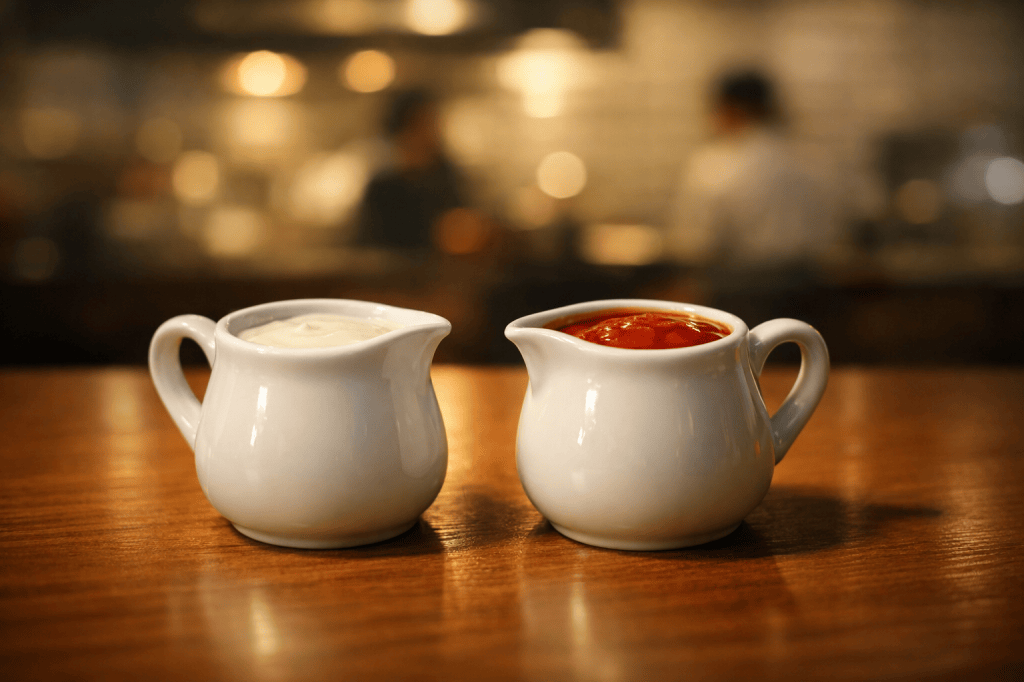
    So when the waitress at Dominium placed two small ceramic jugs on the table, I didn’t understand what I was looking at. They were warm, weighty, almost domestic — the kind of thing you’d expect to find in a farmhouse kitchen, not a chain pizzeria. One held a white garlic sauce — sos czosnkowy, thick and creamy, with that unmistakable Polish dairy tang. The other held tomato sos, deep red and confident, richer than anything I’d ever seen served with pizza.

    They didn’t explain anything. They didn’t ask if we wanted it. Not only that, but they simply placed the jugs down as if this were the most natural thing in the world.

    My friends didn’t react. They didn’t comment.

    I remember staring at the jugs, thinking: Are these ours? No one ever said whether the sauces were free. Nobody itemised them, nobody asked, nobody explained. They simply appeared — as if generosity itself were part of the menu.

    Instinct took over. I poured a small puddle onto my plate and dipped the edge of my pizza in it. The garlic sauce was creamy yet sharp against the heavy blanket of cheese on my pizza. It was nice, but something I could live without. My issue wasn’t garlic; it was that white garlic sauce that always left a weird, clingy taste in my mouth. I’d spent ages doing my best to dodge it — especially on doner kebabs, where it seemed to be applied with the enthusiasm of a fire hose. I’d mutter, “Bez sosu czosnkowego, proszę,” and get that classic look of disbelief. So when friends asked, “Gary, you don’t like garlic?” it wasn’t true. I liked garlic. I just had a long-running feud with the sauce.

    It was the tomato sauce that really caught my attention.

    Casting a discreet glance at other diners, I noticed some dipping straight into the jug. My friends weren’t shy either — they sloshed generous amounts onto their plates, painting thick red pools for dipping. Their confidence made something click. I followed their lead and poured myself a fuller, richer puddle. Bold, spicy, almost stew-like, the tomato sauce clung to the crust in a way British sauces never did. Suddenly, pizza wasn’t just pizza; it was pizza with sauce — a different dish entirely. More tactile. More generous. More Polish.

    From that day on, sos became part of the ritual. Part of the memory. Part of the reason Dominium lodged itself so firmly in my sense of Poland.

    Dominium became the place I liked to return to.

    The pizza itself was the turning point. It was simply far superior to anything I’d ever had from a chain-style pizzeria. The moment it arrived, everything made sense: blistered in places, chewy at the centre, crisp at the edge, made by someone who cared rather than someone who had to.

    I remember staring at it for a second, thinking, this can’t be right… this is Poland.

    And then I tasted it. Fantastic pizza. Later that day, I called my family — genuinely excited, almost laughing — and told them, “Poland does the best pizza I have ever tasted.” They didn’t believe me, of course. They thought I was exaggerating, caught up in the novelty of travel. But when they finally came over to visit, it was the very first place I took them. Watching their scepticism turn into genuine surprise after that first bite was the ultimate payoff. It turned out I hadn’t been exaggerating after all — it really was that good.

    It became a ritual of those early trips: arrive in Gliwice, settle in, and at some point make the pilgrimage to the Rynek for that pizza. My friends knew. They’d smile, amused, indulgent, and we’d go. And every time, Dominium delivered exactly what I remembered — the same layout, the same bustle, the same oversized chefs hats’, the same ceramic sos jugs appearing like a small miracle.

    So when I finally moved to Poland in 2010, Dominium was one of the first places I wanted to return to. I needed to know it was still there, still itself, still the place I’d carried in my head for two years. And it was. The same. In a new life full of unknowns — new language, new streets, new routines — Dominium remained a constant. A small reassurance that some things in Poland were already mine.

    Did you ever eat at Dominium? If so, I’d love to read about your memories of eating there.

    More pizza stories:

  • Train, Street and Bus
    11–16 minutes

    Two months of living in Poland had passed. I’d left Łabędy and moved to Gliwice, yet I still felt apprehensive about using public transport. Looking back, it seems absurd. Was I really so ill-prepared for life in another country? There seemed to be an endless variety of bus services, even strange little minibuses that I assumed disappeared out into the sticks and beyond. I was slowly beginning to understand the railways, but apart from the train, I’d more or less accepted that I would be walking or cycling everywhere.

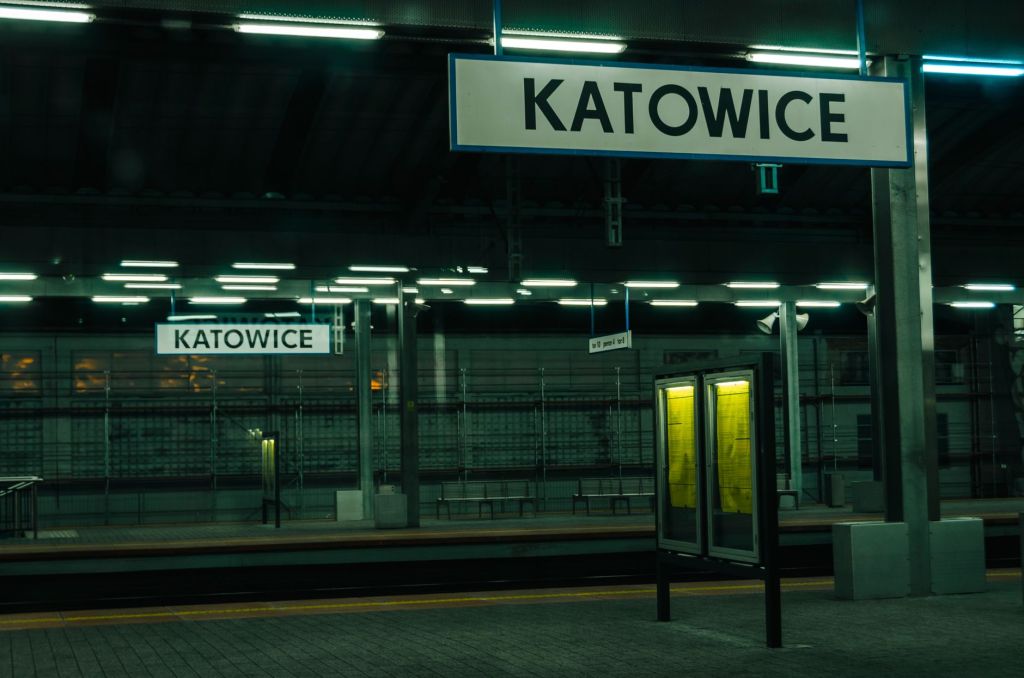
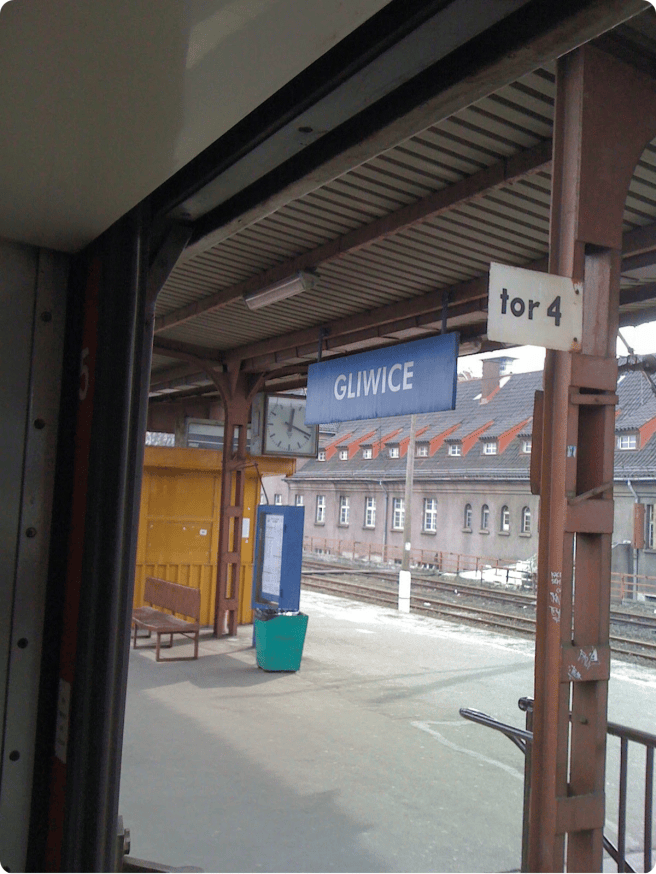
    Track 4/Tor 4 — Waiting to go to Katowice: 2010

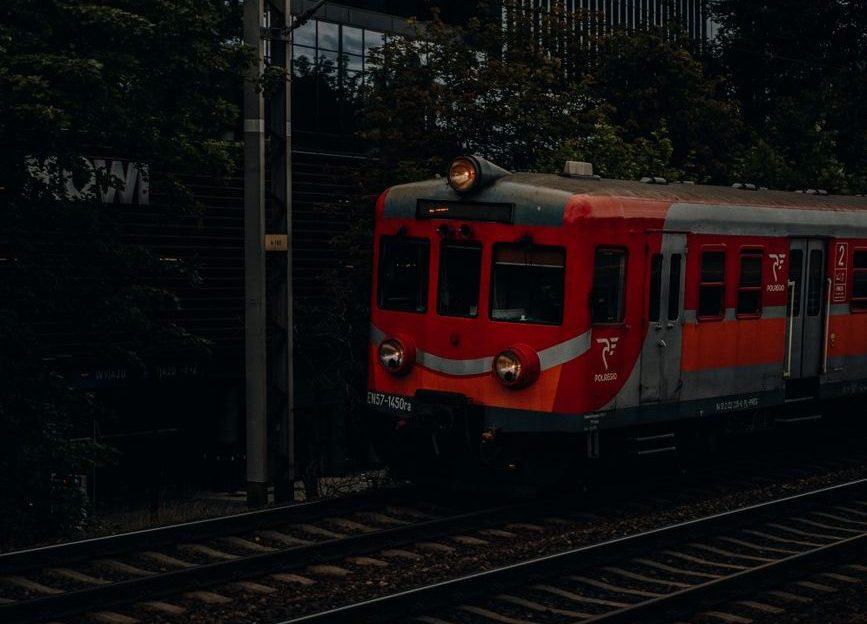
    After long days teaching in Katowice, I’d adapted to travelling by train and no longer hovered awkwardly in the vestibule like a lost tourist. I made sure to get a seat, be polite, and sound confident enough to survive any interaction.

    “Wolne?”

    It was a single word delivered with the confidence of a seasoned commuter, while privately hoping nobody would test the limits of my Polish.

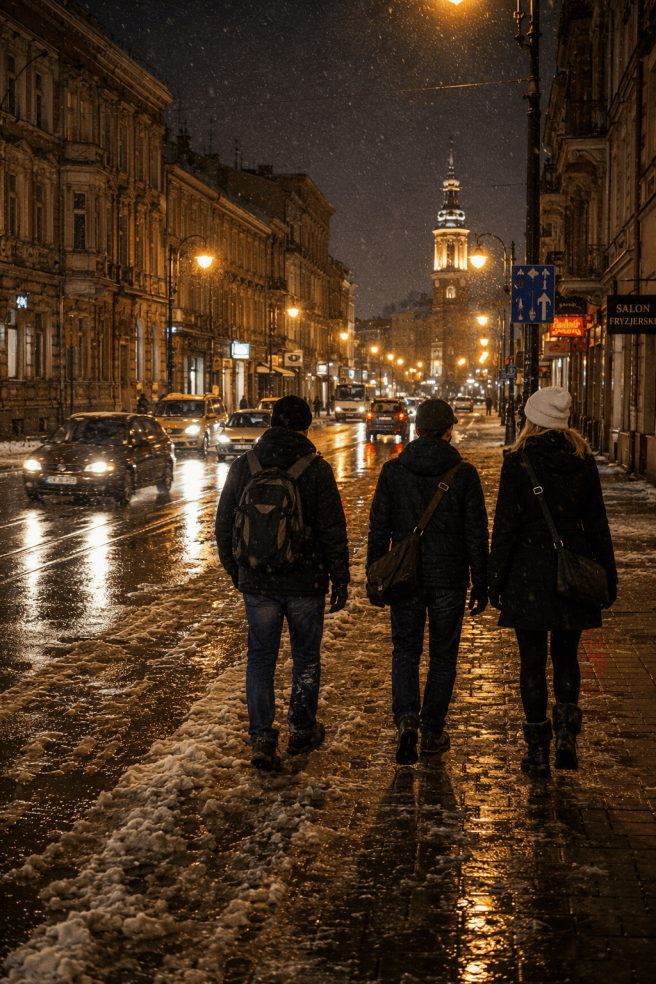
    When I arrived back in Gliwice—usually tired, cold, occasionally homesick, and more than a little lonely—I would march up Zwycięstwa with my arms swinging slightly as though on parade, bags slung over my shoulders. The cold had a way of creeping into your sleeves and settling there, so walking with purpose wasn’t simply a display of confidence; it was survival. The air bit at my cheeks with that sharp, dry cold that made every breath feel faintly metallic. Nobody lingered outside if they could help it. The locals moved with the same determined winter briskness: boots clicking across the pavement, scarves pulled high, and heads lowered against the night.

    Yet, those evenings still felt electric to me.

    Shop windows spilled warm light across the pavements, turning parts of the street into little theatres of colour and movement. Neon signs flickered against older façades, their reflections shimmering along tram rails like streaks of water. The whole street carried its own soundtrack: the low rumble of buses, the distant clatter of heels, and the soft hiss of tyres on wet stone. Every step reminded me that I was somewhere layered with stories—a city where past and present overlapped like a double-exposure photograph.

    I loved those walks despite everything. The lights, the shops, the strange harmony between old and modern architecture. Every journey home felt like a reminder that I was living somewhere truly steeped in history.

    Zwycięstwa ended abruptly at the Rynek, the Market Square, where I would usually slip into the arcades—podcienia in Polish. The old kamienice looming above them, painted in pastel greens, blues, pinks, and creams, seemed to give the grand buildings an unexpected softness. On winter evenings, or at least whenever I crossed it, the Rynek felt oddly deserted. The bars and restaurants glowed at the edges of the square—little islands of warmth and noise, alive with voices and movement—while the vast open space between them lay silent, the sound thinning out into the cold. The contrast was surreal: brightness without the crowd.

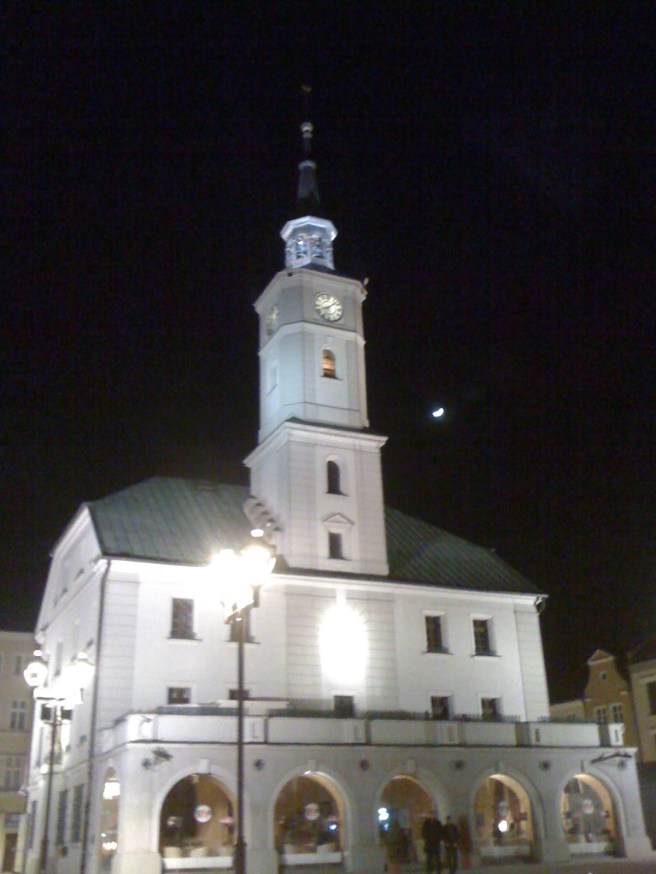
    I’d glance up at the clock on the Ratusz (the town hall) and think either: probably time to keep heading home… or, on slightly more optimistic evenings, just enough time for a quick beer.

    Jak tu nie lubić tego miasta? Pora na piwo / Gliwice Ratusz, January 2011.
    20:07 — officially beer‑o’clock.

    If common sense won, I’d continue along Plebańska Street, passing directly beneath the looming presence of All Saints’ Church. The walls stood so close to the pavement that I could almost have brushed my fingers along the ancient stone as I passed. From there I’d continue along Siemińskiego—nearly home, though still another ten minutes away. By that point I was often exhausted. If I hadn’t stopped for food or a drink, the walk usually took around forty to forty-five minutes.

    I wasn’t used to that kind of lifestyle at all, yet gradually I grew to enjoy it, even when winter seemed determined to test my commitment to living there.

    As I made my way through the city, bright yellow Solaris buses would glide past in the darkness, their windows glowing with warm light. Inside, passengers settled into their seats with the quiet confidence of people who knew exactly where they were going.

    I watched them with a kind of longing. Not envy, just a desire to understand the system: which numbers mattered, where they went, and whether any of them passed near my home. It felt as though the city had handed everyone else a secret map while I remained outside in the cold, pretending I preferred walking anyway.

    There was something oddly reassuring about those yellow buses. They moved with the quiet confidence of belonging, while I was still learning how to do the same.

    I’d been told that if I wanted to use the buses, I should buy tickets in advance from kiosks or grocery shops. Those little kiosks fascinated me. The serving windows were set strangely low, forcing you to bend almost double to speak to the person inside. At the time, I simply didn’t feel confident enough to even attempt the transaction, which seems entirely absurd to me now.

    What unsettled me more was being warned never to buy tickets from the driver unless absolutely necessary. Apparently, boarding through the front doors and asking to buy a ticket delayed the service and was heavily frowned upon by drivers and locals alike. Once aboard, you were expected to validate your ticket immediately using the mechanical stamping machines. That part, at least, I understood from my occasional tram journeys in Katowice.

    The tickets themselves came in three varieties: local, two-city, or three-city tickets. Gliwice sat within a vast industrial web of adjoining cities, so the entire fare system revolved around municipal boundaries rather than the actual distance travelled. The same tickets worked on the trams, too. To me, though, they all looked practically identical except for the price, which seemed to depend entirely on how ambitious your journey was intended to be that day.

    So, despite slowly beginning to understand the mechanics of the system, I still lacked the confidence to actually step onto a bus.

    Until that unexpected meeting.

    I seem to recall it was an especially busy train—seats all taken, the usual stifling heat, heavy condensation on the windows, and surrounded by people who looked every bit as tired as I felt. It wasn’t unusual to find people looking at me. I’d long since accepted that I stood out: the foreigner with the slightly-too-careful pronunciation, the man who still hesitated before stepping onto a platform, the one who checked the timetable twice even when he knew it by heart. You might think I’m exaggerating.

    I’m not. The “Slavic stare” is a very real cultural phenomenon, and I’d become something of a magnet for it.

    But this time felt different.

    Pressed into the corner of the carriage, shoulder to shoulder with commuters who smelled of cold air and long days, I felt a particular gaze settle on me—steady, unblinking, and almost analytical. At first, I ignored it. Then I glanced up, and the world rearranged itself. I noticed two people looking at me, a man and a woman.

    I knew her.

    Or rather, I recognised her in that strange, delayed way you do when you see someone completely outside the context where they belong. She was one of my advanced English students—quiet, observant, the kind who listened far more than she spoke. In class, she had a habit of tilting her head slightly, as if weighing every word. And here she was, doing exactly the same thing, except now it was me under examination.

    For a moment we simply stared at each other, both of us caught between the formal rules of the classroom and the unspoken rules of the evening commute. Then her expression shifted—not a smile, not quite—more like recognition softening into quiet amusement.

    As we approached Zabrze, the crowd around me stood up and began preparing to leave: coats slung back on, the delicate ballet of avoiding each other’s feet, and the gradual freeing up of seats. Those two passengers moved directly into the newly vacant places nearby.

    “Hello. You are Gary from Britam? Do you remember me?”

    I told her that I did. She nodded once, then said, “You look lost,” in English that was far better than she believed it to be.

    I laughed. I knew how to get home from the railway station, sure, but even after months in Gliwice, I still felt like I was navigating a city that kept its core logic tucked just out of my reach.

    “I usually am, but not tonight,” I smiled back.

    That was all the invitation she needed.

    By the time we reached Gliwice, we were talking easily—about university, mathematics, English conversation, and the mysterious world of buying and validating bus tickets. She even clued me into public transportation apps I didn’t even know existed. She explained everything with the kind of patient enthusiasm that made me feel less like a confused foreigner and more like someone finally being welcomed into a secret club.

    We stepped out onto the platform together, the cold air hitting us like a wall, and she gestured toward the exit.

    “Come on,” she said. “If you really are going to walk home, we’ll walk some of the way with you.”

    And so we walked up Zwycięstwa. They flanked me without ever discussing it — she on my right, listening with that tilted‑head attentiveness, and her friend on my left, shy and gentle, offering the occasional polite smile as he tried to keep pace with the speed of my excited chatter.

    Words poured out of me; I couldn’t help it. After weeks of walking this street alone, noticing its façades and strange architectural flourishes with no one to tell, it felt exhilarating to finally share them. I pointed out balconies, cornices, old stonework, the way the street curved under the lamps — and then, without thinking, I stopped us outside Weichmann’s Textile House. That expressive, almost theatrical building had fascinated me from the first moment I saw it, and now I found myself jabbering about its lines and geometry, its strange modernist confidence. To my surprise, even they admitted they’d never really looked up before, never taken notice of the details I was naming.

    Our breath rose in small white clouds as we stood there, the traffic humming around us, snow glowing under the amber lights. I remember the noise, the warmth of their company, and the sudden sense of being swept along by something unexpectedly kind. I felt, strangely and wonderfully, that I was showing two young mathematicians their own city — and that they were happy to see it through my eyes.


    That evening was the beginning of something I didn’t yet have the proper language for—advice, guidance, and eventually, a friendship I came to value far more than she ever realised.

    It became a comforting pattern after that — these small coincidences on the train home. I’d step into the carriage, scan the crowd for a space, and there she’d be: the same slight tilt of the head, the same amused recognition, as if she’d been expecting me all along. We never planned it, but somehow our commutes aligned regularly.

    One night, after a couple more of these chance meetings and our subsequent long walks up Zwycięstwa, she stopped suddenly just as we were leaving the station concourse. She turned to me and said, almost conspiratorially:

    “You know… the A4 bus would take you very near to your home. You’d be back in ten, maybe fifteen minutes. Would you like me to show you?”

    I must have looked utterly bewildered because she laughed — not unkindly, just with that gentle disbelief that anyone would willingly walk that far in the freezing cold by choice.

    Before I could protest, she’d already guided me across the street to a bus stop I’d passed a hundred times without ever actually seeing. It sat strangely in the middle of two lanes of traffic, like a forgotten island. I’d always assumed it was a disused relic of the past.

    “It used to be the tram stop,” she explained. “Now the A4 bus uses it. People still call it the tram.”

    It always amazed me that the old tram tracks were still firmly embedded in the road surface along the former route. They felt like the city’s memories — stubborn, half-forgotten, and waiting to trip up anyone not paying close attention. They were harmless enough, until a bike wheel found them. Mine eventually did. One neat slip, a brief, weightless moment of “oh no,” and then the asphalt rose rapidly to meet me. Nothing broken, nothing dramatic—just bruised pride and that small, private ache of having absolutely no one to blame but myself.

    That night, she handed me her spare ticket—a simple thing, really, but it carried a warmth that caught me entirely off guard. The bus arrived with that soft, familiar hydraulic sigh, and we stepped aboard together.

    Inside, the world softened. It was warm, clean, and bright — a self-contained little glow moving smoothly through the dark city. I realised then how much of my hesitation had been built entirely from guesswork and nerves. She pointed out the stops, the landmarks, and the shortcuts locals used without thinking. In her voice, the geography of the city felt slower, clearer, and genuinely welcoming.

    Her own journey normally ended at the theatre terminus, but that evening she needed to get off at the stop before mine. She carefully explained where I’d need to alight and what landmarks to look out for, so I’d be ready, and then her stop arrived. A quick wave, the doors hissed closed, and suddenly, I was alone. On a bus. In Poland. With a validated ticket—and, oddly, a profound sense of being looked after.

    One stop later, I stepped out into the cold evening air in a bit of a daze, discovered my bearings, and found I was a mere five‑minute walk from my apartment.

    As I became more confident with the bus network, I preferred to get off at Mickiewicz Park and walk just a little further, often calling in at Biedronka or KAFO Kawiarnia. Years later, I moved to an apartment much closer to that exact route, and that specific stop became my default — as if the city had quietly decided we were finally on the same page.

    I’d been walking almost an hour each night not because I had to, but simply because I didn’t yet trust myself to do anything else. And now here I was, minutes from my front door, warmed by the pure kindness of someone who didn’t owe me a thing but chose to help anyway. It was a small gesture, but it stayed with me—the way small things so often do.

    That evening marked a permanent shift. Not just in how I travelled, but in how I felt about living there. The city stopped being an adversarial puzzle I was trying to solve entirely on my own. It became a place where people reached out, where help arrived unexpectedly, and where deep friendships could form in the unlikeliest corners of a crowded evening train.

    And all because someone watched me on one winter evening—and decided to say hello.

  • Learning the Hard Way
    6–10 minutes

    This is the final part of Railway Memories. You can catch up on Part 1 or Part 2

    Coming back from Katowice had none of the calm of getting there. The return journey was a different kettle of fish entirely. Katowice station was in the middle of its transformation then — that remarkable brutalist concrete world being torn down and rebuilt around me. Tunnels diverted, plywood walls thrown up, the air carrying the dull echo of work that never seemed to stop.

    And somewhere in the middle of it all, a busker. A man strumming an acoustic guitar who looked as if he’d stepped out of the 1970s—long hair, army surplus jacket, worn boots—stood there as if none of it concerned him. While the station shifted and fractured around him, he played on. I recognised him; I’d seen him playing in the Tylna Mariacka/Wojewódzka pedestrian tunnel, burrowed deep beneath the city’s massive railway junction. The passage was a surreal, timeless concrete pipeline cutting through a world that was rapidly reinventing itself above ground. It was an industrial artery coated in decades of graffiti—a messy, beautiful clash of vivid street art and hurried midnight tags. Walking through it, you could feel the weight of its history in the cold walls and the damp draft. The tunnel possessed a strange, magnetic echo that made me wonder about the countless thousands who had trodden these same stones before me, their collective footsteps long swallowed by the shadow of the tracks.

    Many years later, I finally put a name to this talented guitarist… Mariusz Goli.

    He played with a fierce, absolute absorption, completely turned inward and oblivious to the commuters rushing past. His skill was staggering—an intricate, lightning-fast cascade of acoustic finger style and flamenco that seemed impossible for a single pair of hands. He didn’t just strum; his fingers moved with a precise, fluid velocity, casting a dense web of notes that filled every corner of the concrete passage. Even if you only stopped to leave some coins, you couldn’t help but be struck by the sheer mastery of it. In that cold, chaotic underworld, his music became a constant, anchoring presence—a beautiful, complex wall of sound that somehow made the concrete feel less stark and the winter air a little less bitter.

    Leaving the city in the late afternoon or evening felt like stepping into a construction site that never slept. By the time I reached the platform, the light was usually gone. The temperature had dropped. Everything felt sharper, darker, heavier — even older somehow — dimmer lights, a different kind of silence. The winter of 2010 was especially cold. Zima stulecia — winter of the century.

    There was never a waiting train, never that gentle moment of choosing a seat and settling in. Instead, there was a strange, instinctive queue that formed only when the train was already rolling into the station. Even if I’d been standing right at the door as it came to a halt, I’d suddenly find myself surrounded — people appearing from every angle, stepping in front, behind, beside me, all with the same quiet determination to get on first.

    One memory of this is especially vivid. It was bitterly cold — the kind that works its way through your shoes and settles in your bones. Known as Trzaskający mróz in Polish. I stood on the platform, stamping my feet, drifting from one spot to another to keep warm. It felt strange. There was no one else waiting. Where was everyone? Had I missed something? You could have heard a pin drop. Why was the train delayed? The cold was by now really beginning to bite into me, draining any of the little energy I had left. I was desperately trying to keep warm, moving across the platform from one track to another. I was in effect, waiting on a peron widmo, a ghost platform.

    Eventually, the announcement came: “Thank the stars ” I thought to myself, “the train to Gliwice.” Right platform. The sign confirmed it. Every cloud has a silver lining, I told myself. I’d endured the cold, but at least I’d board without the usual scramble. Through experience, I even knew where the train would draw to a stop, leaving me with a door opposite.

    Of course, I should have realised there would be no silver lining for my wait in the cold.

    My fellow passengers had been waiting somewhere warmer — the subway, perhaps, or a waiting room out of sight. At the last moment, they appeared, spilling up from the stairs in a quiet, purposeful wave. Warmer, wiser, and entirely unhurried.

    And just like that, I was no longer first.

    The old and tired-looking EN57 — or “Kibel,” the nickname given to this workhorse of a train — crawled into the station and groaned to a complete stop, just as I anticipated it would. The doors opened. People stepped out of the cold and into the light and warmth.

    I was last on board.

    All that time standing in the freezing air, undone in seconds.

    I simply had to adapt. This wasn’t going to change. Musiałem się dostosować…

    In those early days, I didn’t even try to find a seat. I’d stand in the entryway of the carriage — that small, vestibule space by the doors — Przedział wejściowy in Polish. Pressing myself against the wall as the train filled around me. I was often exhausted; my back ached, my legs were heavy from the day. The EN57 doors closed with a incredibly distinct, loud pneumatic hiss followed by a violent slam that shook the frame of the train. I can vividly remember looking through the fogged windows catching the orange streetlights of Chorzów Batory or the dark, looming shapes of the old mines. The journey seemed surreal, slow, at times the train seemed to move at a crawl. After about thirty to forty minutes, sometimes, even longer, we’d arrive in Zabrze. The train seemed to almost empty at here, and only then would I go into the carriage to rest for the next 10 or 15 minutes until we arrived at Gliwice.

    The reason I didn’t sit was simple. I felt too self-conscious. Too aware of how close everyone was, knees and elbows almost touching. It felt like an intrusion, as though I were taking up space I hadn’t quite earned.

    I noticed how easily others settled in. Coats off, scarves unwound, hung neatly on the hooks between the windows. Perfectly normal. But not to me, not then. I kept mine on, stiff and probably looking very out of place, convinced I was being watched — or at least noticed.

    The passengers themselves were different in the evening. Tired faces, damp coats, people carrying the weight of the day home with them. The windows fogged quickly, turning the outside world into streaks of light and shadow, snow or rain dragged sideways across the glass.

    So I stood by the door, doing my best to look as though this was how I preferred to travel.

    It wasn’t.

    At some point — helped along by becoming quite ill — I understood why everyone shed their winter layers the moment they stepped inside. The carriages were incredibly hot, almost stifling. You went from freezing air to something like a greenhouse in seconds, only to step back out later into sub-zero cold again.

    So I adapted.

    Boarding the train became something else entirely. I learned to stand my ground, not aggressively, just with quiet intent—not stepping aside unnecessarily, not hesitating. It felt, at first, as though I had acquired some invisible field around me.

    I learned the language, too, or at least enough of it to belong in that small space when looking for an empty seat:

    “Przepraszam, czy to miejsce jest zajęte?” Sometimes, it took only a hopeful look and a gesture toward a seat, using a simple “Wolne?”

    And the reply: “Wolne.” Sometimes, “Proszę.” Simply put: “Sure. Go ahead. Sit down.” You’re part of this now.

    I learned to take off my coat, my scarf, my jacket, to settle without fuss, without apology.

    There was always a moment, just after the train began to move, when something shifted. A sense of travelling not just between cities, but between versions of myself. The confident teacher in the morning, and the quieter, more reflective figure returning at night, learning the country one journey at a time.

    Coming back wasn’t frightening. It was simply different. A reminder that I was still new here, still learning the rules, still finding my place in a world that changed with the weather and the hour.

    We tend to remember the landmarks — the Rynek, the churches, the monuments. But it’s the smaller, practical places that shape a life without asking permission.

    And for a time, the journeys I made between Gliwice and Katowice did exactly that.


    Jeśli zdarzyło Ci się przechodzić przez dworzec w Gliwicach, podziel się tym, co pamiętasz.

    If you travelled through Gliwice Station yourself, feel free to share what you remember.

    Missed the beginning? Read from the start — [Part 1: Gliwice Station]