Part 2: Da Grasso
And then life shifted.
I was no longer a visitor with open-ended afternoons; I was a teacher with a timetable, living in Gliwice and establishing new, rapid-fire routines. It changed everything about how I ate. I often met a colleague for obiad somewhere close to the school, driven by the shared, urgent need for something fast before classes began.
Our rotation was modest: my two favourite bary mleczne — milk bars — or a superb salad bar on Daszyńskiego, fresh, colourful, vibrant and healthy; grab a sandwich and cake in KAFO, or even a kebab from Ali Baba’s on Zwycięstwa. It had to be close, it had to be fast, and it had to be something we could eat without feeling half-asleep before classes began.
And in the middle of all that everyday eating, another pizza place entered my life: Da Grasso.
One day I suggested Dominium — my old favourite, my Rynek ritual — but she smiled and shook her head. “Good, yes. But expensive. And not really a pre-lesson place. Have you tried Da Grasso?”
Da Grasso. The name alone sounded questionable. I’d walked past it once or twice and it looked like the complete opposite of Dominium — louder, brasher, more chaotic. But it was only a hop, skip and jump from the school, and convenience wins when you’re teaching. So we went.
The moment I opened the door, I realised I’d stepped into a different universe. Loud radio music blasted across the room, unapologetic and energetic. The place was alive — not cosy, not atmospheric, but alive. Downstairs were booths, a high counter, and behind it a huge pizza oven glowing like a furnace. The guys working there moved with frantic confidence, shouting orders, laughing, slapping dough, sliding pizzas in and out of the heat with the speed of people who knew exactly what they were doing. It was chaos, but it was competent chaos.
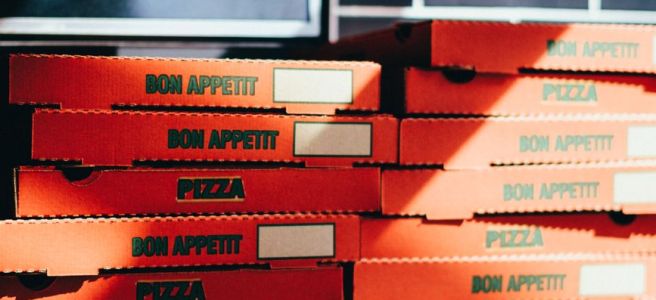
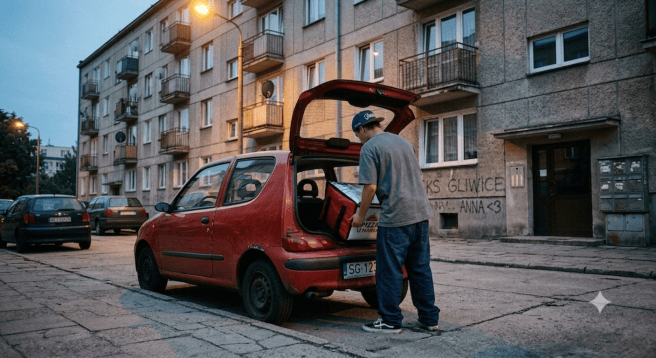
Young lads hovered near the back door, clearly trying to earn a few złoty delivering pizzas in what looked like their own cars. They’d grab enormous boxes — truly huge, almost comically oversized — bag them up, and vanish into the street like pizza-couriers on a mission.
And the pizza? Another surprise. Different to Dominium, but great — fast, fresh, satisfying. A proper pre-lesson pizza. And yes, you got sos too. Because in Poland, pizza without sos is like a sentence without a verb — technically possible, but deeply wrong.
Dominium had been my revelation. Da Grasso became my routine. And she — my colleague, my good friend — was the one who ushered me into it, laughing at my surprise as if she’d known all along that I’d love it.
It quickly became a weekly anchor in the chaos of teaching life. And when you go somewhere every week — especially when you’re a foreigner in a city where foreigners were still rare — you get noticed. The staff recognised me first. Not in a dramatic way, but with that subtle shift in body language that says, oh, it’s him again. A nod. A half-smile. The guys at the oven would glance over, amused, as if wondering how a British teacher had become a regular in their loud, chaotic pizza universe. Then the delivery lads started noticing too, looking at me with curiosity. A foreigner who wasn’t passing through, but returning. Again and again.
Then came the students. Britam students had a radar for teachers outside school. They’d spot us at a distance, nudge each other, whisper, giggle, pretend not to stare. Seeing “Pan Gary” in Da Grasso — eating pizza, laughing with another teacher, being a normal human being — was apparently a thrilling event. They’d walk past the window, glance in, and then arrive at the next lesson with that look of we saw you.
Da Grasso wasn’t just a place to eat any more; it became part of how Gliwice saw me, part of how I was woven into the city’s daily fabric.
This is Part 2 of a series. If you missed the beginning, catch up with Part 1.
Or, part 3.

 Ghosts to Carry, Stories to Keep