
Part 1: The Dominium Revelation and the Tale of Two Sauces.
Dominium came into my life without fanfare.
I’d already tried zapiekanka — basically a baguette with ambitions — and I liked pizza well enough, though never with any real devotion. Home-cooked pizza always disappointed me, lacking that alchemy of proper dough. Pizza Hut was fine. Domino’s deliveries were fine. Pizza, in my world, was reliably okay.
So way back in 2008, when my friends suggested a pizzeria in the Rynek called Dominium, I went along with the easy contentment of someone happy to be out, happy to be with people he trusted, happy to be in the centre of a Polish city that still felt new. Pizza would be nice, I thought, in the same mild way that you think a cup of tea and a slice of fruit cake will be nice.
My first impression was the room itself: an L-shaped restaurant, busy and humming with the scent of charred crusts and melting cheese. The tables near the entrance formed the main dining area, but to the left, the space stretched into an intimate row of small tables with two chairs on either side. On the right, American-style booths climbed toward the counter and till.
Behind the till was the kitchen—ovens glowing, metal surfaces shining—and a small troupe of pizzaioli watching the door with the alertness of stage actors waiting for their cue. They wore chefs’ hats of every conceivable shape, revealing a fascinating clash of kitchen subcultures. A few wore grand, floppy mushroom toques—traditional baker’s caps so oversized and ballooning they seemed to hover above their heads rather than sit on them, giving them the air of romantic, old-world artisans. Right beside them, the high-heat line cooks opted for a grittier look, wearing tight culinary headscarves pulled taut over their brows. These wraps, patterned in a classic black-and-white chequerboard pepitka, gave them the sharp, rapid-fire energy of modern kitchen warriors.
I remember thinking, Fair play… this is interesting. The contrast between the dramatic, hovering berets of the dough-throwers and the tight, monochrome patterns of the oven-tenders made the franchise feel remarkably human, alive, and full of individual swagger.
The diners were a mix of everything Poland had to offer: couples leaning close over shared plates, students laughing too loudly, families celebrating Opa’s or Tata’s birthday, and Babcia and Mama eating pizza with gusto. It felt warm, lived-in, confident — a place that didn’t need to impress because it already knew it was loved.
This was all before I tasted anything. Before the pizza. Before the ceramic sos jars — those mysterious little jugs that appeared without explanation.
In Britain, pizza arrives alone. Naked. Self-contained. If you want sauce, you have to ask for it, pay for it, or tear open a sachet that squirts in the wrong direction. Sauce is an accessory, a condiment, something faintly shameful — a sign that the pizza itself wasn’t quite enough.
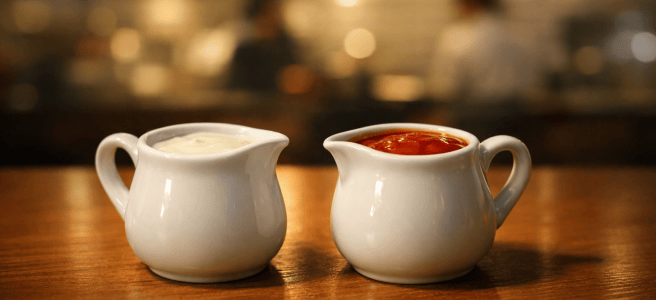
So when the waitress at Dominium placed two small ceramic jugs on the table, I didn’t understand what I was looking at. They were warm, weighty, almost domestic — the kind of thing you’d expect to find in a farmhouse kitchen, not a chain pizzeria. One held a white garlic sauce — sos czosnkowy, thick and creamy, with that unmistakable Polish dairy tang. The other held a tomato sos, deep red and confident, richer than anything I’d ever seen served with pizza.
They didn’t explain anything. They didn’t ask if we wanted it. Not only that, but they simply placed the jugs down as if this were the most natural thing in the world.
My friends didn’t react. They didn’t comment.
I remember staring at the jugs, thinking: Are these ours? No one ever said whether the sauces were free. Nobody itemised them, nobody asked, nobody explained. They simply appeared — as if generosity itself were part of the menu.
Instinct took over. I poured a small puddle onto my plate and dipped the edge of my pizza in it. The garlic sauce was creamy yet sharp against the heavy blanket of cheese on my pizza. It was nice, but something I could live without. My issue wasn’t garlic; it was that white garlic sauce that always left a weird, clingy taste in my mouth. I’d spent ages doing my best to dodge it — especially on doner kebabs, where it seemed to be applied with the enthusiasm of a fire hose. I’d mutter, “Bez sosu czosnkowego, proszę,” and get that classic look of disbelief. So when friends asked, “Gary, you don’t like garlic?” it wasn’t true. I liked garlic. I just had a long-running feud with the sauce.
It was the tomato sauce that really caught my attention.
Casting a discreet glance at other diners, I noticed some dipping straight into the jug. My friends weren’t shy either — they sloshed generous amounts onto their plates, painting thick red pools for dipping. Their confidence made something click. I followed their lead and poured myself a fuller, richer puddle. Bold, spicy, almost stew-like, the tomato sauce clung to the crust in a way British sauces never did. Suddenly, pizza wasn’t just pizza; it was pizza with sauce — a different dish entirely. More tactile. More generous. More Polish.
From that day on, sos became part of the ritual. Part of the memory. Part of the reason Dominium lodged itself so firmly in my sense of Poland.
Dominium became the place I liked to return to.
The pizza itself was the turning point. It was simply far superior to anything I’d ever had from a chain-style pizzeria. The moment it arrived, everything made sense: blistered in places, chewy at the centre, crisp at the edge, made by someone who cared rather than someone who had to.
I remember staring at it for a second, thinking, this can’t be right… this is Poland.
And then I tasted it. Fantastic pizza. Later that day, I called my family — genuinely excited, almost laughing — and told them, “Poland does the best pizza I have ever tasted.” They didn’t believe me, of course. They thought I was exaggerating, caught up in the novelty of travel. But when they finally came over to visit, it was the very first place I took them. Watching their scepticism turn into genuine surprise after that first bite was the ultimate payoff. It turned out I hadn’t been exaggerating after all — it really was that good.
It became a ritual of those early trips: arrive in Gliwice, settle in, and at some point make the pilgrimage to the Rynek for that pizza. My friends knew. They’d smile, amused, indulgent, and we’d go. And every time, Dominium delivered exactly what I remembered — the same layout, the same bustle, the same oversized chefs hats’, the same ceramic sos jugs appearing like a small miracle.
So when I finally moved to Poland in 2010, Dominium was one of the first places I wanted to return to. I needed to know it was still there, still itself, still the place I’d carried in my head for two years. And it was. Exactly the same. In a new life full of unknowns — new language, new streets, new routines — Dominium remained a constant. A small reassurance that some things in Poland were already mine.
Did you ever eat at Dominium? If so, I’d love to read about your memories of eating there.

 Ghosts to Carry, Stories to Keep