This is the final part of Railway Memories. You can catch up on Part 1 or Part 2
Coming back from Katowice had none of the calm of getting there. The return journey was a different kettle of fish entirely. Katowice station was in the middle of its transformation then — that remarkable brutalist concrete world being torn down and rebuilt around me. Tunnels diverted, plywood walls thrown up, the air carrying the dull echo of work that never seemed to stop.
And somewhere in the middle of it all, a busker. A man strumming an acoustic guitar who looked as if he’d stepped out of the 1970s—long hair, army surplus jacket, worn boots—stood there as if none of it concerned him. While the station shifted and fractured around him, he played on. I recognised him; I’d seen him playing in the Tylna Mariacka/Wojewódzka pedestrian tunnel, burrowed deep beneath the city’s massive railway junction. The passage was a surreal, timeless concrete pipeline cutting through a world that was rapidly reinventing itself above ground. It was an industrial artery coated in decades of graffiti—a messy, beautiful clash of vivid street art and hurried midnight tags. Walking through it, you could feel the weight of its history in the cold walls and the damp draft. The tunnel possessed a strange, magnetic echo that made me wonder about the countless thousands who had trodden these same stones before me, their collective footsteps long swallowed by the shadow of the tracks.
Many years later, I finally put a name to this talented guitarist… Mariusz Goli.
He played with a fierce, absolute absorption, completely turned inward and oblivious to the commuters rushing past. His skill was staggering—an intricate, lightning-fast cascade of acoustic finger style and flamenco that seemed impossible for a single pair of hands. He didn’t just strum; his fingers moved with a precise, fluid velocity, casting a dense web of notes that filled every corner of the concrete passage. Even if you only stopped to leave some coins, you couldn’t help but be struck by the sheer mastery of it. In that cold, chaotic underworld, his music became a constant, anchoring presence—a beautiful, complex wall of sound that somehow made the concrete feel less stark and the winter air a little less bitter.
Leaving the city in the late afternoon or evening felt like stepping into a construction site that never slept. By the time I reached the platform, the light was usually gone. The temperature had dropped. Everything felt sharper, darker, heavier — even older somehow — dimmer lights, a different kind of silence. The winter of 2010 was especially cold. Zima stulecia — winter of the century.
There was never a waiting train, never that gentle moment of choosing a seat and settling in. Instead, there was a strange, instinctive queue that formed only when the train was already rolling into the station. Even if I’d been standing right at the door as it came to a halt, I’d suddenly find myself surrounded — people appearing from every angle, stepping in front, behind, beside me, all with the same quiet determination to get on first.
One memory of this is especially vivid. It was bitterly cold — the kind that works its way through your shoes and settles in your bones. Known as Trzaskający mróz in Polish. I stood on the platform, stamping my feet, drifting from one spot to another to keep warm. It felt strange. There was no one else waiting. Where was everyone? Had I missed something? You could have heard a pin drop. Why was the train delayed? The cold was by now really beginning to bite into me, draining any of the little energy I had left. I was desperately trying to keep warm, moving across the platform from one track to another. I was in effect, waiting on a peron widmo, a ghost platform.
Eventually, the announcement came: “Thank the stars ” I thought to myself, “the train to Gliwice.” Right platform. The sign confirmed it. Every cloud has a silver lining, I told myself. I’d endured the cold, but at least I’d board without the usual scramble. Through experience, I even knew where the train would draw to a stop, leaving me with a door opposite.
Of course, I should have realised there would be no silver lining for my wait in the cold.
My fellow passengers had been waiting somewhere warmer — the subway, perhaps, or a waiting room out of sight. At the last moment, they appeared, spilling up from the stairs in a quiet, purposeful wave. Warmer, wiser, and entirely unhurried.
And just like that, I was no longer first.
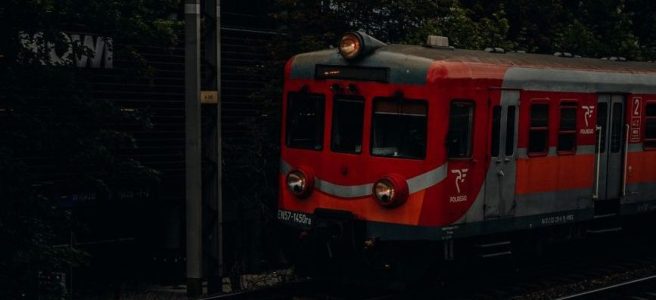
The old and tired-looking EN57 — or “Kibel,” the nickname given to this workhorse of a train — crawled into the station and groaned to a complete stop, just as I anticipated it would. The doors opened. People stepped out of the cold and into the light and warmth.
I was last on board.
All that time standing in the freezing air, undone in seconds.
I simply had to adapt. This wasn’t going to change. Musiałem się dostosować…
In those early days, I didn’t even try to find a seat. I’d stand in the entryway of the carriage — that small, vestibule space by the doors — Przedział wejściowy in Polish. Pressing myself against the wall as the train filled around me. I was often exhausted; my back ached, my legs were heavy from the day. The EN57 doors closed with a incredibly distinct, loud pneumatic hiss followed by a violent slam that shook the frame of the train. I can vividly remember looking through the fogged windows catching the orange streetlights of Chorzów Batory or the dark, looming shapes of the old mines. The journey seemed surreal, slow, at times the train seemed to move at a crawl. After about thirty to forty minutes, sometimes, even longer, we’d arrive in Zabrze. The train seemed to almost empty at here, and only then would I go into the carriage to rest for the next 10 or 15 minutes until we arrived at Gliwice.
The reason I didn’t sit was simple. I felt too self-conscious. Too aware of how close everyone was, knees and elbows almost touching. It felt like an intrusion, as though I were taking up space I hadn’t quite earned.
I noticed how easily others settled in. Coats off, scarves unwound, hung neatly on the hooks between the windows. Perfectly normal. But not to me, not then. I kept mine on, stiff and probably looking very out of place, convinced I was being watched — or at least noticed.
The passengers themselves were different in the evening. Tired faces, damp coats, people carrying the weight of the day home with them. The windows fogged quickly, turning the outside world into streaks of light and shadow, snow or rain dragged sideways across the glass.
So I stood by the door, doing my best to look as though this was how I preferred to travel.
It wasn’t.
At some point — helped along by becoming quite ill — I understood why everyone shed their winter layers the moment they stepped inside. The carriages were incredibly hot, almost stifling. You went from freezing air to something like a greenhouse in seconds, only to step back out later into sub-zero cold again.
So I adapted.
Boarding the train became something else entirely. I learned to stand my ground, not aggressively, just with quiet intent—not stepping aside unnecessarily, not hesitating. It felt, at first, as though I had acquired some invisible field around me.
I learned the language, too, or at least enough of it to belong in that small space when looking for an empty seat:
“Przepraszam, czy to miejsce jest zajęte?” Sometimes, it took only a hopeful look and a gesture toward a seat, using a simple “Wolne?”
And the reply: “Wolne.” Sometimes, “Proszę.” Simply put: “Sure. Go ahead. Sit down.” You’re part of this now.
I learned to take off my coat, my scarf, my jacket, to settle without fuss, without apology.
There was always a moment, just after the train began to move, when something shifted. A sense of travelling not just between cities, but between versions of myself. The confident teacher in the morning, and the quieter, more reflective figure returning at night, learning the country one journey at a time.
Coming back wasn’t frightening. It was simply different. A reminder that I was still new here, still learning the rules, still finding my place in a world that changed with the weather and the hour.
We tend to remember the landmarks — the Rynek, the churches, the monuments. But it’s the smaller, practical places that shape a life without asking permission.
And for a time, the journeys I made between Gliwice and Katowice did exactly that.
Jeśli zdarzyło Ci się przechodzić przez dworzec w Gliwicach, podziel się tym, co pamiętasz.
If you travelled through Gliwice Station yourself, feel free to share what you remember.
Missed the beginning? Read from the start — [Part 1: Gliwice Station]

 Ghosts to Carry, Stories to Keep