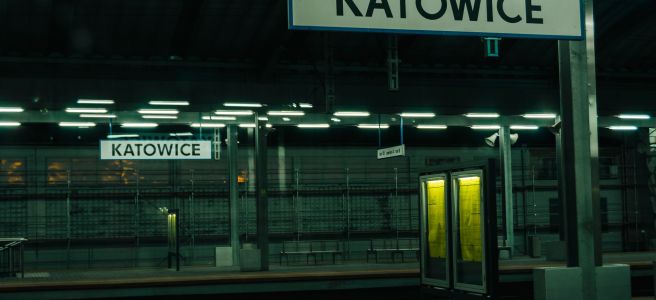
Two months of living in Poland had passed. I’d left Łabędy and moved to Gliwice, yet I still felt apprehensive about using public transport. It seems crazy when I look back upon it now. Was I really so ill-prepared for life in another country? There seemed to be an endless variety of bus services, even strange little minibuses that I assumed disappeared out into the sticks and beyond. I was slowly beginning to understand the railways, but apart from the train, I’d more or less accepted that I would be walking or cycling everywhere.
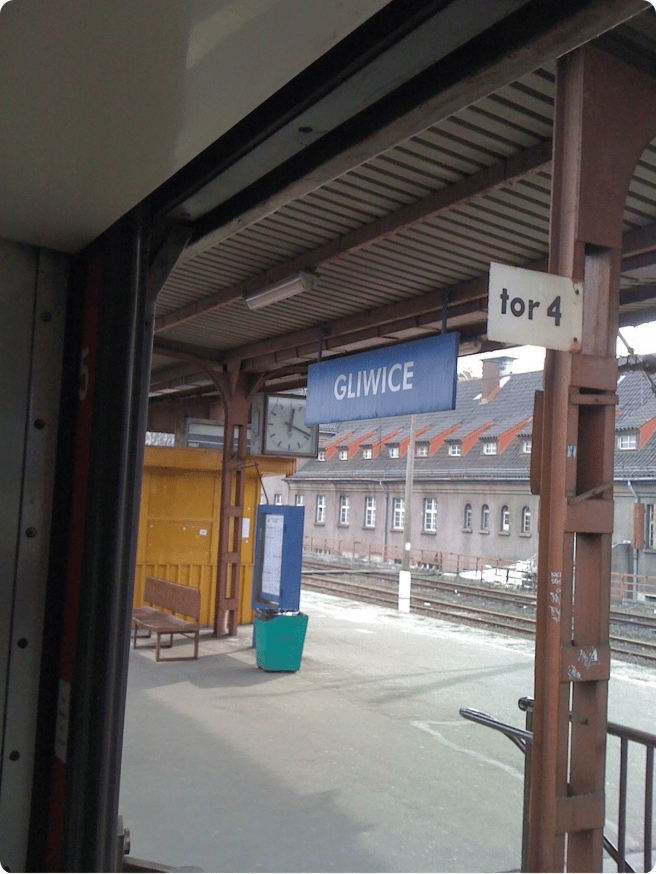
After long days teaching in Katowice, I’d adapted to travelling by train and no longer hovered awkwardly in the vestibule like a lost tourist. I made sure to get a seat, be polite, and sound confident enough to survive the interaction.
“Wolne?”
It was a single word delivered with the hard-earned confidence of a seasoned commuter, while privately hoping nobody would continue the conversation long enough to discover how limited my Polish really was.
When I arrived back in Gliwice—usually tired, cold, occasionally homesick, and more than a little lonely—I would march up Zwycięstwa with my arms swinging slightly as though on parade, bags slung over my shoulders. The cold had a way of creeping into your sleeves and settling there, so walking with purpose wasn’t simply a display of confidence; it was survival. The air bit at my cheeks with that sharp, dry cold that made every breath feel faintly metallic. Nobody lingered outside if they could help it. The locals moved with the same determined winter briskness: boots clicking across the pavement, scarves pulled high, and heads lowered against the night.
Yet those evenings still felt electric to me.
Shop windows spilled warm light across the pavements, turning parts of the street into little theatres of colour and movement. Neon signs flickered against older façades, their reflections shimmering along tram rails like streaks of water. The whole street carried its own soundtrack: the low rumble of buses, the distant clatter of heels, and the soft hiss of tyres on wet stone. Every step reminded me that I was somewhere layered with stories—a city where past and present overlapped like a double-exposure photograph.
I loved those walks despite everything. The lights, the shops, the strange harmony between old and modern architecture. Every journey home felt like a reminder that I was living somewhere truly steeped in history.
Zwycięstwa ended abruptly at the Rynek, the Market Square, where I would usually slip into the arcades—podcienia in Polish. The old kamienice looming above them, painted in pastel greens, blues, pinks, and creams, seemed to give the grand buildings an unexpected softness. On winter evenings, or at least whenever I crossed it, the Rynek felt oddly deserted. The bars and restaurants glowed at the edges of the square—little islands of warmth and noise, alive with voices and movement—while the vast open space between them lay silent, the sound thinning out into the cold. The contrast was surreal: light without company, brightness without the crowd.
I’d glance up at the clock on the Ratusz (the town hall) and think either: probably time to keep heading home… or, on slightly more optimistic evenings, just enough time for a quick beer.
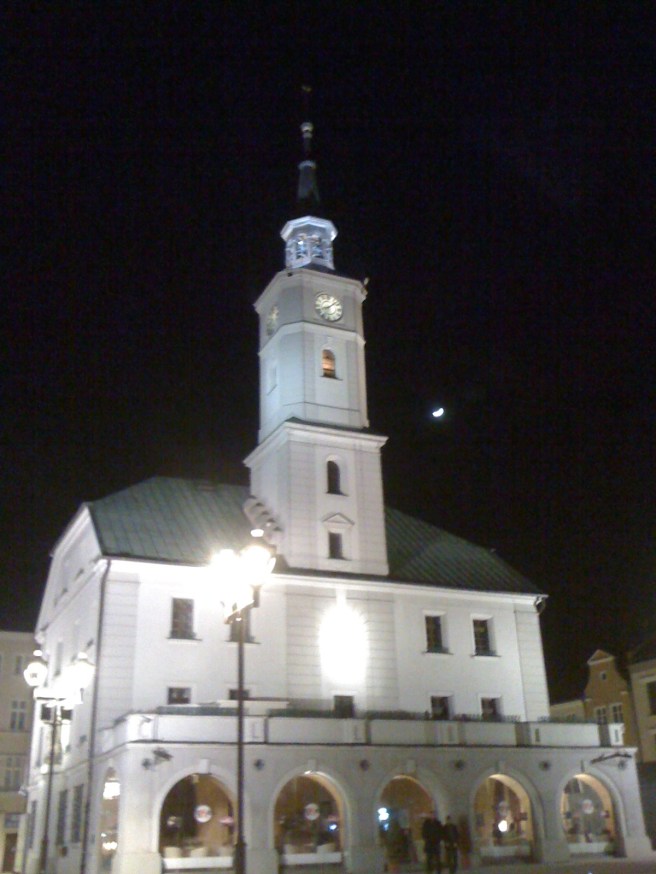
20:07 — officially beer‑o’clock.
If common sense won, I’d continue along Plebańska Street, passing directly beneath the looming presence of All Saints’ Church. The walls stood so close to the pavement that I could almost have brushed my fingers along the ancient stone as I passed. From there I’d continue along Siemińskiego—nearly home, though still another ten minutes away. By that point I was often exhausted. If I hadn’t stopped for food or a drink, the walk usually took around forty to forty-five minutes.
I wasn’t used to that kind of lifestyle at all, yet gradually I grew to enjoy it, even when winter seemed determined to test my commitment to living there.
As I made my way through the city, bright yellow Solaris buses would glide past in the darkness, their windows glowing with warm light. Inside, passengers settled into their seats with the quiet confidence of people who knew exactly where they were going.
I used to watch them with a gentle sort of longing. Not envy exactly, just the simple desire to understand how the system worked: which numbers mattered, where they went, and whether any of them passed anywhere near my home. It felt as though the city had handed everyone else a secret map while I remained outside in the cold, pretending I preferred walking anyway.
There was something oddly reassuring about those yellow buses. They moved smoothly and without hesitation, as though the city itself flowed naturally around them, while I was still learning how to belong. Every time one drifted past, it felt like a quiet promise that eventually I’d figure things out too.
I’d been told that if I wanted to use the buses, I should buy tickets in advance from kiosks or grocery shops. Those little kiosks fascinated me. The serving windows were set strangely low, forcing you to bend almost double to speak to the person inside. At the time, I simply didn’t feel confident enough to even attempt the transaction, which seems entirely absurd to me now.
What unsettled me more was being warned never to buy tickets from the driver unless absolutely necessary. Apparently, boarding through the front doors and asking to buy a ticket delayed the service and was heavily frowned upon by drivers and locals alike. Once aboard, you were expected to validate your ticket immediately using the mechanical stamping machines. That part, at least, I understood from my occasional tram journeys in Katowice.
The tickets themselves came in three varieties: local, two-city, or three-city tickets. Gliwice sat within a vast industrial web of adjoining cities, so the entire fare system revolved around municipal boundaries rather than the actual distance travelled. The same tickets worked on the trams, too. To me, though, they all looked practically identical except for the price, which seemed to depend entirely on how ambitious your journey was intended to be that day.
So, despite slowly beginning to understand the mechanics of the system, I still lacked the confidence to actually step onto a bus.
Until that unexpected meeting.
I seem to recall it was an especially busy train—seats all taken, the usual stifling heat, heavy condensation on the windows, and surrounded by people who looked every bit as tired as I felt. It wasn’t unusual to find people looking at me. I’d long since accepted that I stood out: the foreigner with the slightly-too-careful pronunciation, the man who still hesitated before stepping onto a platform, the one who checked the timetable twice even when he knew it by heart. You might think I’m exaggerating.
I’m not. The “Slavic stare” is a very real cultural phenomenon, and I’d become something of a magnet for it.
But this time felt different.
Pressed into the corner of the carriage, shoulder to shoulder with commuters who smelled of cold air and long days, I felt a particular gaze settle on me—steady, unblinking, and almost analytical. At first I ignored it. Then I glanced up, and the world rearranged itself. I noticed two people looking at me, a man and a woman.
I knew her.
Or rather, I recognised her in that strange, delayed way you do when you see someone completely outside the context where they belong. She was one of my advanced English students—quiet, observant, the kind who listened far more than she spoke. In class, she had a habit of tilting her head slightly, as if weighing every word. And here she was, doing exactly the same thing, except now it was me under examination.
For a moment we simply stared at each other, both of us caught between the formal rules of the classroom and the unspoken rules of the evening commute. Then her expression shifted—not a smile, not quite—more like recognition softening into quiet amusement.
As we approached Zabrze, the crowd around me stood up and began preparing to leave: coats slung back on, the delicate ballet of avoiding each other’s feet, and the gradual freeing up of seats. Those two passengers moved directly into the newly vacant places nearby.
“Hello. You are Gary from Britam? Do you remember me?”
I told her that I did. She nodded once, then said, “You look lost,” in English that was far better than she believed it to be.
I laughed. I knew how to get home from the railway station, sure, but even after months in Gliwice, I still felt like I was navigating a city that kept its core logic tucked just out of my reach.
“I usually am, but not tonight,” I smiled back.
That was all the invitation she needed.
By the time we reached Gliwice, we were talking easily—about university, mathematics, English conversation, and the mysterious world of buying and validating bus tickets. She even clued me into public transportation apps I didn’t even know existed. She explained everything with the kind of patient enthusiasm that made me feel less like a confused foreigner and more like someone finally being welcomed into a secret club.
We stepped out onto the platform together, the cold air hitting us like a wall, and she gestured toward the exit.
“Come on,” she said. “If you really are going to walk home, we’ll walk some of the way with you.”
And so we walked up Zwycięstwa. They flanked me without ever discussing it — she on my right, listening with that tilted‑head attentiveness, and her friend on my left, shy and gentle, offering the occasional polite smile as he tried to keep pace with the speed of my excited chatter. Words poured out of me; I couldn’t help it. After weeks of walking this street alone, noticing its façades and strange architectural flourishes with no one to tell, it felt exhilarating to finally share them. I pointed out balconies, cornices, old stonework, the way the street curved under the lamps — and then, without thinking, I stopped us outside Weichmann’s Textile House. That expressive, almost theatrical building had fascinated me from the first moment I saw it, and now I found myself jabbering about its lines and geometry, its strange modernist confidence. To my surprise, even they admitted they’d never really looked up before, never taken notice of the details I was naming. Our breath rose in small white clouds as we stood there, the traffic humming around us, snow glowing under the amber lights. I remember the noise, the warmth of their company, and the sudden sense of being swept along by something unexpectedly kind. For the first time in weeks, I didn’t feel entirely alone. I felt, strangely and wonderfully, that I was showing two young mathematicians their own city — and that they were happy to see it through my eyes.
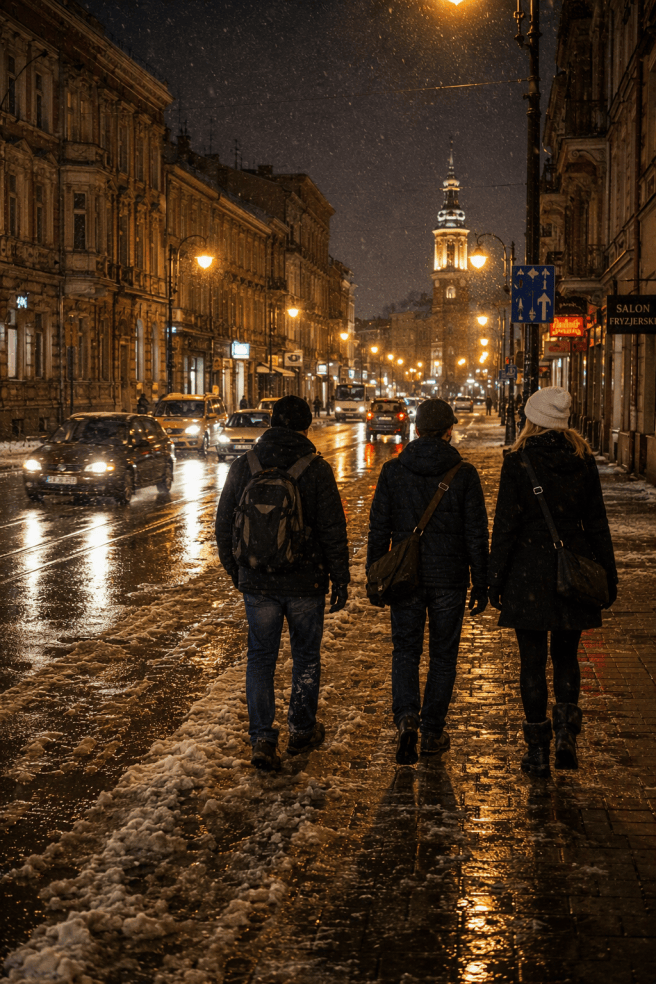
That evening was the beginning of something I didn’t yet have the proper language for—advice, guidance, and eventually, a friendship I came to value far more than she ever realised.
It became a comforting pattern after that—these small coincidences on the train home. I’d step into the carriage, scan the crowd for a space, and there she’d be: the same slight tilt of the head, the same amused recognition, as if she’d been expecting me all along. We never planned it, but somehow our commutes aligned regularly.
One night, after a couple more of these chance meetings and our subsequent long walks up Zwycięstwa, she stopped suddenly just as we were leaving the station concourse. She turned to me and said, almost conspiratorially:
“You know… the A4 bus would take you very near to your home. You’d be back in ten, maybe fifteen minutes. Would you like me to show you?”
I must have looked utterly bewildered, because she laughed—not unkindly, just with that gentle disbelief that anyone would willingly walk that far in the freezing cold by choice.
Before I could protest, she’d already guided me across the street to a bus stop I’d passed a hundred times without ever actually seeing. It sat strangely in the middle of two lanes of traffic, like a forgotten island. I’d always assumed it was a disused relic of the past.
“It used to be the tram stop,” she explained. “Now the A4 bus uses it. People still call it the tram.”
It always amazed me that the old tram tracks were still firmly embedded in the road surface along the former route. They felt like the city’s memories—stubborn, half-forgotten, and waiting to trip up anyone not paying close attention. They were harmless enough, until a bike wheel found them. Mine eventually did. One neat slip, a brief, weightless moment of “oh no,” and then the asphalt rose rapidly to meet me. Nothing broken, nothing dramatic—just bruised pride and that small, private ache of having absolutely no one to blame but myself.
That night, she handed me her spare ticket—a simple thing, really, but it carried a warmth that caught me entirely off guard. The bus arrived with that soft, familiar hydraulic sigh, and we stepped aboard together.
Inside, the world softened. It was warm, clean, and bright—a self-contained little glow moving smoothly through the dark city. I realised then how much of my hesitation had been built entirely from guesswork and nerves. She pointed out the stops, the landmarks, and the shortcuts locals used without thinking. In her voice, the geography of the city felt slower, clearer, and genuinely welcoming.
Her own journey normally ended at the theatre terminus, but that evening she needed to get off at the stop before mine. She carefully explained where I’d need to alight and what landmarks to look out for so I’d be ready, and then her stop arrived. A quick wave, the doors hissed closed, and suddenly I was alone. On a bus. In Poland. With a validated ticket—and, oddly, a profound sense of being looked after.
One stop later, I stepped out into the cold evening air in a bit of a daze. I’d spotted my usual Biedronka store as we’d passed, and realised I needed to alight at the next stop on Daszyńskiego. It was far higher up the street than I had anticipated, and I stood by the door holding onto the rail, ready to press the button to signal my stop, even wondering for a split second if I’d made a massive mistake. But it was fine. The bus stopped, I happily jumped off, discovered my bearings, and found I was a mere five‑minute walk from my apartment.
As I became more confident with the bus network, I preferred to get off at Mickiewicz Park and walk just a little further, often calling in at Biedronka or KAFO Kawiarnia. Years later, I moved to an apartment much closer to that exact route, and that specific stop became my default—as if the city had quietly decided we were finally on the same page.
I’d been walking almost an hour each night not because I had to, but simply because I didn’t yet trust myself to do anything else. And now here I was, minutes from my front door, warmed by the pure kindness of someone who didn’t owe me a thing but chose to help anyway. It was a small gesture, but it stayed with me—the way small things so often do.
That evening marked a permanent shift. Not just in how I travelled, but in how I felt about living there. The city stopped being an adversarial puzzle I was trying to solve entirely on my own. It became a place where people reached out, where help arrived unexpectedly, and where deep friendships could form in the unlikeliest corners of a crowded evening train.
And all because someone watched me on one winter evening—and decided to say hello.

 Ghosts to Carry, Stories to Keep