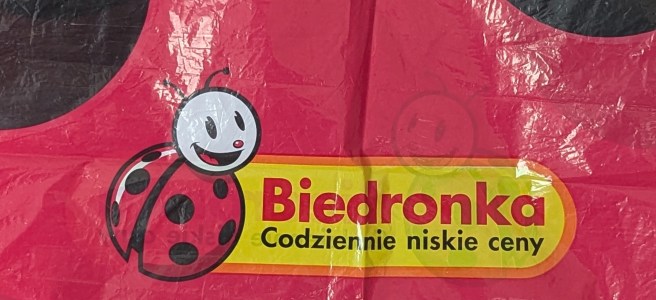
Codziennie niskie ceny
Or, How Biedronka Won Me Over
Arriving in Poland in 2010, I was already familiar with the large, modern shops the country had to offer. Gliwice and Katowice boasted shopping malls that could rival anything in the UK or France. Tesco felt like being back home again — and the French store Carrefour brought back holiday memories. The layout was logical, too: wide aisles, bright lighting, and everything in its rightful place.
But there were also the distinctly Polish shops.
Żabka was everywhere, like a green-and-yellow punctuation mark on every street corner. Open from early morning until late at night — with staff often outside smoking or drinking coffee — it always glowed brightly and was stocked with beer, snacks, and emergency supplies. In my last apartment, yet another fourth-floor walk-up where I had to haul my bike up the stairs, I lived right next door to a Żabka. I’d pop in for a couple of beers or a treat, but it never became my main shop. It was more like a convenient neighbour who didn’t mind that I was sometimes still in my pyjamas.
Then came Społem.
Ah, Społem. Quietly intimidating, museum-like, frozen in a 1970s future that never quite arrived. I walked past my local Społem almost every day, drawn in by its retro charm and that iconic logo. Each time I’d think, “Do I really need to go in there?” It fascinated me, but I never felt entirely ready to step inside.
And then, finally… Biedronka.
In the early days of living in Poland, I rarely visited the Biedronka near my hotel in Łabędy. I went three, maybe four times at most. The layout overwhelmed me — cardboard trays, slightly chaotic aisles, and a disorienting mix of familiar and unfamiliar items. Feeling unsure, I usually stuck to buying the same two things: a banana and a single bułka. Only once did I buy more: a huge pile of oranges I hoped would help me fight off the flu. That was all I could bring myself to buy. I still remember staring at the biggest mountain of green grapes I had ever seen in any supermarket — a towering mound where you picked any size bunch you wanted and bagged it yourself.
Little did I know how important that store — which I once likened to chaos with a barcode — would become to me.
Biedronka: Observations From the Aisles
A few universal truths anyone who has shopped there knows instinctively:
- The crisps are usually in a half-collapsed cardboard tray, as if they’ve survived a minor earthquake.
- The cardboard tray sits on top of another cardboard tray, forming a high-stakes game of budget Jenga.
- The tray is torn because someone grabbed a bag with the urgency of a person defusing a bomb.
- There’s always one flavour nobody wants, overflowing as if trying to prove a point.
- A leaning tower of Lay’s Paprykowe, defying both physics and common sense.
- A rogue packet resting on the floor, pretending it lives there now.
- Self-serve bread and rolls displayed with an optimistic level of trust that you won’t squeeze them (even though everyone absolutely does).
- Piles of bananas and grapes arranged with a level of hope I could only admire, knowing full well they’d be total chaos by noon.
The Biedronka Staff Member: A Portrait of Polish Heroism
Just one person usually operating the till, possessing the unshakeable willpower of someone who has seen queues form like severe weather systems. When not scanning items, they multitask at a level that should qualify them for some kind of national honor — the Order of Biedronka, First Class.
On any given visit, you will witness:
- A tank-like pallet jack being dragged around like part of a military exercise
- Crates being opened, restocked, broken down, and restacked at lightning speed
- Customers weaving through the narrow spaces like they’re navigating a low-budget obstacle course
- Behind the scenes, a mysterious choreography happening at full speed
And then — that till. The single till. The sacred, glowing altar of Polish commerce.
One person runs it like a machine gunner in an old war film, scanning items so fast the barcodes barely have time to register their own existence. You can practically hear the dramatic soundtrack building.
Meanwhile, the queue behind you forms with military precision.
People shifting weight…
Calculating angles…
Eyeing the competition…
Preparing for the moment.
And then it happens. The shout. The call to arms. The ancient ritual cry of the Biedronka cashier:
“OTWIERAMY DRUGĄ KASĘ!”
The reaction is instant. Not human — instinctive. Primal.
People sprint like someone just announced free pierogi for life. Trolleys swing. Baskets fly. Grandmothers move with supernatural agility. It isn’t chaos; it’s pure, synchronized choreography.
How Biedronka Actually Won Me Over
For all its chaos, cardboard trays, and pallet jacks abandoned like sleeping animals in the aisles, Biedronka won me over in the smallest, most human ways. Not through bargains or promotions, but through the quiet rituals of daily life — the ones you only notice once you’ve lived somewhere long enough to stop feeling like a visitor.
The first ritual was the loose change.
I began to notice that the staff in Biedronka never seemed particularly happy to accept large banknotes unless it was absolutely necessary. When they did, it came with an air of subtle disapproval — a tut, a small shake of the head, the kind of silent judgement that needs no translation. Sometimes it wasn’t silent at all; I was initially taken aback at being chastised simply for not having the exact change.
In those early days, I was terrified of holding up the queue. Polish queues move with a strange, unstoppable momentum — fast and slow at the same time. The person (or two, or three) behind you always stands so close they could co-manage your coin counting — a level of proximity that would spark quiet outrage in any British queue. Sometimes I’d feel a trolley gently nudging the back of my legs, in sharp contrast to the polite 2-foot buffer zone you get in the UK. So there I’d be, fumbling with grosze, apologizing in my very best shaky Polish, convinced I was single-handedly disrupting the country’s economic flow.
„Przepraszam… nie mam drobnych…”
(Sorry… I don’t have small change…)
I became surprisingly proficient at apologising when I didn’t have exact coins. I usually tried to pay the precise amount, but keeping a running total in my head was tough. The moment the cashier announced “czterdzieści siedem złotych osiemdziesiąt dziewięć groszy,” my brain would freeze.
That’s when the real panic set in. If I couldn’t read the digital display, I resorted to the only solution I had left: I held out an open palm full of coins — like a child offering up treasure — and let the cashier take whatever was needed.
My visiting friends couldn’t believe I trusted strangers to take the correct amount, but they always did.
Over time, once the staff recognized me, they softened. They’d pick through the coins with gentle efficiency — sometimes smiling, sometimes sighing, but never taking a grosz more than required. It was a small kindness, but it landed with real weight. It made me feel less like an outsider and more integrated into the daily rhythm of the neighborhood.
I practiced rolling my r’s such as in przykro and bardzo, with such confidence that hearing myself say “Przykro mi bardzo” even I felt impressed. Once, an older cashier challenged me — asking why I claimed not to understand Polish when I was clearly speaking it so well. Sometimes a little knowledge is more confusing than none at all!
Then came the single-beer revelation: the moment I realized you could simply unclip one bottle from a six-pack without being tackled by security. In the UK, that felt like a criminal act. In Poland, it was entirely normal. A tiny cultural revelation that made me laugh out loud in the aisle.
Slowly, without realising it, I became a regular. I learned to read Biedronka like an open book. I knew which cashier liked a bit of small talk, which one scanned at superhero speeds, and which one silently judged my late-night crisp selection. I knew when the bread was freshly delivered, when the bananas were at their peak, and when an abandoned pallet jack would inevitably block the coffee aisle.
Years later, a friend asked why I didn’t just pay with a debit card back then. Looking back from today, it seems obvious. But back in 2010, Biedronka wasn’t a card-first world. Even when card terminals appeared, they were temperamental, slow, or marked with a printed sign reading “brak sieci” (no network). Cash was king — it was the rhythm of the place.
A Note on Społem
Społem… ah, Społem.
If Biedronka was noise, rapid movement, and daily theatre, then Społem was its quiet opposite — a peaceful time capsule I passed almost every day. It wasn’t until my final year in Poland that I finally became a regular customer there. By then, something in me had softened, or perhaps Społem had simply patiently waited me out. I grew to love its quiet charm and appreciated how it held onto a nostalgic version of Poland that was rapidly disappearing elsewhere.
But Społem deserves its own story, its own memories, and its own dedicated entry.
This chapter belongs entirely to Biedronka — always, to me, truly: codziennie niskie ceny.

 Ghosts to Carry, Stories to Keep