A Small Silesian Tale of a Dutch Bike, Coffee, and One Unforgettable Driver
On a bumpy‑thump street made of cobble‑stone clicks,
Where the buildings lean sideways in Seussian tricks,
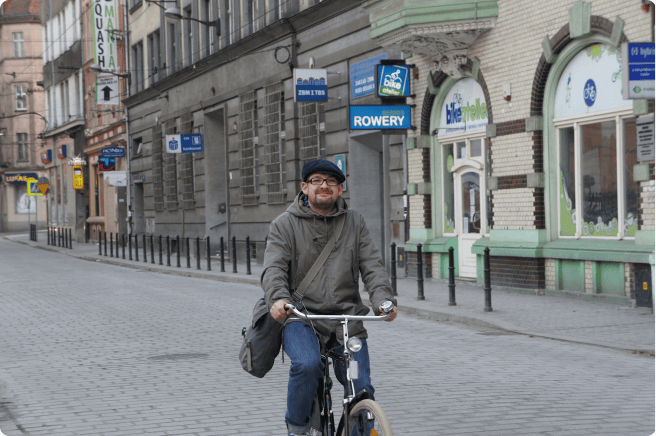
A rider named Gary went zipping along,
With a whizz‑whirly wheel and a ding‑doodle song.
Past the shop full of ROWERYs—oh what a sight—
With sprockets that sparkle and tires that bite,
He pedalled past SERWIS with marvellous speed,
A blur of pure motion, a two‑wheeled stampede.
Mieszkańcy mruczeli: „O rany, to Gary!
Pędzi jak wicher — bez hałasu, bez kary!”
But Gary just grinned as he swooshed down the lane,
For a bike‑loving heart can’t be held by a chain.
So if ever you wander that cobble‑stone way,
And you hear a faint whirrumph at quarter past day,
Znów ktoś zawoła: „To Gary, to Gary!
Śmiga jak błysk — bez hamulców, bez miary!”
Look quick! You might spot him—swift, bright, and merry—
Not a wizard or legend, but trusty old Gary!
Ten sam nauczyciel z torbami pełnymi,
Co śmiga do pracy szosami tutejszymi.
Ma kawę z KAFO, kierowcę pod ręką,
A lekcje z nim nigdy nie były udręką!
I każdy w okolicy powtórzy ci przecie:
„Ten Anglik od kawy jest badass na świecie!”
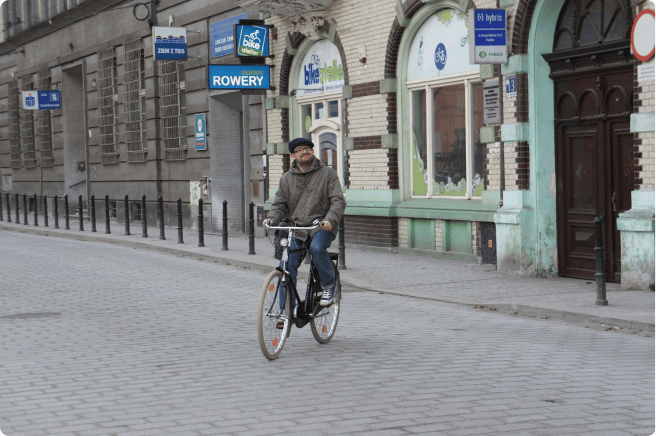
I treasured my bicycle and used it to get around the city whenever possible.
Before I go any further, I should probably explain the bicycle itself — the machine that carried me across Gliwice with such improbable dignity. It was a Gazelle Tour Populair, a Dutch roadster from the 1970s, built with the kind of over‑engineering that makes you wonder whether the designers expected it to survive a minor war. Tall, upright, and impossibly smooth, it didn’t so much roll as float. Those huge wheels were perfect for the city’s level streets; even the cobbles felt softened beneath them.
It had a three‑speed hub and a back‑pedal brake, which meant stopping was a matter of leaning back slightly, as if issuing a polite request. The chain was fully enclosed, a long metal shroud that kept my trousers clean and made the whole bike look like it had stepped out of a black‑and‑white photograph. The leather saddle was enormous — a sprung, creaking throne that absorbed every imperfection in the road and most of the imperfections in my mood.
There was also the skirt guard stretched over the rear wheel — a practical Dutch invention to stop coats, dresses, and, I suspect, the occasional priest’s cassock from being eaten by the spokes. And the rear carrier wasn’t a rack so much as a structural beam. Friends actually sat on it. Not metaphorically. Literally sat on it, side‑saddle, as if this were the most normal thing in the world.
It even had one of those frame‑locks bolted to the seat stays — the kind where you turn a key and a steel bar slides through the spokes with a satisfying clunk. Park, click, walk away. Utterly civilised.
Of course, all this elegance came with a price. The rear wheel was a nightmare. Removing it required the patience of a monk and the mechanical intuition of a Dutch bicycle mechanic. I once tried to fix a puncture outside, in the cold, and ended up reading a forum post that simply said: “Rear wheel removal? Leave it to a qualified mechanic.” I should have listened.
But despite its quirks — or perhaps because of them — the Gazelle was a head‑turner. People would stop and stare as I rolled past, as if a small piece of Amsterdam had taken a wrong turn and ended up in Silesia. An Austrian cycling enthusiast once begged me to sell it to him outside KAFO. His price went up every time I refused. I still don’t know whether he wanted the bike or the story attached to it.
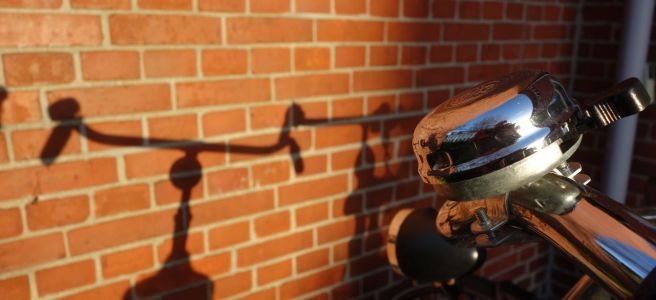
One detail I should mention — because it was impossible to ignore — was the Dutch bell mounted proudly on the handlebars. It wasn’t a polite British ding. It was a silver dome that produced a resonant brrring you could hear half a street away. It had presence. Authority. The sort of sound that suggested the bicycle had diplomatic status.
Gliwice no longer had trams by 2008–2009, but the tracks were still embedded in the roads, along with the overhead infrastructure and the faint memory of something that once rattled through the city. Most of the time they were harmless. Except at one particular junction — a sprawling, multi‑armed tangle of roads known locally as the Spider Junction.
Negotiating it on a bicycle with thin Dutch tyres was an exercise in concentration and mild prayer. The tram tracks ran at just the wrong angle, perfect for swallowing a wheel whole. Locals in cars barely noticed them. Cyclists, however, treated them with the same respect one gives to a sleeping dog of uncertain temperament.
Only once did I make the mistake of letting my front tyre slip into one of the grooves.
For a split second, everything went silent — the bike locked into the track like it had been magnetised — and then chaos erupted. I wobbled, swore, over‑corrected, and somehow managed to free the wheel before becoming a small, British road obstacle in the middle of the Spider Junction. A driver shook his head at me in that universal Silesian way that means: “Why would you do this to yourself?”
After that, I approached the junction with the solemnity of a pilgrim.
Sometimes my morning routine began at the crack of dawn: leaving my apartment, trying to carry my bike down five flights of stairs as quietly as I could, and cycling through the city as early as 6:15 a.m. to meet clients of a local company for a 7 a.m. English grammar lesson.
Even at that hour, cycling through some of the busiest junctions in Gliwice was stressful — especially when large articulated lorries pulled up beside me, often a little too close for comfort. Friends suggested I ride upon the pavements, like any other rational-thinking local would. It made complete sense; the pavements were wide and empty. I was probably being just too Gary, too British — cycling on pavements is against the highway code in the UK, actually illegal — and it was a habit I hadn’t yet learned to shed. The idea of cycling on a pavement felt unthinkable.
After that first lesson, I’d cycle all the way back through the city, now busier with morning traffic, and out toward the industrial sector for my next class — this one for EMPIK, a large national language school that expected teachers and native speakers to “find a way” to every lesson, no matter where it was. It wasn’t unreasonable at all, but getting to a location outside of the city and on time by bike or public transport was… ambitious.
As I began to cycle through the outskirts of the city, heading through the countryside, I usually found myself wearing a ridiculous smile — at least until my return along the same route, when I would reach the small hill I’d previously freewheeled down with sheer joy and now had to pedal back up with considerably less enthusiasm. Probably the only hill I had to use in the entire city.
By June, the approaching summer heat made cycling this route even more of a challenge. I carried a couple of spare shirts with me — strange, but absolutely necessary. On one occasion a wild boar ran straight across my path, so suddenly I instinctively back-pedalled, the rear wheel skidding before I caught the front brake a moment later. Another time I almost fell off my bike when, just as I was entering the industrial sector, a stork — the first I had ever seen — glided silently over my head and into a nearby field. I was mesmerised; its size and wingspan were larger than anything I had ever seen back home in the UK.
Thankfully, the school I taught at the most — Britam — was the complete opposite of EMPIK: small, kind, and consistently considerate. They provided a driver, Pan Bronek, to take the native speakers to lessons further outside Gliwice’s city centre. Officially, I was told it was a routine service. Over time, I grew to recognise it as an act of quiet guardianship and genuine warmth. They were looking out for me as a person, not just a native speaker of English. Unofficially, I suspect it was because I once boarded the wrong train, had my phone die mid‑crisis, and ended up being told — very calmly — that the train couldn’t stop, but they’d slow it down and I’d have to jump at Łabędy. Which I did. Ślązacy would probably shrug and say: „No… jak musisz, to skocz.”
After that, Pan Bronek became part of my rhythm of working beyond Gliwice. Depending on my mood, he’d collect me from outside the Żabka store next to my apartment block, or at KAFO kawiarnia — a café I had decided was my second home. If I wasn’t ready when he arrived at KAFO, the baristas — or Paweł, the owner, who laughed with his whole face — would call out:
“Gary! Pan Bronek is here!”
The whole café would enjoy the moment far too much.
I’d rush out, jump into the car, and be greeted with a cheerful, old‑fashioned “Serwus!” from a man who was rather abrupt, but friendly, slightly gruff, and entirely unafraid to tell me off for being late or for spending all my time in a kawiarnia. He was usually placated by offering him traditional Silesian boiled sweets called szkloki. I was partial to the rhubarb flavour — as he was too.
KAFO drop‑offs were fine. Coffee was respectable.
But on late nights, when we got back to Gliwice around 9 p.m. and if I asked to be dropped at my favourite bar instead of being delivered straight home, he’d give me that classic Silesian look — the one that says everything without saying anything:
„Chłopie… ja cię tu zostawić? Na serio?”
He always did, of course.
But I think he preferred knowing the Anglik was safely delivered, not wandering off into further adventures. I always thanked him sincerely and never once took him for granted. Pan Bronek never let me down.
So… badass? I never thought of myself as anything even close to “badass.” I first saw the comment “Gary is badass” in a detailed report written in Polish, giving feedback to Britam about my lessons with a business group. I was genuinely alarmed. I didn’t understand the rest of the sentence, and for a moment, I was convinced I’d done something terribly wrong. It took me a while to work out that it was, in fact, meant as praise — a very enthusiastic kind of praise.
I still haven’t fully recovered. Gary… badass?— Apparently so.
It’s still very funny.

 Ghosts to Carry, Stories to Keep