
Before I moved to Gliwice, milk bars were a footnote in my phrasebook — bar mleczny: an inexpensive cafeteria, a relic of the communist era. I had visited one in Bytom during an early trip, but it wasn’t until I lived in Gliwice, from 2010 onward, that a milk bar became part of my everyday life.
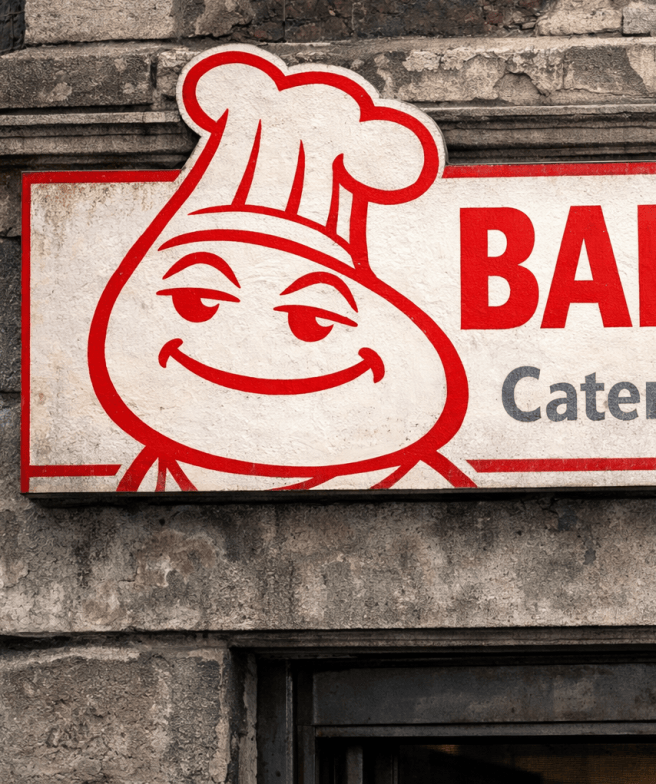
Five minutes from my first apartment, and no more than ten from the next two, set firmly upon the busy crossroads of ulica Styczyńskiego and ulica Kozielska, was a massive, four-story corner kamienica. The ground floor was clad in chunky, decorative blocks of stone, while the upper levels switched to classic brick, framed at the edges with heavy stone corner pieces. The entrance sat neatly in the sharp angle of the intersection, tucked under two floors of balconies that seemed to be permanently judging the traffic below. Above the door hung a long sign featuring a cartoon chef — hat, moustache, and the kind of smile that suggested he knew something you didn’t. Big red letters spelled out Bar Pod Pierożkiem, and underneath, in smaller black text: Catering, organizacja imprez.
I genuinely didn’t realise you could walk in and eat there. So I never did — not until a casual question changed that.
Not long after I moved in, a friend and I were waiting at the pedestrian crossing outside the place. She nodded toward the door and asked, “Ever eaten there?” I said no — I didn’t even know they served food. “It’s not actually a bar?” I asked, already confused. She told me the food was supposed to be very good, especially the pierogi — practically legendary — but the dining experience was, let’s say, less legendary. Most of their business, she said, came from catering weddings and family events, the kind of occasions where good cooking mattered more than ambience or chairs that didn’t squeak. I said I’d give it a try in the next couple of days.
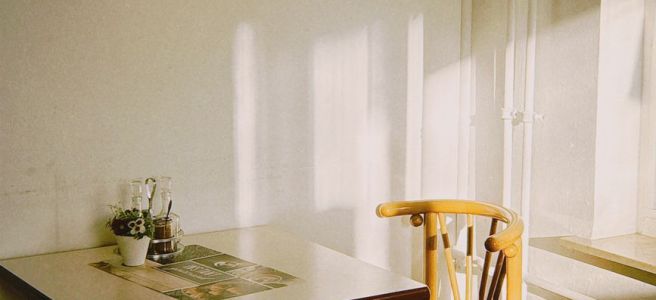
When I finally pushed open that heavy door, the first thing that hit me was the dining room. Laminated tables, plastic chairs, high ceilings — a big, echoing space that felt like a school cafeteria that had taken a vow of silence. No music, no decorations — just the scrape of chairs and the voices drifting out of the kitchen. At the far end, a single dining-room table acted as the boundary to the kitchen — the same kind of laminated table as all the others, just pushed into place and used like a counter to mark where the dining room ended and the kitchen began. Beyond it, you could see the kitchen working away like a quiet engine, the cooks moving with the calm confidence of people who know their pierogi are famous.
To the best of my recollection, I never saw a queue any longer than two people. One afternoon it was a grandmother and a boy I assumed was her grandson. Later, I glanced across the room and watched him tuck into a dish of pierogi ruskie whilst his gran looked on with quiet satisfaction.
I felt slightly wary at first. Not frightened, not unwelcome — just aware of my own clumsiness. I don’t remember much about the menu now; it escapes me. There was a specials board, I think, but I rarely looked at it. The place was never busy, and that somehow made the silence heavier.
And my friend was right. Sometimes the place felt depressing, and I hate admitting that. The cavernous room, the echoing chairs, the absence of music — it could feel like eating in a hall after everyone else had gone home. But there was one person who changed that atmosphere, even slightly: the woman who took the orders and the money, and who called out the dishes when they were ready. She seemed younger than the others, dressed more modernly, with a brisk, efficient manner that never crossed the boundary of familiarity. Direct, straightforward, not unfriendly — just someone who knew her job and did it without fuss.
She warmed to me a little. Not in any sentimental way, but in the practical sense of someone who recognised a regular customer who struggled with ordering. I would stand there, rehearsing the words in my head, and she would wait with a kind of patient neutrality that felt like mercy. I always ordered the same thing: kotlet schabowy, frytki, and whatever surówka was being offered that day. It was a meal I genuinely enjoyed, and in a place that sometimes felt bleak, it was a small anchor of comfort.
Out in the silence of the dining room, the real challenge began. The meal was always freshly cooked; you waited no more than ten minutes, and then your order was called.
The meal was served on a disposable polystyrene plate, the schabowy still quietly sizzling beneath its coating of breadcrumbs. The cutlery was plastic, too. Presumably to save on washing up, once you’d finished eating, you simply dropped the plate and cutlery into a large plastic bin next to the washroom.
However, trying to carve a thick, crisp pork cutlet with a flimsy plastic knife proved to be an exercise in extreme patience and physics. With every attempt to slice through the golden crust, the knife would bend alarmingly, threatening to snap entirely or catapult a piece of meat across the quiet room. It was a tense, absurd battle of wills — just me, a silent room, and a stubborn piece of pork holding its own against a bendy plastic toy.
I didn’t go every day. Once a week, certainly. Twice, sometimes, if the weather was bad or I couldn’t face cooking. Each time I went for the quick, easy option — even on days when I fancied something else. I liked schabowy and frytki a great deal, and habit has a way of disguising itself as preference.
Occasionally, when other customers were present, I noticed their eyes drifting toward my plate. Their meals were usually a simple soup or, more often, pierogi ruskie — everyday staples — while I sat there tucking into what might have looked, to some, like the height of indulgence: a Sunday dinner masquerading as a Tuesday lunch. It wasn’t envy I saw, but a kind of gentle astonishment, as though they wondered what sort of man walked into a milk bar on an ordinary afternoon and ordered a feast.
One day I decided I would break the pattern. I would study the specials board. I would try something new. I pushed open the heavy door, rehearsing a different sentence in my head, determined to expand my horizons.
But before the door had even closed behind me, her voice cut through the room — that familiar, brisk call from the counter, delivered with only the briefest glance in my direction:
“SCHABOWY I FRYTKI DLA PANA!”
And that was that. My attempt at change evaporated in the echoing hall. She had already placed me, already anticipated me, already written the script. I didn’t protest. I paid quietly, took my usual seat, and waited for the usual meal, feeling both defeated and strangely comforted. In a place where I often felt out of step, someone had recognised me — not intimately, not personally, but enough to know what I would ask for before I asked it.
The trouble was, it happened again. And again.
I told my friend, expecting her to share the absurdity, but she dismissed the idea with gentle certainty. “No, Gary, I don’t think so.” I was taken aback. Why wasn’t I being taken seriously? I wanted to eat something else. I wanted to prove I wasn’t trapped in a culinary loop of my own making.
I asked her to come with me. She agreed.
We walked in together, and before the heavy door had even swung shut, the familiar cry rang out across the cavernous room:
“Schabowy i frytki dla pana!”
My friend didn’t laugh. She didn’t show any obvious surprise. She was too polite, too considerate, and perhaps too attuned to the social choreography of the place to draw attention to it. She said it was her turn to pay, and that she’d be happy to explain that I wanted something other than schabowy and frytki — but I pleaded, “No, no… it’s fine. No need to mention anything.” So I sat down at the table I preferred, the one that felt least exposed in that vast, echoing hall.
At the counter, she chatted with the woman. I had no idea what they were discussing, but they were both laughing, and the sound softened the room. My friend ordered her meal and came to join me. I thanked her for paying, and she told me what the lady had said: that she was kind, nice, and from Zabrze. That she travelled every day by tram and bus. That she longed for a job closer to home, but this was all she could find.
It changed something. Not the routine — I still ate schabowy and frytki — but the feeling. The woman who called out my order wasn’t just efficient or modern or brisk. She was someone making a long commute, someone doing her best, someone who had noticed me enough to anticipate my meal but not enough to cross the boundary of familiarity. And somehow, that made the place feel less bleak. Not warm, not welcoming — but human.
I don’t know when it closed. There was no moment, no final visit, no sense of an ending. Life simply shifted. I found myself getting busier, pulled toward the trendy cafés near the Rynek or the salads at Bistro Gliwice. My last apartment was closer to the city centre, and the corner of Styczyńskiego and Kozielska became a place I passed less often. It slipped out of my routine the way certain habits do when your life changes shape — gradually, almost imperceptibly.
Years later, sitting at a desk far from Gliwice and trying to map out these memories for my blog, I decided to retrace my old steps. I opened Google Street View, dropping the digital pin onto that familiar grey corner. The sign with the chef had gone. The heavy front door and windows looked different too. Another company now occupied the space.
For a long time, I assumed that was the end of the story. I felt a quiet, familiar pang of expat nostalgia — the assumption that the pieces of the world you leave behind inevitably vanish when you turn your back. I imagined the cavernous room permanently silent, the quiet engine of the kitchen turned off for good.
But memory is a tricky narrator. Just recently, digging deeper into the local history of that neighbourhood, I stumbled across a detail I had missed. The place hadn’t disappeared. Pod Pierożkiem was still living.
It wasn’t a state-subsidised milk bar, not officially, but it had lived exactly like one. And when the old corner finally closed, the owners didn’t give up — they simply moved the entire operation across the city to ul. Okopowa, right beside the train station. Same traditional recipes, same quiet purpose.
I like knowing that. I like knowing it didn’t end in silence. That somewhere, in another part of Gliwice, the same recipes, the same rhythm carried on. It makes my memories feel less like fragments and more like part of a longer story — one I only glimpsed for a few years, but which didn’t stop when I walked away.

 Ghosts to Carry, Stories to Keep