Two-wheel traveller, occasional worker, and quiet recorder of old moments. Writing vignettes, short pieces, and poetry about past lives, daily routines, and the space between memory and place.
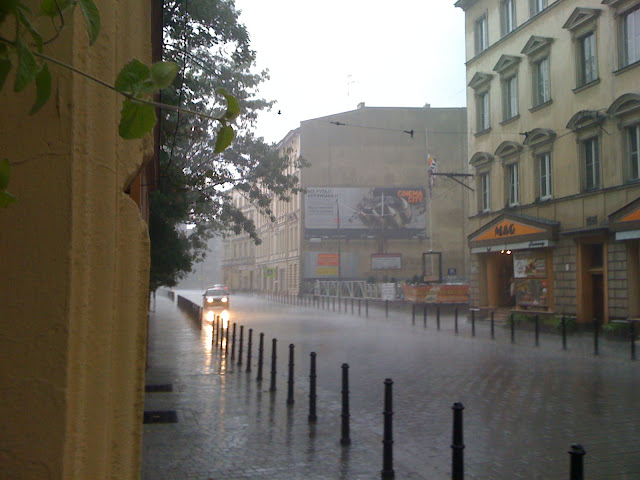
The rain didn’t sprinkle,
it didn’t just fall—
it walloped the square
like a great watery wall.
I sat in the kawiarnia,
just minding my seat,
when Alphonse shot out
in his deck shoes—so neat!
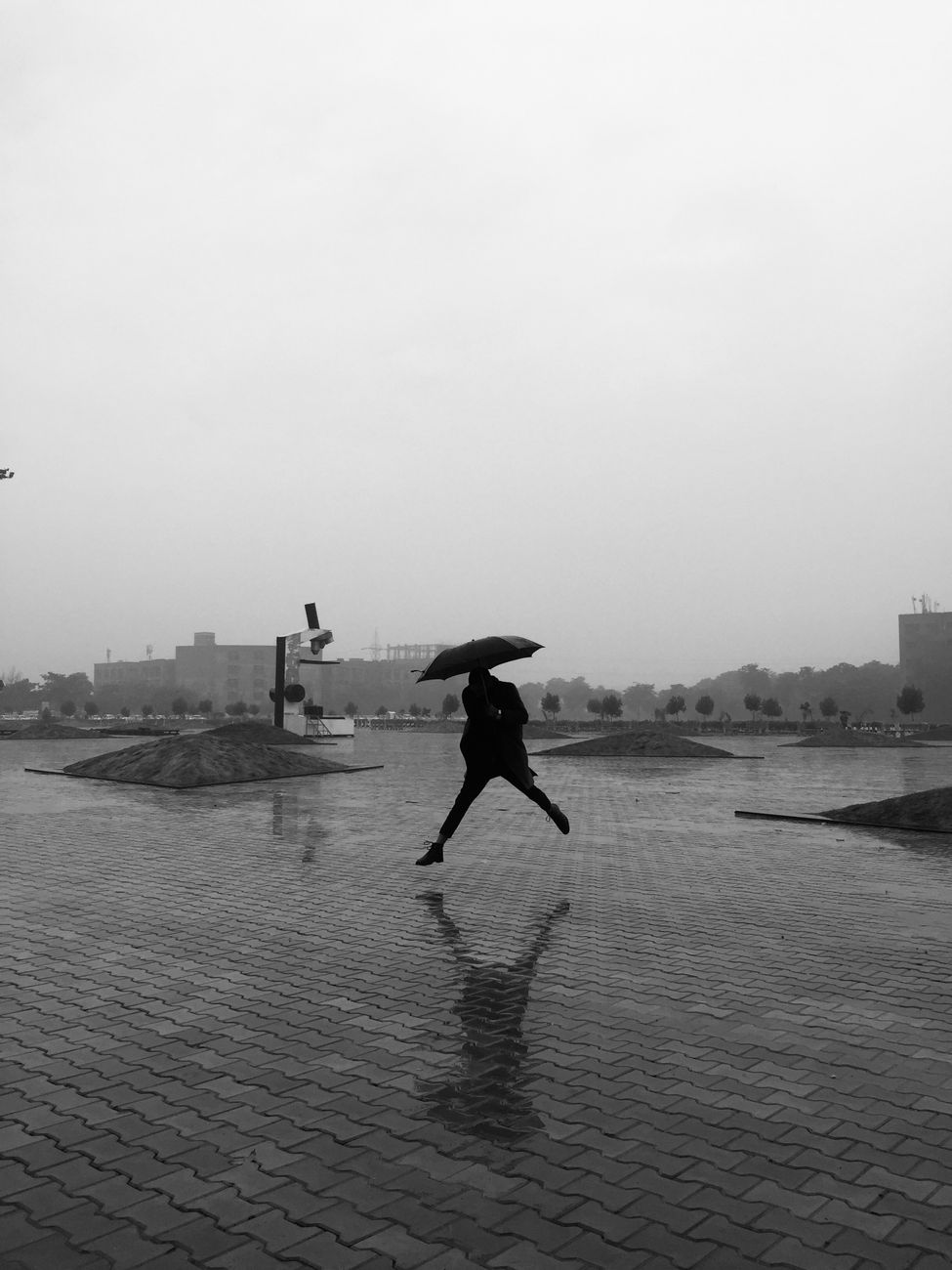
He leaned at an angle
that made no real sense,
as if dodging the raindrops
by sheer confidence.
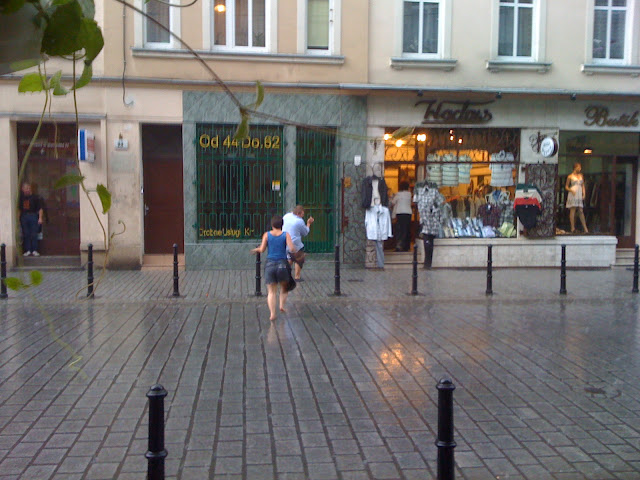
And Kinga dashed after,
bare legs, bare feet,
half‑skipping, half‑tilting
her way down the street.
They zigged and they zagged
in a rain‑dodger’s dance—
the kind grown‑ups forget
till they’re given the chance.
The downpour was wild,
a true cats‑and‑dogs show—
they splashed through the puddles,
got soaked head to toe.
Then circled right back
with the world’s biggest grin,
while a man by the doorway
stood blinking—rain in.
And here’s the true wonder—
I still don’t know why
two baristas chose raindrops
beneath that grey sky.
But joy has its reasons
that reason won’t catch—
two baristas, one rainstorm,
a spontaneous match.
Dwójka baristów i ulewa
Deszcz nie mżył spokojnie,
nie kapał ot, tak —
on walnął w to miasto
jak wodny atak.
Siedziałem w kawiarni,
przy stoliku w tle,
gdy Alphonse wybiegł
w swych butach — o, nie!
Pochylił się dziwnie,
jakby chciał deszcz minąć,
jakby samą postawą
mógł krople powstrzymać.
A za nim Kinga —
gołe stopy, gołe nogi,
pół‑skokiem, pół‑tańcem
pobiegła wzdłuż drogi.
Zygzaki, uniki,
taniec w strugach i mgle —
taki, o którym dorośli
zapominają, że jest.
Lało jak z cebra,
aż bruk cały lśnił,
a oni w kałużach
mokli — aż po brwi.
Wrócili po chwili
z uśmiechem po uszy,
a mężczyzna pod daszkiem
aż oczy przetarł z suszy.
I w tym cały sekret —
do dziś nie wiem sam,
czemu biegli w deszczu,
skoro dach był tam.
Lecz radość ma powody,
których rozum nie złapie —
dwoje ludzi i ulewa,
chwila szczęścia w złapanym kadrze.
A small memory for the International Day of Happiness that took place earlier this year — a reminder that joy often arrives unplanned, like a sudden summer rain.
Małe wspomnienie, które napisałem na początku tego roku na Międzynarodowy Dzień Szczęścia — przypomnienie, że radość często pojawia się niespodziewanie, jak nagła letnia ulewa.
Names have been gently changed honouring privacy, though the magic of the moment remains untouched.
Imiona zostały delikatnie zmienione ze względu na prywatność, ale magia tamtej chwili pozostaje autentyczna.
🎵 Music for leaning a little sideways into the world — bright, strange, and beautifully off‑balance.
I’d seen their kind in films, usually French or Eastern European, often black and white: those wonderfully solid pieces of cylindrical street furniture that seemed to belong naturally to the urban landscape. Kiosks. Poster columns. Tram wires. Things that looked entirely ordinary to the people who lived among them, yet somehow cinematic to me.
And the słup was never empty — bearing a tree-ring history of Polish weekends and beyond.
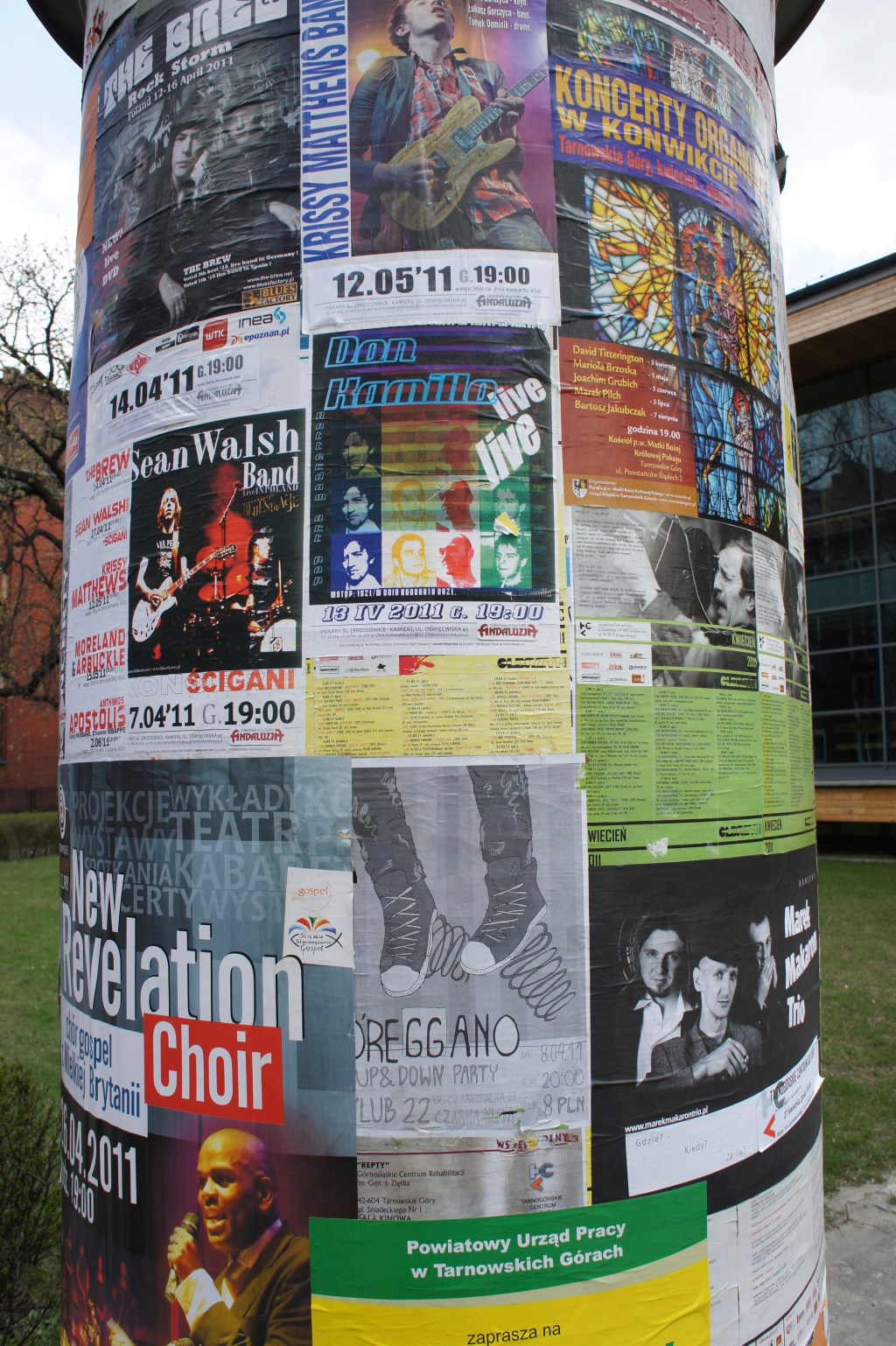
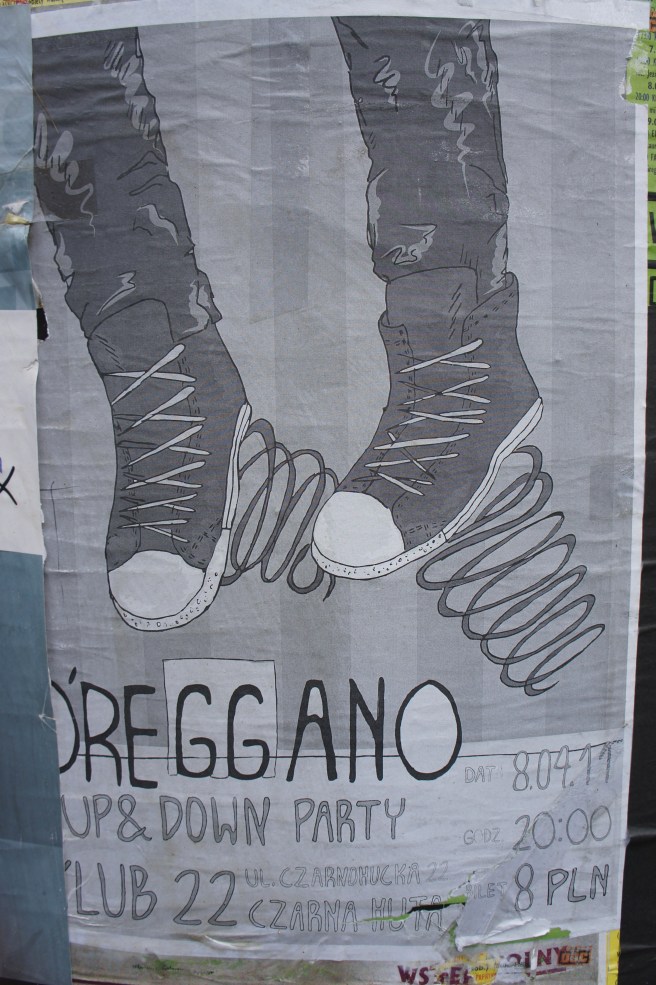
By spring 2011, this one in Tarnowskie Góry was covered in posters for concerts, theatre, exhibitions and whatever else was happening. Most were professionally produced, crowded with photographs, logos, sponsors, dates and information. They competed for attention.
I wasn’t particularly interested in any of them.
Then I noticed the shoes.
Right in the middle of all that visual noise was a small, handmade poster. Two high-top sneakers, crudely drawn, with enormous springs attached to their soles.
Beneath them, in equally hand-drawn lettering:
O’REGGANO UP & DOWN PARTY KLUB 22
It was amateurish, unpretentious and completely unlike everything around it.
I didn’t know who O’reggano was. I had no idea where Klub 22 hid itself in the city, or what an “Up & Down Party” meant. But I fell in love with it instantly for its simplicity.
These tiny sketched shoes were trying to defy gravity.
I pressed the shutter, captured the frame, and carried the mystery home with me.
Looking at the photograph today from 2026, the simplicity I fell in love with feels even more powerful. It wasn’t just a clever graphic; it was the literal heartbeat of a room.
I now know that Klub 22 was a multi-level rock haven, but looking at the sketch today, I realise ‘Up & Down’ meant something much deeper than stairs. It was the literal physics of the room. It was the kinetic architecture of dance — the compression of a body sinking into the heavy ‘down’ of a bass line, and the explosive release launching ‘up’ into the chorus. Those hand-drawn springs captured the very mechanism of human rhythm: the urge to defy the concrete beneath our boots, if only for the length of a song.
Fifteen years later, I can finally hear the music.
PL: Wiem już, że Klub 22 był dwupoziomową świątynią rocka, ale patrząc dziś na ten szkic, dociera do mnie, że „Up & Down” oznaczało coś znacznie głębszego niż tylko bieganie po schodach. To była czysta fizyka tego miejsca. Kinetyczna architektura tańca – moment, w którym ciało kurczy się, uginając pod ciężarem basowego „down”, by za chwilę wystrzelić w górę, w euforyczne „up” niesione refrenem. Te odręcznie narysowane sprężyny idealnie uchwyciły sam mechanizm ludzkiego rytmu: tę rozpaczliwą potrzebę oderwania się od twardego betonu, choćby tylko na czas trwania jednego utworu.
Piętnaście lat później w końcu słyszę muzykę.
Author’s Notes
Słup: In Poland, the iconic circular concrete advertising column is called a słup ogłoszeniowy. (plural: słupy ogłoszeniowe) Or more simply, a słup, (plural: słupy).
Klub 22 in Tarnowskie Góry (originally located at 22 Czarnohucka Street) was an iconic venue on the Silesian rock, alternative, and live concert map.
Oregano Chino: A popular Silesian alternative rock band that regularly performed live at Club 22. Their high-energy shows drew massive crowds of fans in Tarnowskie Góry. The band’s name is stylised on the poster with a double ‘G’ as O’REGGANO, which was a common alternative spelling used by the band and fans at the time.
Up & Down Party: The name of recurring dance events hosted at the club. As much as I’d like to attribute the name to the physical physics of the dance floor and those hand-drawn springs, it may have simply referenced the architecture of the building, where parties took place simultaneously on the ground floor and the upper level. To be honest, I really don’t know. I’m just guessing at the history here. If you know the actual reason the party was named so — and why it was in English — I would love for you to reach out and tell me!
Up & Down Party:Cykl imprez, które regularnie nakręcały ten klub. Jak bardzo bym nie chciał przypisać tej nazwy fizyce rozgrzanego do czerwoności parkietu i tej sprężynującej, koncertowej energii, mogła to być tylko aluzja do układu budynku – z imprezami tętniącymi równolegle na dwóch poziomach: dole i górze. Szczerze mówiąc, to tylko moje domysły. Jeśli pamiętasz tamte czasy, wiesz skąd wzięła się ta nazwa i dlaczego była po angielsku, zostaw komentarz i uświadom mnie!
When I landed in Gliwice at the end of September 2010, the local coffee landscape was a strange hybrid of the traditional and the derivative. On one end were the classic kawiarnias, which felt remarkably like traditional British tea rooms — slightly stuffy, polite, and formal. A small kawiarnia became my go-to, located just outside the Rynek on a quiet backstreet. It had, at the very most, five tables, all clad in white tablecloths and accompanied by piped classical music.
The reason I went there was twofold: the owner was a delightful, friendly gentleman who seemed genuinely pleased that I adored the other reason for my weekly pilgrimage — his wife’s creation of the ultimate Tort Czarny Las, the Polish version of Black Forest gateau. He glowed with gentle pride in her baking and confectionery skills, and that quiet devotion gave the place a warmth that softened its formality.
On the other end of the spectrum were venues caught in a cosy ’90s time warp: dark wood, velvet settees, and deep armchairs made for lingering over lattes with far too much texture. I often found myself at Kofeina on ul. 3 Maja near the railway station in Katowice when I travelled there for my English classes. With its Wi-Fi and quiet corners, it was a comforting place to settle in and prepare — or gently review — my lesson plan. I always ordered tea with milk, alongside a big wedge of sernik (cheesecake), and the staff never failed to be kind. Once my preparation was done, I loved sitting by the window, watching the trams and people pass by as they moved through the rhythms of their everyday lives.
Katowice: I used to dream of picking up this bike and running away with it — what a beauty!
In Gliwice, I often drifted toward a branch of Coffeeshop Company — an Austrian franchise that felt like a slightly altered reflection of Starbucks. It was functional enough, but it carried that familiar corporate vastness I’d hoped to leave behind. Still, its wide, open ground floor, soft sofas, and generous chairs made it a convenient and comfortable refuge. The staff were also very friendly and keen to please. I hosted some of my earliest free English conversation club meetings there — lively, warm evenings that lingered in my memory, more like gatherings of friends than formal sessions, which is undoubtedly what they grew into. I remember everyone seemed to opt to drink tea of different types — without milk.
Tea in a glass, without milk… Toto, I’ve a feeling we’re not in the UK any more.
All the while, I moved through my caffeine routine half-asleep, unaware that something quieter and more meaningful was beginning to stir. If a new wave of cafés had already arrived during my visits between 2007 and 2010, it slipped past me unnoticed. I wasn’t yet tuned to its frequency.
Then came May 2011, and everything shifted with startling clarity.
For weeks — almost every day — I passed a particular storefront on ulica Jana Siemińskiego, never sensing the quiet transformation unfolding behind its walls. The windows and door were completely papered over, sealing in whatever was happening inside. From the street, it looked like a secret waiting for the right moment to reveal itself.
Then came a warm, sunny mid-morning that month. I was walking back from showing my daughter around the Rynek when I noticed the paper was finally gone from the windows. The large wood-framed glass door stood open, as if inviting me in. I paused, looked inside, and felt something shift — a quiet recognition, almost like déjà vu, but warmer.
It was beautiful.
Not corporate. Not nostalgic. Not derivative. It felt intentional — crafted, not copied.
The space breathed with a minimalist, industrial warmth: hand-cut plywood, bespoke wooden fixtures, industrial lamps, handmade cushions and backrests. The back room opened into a world of fresh flowers, art prints, and exposed brickwork that seemed to glow in the morning light. It was as if someone had distilled all the emerging signals of a new café culture — the care, the craft, the quiet confidence — and poured them into a single, coherent space.
And then the workstation stopped me in my tracks. The gleaming espresso machine, the professional grinder, the rows of quality Inker cups — it was a declaration. Someone cared. Someone wanted to do this properly.
My excitement was already bubbling over, but the tipping point — the detail that made my daughter burst into laughter at my sudden, unfiltered joy — was the vinyl. A small selection of records standing proudly next to a vintage record player and speakers. It was such a simple thing, yet it felt like a message written just for me: You belong here.
It felt like a perfect entry onto a wave — that moment when everything locks together, and you just know: This is it.
Paweł, the owner, watched my reaction with a mix of surprise and delight. And when he spoke to us in English, it felt like the final click of a lock turning.
The paper had come off the windows, and I had stepped across the threshold of my third place.
KAFO wasn’t just a kawiarnia. It was a sanctuary — a space that held me gently during moments when I felt utterly alone, and lifted me during moments when I felt alive with possibility. It wove itself into the rhythm of my days: a place to meet friends, to work, to breathe, to simply exist without explanation. A place that asked nothing of me except that I show up and enjoy.
As I sat there, either alone or with friends, taking it all in, I realised I wasn’t just witnessing a cultural shift — I was living inside it. This wasn’t theory or observation. It was personal. It was happening to me, around me, with me. By the end of 2011 and into 2012, the change was unmistakable: attitudes, fashion, music, third-wave kawiarnias, microbreweries — all part of a movement that had quietly been gathering momentum until the day I walked through that open door.
Then came the late nineties, and almost overnight the British high street changed its scent.
Starbucks appeared with its bucket‑sized paper cups, sugary syrups, and that unmistakable sickly vanilla and burnt‑milk aroma that seemed to drift out of every doorway. Costa followed, multiplying across Chester until it felt as though every corner had one. Caffè Nero arrived too — there was even one in Wrexham where I sometimes worked — trying to offer something darker, moodier, more “continental,” though at the time it all felt impossibly sophisticated.
We shifted from asking for frothy coffee to ordering lattes, cappuccinos, and Americanos. I once asked, “Why Americano?” I got a simple shrug from the stressed-looking young lady wearing a t-shirt with barista emblazoned upon it. “Not too sure,” came the reply. No more was said.
It was corporate, it was uniform, and for a while we believed it was the height of refinement. But it also nudged my palate away from instant coffee for good, preparing me — without my realising it — for the independent, obsessive, quietly revolutionary coffee culture I would later fall in love with.
Holidays abroad — and even long-haul flights to Canada — offered a temporary escape. To save money on skiing trips, flights from Manchester to Vancouver, I frequently booked indirect routes that sent me backward into Europe first. Spending a layover at Schiphol or Frankfurt meant I was essentially flying East over the North Sea just to turn around and fly right back over the UK. Yet, there was something irresistibly cool about standing at those bustling continental transit bars.
Nursing a tiny shot of espresso under the glowing banners of Lavazza, Segafredo, or my favourite, Illy, made the detour feel entirely worth it. Knocking back that bitter, sophisticated shot while gripping a complimentary speculoos biscuit became my passport into an entirely different coffee world before the long trudge across the Atlantic.
Landing in Vancouver, the sheer scale of Canadian coffee devotion hit me like a jolt of pure caffeine. Back home, a coffee shop was a novelty; here, it was infrastructure. Starbucks was ubiquitous, its green sirens claiming every major street corner in the city. Yet, it wasn’t the Seattle giant that won me over. Instead, I fell hard for Second Cup, a home-grown Canadian chain that felt infinitely warmer, trading corporate minimalism for rich roasts and cozy armchairs. And then, of course, there was Tim Hortons. This was in the golden era, long before corporate takeovers flattened its soul. Back then, “Tims” meant genuinely great, fresh coffee paired with incredible, freshly glazed doughnuts that felt like a national birthright.
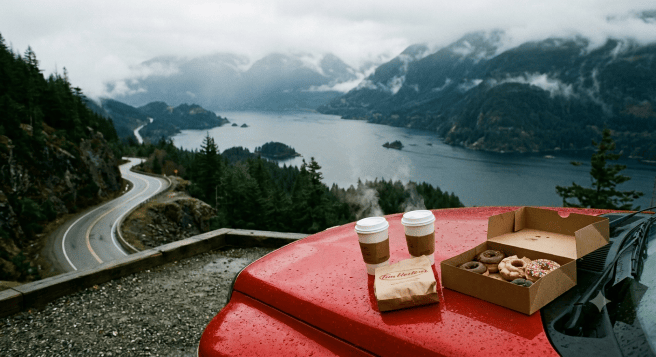
Drinking coffee in Canada wasn’t just a morning routine; it was a companion to adventure. Whenever we made the pilgrimage up Highway 99 toward Whistler, a pit stop at the Squamish Tim Hortons was an absolute mandate. In the early days, before the 2010 Winter Olympics transformed the route, the Sea to Sky Highway was a thrilling, white-knuckle ribbon of asphalt carved precariously into the mountain cliffs. Trying to avoid staring down at the dizzying drops into Howe Sound became a ritual. Years later, the highway would be straightened, widened, and tamed for the Olympic crowds. But whether navigating the dangerous, winding curves of the past or cruising the smooth highway of the post-Olympic era, that much-beloved family pit stop remained unchanged: a hot coffee, a box of fresh donuts or Timbits, and the crisp, pine-scented air of British Columbia.
Eventually, our travels drew us away from the mainland and across the Strait of Georgia, where we fell completely in love with Vancouver Island. It was my first-ever visit to this incredible island, and I was immediately struck by the warmth of the people as we headed up toward the snow-choked peaks of Mount Washington. We met up with a friend who lived on the island and was understandably delighted to act as a guide and show us around. It was a completely mundane stop along the way that provided my ultimate coffee epiphany.
Pulling into a rustic island service station to refuel the pickup, I noticed they served coffee. I watched as my friend walked calmly up to the counter and casually asked the cashier, “How fresh is the coffee?” Fully expecting a shrug, I was stunned when the lady behind the till didn’t guess; she actually checked a physical timer resting beside the pots. “Oh, it’s a bit old,” she replied with a smile. “If you don’t mind waiting a couple of minutes, I’ll brew you a completely fresh batch.” I stood there, mouth agape, completely mesmerised. Miles from any major city, coffee freshness wasn’t an afterthought — it was a timed metric of hospitality
Naturally, when I returned home to the UK, my standards had been entirely warped by the Canadian experience. Finding myself back in Chester, I decided to test the waters. I walked up to a counter — I won’t name the company — looked at the standing coffee, and boldly asked, “How fresh is the drip coffee?”
That question was answered by a look of absolute bewilderment — a silent, defensive ‘What? Does it even matter?’ written across the face of the assistant taking orders. I am sure I must have been the first customer to dare ask that question.
After a beat, The barista busying themselves steaming milk looked over, and gave me the ultimate, classic British reply:
“It’s still okay.”
Not even a glance at the timers. No fresh batch offered. Just a lukewarm reassurance that the coffee hadn’t yet turned to poison. I took my cup, realising with a heavy sigh that the global coffee revolution had a very long way to go before it ever reached Cheshire. Unsurprisingly, it tasted muddy, bitter, and unpleasant — a lukewarm cup of disappointment, and a sudden, aching homesickness for Canada.
Whistler operated by its own unique set of rules. Unlike the rest of British Columbia, where the green siren dominated every block, there was absolutely no Starbucks or Tim Hortons allowed within the pristine pedestrian footprint of Whistler Village. Instead, the village corporate coffee crown belonged to Second Cup, which we frequented and absolutely loved. It became our cozy, reliable haven, a place to thaw out and watch the global ski crowd drift past the windows.
By the late 2000s, my brief romance with the high‑street chains had worn thin. I was tired of the sameness: the oversized cups filled with over‑extracted, bitter coffee drowned in milk and foam. I had taken to ordering a simple glass of water and an espresso. Even a basic Americano felt like a watery chore. Nero became my default for a time, simply because its darker roast had a little more bite, and they sold interesting biscotti that were almost impossible to bite down upon, but perfect for dunking. I didn’t want a bucket of hot milk; I wanted real coffee. I just didn’t know where to find it yet.
I remember standing in a newly opened Starbucks.
“Name, please?” the bright, bubbly server asked.
“It’s Gary,” I replied, watching her write something on the paper cup with confident strokes.
“OK, we’ll call your name when it’s ready.”
I waited. After five minutes, a voice called out, “Americano with milk for Harry!” I looked around. No one moved.
“I’m Gary,” I offered helpfully.
The barista frowned at the cup. “But it’s for Harry.”
“If it’s an Americano, medium, with milk… it’s mine.”
“Are you Harry?”
“No, I’m Gary. I think it’s a simple misunderstanding.”
She looked at the cup, back at me, smiled and handed it over.
Written upon the cup was the name Harry, accompanied by a small heart drawn in a heavy Sharpie kind of purple colour ink.
I drank Harry’s Americano, still trying to understand this strange ritual of names and hearts on paper cups.
Gary… Harry? Close.
In the UK, I had already noticed in cities like Manchester, Liverpool, and of course, London, a wave of independent cafés multiply, craft micro-breweries flourish, and a new subculture take shape — the so-called “hipster,” or “nerdy cool,” as I preferred to think of it. Knitted beanies, skinny jeans, lumberjack shirts, thick-framed glasses, fixie bikes, vinyl records, and immaculate male grooming — beards, barbers, and waxed ’taches — were no longer fringe signals of a niche tribe. They were becoming the visual language of a cultural shift.
What struck me most was how seamlessly this aesthetic wrapped itself around everyday rituals. Coffee wasn’t just coffee; it was an identity marker. Beer wasn’t just beer; it was a craft. Even a haircut became a curated experience.
I vividly recall my first visit to a new-wave barber in Manchester. The place felt less like a shop and more like a stage set for a lifestyle I wasn’t sure I belonged to yet. The barber himself was inked almost from fingertip to collarbone — not in a way that demanded attention, but in the quiet, curated style that had become part of the new aesthetic. It simply blended into the craft-driven seriousness of the space.
His meticulous attention to detail, the razor-sharp fade, the bewildering array of grooming products lined up like scientific instruments — all of it signalled a reverence for barbering as a skill, a passion, a discipline. The tattoos were just another thread in that tapestry, an understated part of the package rather than the point of it.
And then he offered me an ice-cold beer.
A beer — during a haircut. It was such a small gesture, yet it marked a clean entry into a world where the ordinary was being reimagined, polished, and presented with a wink of self-aware cool.
Throughout my writing, I find myself returning to a kawiarnia — a small café called KAFO, sometimes simply Kafo — as though it were a doorway into a moment I can’t quite step back into.
I’m not sure why I’ve never written about it more fully. Perhaps I’ve held back because the place lives in memory with a tenderness that resists being pinned down; in theory, it should have been easy to capture, yet every attempt feels like reaching for something already fading, a sweetness edged with the knowledge that time has moved on.
This story begins in my earliest memories of coffee — long before café culture had a name, back when a hot drink in Britain simply meant a strong pot of tea. In the 1960s and 70s, the North East working-class landscape ran on leaves and boiling water; almost everyone I knew drank instant coffee at best.
Even a day trip to nearby Roker or Seaburn beach would find a queue of people at the cafe — and it was definitely a ‘cafe,’ missing its French accent because the owners had spent the punctuation budget on the roof. For some brilliant, aggressively practical reason, they had painted CAFE in massive, whitewashed block capitals directly onto the sloping slates. It wasn’t for the benefit of low-flying aircraft, but for the passengers on the top deck of the double-decker buses rattling past — a giant, unavoidable aerial command to get off at the next stop and have your tea scalded.
And scalded it was.
The focal point of the entire operation was a small, salt-encrusted serving hatch. From its opening drifted the roar of a commercial boiler and the sharp, tannic scent of loose-leaf tea.
People didn’t just sit on the sand with paper cups; they would send a designated runner up the beach slip to join the usual queue at the cafe window, carrying a heavy, white enamel tea container. It was exactly the sort of utilitarian tin a miner took down the pit, or a shipyard worker carried to the yard — complete with a wire handle and a battered lid that doubled as a cup.
There was something wonderfully absurd about sitting on a deckchair, whether on a calm, bright and sunny school holiday or in a freezing coastal gale, waiting for someone to trudge back through the sand dunes hoisting three pints of boiling-hot builder’s brew in a piece of industrial hardware.
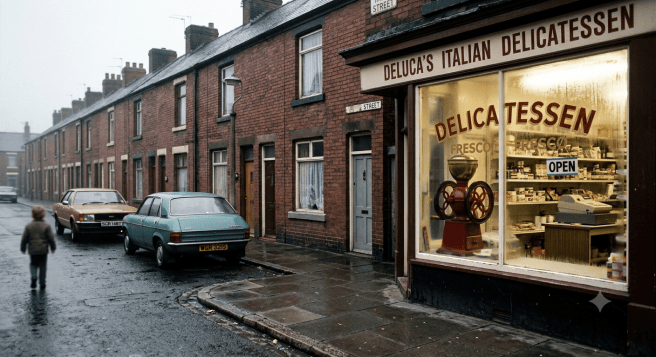
The only glimpse I had of anything different was the Italian delicatessen in Sunderland that I’d pass on my way to school. It sat on a small corner, just a door or two down from a barber shop. Though now much of my childhood landscape has faded, this corner remains completely untouched by time.
In the shop window sat a great red machine that took up almost the entire pane. People have since suggested to me that it might have been a large meat slicer, but my memory refuses to trade away the truth. It wasn’t a slicer. It was an industrial behemoth of a coffee grinder — a magnificent contraption topped with a massive hopper and flanked by a heavy wheel. To my nine-year-old eyes, it wasn’t just utility; it was simply, breathtakingly beautiful. It stood proudly like an exotic relic from another world, releasing the unforgettable smell of freshly crushed coffee beans straight into the cold, coastal air — a scent, that on the right wind, clashed with the distant smell of hops of the Vaux Brewery, industrial smog and the sharp bite of the North Sea.
My mother was the lone exception to the rule of tea. She owned an electric percolator, a prized piece of modern chrome she kept strictly for special occasions. Its contents were a ritual in themselves, bought from the Ringtons man who carried his heavy wicker basket up our path to deliver the precious metal cans of ground coffee. When company came, she would carefully snap Kit Kats into individual fingers, arranging them on a tea plate to make the luxury stretch. Then, the kitchen would fill with the dramatic, acoustic journey of the machine: a quiet, hollow hiss, a steady, hypnotic glug-chug-glug as the dark liquid slapped against the clear glass knob on the lid, and finally, a frantic, breathless splut-gurgle-gasp before it fell silent.
But I was no coffee drinker then. For me, the true geography of comfort was mapped out when we visited or stayed at my grandparents’ home.
My grandmother relied on something that seemed wonderfully strange to me: Camp Coffee, with its curious label, which I loved to study. The Camp Coffee label featured a colonial-era camp scene: a military tent in the background with a flag flying on top bearing the message, “READY AYE READY”. In front was a very grand-looking Gordon Highlander soldier in a kilt. He was pictured seated, holding a cup and saucer next to a standing Sikh who, I assumed, was some kind of soldier-orderly. Whilst I didn’t like the smell of the coffee inside, my grandmother used it to make a moist, unforgettable coffee cake crowned with a thick, almost al dente, fudge-like fondant icing. No other coffee cake has ever tasted like hers.
A modern label for modern times. The Sikh soldier and Highlander, finally sitting side by side.
I don’t recall either grandparent drinking it, or actually any type of coffee — ever. Always tea, loose-leaf and brewed in a huge brown ceramic teapot, then covered with a knitted tea cozy. Tea came in cardboard boxes with instructions like, “Always Use Freshly Drawn Water”. I remember thinking there was something very peculiar about drawing water — and imagined it was directed to people who used a well to draw their water from.
A popular brand of tea also included collectable tea-cards — little treasures that felt like windows onto a world far beyond our own. Those vibrant, illustrated cards slipped from the cardboard boxes like tiny gifts, each front showing exotic wildlife, steam locomotives or long‑forgotten kings, and each reverse filled with neat rows of facts that seemed to hold all the promise of adventure.
My friends traded them with breathless excitement, their pockets full of possibilities. I watched from nearby, not unhappy, just aware that my grandparents—kind, steady, and endlessly generous — had their own favourite tea. They’d brewed the same brand for years, and I grew to love the quiet ritual of it: the familiar packet, the rising steam, the way a simple cup brought them such contentment.
I accepted that their tea would never contain those coveted cards. Their happiness mattered more, and sitting with them over a warm cup felt richer than any collection. Still, every so often, a small, tender ache would surface, knowing I’d never paste those cards into the commemorative albums my friends carried like cherished trophies.
These were the quiet foundations of my life. Long before I ever stepped into a modern coffee shop, and before I spent nearly all my spare time soaking in the atmosphere of a place that exceeded every expectation, comfort had already been defined for me. It was stitched into the rhythm of my childhood: a bubbling chrome pot on a Saturday afternoon, or a slice of grandmother’s moist Camp Coffee cake with its thick, al dente fondant icing.
My bedtime drink, however belonged to the rival malted kingdoms of Horlicks and my own preference, Ovaltine.
A café, as I understood it growing up in the UK, was usually the kind of place people affectionately called a caff, or a greasy spoon. The coffee was almost always instant with milk — sometimes, if you were lucky, made with steamed milk. There were other cafés too, family‑run places often rooted in Italian or other migrant communities, where hulking espresso machines sat gleaming and slightly terrifying, as if they required an engineering degree to operate. Even my mother had her own memories of such places: in the mid-to-late 1950s Sunderland town centre, she frequented Louis Café, an Italian family‑run spot where she listened to rock and roll on the jukebox, drank hot orange squash, and occasionally ordered something she described simply as frothy coffee.
Tea rooms were another world entirely — white table linen, bone china, cucumber sandwiches, Victoria sponge, scones. Quintessentially British, with regional variations that felt almost ceremonial: Cornish or Devonshire afternoon tea, Welsh afternoon tea, Scottish afternoon tea, each with its own quiet rituals.
At home, my own attempts at coffee were a patchwork of experiments. I used a Moka pot with varying results — usually bad, very bad. I managed a decent cafetière, or French press brew, and I dabbled with Melitta plastic filter cones and papers, though I never seemed to get them right. I loathed instant coffee, yet still drank it — or at least a quarter of the cup — before giving up.
Attribution:
Camp Coffee Label Image: Cropped from Camp Coffee by Olive Amar, licensed under CC BY-SA 4.0.
Around this time, I was entrusted with one of the most unusual student groups I ever taught: senior judges from the District Court (Sąd Rejonowy w Gliwicach). These were people whose daily decisions shaped the quiet, unseen architecture of other people’s lives. They carried authority in a way that didn’t need to be announced—it simply settled around them, like a natural element of the room.
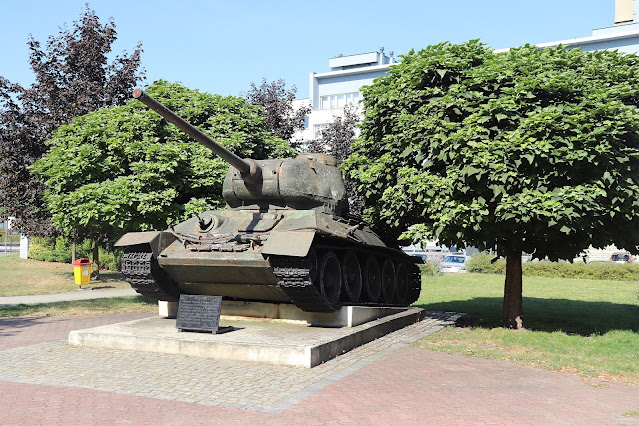
Their court building on Powstańców Warszawy carried that familiar Prussian solidity —symmetrical, slightly austere, and civic in a way that suggested endurance rather than grandeur. Just a short-distance away, a Soviet-built T‑34 tank faced the building with its own kind of heavy stillness — a relic from another century that seemed to be watching the present with patient confusion. I’d later learn that its steel skin told only half a story; the men who had commanded that roaring engine were actually Polish soldiers who had survived Siberian labour camps, seizing the only machine available to fight their way back home.
Back in 2012, the tank barely registered to the locals. Children climbed over its iron hull as if it were a playground, and I walked past it daily without a second thought. It was simply part of the city’s layered strangeness—one of those details you only fully understand in hindsight, when memory has had time to settle and reveal its sharp edges.
The T-34 monument on Powstańców Warszawy. Image by Andrzej Otrębski, licensed under CC BY‑SA 4.0.
It was a ridiculous thought, but it grounded everything: a British ex-cop turned English teacher, locking a bicycle beneath the gaze of a Soviet manufactured tank before walking into a Prussian courthouse to instruct senior judiciary and paralegals. Gliwice had a unique way of making the improbable feel entirely normal.
Inside the building, past the security checkpoint, the atmosphere shifted. The interior was unexpectedly modern: bright corridors, clean lines, and pale wood. These were courtrooms designed not to intimidate, but to clarify — a space where choices were executed with geometric precision, not theatrical performance. Walking through those halls, I felt a quiet awareness of being allowed into a world that wasn’t mine, but that I was being trusted to enter all the same.
By then, I thought I understood courtrooms. I’d stood in enough of them back home — especially inside the heavy, oak-panelled rooms of Chester Crown Court, spaces specifically designed to project a centuries-old lawful authority. I knew the choreography, the internal tension, and the subtle shifts in cadence that could alter a case. But this was entirely different. Not because of the setting, but because of my place within it. I wasn’t there to provide evidence, manage a custody line, or observe proceedings. I was there to teach. My role was to guide conversation, not control it. The architecture hadn’t changed; I had.
Our usual lessons took place in a neutral, functional conference room where legal minds shifted easily into an administrative rhythm. It worked well. Their English command was already advanced, requiring me to be highly precise, confident, and meticulously prepared; at times, the standard grammar books felt beneath their intellect.
During a lesson warm-up chat, they asked how long I had been teaching. I explained that I was, in fact, a retired police officer from North Wales who had moved to Silesia, and that I had three years of TEFL experience under my belt working for Britam. That seemed to interest them, though not in the way I might have expected. There was no visible surprise, no sudden shift in tone, and no barrage of questions. Instead, a quiet, measured attentiveness settled over the table.
Perhaps they were surprised, or even slightly shocked, but years of judicial discipline ensured it didn’t show on their faces. These were people accustomed to listening intently, to weighing what they heard without immediately revealing their hand. They had spent decades hearing every imaginable explanation and version of events — plausible or otherwise — and had learned to hold their internal reactions in check. So they remained calm, collected, and genuinely interested.
One morning, our usual conference room was occupied at short notice. Apologies were made, but an alternative space had been secured. A courtroom was free for our lesson—an actual courtroom.
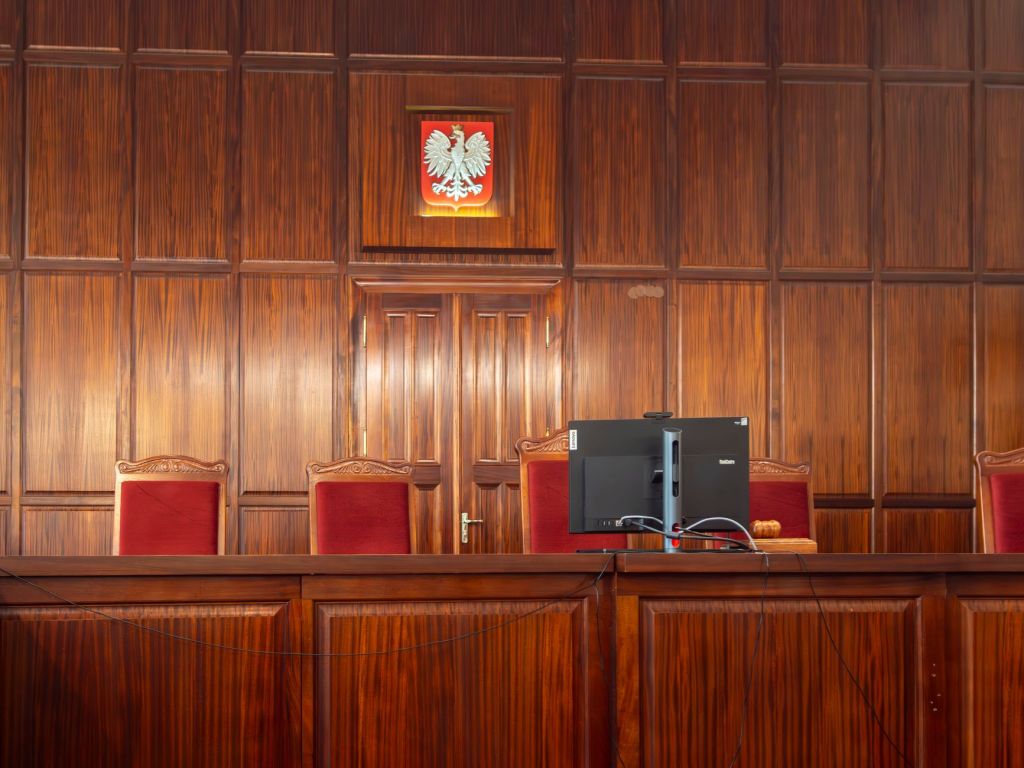
The space was immaculate — so clean I half-considered removing my shoes before stepping past the threshold. It was brightly lit, finished in pale, polished wood. A red plaque bearing the white eagle — the Orzeł Biały — presided over the judge’s bench. Deep red upholstery lined the panel’s chairs, creating a deliberate, stark contrast to the light timber. Everything aligned with absolute geometric precision: the desks, the microphones, and the monitors were placed as if measured with a ruler. The difference from our usual meeting room was immediate. The massive height of the ceiling reinforced the sense that this room existed for heavy decisions, not casual discussion. Authority was built directly into the furniture.
I tried to remain completely unfazed by our surroundings. The judges settled themselves across the benches — scattered and relaxed, as if this solemn chamber were just another staff room. I stayed standing, as I always preferred to do when instructing; standing kept me steady and kept the lesson moving. Perhaps it was that — my refusal to sit, my stubborn posture of professional routine—that amused them so much.
“Go on, Gary,” one of them said, smiling across the desk. “Sit in the chair. You must be tired of standing.”
The judge’s chair.
I tried to play it cool, but I didn’t just sit. I eased myself into the red leather with a kind of mock ceremony — a tiny, theatrical flourish I hadn’t planned but couldn’t resist. It wasn’t quite a bow, just enough to acknowledge the beautiful absurdity of the moment.
They laughed immediately — a warm, generous laughter that filled the high ceiling in a way legal authority never could. And then I laughed too. Because how could I not? The entire thing was ridiculous, human, and strangely tender.
And that day, something softened. Perhaps being inside their own professional environment allowed it. Perhaps the moment itself — unexpected, slightly absurd — made room for a different kind of connection. Or perhaps it had always been there, just not immediately visible.
They were never people to show everything at once. Not in our standard conference room, not when I revealed my policing past, and not even here, at first. But when the recognition came, it was unmistakable. For a few minutes, the rigid judicial hierarchy completely dissolved. Somewhere at that moment — sitting in that high-backed red chair, not as an officer of the law but as an English teacher — the past and present overlapped. Not in conflict, just in mutual recognition.
It only happened once, but it stayed with me. Not because of the physical chair itself, but because of the genuine warmth behind the gesture — the quiet, generous understanding that, for those brief minutes, our official roles didn’t matter.
Those unexpected hours inside the courtroom softened something deep within me. Outside, the Silesian spring was finally arriving. Even on the difficult days when I felt physically lost and unwell, even when the quiet sadness of my upcoming departure pressed in at the edges, the city was softening. The daylight lingered a little longer each afternoon. The air lost its sharp winter bite. The trees opposite my apartment windows began to show the faintest brush of green, as if the season itself were reminding me that endings don’t cancel beginnings.
Perhaps that’s why, in those final months, I taught with a kind of fierce tenderness. I wanted every single lesson at Britam to truly matter. I wanted the spaces I walked into — the corporate boardrooms, the teenage classrooms, and even that geometric courtroom—to hold something memorable for the students I was about to leave behind. I lacked control over my health, my future, or the impending ache of returning home. But I could completely control this: the way I showed up. The way I taught. The way I made each remaining day count.
And perhaps that’s why, in the weeks that followed, I found myself teaching with a distinct looseness and creativity I hadn’t expected — a resolve to make our time count that carried me into a period of beautifully unrestrained invention, one that would eventually produce a bowl of origami cubes, a minor flood on a school landing, and one final bit of magic.
“Gliwice T‑34 tank” — Image by Andrzej Otrębski, licensed under CC BY-SA 4.0
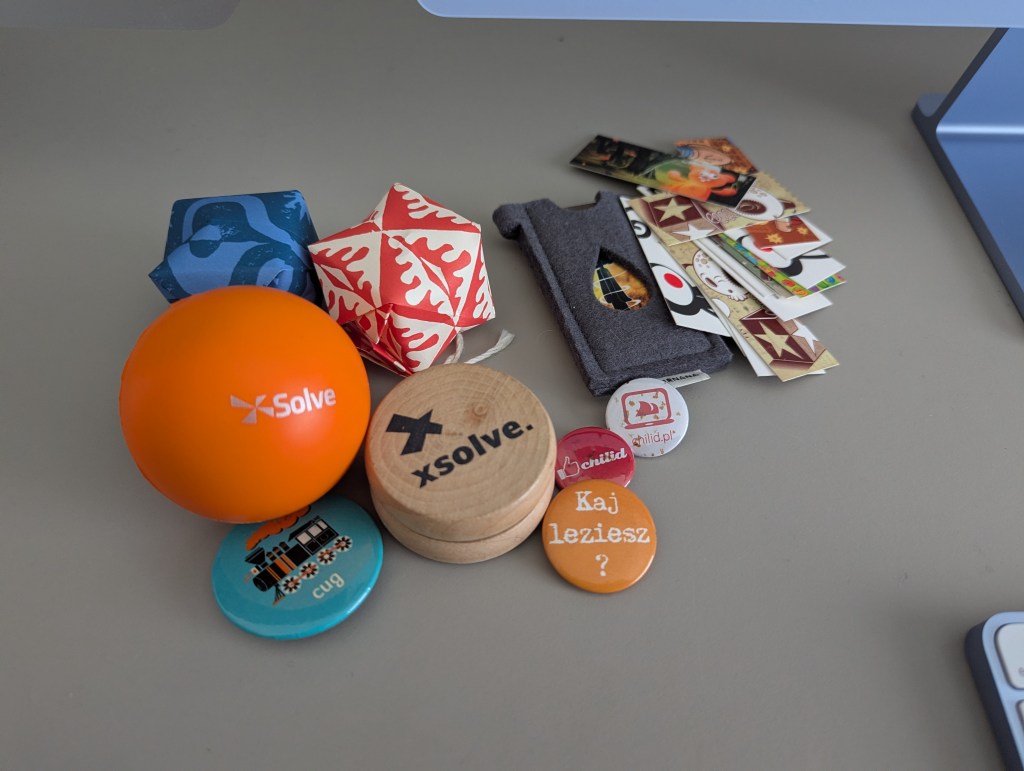
Mementos from the loft: Official XSolve yo-yos, Chilid pins, and the legendary Silesian ‘Kaj leziesz?’ badge.
XSolve was a software development company, and Chilid was their sister company of graphic designers. Together, they were unlike any other place I ever taught. Their creativity and technical skill fascinated me. XSolve built the engine — the solid, reliable machinery beneath the surface —while Chilid added the colour and flair. Combined, they always felt a bit like a Silesian cug — a steam train full of character and momentum, carrying creativity forward with real style.
And then there was their office. A ground-floor converted loft space defined by exposed brick and industrial ventilation tubing overhead. It was part games room, part creative hub, buzzing with coders, designers, heavy headphones, and glowing monitors. It carried the kind of curated chaos that made you feel as though innovation was happening inside the walls themselves. There was even a table for piłkarzyki — or ‘little footballers’, as the Poles call a football table — those with plastic players on metal rods, where every evening match sounded like a small civil war. The team offered a perpetually friendly welcome, served great coffee, and even held summer beach parties with actual sand dumped outside the doors.
I only ever went there in the evenings, when the day had thinned out and the building had settled into a quieter rhythm. I’d arrive early, sink into one of the massive sofas, and let the atmosphere wrap around me. The coders who stayed behind moved in their own private worlds—headphones on, half‑lost in whatever code they were building — while the designers chatted gently at the far tables, their laughter low and warm. Someone would always wander over eventually to ask about my day, tease me about my bicycle, or brew me a fresh coffee. For a space that buzzed with kinetic energy during daylight hours, the evenings had an odd, lovely calm to them. Perhaps that’s why any sudden noise felt like a sharp rupture in the quiet — a single, unpredictable note in an otherwise peaceful room.
Because they had a parrot. A real one. In a cage.
He was a highly intelligent, intensely observant African Grey who watched the entire office with the cool, appraising stare of someone who had seen far too much. To this day, I’m still not convinced the cage was for the bird’s protection. I think it was for mine.
On my very first evening, I entered the loft pushing my bike, trying desperately to look as though I belonged when clearly I didn’t. The parrot turned its head slowly, deliberately, and then — without a shred of warning — launched into a strange, rhythmic, punk‑rock pogo dance. It was a head‑bobbing, full‑body vertical bounce that made me freeze dead in my tracks. I stared at it. It stared at me. I swear something fundamental shifted in that vestibule; from then on, the bird was never entirely sure about my presence.
Sometimes, entirely unexpectedly and always after hearing an English voice, namely mine, it would let out a sharp, metallic screech. It was the kind of industrial sound that made me wonder whether parrots could file formal HR complaints. The developers would laugh, and I would laugh right along with them.
The team, on the other hand, were exceptionally warm, funny, and frighteningly intelligent. They didn’t want rigid grammar drills unless they specifically asked for them. What they craved was creativity — fluid conversation, conceptual ideas, and movement. XSolve gave me the ultimate tools to deliver it. If I needed high-speed Wi‑Fi, it was instant. If I wanted to analyse a video, a foreign article, or a piece of art, they’d wave me toward the network as if it were a communal playground. Armed with my iPad and MacBook Pro, the sheer technical freedom made me a braver educator. Technology wasn’t an obstacle in that loft; it was an open invitation.
I became a kind of whiteboard wizard, frantically drawing diagrams, arrows, timelines, and visual metaphors—anything that could spark a live debate. It was the only corporate environment where I could be fully animated without anyone blinking an eye. In fact, they seemed to thrive on it. My high-energy presentation style balanced out the quiet, intense focus of the coders working behind the glass partition.
Once, in the middle of a particularly enthusiastic linguistic explanation, I grabbed a marker pen and began plotting definitions at high speed. It wasn’t until I stepped back — immensely proud of the sprawling masterpiece I’d just created — that my eyes caught the label on the casing. The marker was completely permanent.
A long, dead silence fell over the room.
Right on cue, the parrot screeched. Somewhere out in the main corridor, a designer laughed.
I stood there staring at the whiteboard, wondering whether that African Grey was about to be unleashed from its cage and if I could physically outrun it with my single-speed bike. Fortunately, they didn’t mind. Of course, they didn’t. Someone instantly fetched a bottle of industrial‑strength solvent, someone else poured a fresh coffee, and within minutes the board was spotless again. But for one brief, terrifying moment, I was entirely convinced the bird had been waiting all evening for that exact mistake.
XSolve was beautifully chaotic, surreal, and endlessly welcoming. It was a space where I could be entirely myself—animated, eccentric, and slightly bewildered—and somehow it worked. Even the punk parrot tolerated me in the end. Or, at the very least, he stopped pogo‑dancing every time I wheeled my bicycle through the front door.
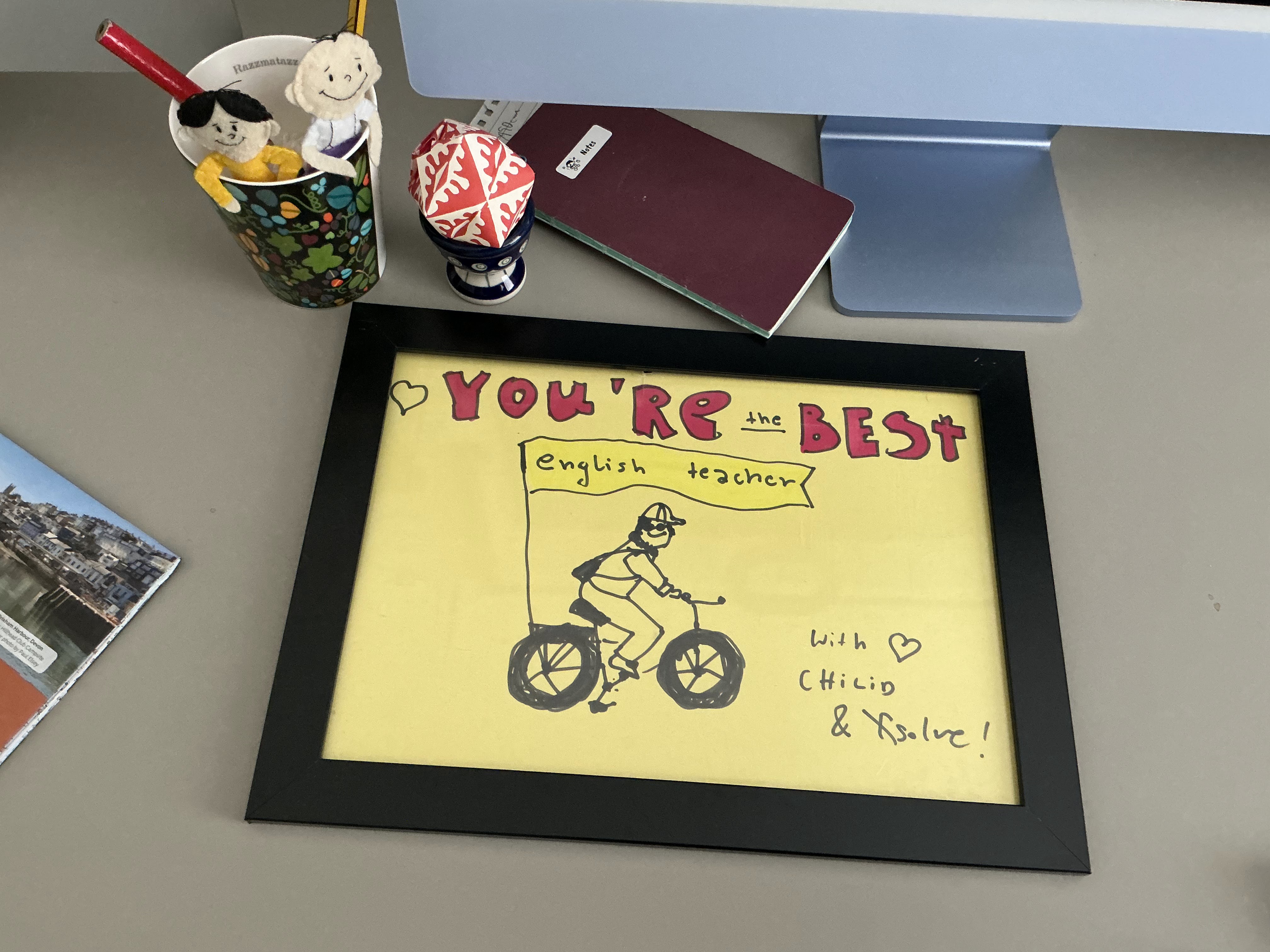
A genuine Chilid and XSolve hand-crafted print given to me as a thank you. Still looking as fresh as ever in 2026.
What I didn’t realize then—something that only surfaced years later while researching this chapter—was that the story hadn’t finished with me. Not quite.
Recently, while looking back through old photographs and half-forgotten details, I found myself trying to recall something oddly specific: the name of that pogo-dancing African Grey. I’m certain it had a name, but I failed to commit it to memory.
Hoping to find a picture or a clue, I decided to check the firms’ social media archives. Instead, I stumbled upon a revelation. XSolve and Chilid had moved out of their original ground-floor loft.
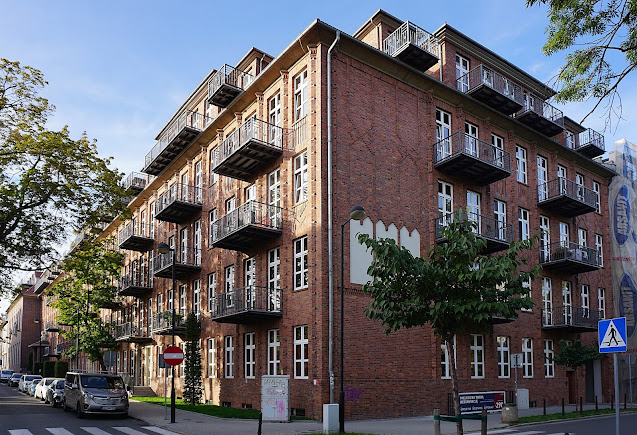
Their new headquarters looked incredible—completely restored, modern, and flooded with daylight. As I scrolled through the architectural photographs of the brick facade, a sudden shock of recognition caught my attention. I knew this building. Or, at least, I thought I did.
The stunningly restored brickwork of Number 13 on Królowej Bony Street.
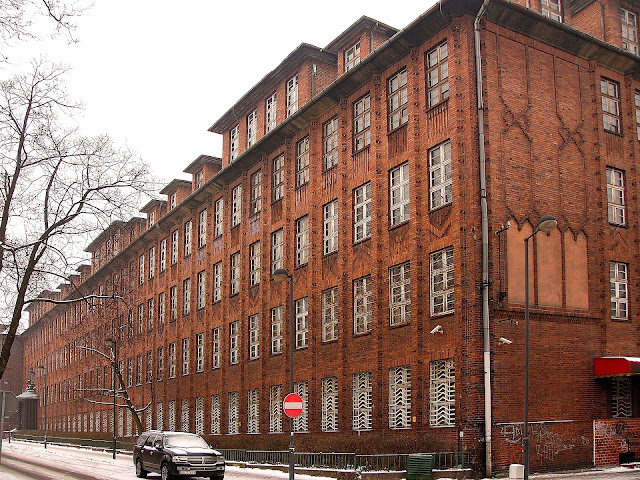
It took a moment for the geography to land. It was the same majestic brick structure I used to walk past almost daily during my final months in Gliwice: Number 13 on Królowej Bony Street. Back in 2014, it had been entirely empty—a remarkable historical monument left to fade, sad and vacant, but retaining that haunting beauty that abandoned brickwork always holds.
Gliwice, ul. Królowej Bony 13: The former Teacher Training College building as it stood vacant.
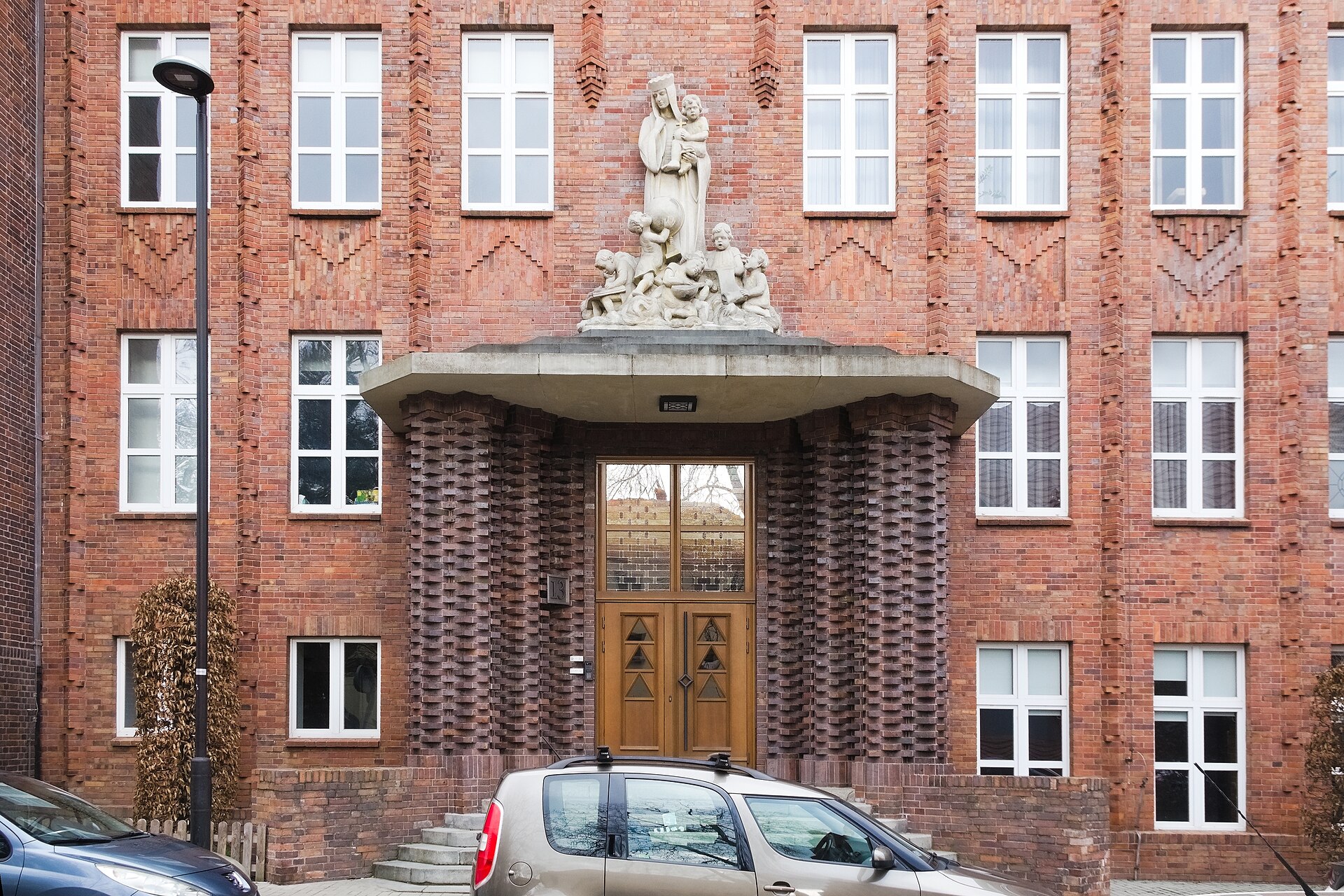
I distinctly remembered walking past its shadowed arches with my close colleague from Britam. I had stopped on the pavement to admire the ornate architecture. She had gone quiet, looking up at the grand entrance with a reflective, nostalgic expression, before pointing casually to the double doors. “I studied here,” she murmured.
It was the old Kolegium Nauczycielskie — the city’s historic Teacher Training College. She had sat on those very steps, attended lectures behind those tall windows, and built the foundational path that eventually led her into our shared profession. At the time, it was just a passing remark — one of those brief conversational fragments that doesn’t seem to carry any immediate weight.
The grand entrance brought back to life, seamlessly blending historical pedagogy with modern technology.
But sitting at my desk here in the UK years later, looking at that magnificent space brought back to vibrant life — now serving as the high-tech home to the very creative companies that had welcomed me so warmly — the entire perspective shifted. A quick email to my old friend confirmed the alignment. The place I had walked past without fully understanding had always been an invisible thread woven into the fabric of the story. Gliwice has a beautiful, uncanny way of doing that: of holding its human connections quietly in the brickwork, only revealing them when you are finally ready to see them.
The company eventually grew and evolved into a unified force known today as Boldare, but in my memory, they will always remain the two distinct spirits that first welcomed me. XSolve built the high-performance engine, Chilid gave it its brilliant aesthetic soul, and together, they created something utterly unique. They moved into that historic, empty school where my colleague once trained to be an educator, now transformed into a breathtaking, bleeding-edge tech ecosystem—a masterful blend of 1920s brickwork and glass-partitioned creative freedom.
Discovering that connection felt like one final gift from Gliwice itself. What had once seemed like an unrelated collection of workplaces, friendships, and chance encounters suddenly revealed itself as a tightly woven tapestry.
Yet, as spectacular as their new architectural home is, my mind always drifts back to those quieter evenings in their original ground-floor loft. I think of the kinetic energy, the smell of fresh coffee, the raucous civil wars over the piłkarzyki table, and the sharp, unpredictable screech of a punk-rock African Grey waiting for me to make a mistake with a permanent marker.
And then, at the end of that memorable term, came the official digital feedback form.
I still remember reading the slip, blinking, and wondering if it was a sophisticated joke, an elite compliment, or a brilliant mix of both. Under the mandatory “Comments” section, one of the software developers had simply written:
“Gary is badass.”
It was, once again, that phrase—the one that seemed to follow me through the cobblestone streets like a slightly confused tattoo. To this day, it remains the most unexpected piece of professional evaluation I have ever received in my career.
Looking back, it was one of the most joyful teaching environments I ever stepped into: a brilliant loft space full of exceptional minds, strong coffee, a raucous football table, and a bird who judged me far more harshly than any human ever did. And somehow, the whole glorious ecosystem was just… cool.
In the summer of 2013, I returned to Gliwice needing a new apartment. A friend helped me find a place located closer to the centre — a delightful flat with underfloor heating and a kitchen I genuinely loved. But as winter approached, a deep fatigue began to settle in. The workload felt endless. I wasn’t complaining; I was simply moving forward, doing the job, and trying to meet every expectation I believed existed.
Yet, in the middle of that exhaustion, there were moments that lifted me. Once, a class of teenagers decorated the classroom with banners made from that coarse, grey, school‑issue toilet paper—the kind that dissolves if you look at it too hard. Hearts, flowers, and “We love Gary” were scrawled across the rough paper like a beautiful, budget Valentine’s Day parade. I took it down after the lesson, but I couldn’t bring myself to throw it away. It felt too earnest, too chaotic, and too uniquely them. On other days, I’d walk into a classroom to find notes, smiley faces, or a wobbly sketch of me on my bicycle hastily drawn on the whiteboard.
By Christmas, back in the UK, my family was visibly concerned. I had lost weight and looked entirely spent. I went into Chester for a haircut and arranged to meet my daughter directly afterward. She had recently returned home from university, and I was genuinely looking forward to catching up.
Within minutes of sitting down in the café, she asked — with her usual directness — why I had dyed my hair in strange white patches. I laughed, assuming it was a joke. But she wasn’t smiling. She looked confused and urged me to go to the washroom to look in the mirror.
It felt surreal, sitting in a bustling café discussing my appearance. I caught my reflection in the window and thought it looked normal enough, so I demurred, muttering that I’d check later. But she refused to drop it. Without my glasses during the haircut, I hadn’t noticed anything unusual in the barber’s chair. My hair was graded short, but it looked fine to me.
Resourceful as ever, my daughter pulled out her phone, snapped photos of the sides and back of my head, and slid the screen across the table.
I could instantly see why she was worried.
My hair looked bizarre — marked with patterns like leopard‑fur rosettes, with distinct white patches scattered through my usual brown and grey. I didn’t know what to say. Seeing her worry, I tried to laugh it off as normal ageing, but privately, a quiet concern set in. Why couldn’t I see my own body changing when everyone else could? Had the barber simply stayed silent out of politeness?
When the holidays ended, I returned to Poland — to a place I had grown deeply attached to, a landscape that had quietly settled into my identity. The physical signs were no longer subtle; they were written on my face and in the way people looked at me. But I simply accepted the dramatic speed at which my hair was silvering. I had a relentless schedule and far too many demands to sit around worrying about aesthetics.
By February, the Silesian winter had deepened. I walked into a classroom of teenagers I hadn’t taught since the autumn term. They were a bright, creative group, and I had been looking forward to seeing them again.
I opened the door.
The chatter stopped instantly—not out of formal discipline, but pure shock. A student whispered to her neighbour in urgent Polish: “What happened to his hair?”
By then, it had turned completely snow-white.
March 2014: Fuelling up for afternoon lessons. Yes—I did teach wearing a favorite t-shirt and a ‘Kaj my som?’ badge.
A Difficult Decision
By March 2014, I knew I had to return to the UK. The underlying reasons were complex, but the immediate truth was plain: I couldn’t keep running on empty.
I didn’t want to give a month’s notice and suddenly vanish. I wanted to see out the winter–spring term through May and leave properly, but I didn’t know how to break the news. One morning, while preparing a lesson, my phone rang. It was Pani Grażyna. My hands began to tremble as I answered, trying desperately to keep my voice steady.
She wasn’t calling about administration. She was inviting me to lunch with her and her husband — whom I knew well from our private conversation sessions — to personally thank me for my work at the academy.
I managed to accept, my throat tight. She was delighted, asking if we could meet that very day before my afternoon classes. I couldn’t say no. I was being honoured and thanked at the exact moment I was preparing to resign.
The restaurant was quiet and thoughtfully chosen. Both of them were warm, relaxed, and genuinely happy to see me, but within minutes, they could tell something was terribly wrong. I could barely touch my food. I kept asking myself when the right moment would be, only to realise there was no right moment.
And then the words simply spilled out.
I apologised and told them I was leaving, though I promised to stay through the end of May to finish the term properly. An immediate silence fell over the table. They stopped eating. They weren’t angry — they were stunned, concerned, trying to process why a teacher they valued so highly was walking away. I instantly regretted the timing, wishing I had waited, but the words were out. Lunch ended quietly with polite gratitude, another apology, and a hasty reminder to myself that I still had worksheets to photocopy before my afternoon class. Normal tasks, but nothing felt normal any more.
Later that day, I knocked on Pani Grażyna’s office door and was asked to step inside. I wasn’t nervous, just overwhelmingly sad. She looked up at me with immense kindness, approaching me not as an employer dealing with a departing employee, but as someone who genuinely cared about my well-being. She sat me down, looked at my snow-white hair, and offered every accommodation she could think of.
“There will always be a place for you here.”
They wanted me to stay — not merely because they needed a native speaker, but because they didn’t want to lose me. That was the hardest part to swallow.
I wasn’t leaving out of frustration or exhaustion with the job. I was leaving because my body and mind were failing me, and I was trying to shield everyone else from that truth. They were offering me a lifeline at the exact moment I knew I couldn’t take it.
In the end, there was no clean ending to hold on to, no single definitive moment to mark as the last — only a slow dimming of something that had once felt so certain.
I had carried on for as long as humanly possible, through the noise, the relentless work, the laughter, and the subtle warnings I had chosen to ignore. When I finally stopped, it was not because I had reached a destination.
It was because I understood, at last, that I had run out of road.
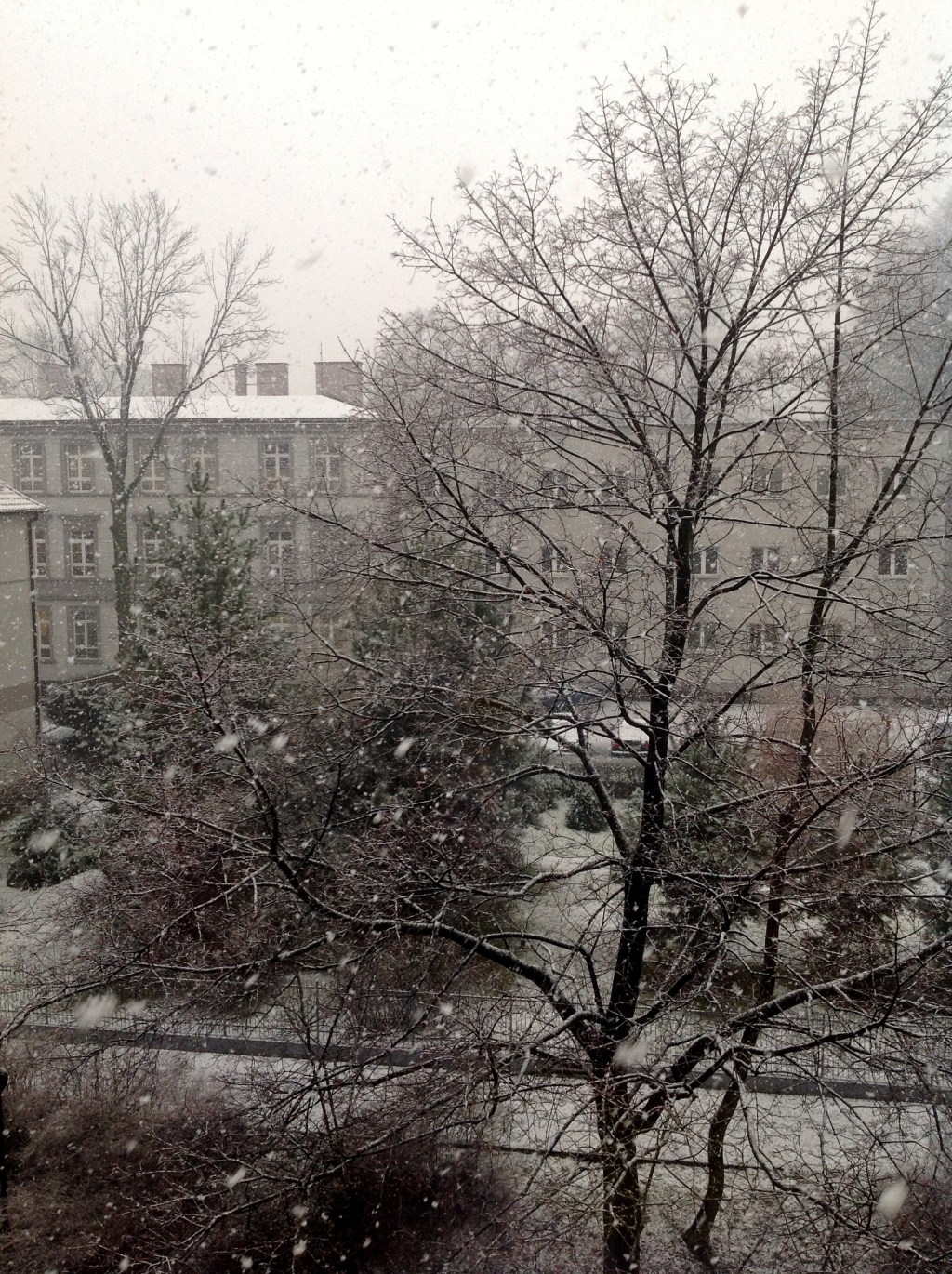
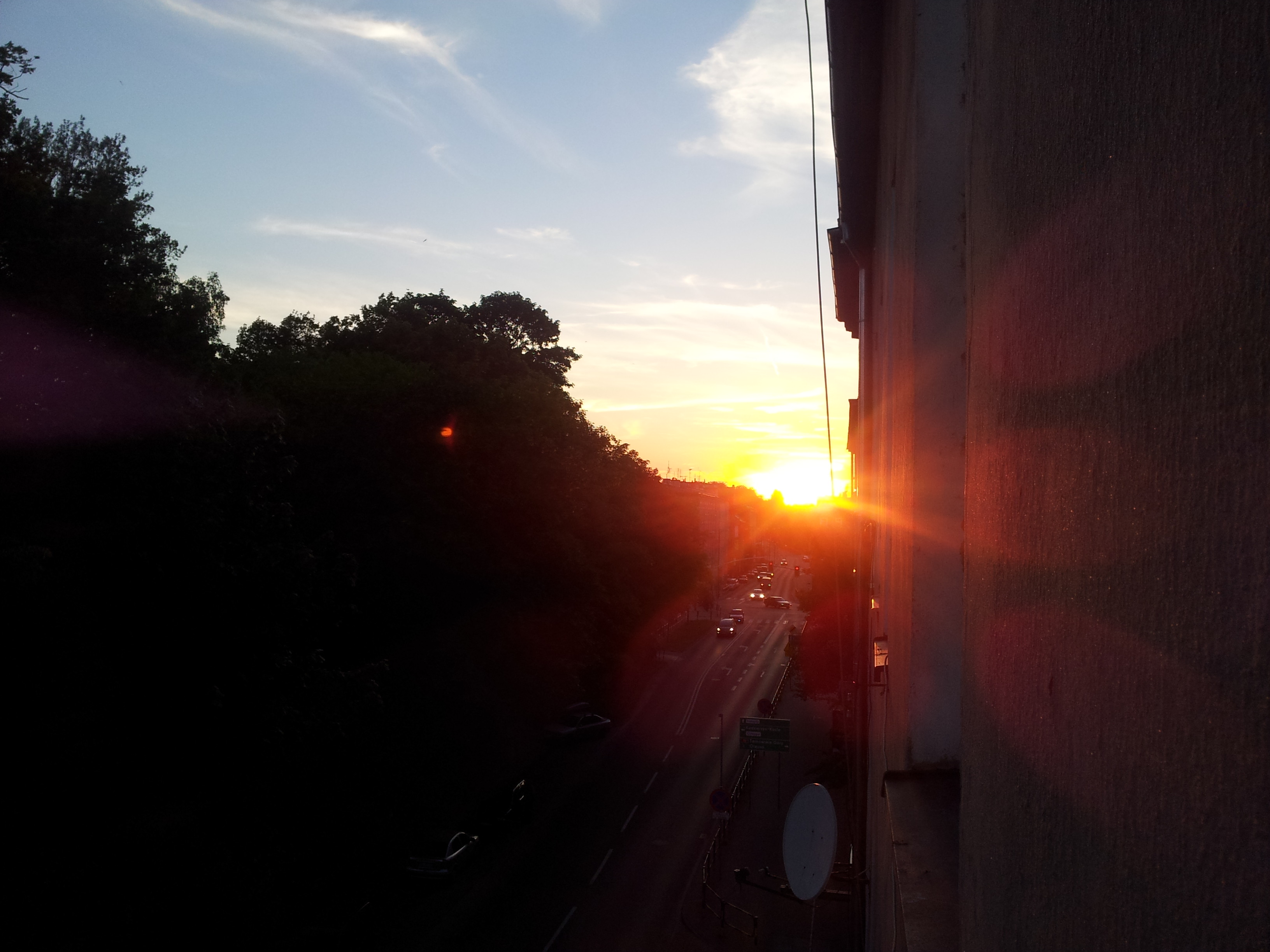
Sunset on Kozielska, looking out of my apartment window
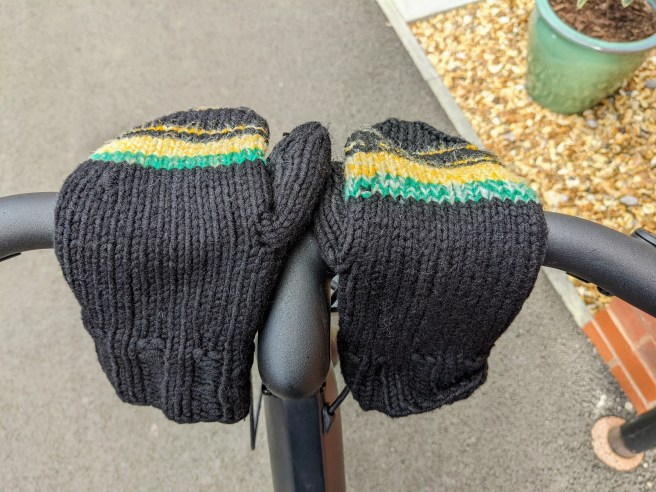
The first pair — black wool with a high‑visibility yellow stripe, a joke that became warmth.
A friend knitted me mittens for the cold Polish winters.
No one had ever asked me whether I would like a pair made specially for me.
Imagine that.
Not being sold something.
Not being given a gift card.
Just being asked:
Would you like some woollen mittens?
Any colour you’d like.
“High‑visibility yellow,” I joked.
Weeks later they arrived: black wool with a bright yellow stripe running front and back in a clean, continuous line.
Impossible to lose in the snow.
Perfect for hand signals on my bike.
She was delighted whenever she saw me wearing them.
“You could set up a business,” I suggested. “High-vis winter gear.”
She laughed loudly at the idea of becoming a commercial mitten maker.
That should have been enough.
It wasn’t.
She knitted another pair.
“Could you do the next ones with a red stripe on one, and green on the other?” I asked.
“Why red and green?”
“To help me remember left from right.”
She laughed. “But mittens don’t have a left and right — you can wear either one on either hand.”
I explained that ships and aircraft use red for port and green for starboard.
Left and right made visible.
So she knitted me port and starboard mittens.
Suddenly my bicycle was no longer a bicycle.
It became a ship sailing down to KAFO, or an aircraft climbing up ulica Zwycięstwa. Every journey carried a quiet reminder of which side was which.
Port and Starboard
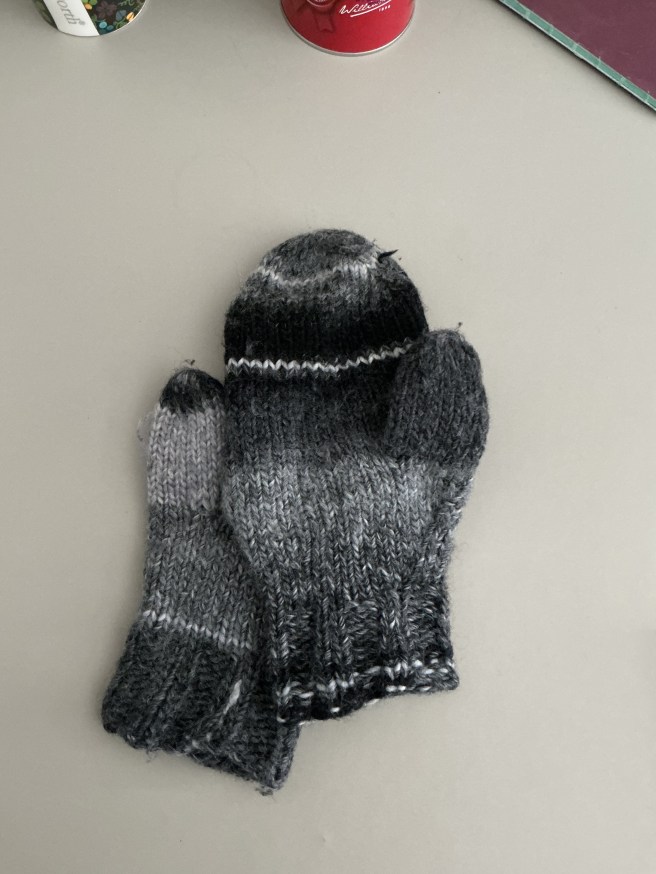
And then there was a third pair.
Charcoal and grey.
The posh pair — for town, for winter light, for looking quietly distinguished at a freezing tram stop.
More than ten years later I still wear them.
The colours have faded; the wool has softened.
But they remain perfectly serviceable.
The red one is still port.
The green one is still starboard.
And every winter, somewhere between home and the shops, a bicycle still becomes a ship.
Posh mittens – still looking posh
Author’s Note
A poem sits here — take a peek, open the door
Some kindnesses shine long after the moment has passed.
These mittens were one of them —
a small bright gift offered in winter,
chosen in colours that still guide me.
She made them with laughter,
with care that asked for nothing,
with a gentleness, I did not yet know how to name.
She might one day see this piece.
Paths continue to cross in unexpected ways,
and kindness has a way of finding its own direction.
It is enough to share how her warmth travelled with me
through seasons and across countries,
into the quiet place where memory keeps its softest echoes.
This is written for her —
for the colours she chose,
for the hands that shaped them,
for the visible kindness she left behind.
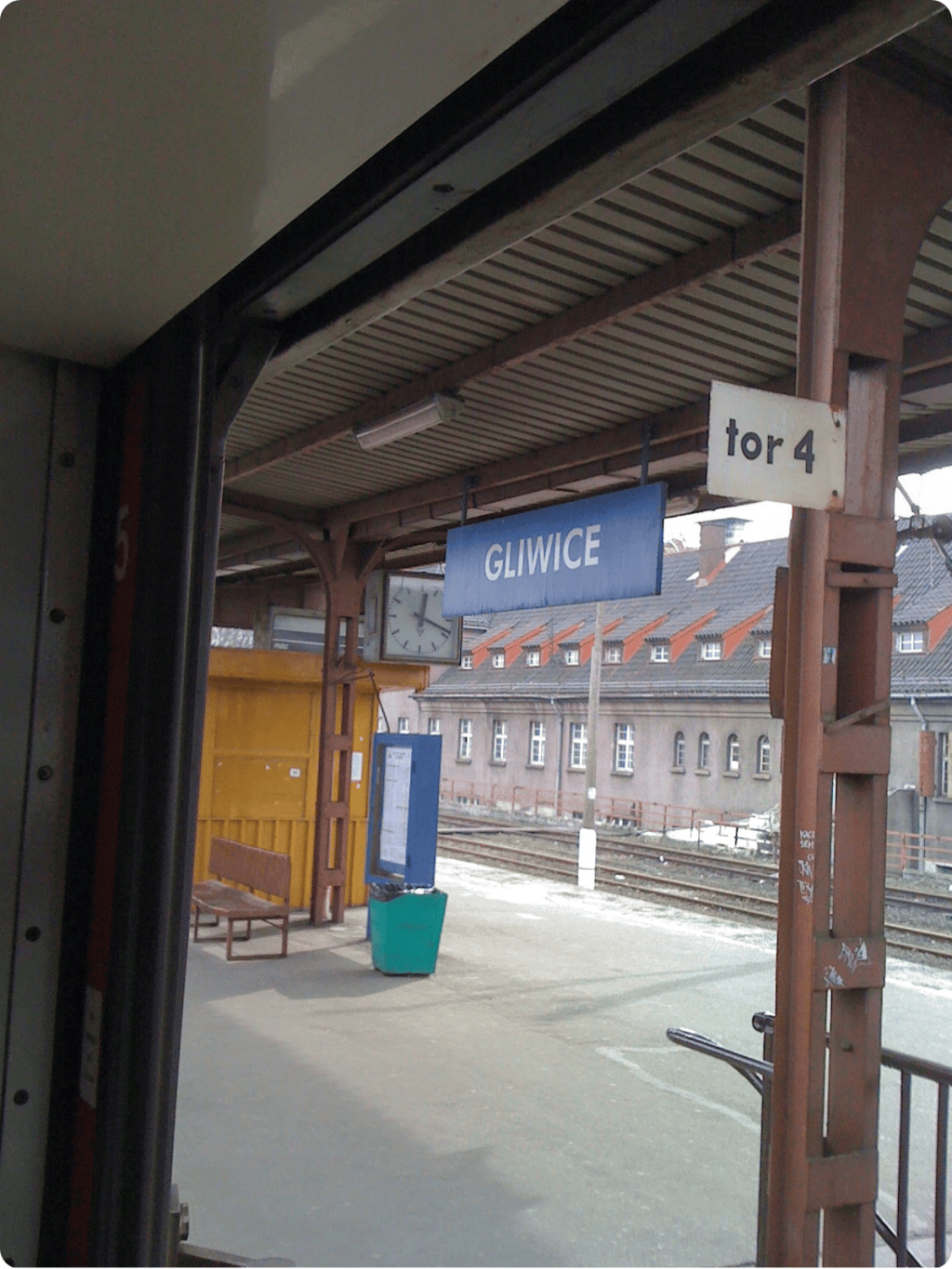
On 9 March 2014 at 09:42 at Gliwice station, a PKP EU07 locomotive (EU07-067) departed into the biting cold air. Locally known as “Siódemka” (The Seven), this Polish transit workhorse hauled Intercity coaches and a classic WARS bar car.
The early-spring sky was a soft, pale blue towards the horizon—bright but biting cold, the sort of morning where the light looks warmer than it feels. And there, in that thin, quiet air, a PKP EU07 locomotive eased away from the platform. Pantograph raised against the overhead wires, its heavy electric whine gathered strength, a mechanical hum vibrating through the concrete like a half-forgotten memory. It rolled past with the massive, unassuming assurance of an industrial workhorse that had outlived fashions and timetables alike, hauling its immaculate coaches and the BAR car into the distance. A relic of iron and current, simply getting on with the job.
At the time of filming EU07-067 slide away from the Gliwice platform I had no idea I was actually capturing a machine with direct British ancestry.
The English Electric Connection:
This machine carried direct British ancestry, stemming from late-1950s technology licences and plans purchased from English Electric, mirroring the British Rail Class 83. Initial UK imports were called “Anglik” (The Englishman) or “L”, which evolved into “Ełka” when the Pafawag factory in Wrocław began domestic production.
Born in 1969:
This specific locomotive, EU07-067, was built in 1969 at the legendary Pafawag factory in Wrocław using that exact modified British design.
The Ultimate Workhorse:
When I filmed it in March 2014 hauling Intercity coaches and a classic WARS bar car, that machine had already been relentlessly pounding the Polish rails for 45 years straight. It is the absolute definition of an industrial workhorse.
The image of a British guy standing on a cold Gliwice platform, filming a machine engineered via British ancestry that spent half a century becoming the mechanical soul of Polish transit, brings my entire narrative arc into a beautiful, full circle.
🇵🇱
Śląskie Tory: EU07-067
9 marca 2014 roku o godzinie 09:42 na stacji w Gliwicach lokomotywa PKP EU07-067 ruszyła w przeszywająco zimne poranne powietrze. Znana w kolejarskim i miłośniczym środowisku po prostu jako „Siódemka”, ta niezawodna legenda polskich szlaków prowadziła skład wagonów InterCity wraz z klasycznym wagonem restauracyjnym WARS.
Wczesnowiosenne niebo miało przy horyzoncie delikatny, blady odcień błękitu. Było jasno, niemal pogodnie, lecz chłód wciąż dawał się we znaki. To był jeden z tych poranków, gdy światło wydaje się cieplejsze, niż jest w rzeczywistości. W tej cienkiej, nieruchomej atmosferze lokomotywa PKP EU07 spokojnie odłączyła się od peronu i zaczęła nabierać prędkości. Pantograf uniesiony ku sieci trakcyjnej, charakterystyczny świst i narastający pomruk silników elektrycznych rozchodziły się po stacji, a ich drgania przenikały beton niczym echo dawno zapomnianych wspomnień.
Mijała obserwatora z masywną, pozbawioną ostentacji pewnością siebie maszyny stworzonej do ciężkiej pracy. Konstrukcji, która przeżyła zmieniające się mody, rozkłady jazdy i kolejne epoki polskiej kolei. Ciągnęła nieskazitelnie utrzymane wagony oraz wagon WARS, znikając stopniowo w oddali. Była jak relikt zbudowany z żelaza i elektrycznego prądu, który po prostu wykonywał swoje zadanie.
Brytyjskie korzenie
Ta maszyna nosiła w sobie wyraźne brytyjskie dziedzictwo. Jej historia sięga końca lat pięćdziesiątych, gdy Polska zakupiła od firmy English Electric licencje i dokumentację techniczną stanowiące podstawę konstrukcji wzorowanej na brytyjskiej lokomotywie British Rail Class 83. Pierwsze egzemplarze pochodzące bezpośrednio z Wielkiej Brytanii zyskały przydomki „Anglik” lub po prostu „Ełka”, a wraz z rozpoczęciem krajowej produkcji w zakładach Pafawag we Wrocławiu ta konstrukcja stała się integralną częścią polskiej kolei.
Urodzona w 1969 roku
Prezentowana tutaj lokomotywa, EU07-067, została zbudowana w roku 1969 w legendarnych zakładach Pafawag we Wrocławiu, właśnie na bazie tej zmodyfikowanej brytyjskiej konstrukcji.
Wzór kolejowego „woła roboczego”
Gdy filmowałem ją w marcu 2014 roku, prowadzącą wagony InterCity i klasyczny wagon WARS, miała już za sobą 45 lat nieprzerwanej służby na polskich torach. Trudno o lepszy przykład prawdziwego kolejowego „woła roboczego” – maszyny stworzonej do codziennej pracy i wykonującej ją przez całe pokolenia.
Jest coś niezwykle symbolicznego w obrazie Brytyjczyka stojącego na zimnym peronie w Gliwicach i filmującego lokomotywę, która wywodzi się z brytyjskiej myśli technicznej, lecz przez pół wieku stała się mechaniczną duszą polskiego transportu kolejowego. To właśnie taki moment sprawia, że cała ta historia zatacza piękne koło.