A Trip Through Three Waves of Coffee
Paddling Out — The First Wave
Throughout my writing, I find myself returning to a kawiarnia — a small café called KAFO, sometimes simply Kafo — as though it were a doorway into a moment I can’t quite step back into.
I’m not sure why I’ve never written about it more fully. Perhaps I’ve held back because the place lives in memory with a tenderness that resists being pinned down; in theory, it should have been easy to capture, yet every attempt feels like reaching for something already fading, a sweetness edged with the knowledge that time has moved on.
This story begins in my earliest memories of coffee — long before café culture had a name, back when a hot drink in Britain simply meant a strong pot of tea. In the 1960s and 70s, the North East working-class landscape ran on leaves and boiling water; almost everyone I knew drank instant coffee at best.
Even a day trip to nearby Roker or Seaburn beach would find a queue of people at the cafe — and it was definitely a ‘cafe,’ missing its French accent because the owners had spent the punctuation budget on the roof. For some brilliant, aggressively practical reason, they had painted CAFE in massive, whitewashed block capitals directly onto the sloping slates. It wasn’t for the benefit of low-flying aircraft, but for the passengers on the top deck of the double-decker buses rattling past — a giant, unavoidable aerial command to get off at the next stop and have your tea scalded.
And scalded it was.
The focal point of the entire operation was a small, salt-encrusted serving hatch. From its opening drifted the roar of a commercial boiler and the sharp, tannic scent of loose-leaf tea.
People didn’t just sit on the sand with paper cups; they would send a designated runner up the beach slip to join the usual queue at the cafe window, carrying a heavy, white enamel tea container. It was exactly the sort of utilitarian tin a miner took down the pit, or a shipyard worker carried to the yard — complete with a wire handle and a battered lid that doubled as a cup.
There was something wonderfully absurd about sitting on a deckchair, whether on a calm, bright and sunny school holiday or in a freezing coastal gale, waiting for someone to trudge back through the sand dunes hoisting three pints of boiling-hot builder’s brew in a piece of industrial hardware.
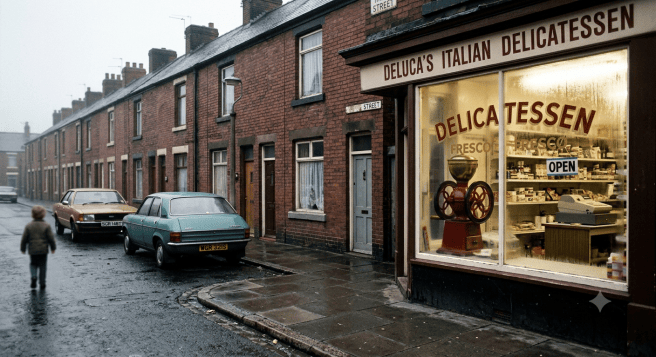
The only glimpse I had of anything different was the Italian delicatessen in Sunderland that I’d pass on my way to school. It sat on a small corner, just a door or two down from a barber shop. Though now much of my childhood landscape has faded, this corner remains completely untouched by time.
In the shop window sat a great red machine that took up almost the entire pane. People have since suggested to me that it might have been a large meat slicer, but my memory refuses to trade away the truth. It wasn’t a slicer. It was an industrial behemoth of a coffee grinder — a magnificent contraption topped with a massive hopper and flanked by a heavy wheel. To my nine-year-old eyes, it wasn’t just utility; it was simply, breathtakingly beautiful. It stood proudly like an exotic relic from another world, releasing the unforgettable smell of freshly crushed coffee beans straight into the cold, coastal air — a scent, that on the right wind, clashed with the distant smell of hops of the Vaux Brewery, industrial smog and the sharp bite of the North Sea.
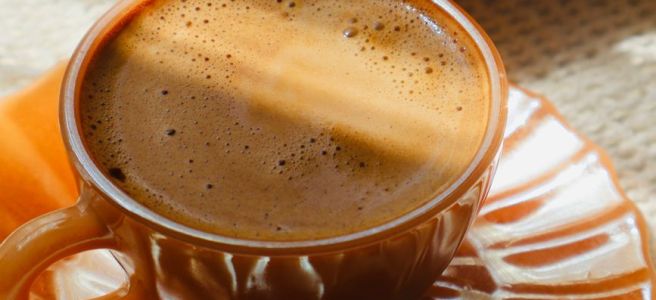
My mother was the lone exception to the rule of tea. She owned an electric percolator, a prized piece of modern chrome she kept strictly for special occasions. Its contents were a ritual in themselves, bought from the Ringtons man who carried his heavy wicker basket up our path to deliver the precious metal cans of ground coffee. When company came, she would carefully snap Kit Kats into individual fingers, arranging them on a tea plate to make the luxury stretch. Then, the kitchen would fill with the dramatic, acoustic journey of the machine: a quiet, hollow hiss, a steady, hypnotic glug-chug-glug as the dark liquid slapped against the clear glass knob on the lid, and finally, a frantic, breathless splut-gurgle-gasp before it fell silent.
But I was no coffee drinker then. For me, the true geography of comfort was mapped out when we visited or stayed at my grandparents’ home.
My grandmother relied on something that seemed wonderfully strange to me: Camp Coffee, with its curious label, which I loved to study. The Camp Coffee label featured a colonial-era camp scene: a military tent in the background with a flag flying on top bearing the message, “READY AYE READY”. In front was a very grand-looking Gordon Highlander soldier in a kilt. He was pictured seated, holding a cup and saucer next to a standing Sikh who, I assumed, was some kind of soldier-orderly. Whilst I didn’t like the smell of the coffee inside, my grandmother used it to make a moist, unforgettable coffee cake crowned with a thick, almost al dente, fudge-like fondant icing. No other coffee cake has ever tasted like hers.
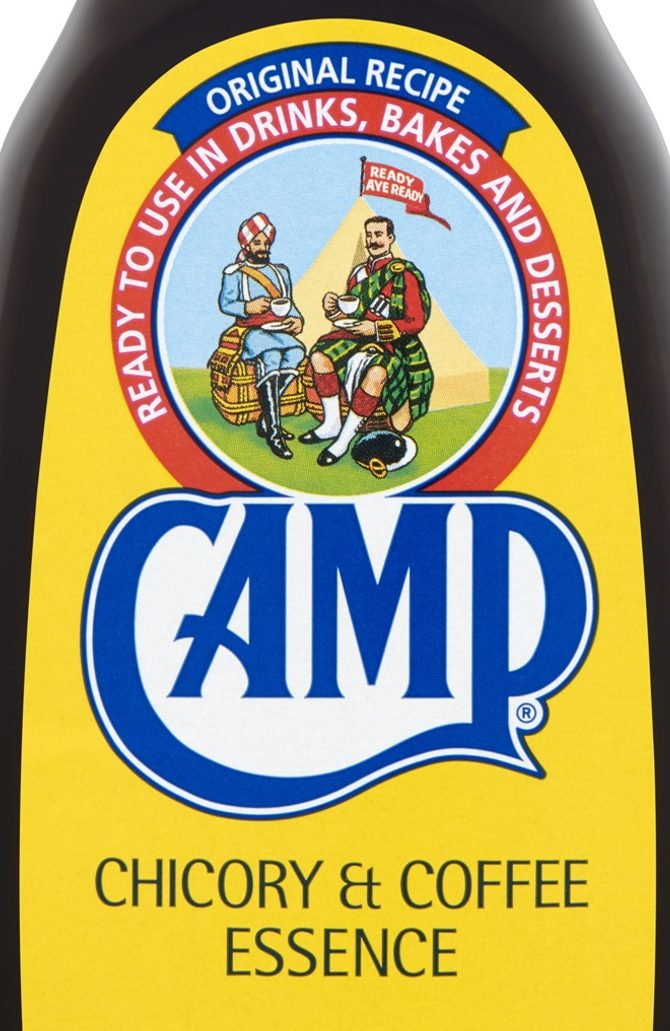
A modern label for modern times. The Sikh soldier and Highlander, finally sitting side by side.
I don’t recall either grandparent drinking it, or actually any type of coffee — ever. Always tea, loose-leaf and brewed in a huge brown ceramic teapot, then covered with a knitted tea cozy. Tea came in cardboard boxes with instructions like, “Always Use Freshly Drawn Water”. I remember thinking there was something very peculiar about drawing water — and imagined it was directed to people who used a well to draw their water from.
A popular brand of tea also included collectable tea-cards — little treasures that felt like windows onto a world far beyond our own. Those vibrant, illustrated cards slipped from the cardboard boxes like tiny gifts, each front showing exotic wildlife, steam locomotives or long‑forgotten kings, and each reverse filled with neat rows of facts that seemed to hold all the promise of adventure.
My friends traded them with breathless excitement, their pockets full of possibilities. I watched from nearby, not unhappy, just aware that my grandparents—kind, steady, and endlessly generous — had their own favourite tea. They’d brewed the same brand for years, and I grew to love the quiet ritual of it: the familiar packet, the rising steam, the way a simple cup brought them such contentment.
I accepted that their tea would never contain those coveted cards. Their happiness mattered more, and sitting with them over a warm cup felt richer than any collection. Still, every so often, a small, tender ache would surface, knowing I’d never paste those cards into the commemorative albums my friends carried like cherished trophies.
These were the quiet foundations of my life. Long before I ever stepped into a modern coffee shop, and before I spent nearly all my spare time soaking in the atmosphere of a place that exceeded every expectation, comfort had already been defined for me. It was stitched into the rhythm of my childhood: a bubbling chrome pot on a Saturday afternoon, or a slice of grandmother’s moist Camp Coffee cake with its thick, al dente fondant icing.
My bedtime drink, however belonged to the rival malted kingdoms of Horlicks and my own preference, Ovaltine.
A café, as I understood it growing up in the UK, was usually the kind of place people affectionately called a caff, or a greasy spoon. The coffee was almost always instant with milk — sometimes, if you were lucky, made with steamed milk. There were other cafés too, family‑run places often rooted in Italian or other migrant communities, where hulking espresso machines sat gleaming and slightly terrifying, as if they required an engineering degree to operate. Even my mother had her own memories of such places: in the mid-to-late 1950s Sunderland town centre, she frequented Louis Café, an Italian family‑run spot where she listened to rock and roll on the jukebox, drank hot orange squash, and occasionally ordered something she described simply as frothy coffee.
Tea rooms were another world entirely — white table linen, bone china, cucumber sandwiches, Victoria sponge, scones. Quintessentially British, with regional variations that felt almost ceremonial: Cornish or Devonshire afternoon tea, Welsh afternoon tea, Scottish afternoon tea, each with its own quiet rituals.
At home, my own attempts at coffee were a patchwork of experiments. I used a Moka pot with varying results — usually bad, very bad. I managed a decent cafetière, or French press brew, and I dabbled with Melitta plastic filter cones and papers, though I never seemed to get them right. I loathed instant coffee, yet still drank it — or at least a quarter of the cup — before giving up.
Attribution:
Camp Coffee Label Image: Cropped from Camp Coffee by Olive Amar, licensed under CC BY-SA 4.0.

 Ghosts to Carry, Stories to Keep