When I landed in Gliwice at the end of September 2010, the local coffee landscape was a strange hybrid of the traditional and the derivative. On one end were the classic kawiarnias, which felt remarkably like traditional British tea rooms — slightly stuffy, polite, and formal. A small kawiarnia became my go-to, located just outside the Rynek on a quiet backstreet. It had, at the very most, five tables, all clad in white tablecloths and accompanied by piped classical music.
The reason I went there was twofold: the owner was a delightful, friendly gentleman who seemed genuinely pleased that I adored the other reason for my weekly pilgrimage — his wife’s creation of the ultimate Tort Czarny Las, the Polish version of Black Forest gateau. He glowed with gentle pride in her baking and confectionery skills, and that quiet devotion gave the place a warmth that softened its formality.
On the other end of the spectrum were venues caught in a cosy ’90s time warp: dark wood, velvet settees, and deep armchairs made for lingering over lattes with far too much texture. I often found myself at Kofeina on ul. 3 Maja near the railway station in Katowice when I travelled there for my English classes. With its Wi-Fi and quiet corners, it was a comforting place to settle in and prepare — or gently review — my lesson plan. I always ordered tea with milk, alongside a big wedge of sernik (cheesecake), and the staff never failed to be kind. Once my preparation was done, I loved sitting by the window, watching the trams and people pass by as they moved through the rhythms of their everyday lives.
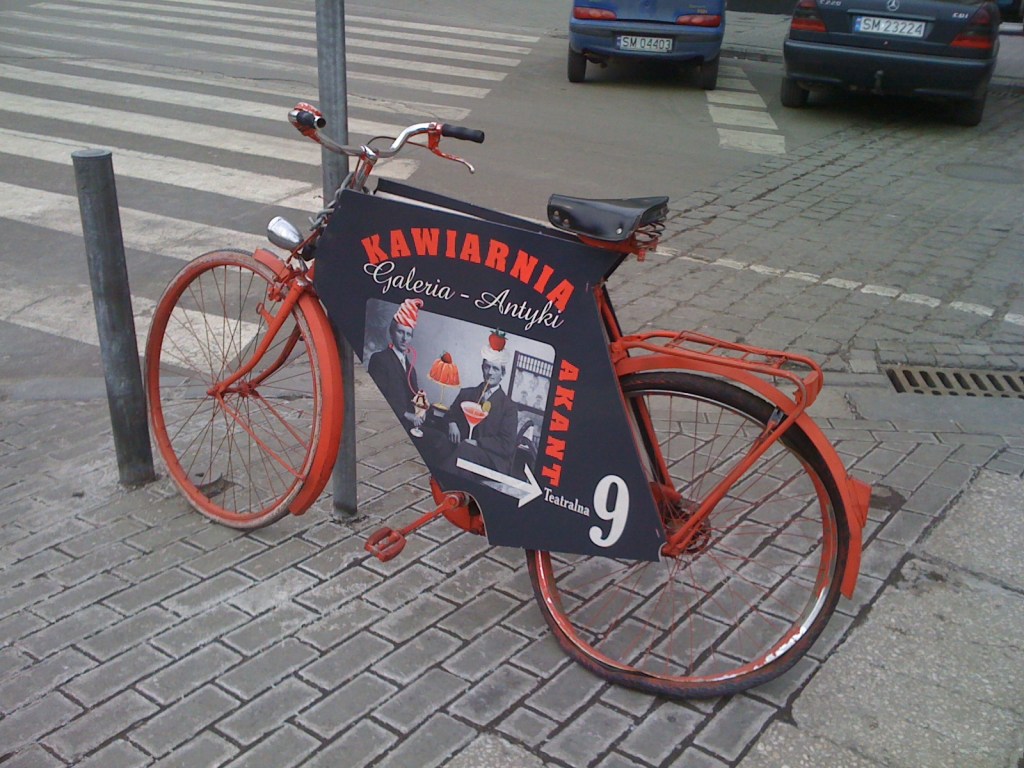
Katowice: I used to dream of picking up this bike and running away with it — what a beauty!
In Gliwice, I often drifted toward a branch of Coffeeshop Company — an Austrian franchise that felt like a slightly altered reflection of Starbucks. It was functional enough, but it carried that familiar corporate vastness I’d hoped to leave behind. Still, its wide, open ground floor, soft sofas, and generous chairs made it a convenient and comfortable refuge. The staff were also very friendly and keen to please. I hosted some of my earliest free English conversation club meetings there — lively, warm evenings that lingered in my memory, more like gatherings of friends than formal sessions, which is undoubtedly what they grew into. I remember everyone seemed to opt to drink tea of different types — without milk.
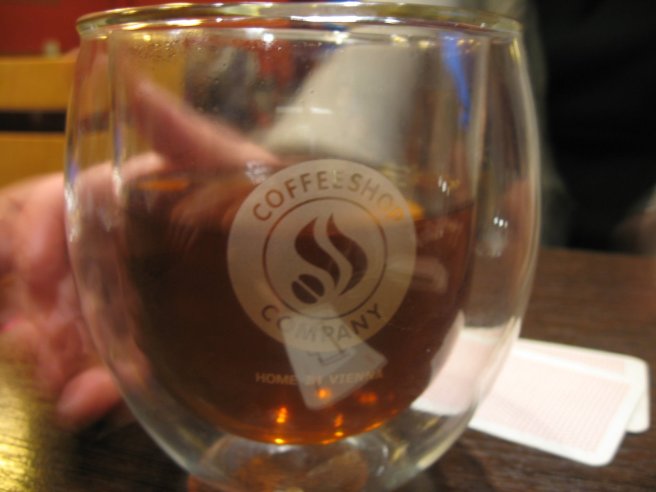
Tea in a glass, without milk… Toto, I’ve a feeling we’re not in the UK any more.
All the while, I moved through my caffeine routine half-asleep, unaware that something quieter and more meaningful was beginning to stir. If a new wave of cafés had already arrived during my visits between 2007 and 2010, it slipped past me unnoticed. I wasn’t yet tuned to its frequency.
Then came May 2011, and everything shifted with startling clarity.
For weeks — almost every day — I passed a particular storefront on ulica Jana Siemińskiego, never sensing the quiet transformation unfolding behind its walls. The windows and door were completely papered over, sealing in whatever was happening inside. From the street, it looked like a secret waiting for the right moment to reveal itself.
Then came a warm, sunny mid-morning that month. I was walking back from showing my daughter around the Rynek when I noticed the paper was finally gone from the windows. The large wood-framed glass door stood open, as if inviting me in. I paused, looked inside, and felt something shift — a quiet recognition, almost like déjà vu, but warmer.
It was beautiful.
Not corporate. Not nostalgic. Not derivative. It felt intentional — crafted, not copied.
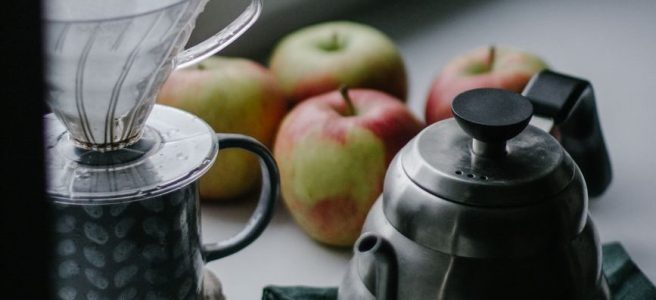
The space breathed with a minimalist, industrial warmth: hand-cut plywood, bespoke wooden fixtures, industrial lamps, handmade cushions and backrests. The back room opened into a world of fresh flowers, art prints, and exposed brickwork that seemed to glow in the morning light. It was as if someone had distilled all the emerging signals of a new café culture — the care, the craft, the quiet confidence — and poured them into a single, coherent space.
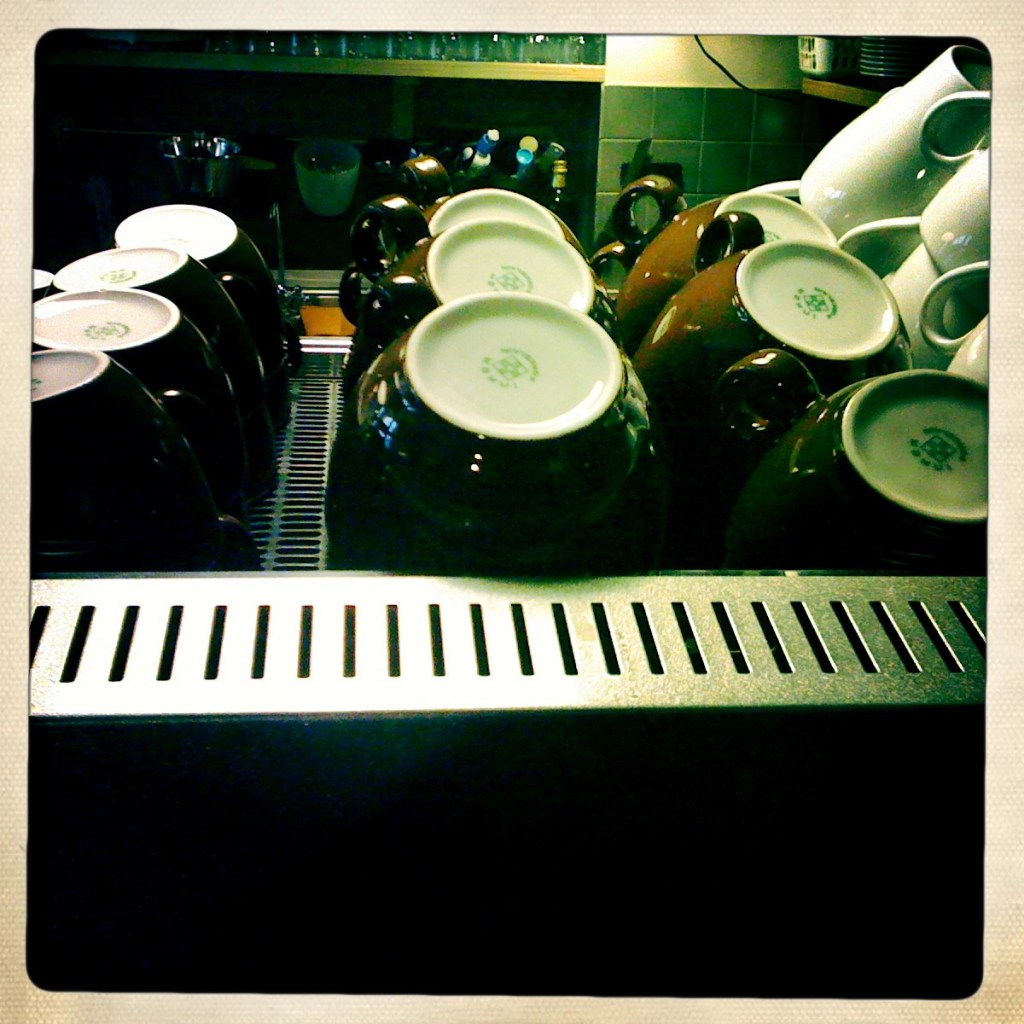
And then the workstation stopped me in my tracks. The gleaming espresso machine, the professional grinder, the rows of quality Inker cups — it was a declaration. Someone cared. Someone wanted to do this properly.
My excitement was already bubbling over, but the tipping point — the detail that made my daughter burst into laughter at my sudden, unfiltered joy — was the vinyl. A small selection of records standing proudly next to a vintage record player and speakers. It was such a simple thing, yet it felt like a message written just for me: You belong here.
It felt like a perfect entry onto a wave — that moment when everything locks together, and you just know: This is it.
Paweł, the owner, watched my reaction with a mix of surprise and delight. And when he spoke to us in English, it felt like the final click of a lock turning.
The paper had come off the windows, and I had stepped across the threshold of my third place.
KAFO wasn’t just a kawiarnia. It was a sanctuary — a space that held me gently during moments when I felt utterly alone, and lifted me during moments when I felt alive with possibility. It wove itself into the rhythm of my days: a place to meet friends, to work, to breathe, to simply exist without explanation. A place that asked nothing of me except that I show up and enjoy.
As I sat there, either alone or with friends, taking it all in, I realised I wasn’t just witnessing a cultural shift — I was living inside it. This wasn’t theory or observation. It was personal. It was happening to me, around me, with me. By the end of 2011 and into 2012, the change was unmistakable: attitudes, fashion, music, third-wave kawiarnias, microbreweries — all part of a movement that had quietly been gathering momentum until the day I walked through that open door.
If you know… you know.

 Ghosts to Carry, Stories to Keep