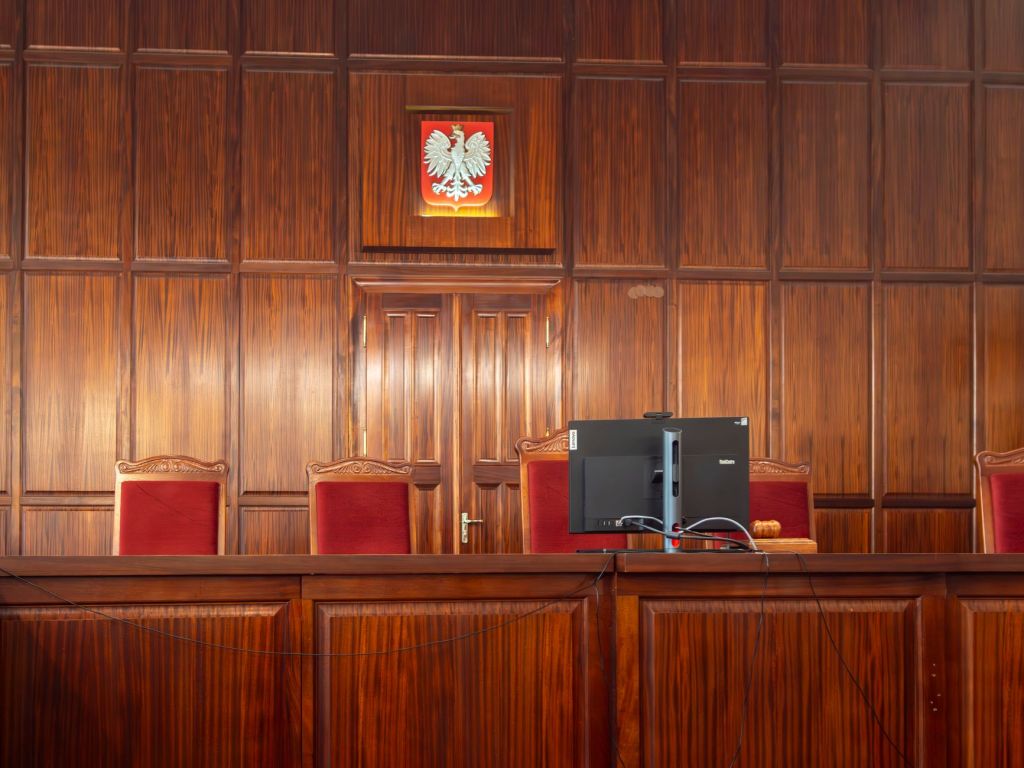
District Court
Around this time, I was entrusted with one of the most unusual student groups I ever taught: senior judges from the District Court (Sąd Rejonowy w Gliwicach). These were people whose daily decisions shaped the quiet, unseen architecture of other people’s lives. They carried authority in a way that didn’t need to be announced—it simply settled around them, like a natural element of the room.
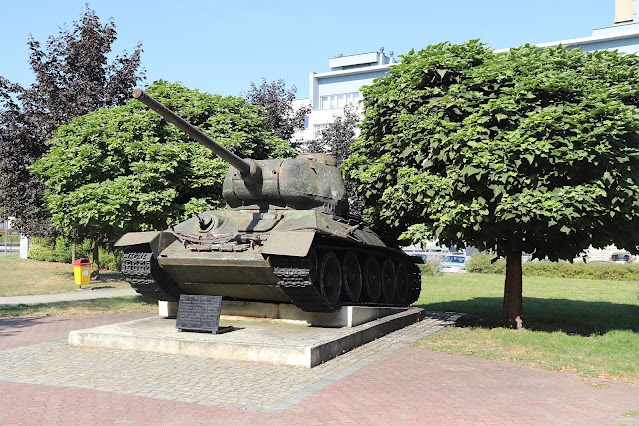
Their court building on Powstańców Warszawy carried that familiar Prussian solidity —symmetrical, slightly austere, and civic in a way that suggested endurance rather than grandeur. Just a short-distance away, a Soviet T‑34 tank faced the building with its own kind of heavy stillness — a relic from another century that seemed to be watching the present with patient confusion. I’d later learn that its steel skin told only half a story; the men who had commanded that roaring engine were actually Polish soldiers who had survived Siberian labour camps, seizing the only machine available to fight their way back home.
Back in 2012, the tank barely registered to the locals. Children climbed over its iron hull as if it were a playground, and I walked past it daily without a second thought. It was simply part of the city’s layered strangeness—one of those details you only fully understand in hindsight, when memory has had time to settle and reveal its sharp edges.
It was a ridiculous thought, but it grounded everything: a British ex-cop turned English teacher, locking a bicycle beneath the gaze of a Soviet manufactured tank before walking into a Prussian courthouse to instruct senior judiciary and paralegals. Gliwice had a unique way of making the improbable feel entirely normal.
Inside the building, past the security checkpoint, the atmosphere shifted. The interior was unexpectedly modern: bright corridors, clean lines, and pale wood. These were courtrooms designed not to intimidate, but to clarify — a space where choices were executed with geometric precision, not theatrical performance. Walking through those halls, I felt a quiet awareness of being allowed into a world that wasn’t mine, but that I was being trusted to enter all the same.
By then, I thought I understood courtrooms. I’d stood in enough of them back home — especially inside the heavy, oak-panelled rooms of Chester Crown Court, spaces specifically designed to project a centuries-old lawful authority. I knew the choreography, the internal tension, and the subtle shifts in cadence that could alter a case. But this was entirely different. Not because of the setting, but because of my place within it. I wasn’t there to give evidence, manage a custody line, or observe proceedings. I was there to teach. My role was to guide conversation, not control it. The architecture hadn’t changed; I had.
Our usual lessons took place in a neutral, functional conference room where legal minds shifted easily into an administrative rhythm. It worked well. Their English command was already advanced, requiring me to be highly precise, confident, and meticulously prepared; at times, the standard grammar books felt beneath their intellect.
During a lesson warm-up chat, they asked how long I had been teaching. I explained that I was, in fact, a retired police officer from North Wales who had moved to Silesia, and that I had three years of TEFL experience under my belt working for Britam. That seemed to interest them, though not in the way I might have expected. There was no visible surprise, no sudden shift in tone, and no barrage of questions. Instead, a quiet, measured attentiveness settled over the table.
Perhaps they were surprised, or even slightly shocked, but years of judicial discipline ensured it didn’t show on their faces. These were people accustomed to listening intently, to weighing what they heard without immediately revealing their hand. They had spent decades hearing every imaginable explanation and version of events—plausible or otherwise—and had learned to hold their internal reactions in check. So they remained calm, collected, and genuinely interested.
One morning, our usual conference room was occupied at short notice. Apologies were made, but an alternative space had been secured. A courtroom was free for our lesson—an actual courtroom.
The space was immaculate — so clean I half-considered removing my shoes before stepping past the threshold. It was brightly lit, finished in pale, polished wood. A red plaque bearing the white eagle — the Orzeł Biały — presided over the judge’s bench. Deep red upholstery lined the panel’s chairs, creating a deliberate, stark contrast to the light timber. Everything aligned with absolute geometric precision: the desks, the microphones, and the monitors were placed as if measured with a ruler. The difference from our usual meeting room was immediate. The massive height of the ceiling reinforced the sense that this room existed for heavy decisions, not casual discussion. Authority was built directly into the furniture.
I tried to remain completely unfazed by our surroundings. The judges settled themselves across the benches — scattered and relaxed, as if this solemn chamber were just another staff room. I stayed standing, as I always preferred to do when instructing; standing kept me steady and kept the lesson moving. Perhaps it was that — my refusal to sit, my stubborn posture of professional routine—that amused them so much.
“Go on, Gary,” one of them said, smiling across the desk. “Sit in the chair. You must be tired of standing.”
The judge’s chair.
I tried to play it cool, but I didn’t just sit. I eased myself into the red leather with a kind of mock ceremony—a tiny, theatrical flourish I hadn’t planned but couldn’t resist. It wasn’t quite a bow, just enough to acknowledge the beautiful absurdity of the moment.
They laughed immediately—a warm, generous laughter that filled the high ceiling in a way legal authority never could. And then I laughed too. Because how could I not? The entire thing was ridiculous, human, and strangely tender.
And that day, something softened. Perhaps being inside their own professional environment allowed it. Perhaps the moment itself—unexpected, slightly absurd—made room for a different kind of connection. Or perhaps it had always been there, just not immediately visible.
They were never people to show everything at once. Not in our standard conference room, not when I revealed my policing past, and not even here, at first. But when the recognition came, it was unmistakable. For a few minutes, the rigid judicial hierarchy completely dissolved. Somewhere in that moment—sitting in that high-backed red chair, not as an officer of the law but as an English teacher—the past and present overlapped. Not in conflict, just in mutual recognition.
It only happened once, but it stayed with me. Not because of the physical chair itself, but because of the genuine warmth behind the gesture—the quiet, generous understanding that, for those brief minutes, our official roles didn’t matter.
Those unexpected hours inside the courtroom softened something deep within me. Outside, the Silesian spring was finally arriving. Even on the difficult days when I felt physically lost and unwell, even when the quiet sadness of my upcoming departure pressed in at the edges, the city was softening. The daylight lingered a little longer each afternoon. The air lost its sharp winter bite. The trees opposite my apartment windows began to show the faintest brush of green, as if the season itself were reminding me that endings don’t cancel beginnings.
Perhaps that’s why, in those final months, I taught with a kind of fierce tenderness. I wanted every single lesson at Britam to truly matter. I wanted the spaces I walked into—the corporate boardrooms, the teenage classrooms, and even that geometric courtroom—to hold something memorable for the students I was about to leave behind. I lacked control over my health, my future, or the impending ache of returning home. But I could completely control this: the way I showed up. The way I taught. The way I made each remaining day count.
And perhaps that’s why, in the weeks that followed, I found myself teaching with a distinct looseness and creativity I hadn’t expected—a resolve to make our time count that carried me into a period of beautifully unrestrained invention, one that would eventually produce a bowl of origami cubes, a minor flood on a school landing, and one final bit of magic.
“Gliwice T‑34 tank” — Image by Andrzej Otrębski, licensed under CC BY-SA 4.0


Leave a comment