Then came the late nineties, and almost overnight the British high street changed its scent.
Starbucks appeared with its bucket‑sized paper cups, sugary syrups, and that unmistakable sickly vanilla and burnt‑milk aroma that seemed to drift out of every doorway. Costa followed, multiplying across Chester until it felt as though every corner had one. Caffè Nero arrived too — there was even one in Wrexham where I sometimes worked — trying to offer something darker, moodier, more “continental,” though at the time it all felt impossibly sophisticated.
We shifted from asking for frothy coffee to ordering lattes, cappuccinos, and Americanos. I once asked, “Why Americano?” I got a simple shrug from the stressed-looking young lady wearing a t-shirt with barista emblazoned upon it. “Not too sure,” came the reply. No more was said.
It was corporate, it was uniform, and for a while we believed it was the height of refinement. But it also nudged my palate away from instant coffee for good, preparing me — without my realising it — for the independent, obsessive, quietly revolutionary coffee culture I would later fall in love with.
Holidays abroad — and even long-haul flights to Canada — offered a temporary escape. To save money on skiing trips, flights from Manchester to Vancouver, I frequently booked indirect routes that sent me backward into Europe first. Spending a layover at Schiphol or Frankfurt meant I was essentially flying East over the North Sea just to turn around and fly right back over the UK. Yet, there was something irresistibly cool about standing at those bustling continental transit bars.
Nursing a tiny shot of espresso under the glowing banners of Lavazza, Segafredo, or my favourite, Illy, made the detour feel entirely worth it. Knocking back that bitter, sophisticated shot while gripping a complimentary speculoos biscuit became my passport into an entirely different coffee world before the long trudge across the Atlantic.
Landing in Vancouver, the sheer scale of Canadian coffee devotion hit me like a jolt of pure caffeine. Back home, a coffee shop was a novelty; here, it was infrastructure. Starbucks was ubiquitous, its green sirens claiming every major street corner in the city. Yet, it wasn’t the Seattle giant that won me over. Instead, I fell hard for Second Cup, a home-grown Canadian chain that felt infinitely warmer, trading corporate minimalism for rich roasts and cozy armchairs. And then, of course, there was Tim Hortons. This was in the golden era, long before corporate takeovers flattened its soul. Back then, “Tims” meant genuinely great, fresh coffee paired with incredible, freshly glazed doughnuts that felt like a national birthright.
Drinking coffee in Canada wasn’t just a morning routine; it was a companion to adventure. Whenever we made the pilgrimage up Highway 99 toward Whistler, a pit stop at the Squamish Tim Hortons was an absolute mandate. In the early days, before the 2010 Winter Olympics transformed the route, the Sea to Sky Highway was a thrilling, white-knuckle ribbon of asphalt carved precariously into the mountain cliffs. Trying to avoid staring down at the dizzying drops into Howe Sound became a ritual. Years later, the highway would be straightened, widened, and tamed for the Olympic crowds. But whether navigating the dangerous, winding curves of the past or cruising the smooth highway of the post-Olympic era, that much-beloved family pit stop remained unchanged: a hot coffee, a box of fresh donuts or Timbits, and the crisp, pine-scented air of British Columbia.
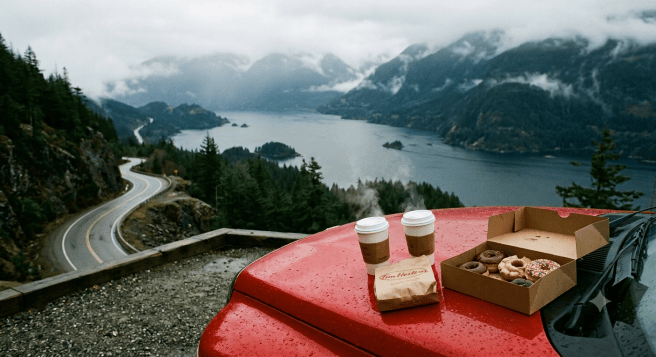
Eventually, our travels drew us away from the mainland and across the Strait of Georgia, where we fell completely in love with Vancouver Island. It was my first-ever visit to this incredible island, and I was immediately struck by the warmth of the people as we headed up toward the snow-choked peaks of Mount Washington. We met up with a friend who lived on the island and was understandably delighted to act as a guide and show us around. It was a completely mundane stop along the way that provided my ultimate coffee epiphany.
Pulling into a rustic island service station to refuel the pickup, I noticed they served coffee. I watched as my friend walked calmly up to the counter and casually asked the cashier, “How fresh is the coffee?” Fully expecting a shrug, I was stunned when the lady behind the till didn’t guess; she actually checked a physical timer resting beside the pots. “Oh, it’s a bit old,” she replied with a smile. “If you don’t mind waiting a couple of minutes, I’ll brew you a completely fresh batch.” I stood there, mouth agape, completely mesmerised. Miles from any major city, coffee freshness wasn’t an afterthought — it was a timed metric of hospitality
Naturally, when I returned home to the UK, my standards had been entirely warped by the Canadian experience. Finding myself back in Chester, I decided to test the waters. I walked up to a counter — I won’t name the company — looked at the standing coffee, and boldly asked, “How fresh is the drip coffee?”
That question was answered by a look of absolute bewilderment — a silent, defensive ‘What? Does it even matter?’ written across the face of the assistant taking orders. I am sure I must have been the first customer to dare ask that question.
After a beat, The barista busying themselves steaming milk looked over, and gave me the ultimate, classic British reply:
“It’s still okay.”
Not even a glance at the timers. No fresh batch offered. Just a lukewarm reassurance that the coffee hadn’t yet turned to poison. I took my cup, realising with a heavy sigh that the global coffee revolution had a very long way to go before it ever reached Cheshire. Unsurprisingly, it tasted muddy, bitter, and unpleasant — a lukewarm cup of disappointment, and a sudden, aching homesickness for Canada.
Whistler operated by its own unique set of rules. Unlike the rest of British Columbia, where the green siren dominated every block, there was absolutely no Starbucks or Tim Hortons allowed within the pristine pedestrian footprint of Whistler Village. Instead, the village corporate coffee crown belonged to Second Cup, which we frequented and absolutely loved. It became our cozy, reliable haven, a place to thaw out and watch the global ski crowd drift past the windows.
By the late 2000s, my brief romance with the high‑street chains had worn thin. I was tired of the sameness: the oversized cups filled with over‑extracted, bitter coffee drowned in milk and foam. I had taken to ordering a simple glass of water and an espresso. Even a basic Americano felt like a watery chore. Nero became my default for a time, simply because its darker roast had a little more bite, and they sold interesting biscotti that were almost impossible to bite down upon, but perfect for dunking. I didn’t want a bucket of hot milk; I wanted real coffee. I just didn’t know where to find it yet.
I remember standing in a newly opened Starbucks.
“Name, please?” the bright, bubbly server asked.
“It’s Gary,” I replied, watching her write something on the paper cup with confident strokes.
“OK, we’ll call your name when it’s ready.”
I waited. After five minutes, a voice called out, “Americano with milk for Harry!”
I looked around. No one moved.
“I’m Gary,” I offered helpfully.
The barista frowned at the cup. “But it’s for Harry.”
“If it’s an Americano, medium, with milk… it’s mine.”
“Are you Harry?”
“No, I’m Gary. I think it’s a simple misunderstanding.”
She looked at the cup, back at me, smiled and handed it over.
Written upon the cup was the name Harry, accompanied by a small heart drawn in a heavy Sharpie kind of purple colour ink.
I drank Harry’s Americano, still trying to understand this strange ritual of names and hearts on paper cups.
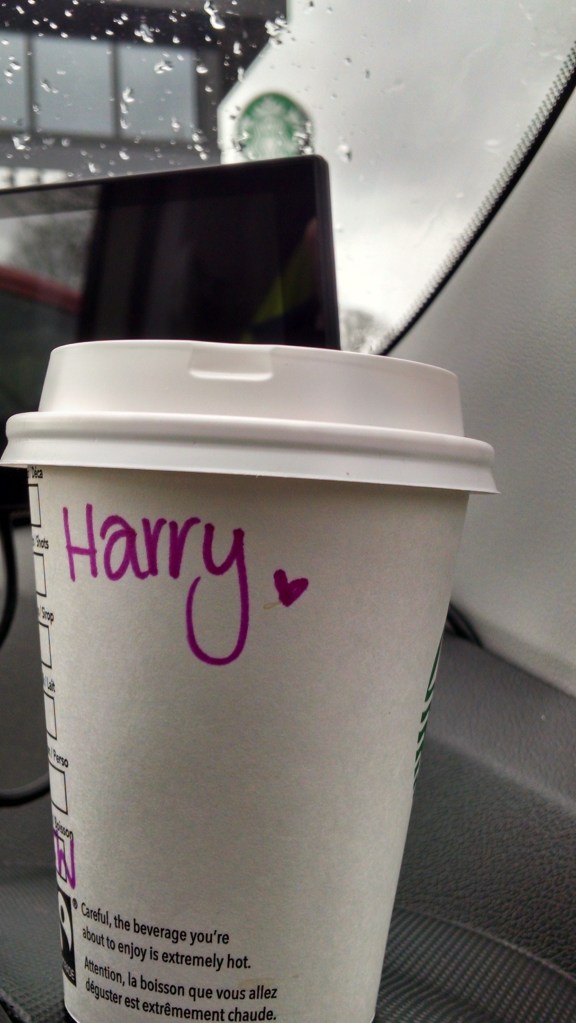
Gary… Harry? Close.
In the UK, I had already noticed in cities like Manchester, Liverpool, and of course, London, a wave of independent cafés multiply, craft micro-breweries flourish, and a new subculture take shape — the so-called “hipster,” or “nerdy cool,” as I preferred to think of it. Knitted beanies, skinny jeans, lumberjack shirts, thick-framed glasses, fixie bikes, vinyl records, and immaculate male grooming — beards, barbers, and waxed ’taches — were no longer fringe signals of a niche tribe. They were becoming the visual language of a cultural shift.
What struck me most was how seamlessly this aesthetic wrapped itself around everyday rituals. Coffee wasn’t just coffee; it was an identity marker. Beer wasn’t just beer; it was a craft. Even a haircut became a curated experience.
I vividly recall my first visit to a new-wave barber in Manchester. The place felt less like a shop and more like a stage set for a lifestyle I wasn’t sure I belonged to yet. The barber himself was inked almost from fingertip to collarbone — not in a way that demanded attention, but in the quiet, curated style that had become part of the new aesthetic. It simply blended into the craft-driven seriousness of the space.
His meticulous attention to detail, the razor-sharp fade, the bewildering array of grooming products lined up like scientific instruments — all of it signalled a reverence for barbering as a skill, a passion, a discipline. The tattoos were just another thread in that tapestry, an understated part of the package rather than the point of it.
And then he offered me an ice-cold beer.
A beer — during a haircut. It was such a small gesture, yet it marked a clean entry into a world where the ordinary was being reimagined, polished, and presented with a wink of self-aware cool.

 Ghosts to Carry, Stories to Keep