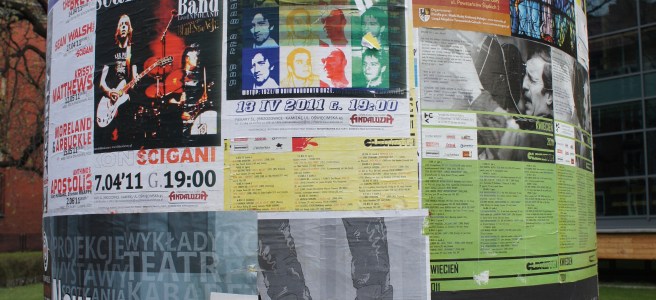
I’d become fascinated by the słup.
I’d seen their kind in films, usually French or Eastern European, often black and white: those wonderfully solid pieces of cylindrical street furniture that seemed to belong naturally to the urban landscape. Kiosks. Poster columns. Tram wires. Things that looked entirely ordinary to the people who lived among them, yet somehow cinematic to me.
And the słup was never empty — bearing a tree-ring history of Polish weekends and beyond.
By spring 2011, this one in Tarnowskie Góry was covered in posters for concerts, theatre, exhibitions and whatever else was happening. Most were professionally produced, crowded with photographs, logos, sponsors, dates and information. They competed for attention.
I wasn’t particularly interested in any of them.
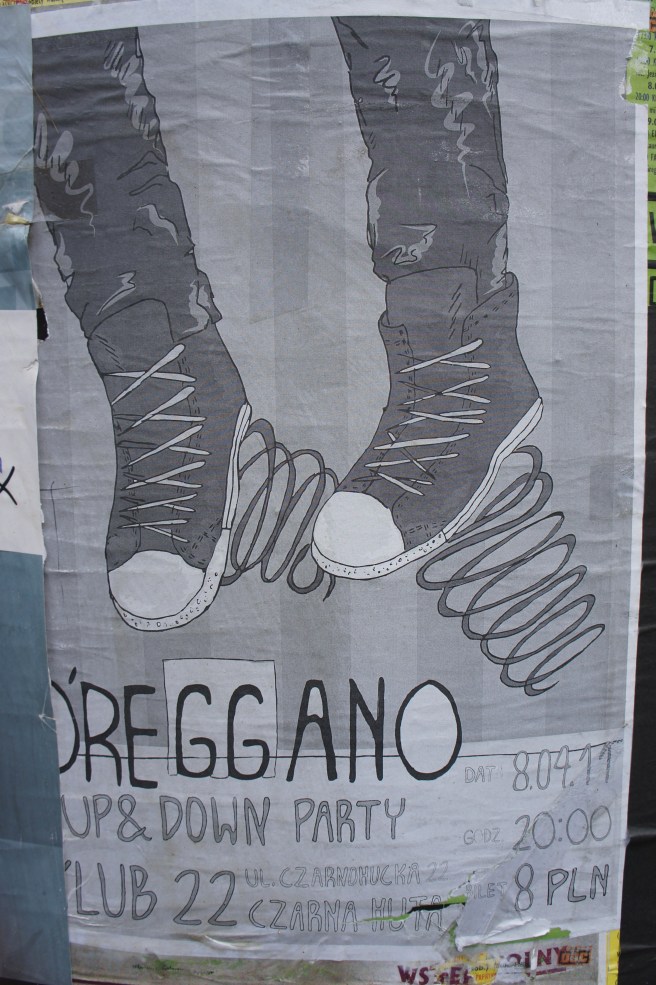
Then I noticed the shoes.
Right in the middle of all that visual noise was a small, handmade poster. Two high-top sneakers, crudely drawn, with enormous springs attached to their soles.
Beneath them, in equally hand-drawn lettering:
O’REGGANO
UP & DOWN PARTY
KLUB 22
It was amateurish, unpretentious and completely unlike everything around it.
I didn’t know who O’reggano was. I had no idea where Klub 22 hid itself in the city, or what an “Up & Down Party” meant. But I fell in love with it instantly for its simplicity.
These tiny sketched shoes were trying to defy gravity.
I pressed the shutter, captured the frame, and carried the mystery home with me.
Looking at the photograph today from 2026, the simplicity I fell in love with feels even more powerful. It wasn’t just a clever graphic; it was the literal heartbeat of a room.
I now know that Klub 22 was a multi-level rock haven, but looking at the sketch today, I realise ‘Up & Down’ meant something much deeper than stairs. It was the literal physics of the room. It was the kinetic architecture of dance — the compression of a body sinking into the heavy ‘down’ of a bass line, and the explosive release launching ‘up’ into the chorus. Those hand-drawn springs captured the very mechanism of human rhythm: the urge to defy the concrete beneath our boots, if only for the length of a song.
Fifteen years later, I can finally hear the music.
PL:
Wiem już, że Klub 22 był dwupoziomową świątynią rocka, ale patrząc dziś na ten szkic, dociera do mnie, że „Up & Down” oznaczało coś znacznie głębszego niż tylko bieganie po schodach. To była czysta fizyka tego miejsca. Kinetyczna architektura tańca – moment, w którym ciało kurczy się, uginając pod ciężarem basowego „down”, by za chwilę wystrzelić w górę, w euforyczne „up” niesione refrenem. Te odręcznie narysowane sprężyny idealnie uchwyciły sam mechanizm ludzkiego rytmu: tę rozpaczliwą potrzebę oderwania się od twardego betonu, choćby tylko na czas trwania jednego utworu.
Piętnaście lat później w końcu słyszę muzykę.
Author’s Notes
Słup: In Poland, the iconic circular concrete advertising column is called a słup ogłoszeniowy. (plural: słupy ogłoszeniowe) Or more simply, a słup, (plural: słupy).
Klub 22 in Tarnowskie Góry (originally located at 22 Czarnohucka Street) was an iconic venue on the Silesian rock, alternative, and live concert map.
Oregano Chino: A popular Silesian alternative rock band that regularly performed live at Club 22. Their high-energy shows drew massive crowds of fans in Tarnowskie Góry. The band’s name is stylised on the poster with a double ‘G’ as O’REGGANO, which was a common alternative spelling used by the band and fans at the time.
Up & Down Party: The name of recurring dance events hosted at the club. As much as I’d like to attribute the name to the physical physics of the dance floor and those hand-drawn springs, it may have simply referenced the architecture of the building, where parties took place simultaneously on the ground floor and the upper level. To be honest, I really don’t know. I’m just guessing at the history here. If you know the actual reason the party was named so — and why it was in English — I would love for you to reach out and tell me!
Up & Down Party: Cykl imprez, które regularnie nakręcały ten klub. Jak bardzo bym nie chciał przypisać tej nazwy fizyce rozgrzanego do czerwoności parkietu i tej sprężynującej, koncertowej energii, mogła to być tylko aluzja do układu budynku – z imprezami tętniącymi równolegle na dwóch poziomach: dole i górze. Szczerze mówiąc, to tylko moje domysły. Jeśli pamiętasz tamte czasy, wiesz skąd wzięła się ta nazwa i dlaczego była po angielsku, zostaw komentarz i uświadom mnie!

 Ghosts to Carry, Stories to Keep