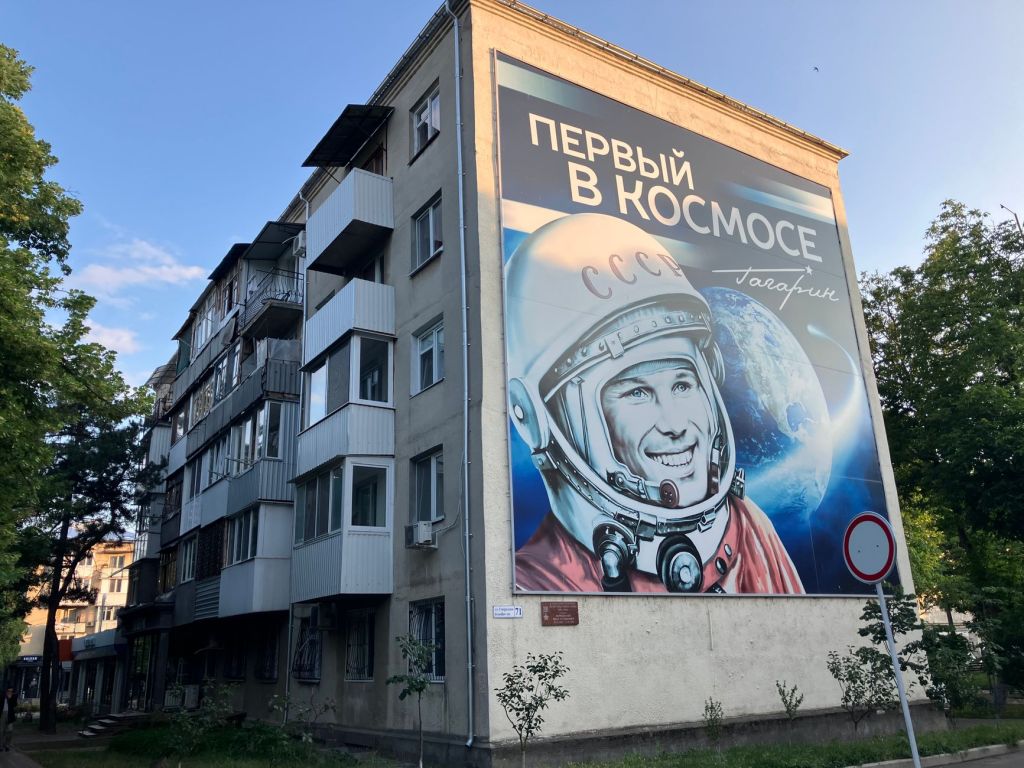
The Red Star in the Sock Drawer
From the First Moscow Watch Factory to the front paw of a cosmonaut dog, and from an easyJet duty-free catalogue to a freezing rural delivery route.
A reflection on time, memory, and the true price of everything.
Act I: Conductor of Time
Wristwatches are practical works of engineering wonder. They tell you where we are in time, where we should be, and, more often than not, where we need to be, but aren’t. Yet they can be much more than that: a wristwatch can be a work of art, an object of beauty or treasured heirloom carrying history far beyond its monetary value.
My professional life, from leaving school onwards, revolved around time. Being in the right place at the right time, or recording the exact time of day, and even being cross-examined about a specific time — a working and dependable wristwatch was essential.
In a career where it was not uncommon to be approached or photographed by overseas tourists and asked the time — even when standing under the town hall clock in a small picturesque rural market town, in which I spent most of my service — my wristwatch had to be reliable, practical, and strong enough to withstand some, at times, very rough physical experiences. I formed the opinion that it was best to buy a reliable, inexpensive wristwatch.
Despite my own interest in wristwatches, especially military timepieces that carry a vintage horological tradition, I actually never got around to acquiring one. The reason might sound surprising: I don’t like wearing wristwatches. At home, I’d remove my wristwatch as soon as I could, and place it in some prominent position to remind me to refasten it when I left.
Act II: Ice Cold Twix and Duty-Free Browsing at 30,000 Feet
In October 2010, I took a leap into the unknown and began teaching English in the Silesian region of Poland. Trips back to the UK were always by easyJet, flying return from John Paul II Kraków-Balice to Liverpool, with the exception of one unforgettable trip where I ended up in Warsaw! I always enjoyed browsing the free travel magazine placed in the seat pocket and often asked if I could keep one; they actually had some useful teaching material in them. The accompanying duty-free catalogue was always interesting to browse, but failed to persuade me I needed to buy cosmetics, aftershave, whisky or other types of alcohol. Until one particular flight.
Travelling on a weekend break back to the UK with easyJet, complete with my speedy boarding card perks, I pre-booked my usual seat, acquired my default in-flight refreshment, coffee and a Twix. The Twix was always ice-cold — it actually snapped apart, was crunchy with almost unyielding toffee that only become very chewy as it warmed in the mouth. Discovering this was by complete accident; there was nothing on the in-flight menu that tickled my fancy, other than a coffee with milk. While the crew member was preparing my coffee, I hurriedly scanning the menu, and feeling hungry, my eyes settled upon a Coffee and Twix deal. I asked for the deal, and the rest is history. Once I’d experienced that strange ice-cold Twix surprise, I was well and truly smitten. It thereafter became an integral part of my flight.
Later, flicking through the duty-free catalogue, I stopped and studied an item being advertised as a new addition. A wristwatch. A Sturmanskie (Штурманские) Gagarin Retro wristwatch. I was absolutely fascinated by it. The description of the watch mentioned how Sturmanskie created watches exclusively for Soviet Air Force pilots. The text further claimed a Sturmanskie wristwatch was worn by Yuri Gagarin during the first human spaceflight in 1961. The watch commemorated Yuri and that first flight into space by man. I was under no illusion that this was some clever marketing by a modern watch manufacturer created for travel retail catalogues. Yet, something about the watch fascinated me.
The watch face was especially striking. I adored its retro appearance; its simplicity I found beautiful — a cream-coloured face, luminous hour and minute hands, the name Штурманские and Gagarin typeset into the face, and the crowning glory to me, an iconic winged red star logo. On the rear of the watch was an inscription of Yuri and the date of his historic space flight. I looked at it for some considerable time. The price was reasonable, but surely Yuri Gagarin would have worn something else. I returned the catalogue, selected some music to listen to via my iPhone and headphones, settled back, closed my eyes and dozed until we were notified of the approach to Liverpool.
Act III: Watches In Space
During the weekend I found myself thinking about how I had read Yuri Gagarin had worn a mechanical wristwatch during that historic flight. I felt sure he would have worn something far more advanced than the catalogue blurb claimed. Doing some minor digging about Yuri Gagarin and the wristwatch he wore into space, I was amazed to discover he really did wear an 1MChZ (First Moscow Watch Factory) “Type 1” Sturmanskie wristwatch, simply fastened over the sleeve of his bright orange spacesuit. Taking a deeper dive into wristwatches in space, I read that whilst Yuri was the first man into space, his Sturmanskie wristwatch — or any other backup watch he had with him — was not the first mechanical wristwatch to have travelled to outer space.
The first mechanical wristwatch into outer space wasn’t even a Sturmanskie. I discovered that the story about the first wristwatch going into orbit was totally unplanned and actually occurred a month before Yuri’s flight. I was amused to read that first wristwatch in space moment had occurred during a successful test launch, flight, re-entry and landing — essentially a kind of dress rehearsal for Yuri’s mission. The rocket was actually crewed; seated within the capsule sat a life-sized human mannequin named Ivan Ivanovich. I read with astonishment that Ivan wasn’t alone. He had a fellow cosmonaut as company, a small black dog called, yes, you guessed it already: Blackie. (Чернушка or Chernushka) I was intrigued to discover more and couldn’t resist trying to verify the story. Deeper down the rabbit hole I dived.
It fascinated me to read a couple of conflicting claims. One of the flight doctors, Abraham Genin, curious about how zero gravity and severe G-forces might affect a mechanical movement, decided to conduct a clandestine experiment of his own. He picked his trusty Pobeda (Победа) wristwatch — a watch he’d grown slightly bored of, but admired because it had survived years of rough daily wear and even swimming. Incredibly, despite the potential risk to the mission — no matter how minor — he secretly strapped it to one of Blackie’s front legs as she was being secured into her life-support crate. I also read another version that the comrade doctor wrapped the wristwatch in a cloth and placed it within the mannequin. The more I read, the more I leaned toward the version where he fastened the watch to one of Blackie’s front paws.
Launch and flight went as planned. I learned that Ivan the mannequin successfully exited the capsule on re-entry by means of an ejection seat and parachute, landing without damage. When the recovery team finally unbolted the dog’s life support crate from the capsule, after it had safely drifted down to Earth by parachute and landed in a snowy field, out popped Blackie — allegedly drenched in sweat, wildly relieved, and tail wagging — wearing a personal, inscribed timepiece on one of her legs.
I couldn’t help but laugh imagining the fallout. The moment the recovery team discovered an unauthorised watch on a space dog and turned it over to read the inscription — the doctor’s own name, Abraham Genin — his telephone must have rung. Answering, Dr Genin heard, “Comrade Doctor… we have a few questions for you.” He must have thought he was heading straight for a cold post in Siberia. Yet the watch worked, Blackie survived, and history was quietly made.
I was amazed to discover that Ivan the mannequin had been testing the very same landing method Yuri would use a month later: ejecting at high altitude and returning to Earth by parachute. Like most people, I had always assumed a cosmonaut remained secured inside the capsule all the way down.
I was astounded to read that prior to the ejection phase, Yuri was subjected to extraordinary physical conditions. The capsule was unexpectedly caught in some kind of spin due to external equipment that was preventing a planned, smooth re-entry. He was subjected to punishing conditions during those moments — a testament to his mental and physical conditioning. Eventually, the capsule’s spin was stopped as the intense heat of re-entry burnt off the external equipment. I like to think his wristwatch continued to work through it all, too.
As the re-entry stage kicked in, the capsule door blew off, automatically triggering his ejection at 20,000 feet. The seat separated, his parachute opened, and then a life-threatening crisis began. He had no internal oxygen supply, relying instead on a suit valve designed to open and let in outside air as he fell. The valve jammed. Having survived orbit and re-entry, Yuri was suddenly at risk of suffocating just miles from the ground. Remaining calm, he used a small mirror on his sleeve to locate the stuck valve and work it open, finally letting the air rush in.
Act IV: Up Front Sturmanskie Owner
On my return flight to Kraków, there was no hesitation. Being an easyJet Plus cardholder, my default choice was always an “Up Front” aisle seat in the first few rows, travelling light with just a small carry-on bag tucked beneath the seat in front of me. As soon as I sat down, before the engines even spun up, I pulled the duty-free magazine straight from the seat pocket to check that the watch was still listed.
I ordered my usual coffee and ice-cold Twix, waiting with suppressed excitement as the cabin crew pushed the duty-free trolley up the aisle. Being in row two or three meant I was among the very first passengers approached. As the cart stopped beside me, I waved the attendant down, handed over my card, and bought the Sturmanskie right there in my seat. I sat back with the box in my hands, quietly thrilled.
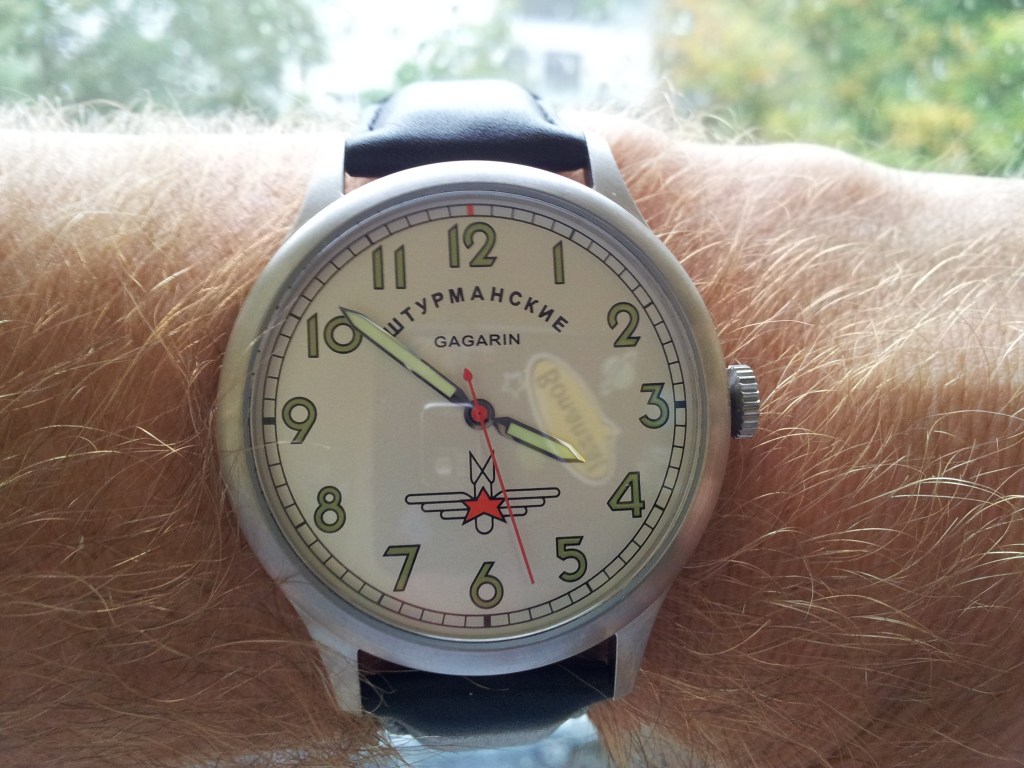
I wore my Sturmanskie wristwatch with pride; it gave me a great deal of enjoyment. Whilst not a mechanical watch, clearly manufactured for travel retail, I adored everything about it. It looked different, it kept perfect time, it was light and discreet, and it didn’t draw any attention — not that I noticed anyway. I don’t remember a single comment ever being made about it… until a cold December night in 2017.
Act V: The Collision
Years later, after I had returned to the UK, I took a seasonal Christmas job with a well-known wine company in my hometown. The wine itself didn’t quite suit my palate, but the delivery side of the business suited my soul. It was tough, physical work — navigating rough roads, biting winter weather, and long hours across a massive rural territory — but it gave me purpose.
It was on one of those gruelling, freezing winter nights that my path crossed with a different kind of reality. Exhausted, having missed my breaks, I pulled into a brightly lit service station, drawn in by the promise of a hot coffee. Needing a little extra comfort, I skipped the stale pastries and walked into the main shop to find a chocolate bar — subconsciously, perhaps, chasing the comfort of that ice-cold Twix from my easyJet days.
As I walked through the door, I froze. Standing inside were two people, one of whom was a prominent television celebrity — a highly experienced antique expert and auctioneer whose sharp wit and deep historical knowledge I had admired on screen for years.
Yielding to a rare moment of spontaneous curiosity, as I passed her I extended my arm to show her the cream dial and the red winged star. I asked a light-hearted, polite, and completely respectful question: “Any value?”
I knew it wasn’t a rare 1957 vintage mechanical timepiece. It was a joke, a brief moment of human connection on a cold night.
She looked at the watch, then looked at me, and delivered a line that hit me like a physical blow: “Worthless, utterly worthless… just like you.” She then looked away.
The words blindsided me. Having spent nine years in the Royal Navy as an aircraft firefighter and medic, followed by a long police career spent handling some of the roughest parts of society, I had seen life at its rawest — and had been called almost everything under the sun — and had learned to brush it off. But, I had never been called worthless. Never. Nor had I ever used such a word to describe another human being.
Speechless, confused, and carrying a deep, heavy hurt, I didn’t stop; I just continued to walk out into the cold night, instantly blaming myself for opening the door to such cruelty. I blamed myself. I really did. What on earth did I expect? I was horrified, even ashamed. I sat in the driving seat of my van, wishing I were somewhere else. It was dark, bitterly cold, and beginning to drizzle. I had two more deliveries and was a long way from home. I sat there for some time, having lost my appetite and any desire to drink my rapidly cooling coffee. I tried to find excuses for her behaviour: she was having a bad day, perhaps; maybe she thought me rude, stupid, or worse — not socially worth engaging with. I made a vow to myself: I must not tell anyone else. It was just so hurtful and embarrassing.
The Sturmanskie came off my wrist that night. I couldn’t look at it without tasting the bitterness of that encounter. I tucked it deep into my sock drawer, hoping to bury the memory with it. I often saw the same celebrity on television, despite holding no malice or ill will towards her, it was difficult viewing. The memory of that night just returned to haunt me. I’d walk away, turn the channel over… anything just to not re-live that night. Even years later, whilst I was preparing some food, my daughter called out, hoping to tease me, “Hey dad, you like this lady on TV, yes?” I turned around to see the same celebrity on the screen. I nearly, so very nearly, explained to my daughter what the person had said to me. That she had described her father as worthless. I just couldn’t relate the sorry tale. I felt my story might not be believed, or my daughter would understand the hurt I’d experienced and feel sad for me.
Act VI: Forgiveness and Reclaiming the Star
So, my watch lay there under a pile of socks, ticking away in the dark until the battery drained, and the hands stopped at 3:26 — morning, afternoon, the exact date, I have no idea.
Until a few days ago.
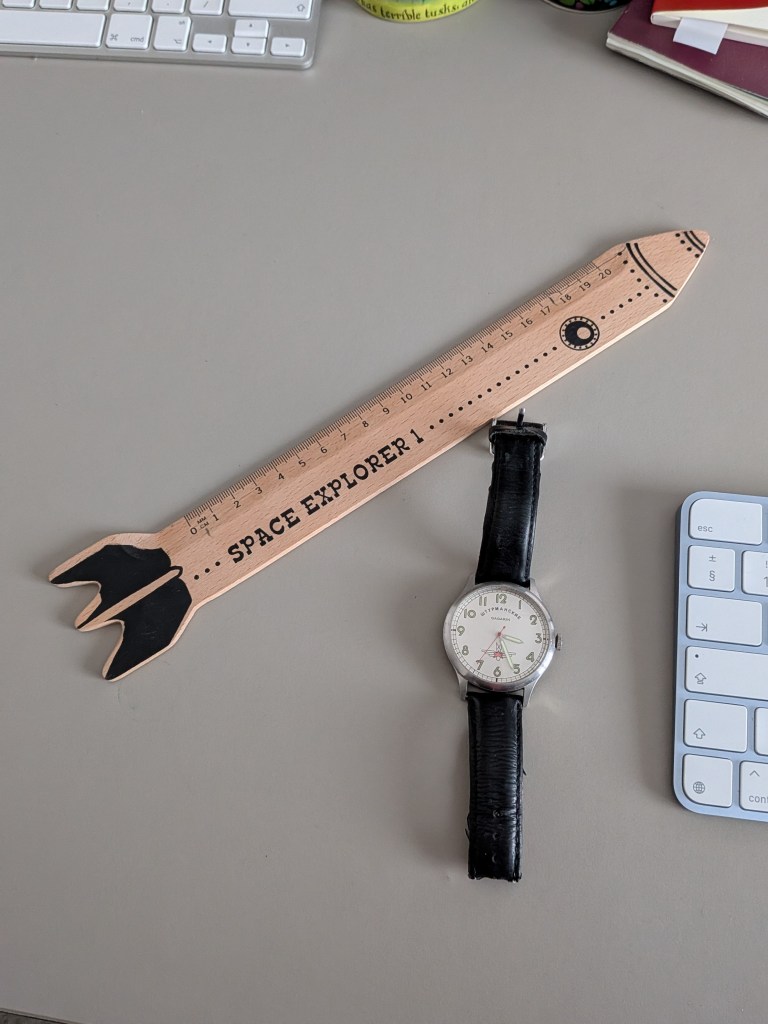
While tidying up my sock drawer, I came across the simple cream face and the iconic red star and brought the memory back to me. Holding it again, the fog of that old encounter finally cleared, and the true legacy of the watch came rushing back.
A television auctioneer can only see value if an item can be bought and sold for a profit. But some things possess a wealth that cannot be measured in pounds and pence. This watch carries the spirit of a life-sized mannequin named Ivan, flung into the atmosphere to pave the way for history. It carries the memory of Blackie the dog, charting unknown territory with a secret timepiece strapped to her leg. It carries the weight of Yuri Gagarin, choking for oxygen beneath a canopy of silk, proving that humanity could reach for the stars and survive the fall.
More than that, it carries my own history. It is a monument to my leap of faith into Poland, to the happy memories of Silesia, and to the resilience it took to rebuild my life and deliver an honest day’s work on freezing rural roads.
A wristwatch tells you where you are in time. It took me years to realise that this simple watch was waiting for me to catch up to it. It doesn’t belong at the bottom of my sock drawer, and its worth is not dictated by a cruel word in a service station. It belongs on my wrist. It just needs a new battery, and then, like the cosmonauts before it, it will be ready to face the world once more.


Leave a Reply