Cake isn’t Bread
One of my earliest misunderstandings came when I wandered into a cukiernia near my hostel in Łabędy, I was determined to buy something — anything — other than a banana and a self-serve bułki from Biedronka, just to prove I could manage elementary Polish.
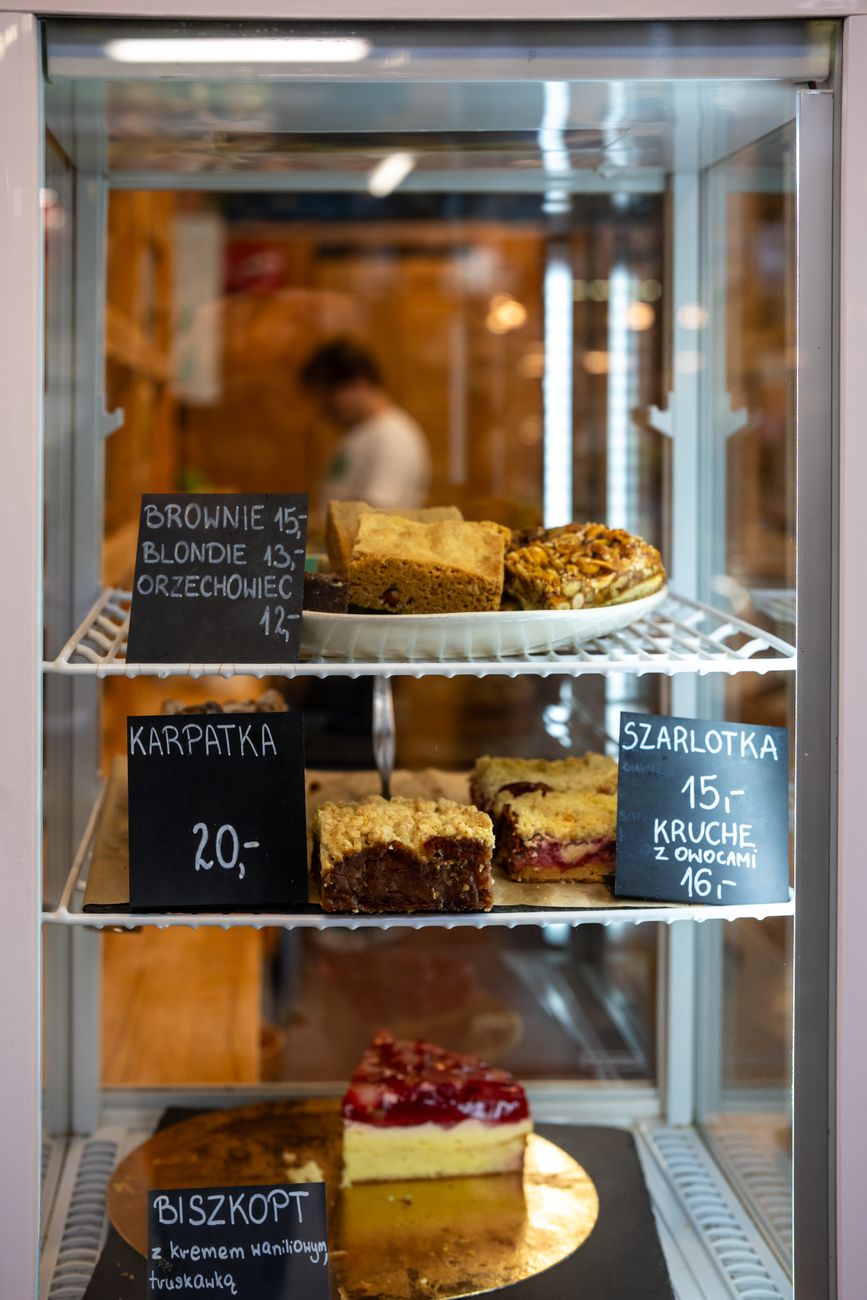
I can still see the trays of cakes in that cukiernia: huge tray‑bakes cut into perfect squares, stacked on a wheeled metal rack with layer upon layer of sweetness. They looked magnificent. There were traditional cakes too, the kind I’d seen in Polish homes — sernik, makowiec, karpatka. Everything looked delicious, comforting, safe.
And honestly, the place looked as if it might sell bread. Counters, trays, the smell of baking — all the familiar signals of somewhere you could ask for chleb i bułki without sounding absurd. I didn’t know yet that a cukiernia wasn’t a bakery. I didn’t know the invisible distinctions locals never have to think about.
So I walked in determined.
I would buy something.
I would manage.
I would prove to myself that I could live here.
But determination evaporates quickly when you don’t know what you’re doing — and even faster when you realise, too late, that you’ve misunderstood the kind of place you’ve stepped into.
I asked for chleb i bułki — bread and rolls. The words came out confidently, and then hung in the air like a mistake I couldn’t pull back.
One of the women said something I didn’t understand and shook her head.
They turned back to their work, probably thinking nothing of it, but at that moment it felt as if I’d asked for something utterly absurd.
I suddenly felt very visible, and very out of place.
I stood there utterly bewildered, willing myself to pull it together, to order something, anything. Time seemed to freeze. I can still see the beautiful selection of cakes, the metal rack stacked with pastries, and the two women moving around it with brisk efficiency while I hovered uselessly in front of the counter. If I could have clicked my fingers and disappeared, I would have.
My confidence collapsed almost instantly. It wasn’t the mistake itself that unsettled me, but the sudden realisation that I was completely unprepared for even the simplest interaction.
I felt the heat rise in my face. My confidence collapsed almost instantly. It wasn’t the mistake that unsettled me, but the sudden realisation that I was completely unprepared for even the simplest interaction.
They were probably just surprised, and I doubt they meant anything unkind. But feeling overwhelmed and out of my depth, it felt sharper than it probably was.
After what felt like an eternity, I tried again — but all I could manage was to point at something that looked vaguely like a Danish pastry and ask for two. Later, I learned it was a drożdżówka. One of the women bagged them without a word.
I placed a 20 zł note into the cash tray, hoping that at least I was following the right etiquette.
But they didn’t have change for such a large note.
The questions came quickly, and I understood almost none of them.
I could feel myself becoming a small complication at the counter, even though they were only trying to sort out the payment.
I apologised in broken Polish and said I was English. I emptied my pockets into the tray, dropping a 5 zł coin and some other coins, including tiny grosze that I wasn’t sure would cover any kind of purchase. They sorted out the payment, counting the change carefully into the tray — and somehow, by the end of it, I had acquired more tiny grosze than when I emptied my pockets.
I gathered it up without checking and escaped with my paper bag of drożdżówki radiating warmth through the paper into my hand.
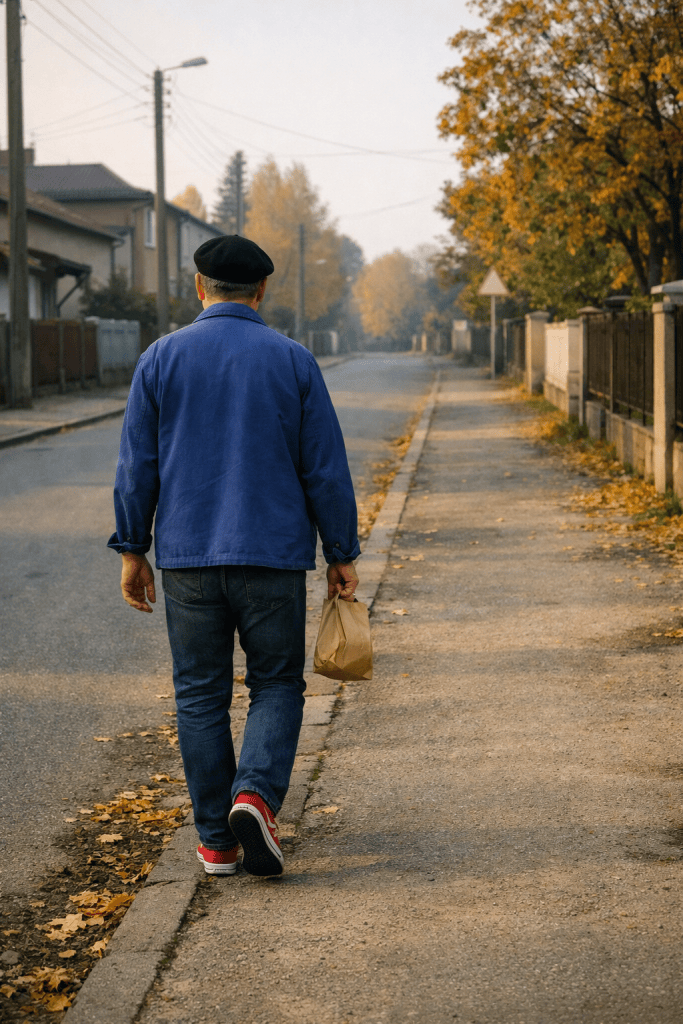
A reflective walk back carrying drożdżówka — every cloud has a silver lining
 Ghosts to Carry, Stories to Keep
Leave a comment