The Move and Arrival in Łabędy
I didn’t realise, not fully, how much of my future I had already set in motion. Those Polish lessons I’d taken — the ones I treated as a curiosity, a polite nod to a country I visited often — suddenly revealed themselves as preparation. Not deliberate or strategic or sensible, but the quiet kind that builds in the background while you’re busy doing something else. I had learned just enough Polish to feel brave, and nowhere near enough to be safe.
Looking back now, the clues were everywhere. I just didn’t fully recognise them at the time. The decision to leave the Police came like a trapdoor opening beneath me. In 2009 I was planning seven more years of service; the next, I was staring at a pension calculation that said I could walk away in 2010. I remember the shock more than the freedom. What now? And then the suggestion — half‑serious, half‑hopeful — from Polish friends: “Come to Poland. Teach English. We’ll help you.”
It sounded mad. It sounded perfect.
I had spent three years visiting Poland, eating obiad in warm kitchens, being fed, guided, and looked after. I knew Katowice, Gliwice, Bytom. I knew zapiekanka and schabowy and the strange comfort of Polish fast food. I knew the rhythm of Polish hospitality, the way people fed you before they asked questions. But visiting is not living. I didn’t fully understand that yet.
Two days after leaving the Police, I landed in Poland with two jobs lined up, a handful of phrases, and the belief that offers of assistance would smooth the way. In reality, I was painfully unprepared. I had underestimated everything — the language, the bureaucracy, the loneliness, the sheer weight of starting again.
My first home was the small hotel — or rather hostel — in Łabędy. It wasn’t glamorous, but it was mine. A room, a bed, a door I could close. I bought a bułka and a banana from the nearby Biedronka store because I didn’t know what else to buy. I didn’t know how to order anything more complicated. But that wasn’t entirely true.
The strange thing was… I did know some Polish. I knew how to ask for things. I could manage simple phrases. Later, I even became good at coping — holding out coins for a cashier to choose the right amount, rehearsing twenty everyday sentences until they came out fluently. But in those early days, knowledge wasn’t the problem. Confidence was. And something else too: I didn’t want to ask for help. I didn’t want to seem helpless, or be a burden, or admit how lost I really was.
Asking if someone spoke English was too easy, and once a lady threw the question straight back at me: “Why should I speak English? I’m Polish. In Poland. You should speak Polish too.”
She had a point.
I didn’t want to ask for help.
And then — as so often happens in Poland — someone stepped in.
The details are simple: a meal offered, a gesture of concern, a kindness that arrived without ceremony. In those early days, food was not just food. It was rescue. It was reassurance. It was the reminder that I wasn’t entirely alone. The hospitality I had known as a visitor returned, but now it carried a different weight. It wasn’t just generosity; it was survival.
Those first meals kept me afloat when everything else felt uncertain. They were the bridge between the life I had left and the life I was trying to build. Slowly, I began to understand something important: I hadn’t simply chosen Poland. In its own quiet way, Poland had made room for me too.
Standing in that small hotel room, I realised something that had been building for years:
This wasn’t a visit any more.
This was my life now.
And it would begin, as so many Polish stories do, with acts of friendship, extraordinary kindness — and food.
The Hostel, the Restaurant, and the Awkward First Meals
The hostel in Łabędy had a small restaurant attached. I remember it being divided into two areas, though I couldn’t tell you now what the difference was. I used it rarely, and I still don’t fully understand why. It would have made life easier. But something in me hesitated.
Maybe it was shyness.
Maybe it was the feeling of being an outsider.
Maybe it was the atmosphere.
In the evenings the place was busy, filled with men who seemed to be staying there to be close to the huge industrial zone down the road. Many were from other countries — Germans especially — and the whole place reminded me faintly of a motorway service‑station canteen. Not unfriendly, not unpleasant, just… functional. A place for people who knew exactly why they were there.
Some days I didn’t know why I was there.
Not yet.
The staff were friendly. Breakfast was usually scrambled eggs and sausages, served without fuss by two young ladies, identical twins. I used to watch them and wonder if they ever had some innocent fun swapping roles, confusing guests who were only half awake. In my head I started thinking of them as “The Breakfast Twins” — appearing each morning with the same calm efficiency, the same quiet smiles.
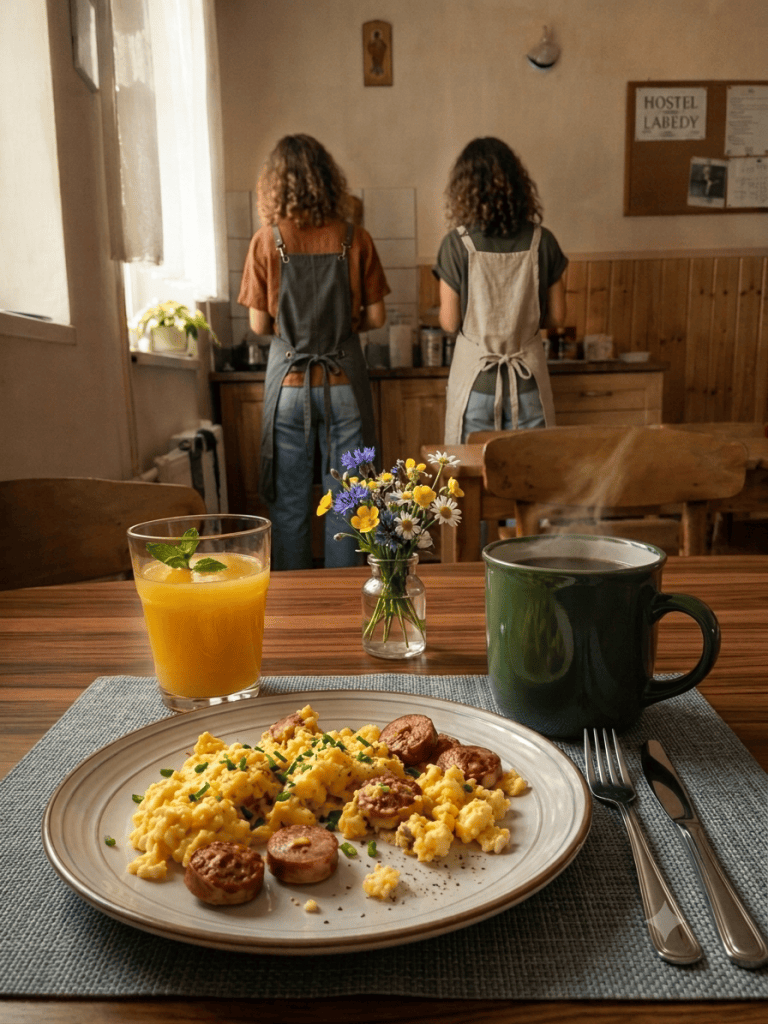
śniadania with the twins
In the evenings, until ten., they served Polish dishes — proper meals — but I was teaching most afternoons and often didn’t return till after nine, and by the time I returned I felt too awkward to walk into a room full of strangers who all seemed to belong there more than I did. I used to look longingly through the window as I passed. There was draught beer, a television on the wall, people relaxing after work. It seemed impossibly easy for them. I often thought to myself that I might pop down later, but once I closed the door to my room, I never did.
So I made do.
Most evenings I bought a packet-soup, a banana and a bułka — if there were any left — from Biedronka and called it dinner. It wasn’t a choice. It was a retreat — a way of avoiding embarrassment, avoiding conversation, avoiding the possibility of getting something wrong.
And of course, I did get things wrong.
Cake isn’t Bread
One of my earliest mistakes came when I wandered into a cukiernia near my hostel, determined to buy something — anything — just to prove I could manage.
I can still see the trays of cakes in that cukiernia: huge tray‑bakes cut into perfect squares, stacked on a wheeled metal rack with layer upon layer of sweetness. They looked magnificent. There were traditional cakes too, the kind I’d seen in Polish homes — sernik, makowiec, karpatka. Everything looked delicious, comforting, safe.
And honestly, the place looked as if it might sell bread. Counters, trays, the smell of baking — all the familiar signals of somewhere you could ask for chleb i bułki without sounding absurd. I didn’t know yet that a cukiernia wasn’t a bakery. I didn’t know the invisible distinctions locals never have to think about.
So I walked in determined.
I would buy something.
I would manage.
I would prove to myself that I could live here.
But determination evaporates quickly when you don’t know what you’re doing — and even faster when you realise, too late, that you’ve misunderstood the kind of place you’ve stepped into.
I asked for chleb i bułki — bread and rolls. The words came out confidently, and then hung in the air like a mistake I couldn’t pull back.
One of the women said something I didn’t understand and shook her head.
They turned back to their work, probably just continuing with their day, but in that moment it felt as if I’d asked for something ridiculous.
I suddenly felt very visible, and very out of place.
I stood there utterly bewildered, willing myself to pull it together, to order something, anything. Time seemed to freeze. I can still see the beautiful selection of cakes, the metal rack stacked with pastries, and the two women moving around it with brisk efficiency while I hovered uselessly in front of the counter. If I could have clicked my fingers and disappeared, I would have.
But in that moment, I felt stupid.
Utterly, abjectly stupid.
I felt the heat rise in my face. My confidence collapsed almost instantly. It wasn’t the mistake that unsettled me, but the sudden realisation that I was completely unprepared for even the simplest interaction.
They were probably just surprised, and I doubt they meant anything unkind. But in that moment, overwhelmed and out of my depth, it felt sharper than it probably was.
After what felt like an eternity, I tried again — but all I could manage was to point at something that looked vaguely like a Danish pastry and ask for two. Later, I learned it was a drożdżówka. One of the women bagged them without a word.
I placed a 20 zł note into the cash tray, hoping that at least I was following the right etiquette.
But they didn’t have change for such a large note.
The questions came quickly, and I understood almost none of them.
I could feel myself becoming a small complication at the counter, even though they were only trying to sort out the payment.
I apologised in broken Polish and said I was English. I emptied my pockets into the tray, dropping a 5 zł coin and some other coins, including tiny grosze that I wasn’t sure would cover any kind of purchase. They sorted out the payment, counting the change carefully into the tray — and somehow, by the end of it, I had acquired more tiny grosze than when I emptied my pockets.
I gathered it up without checking and escaped with my paper bag of drożdżówki radiating warmth through the paper into my hand.
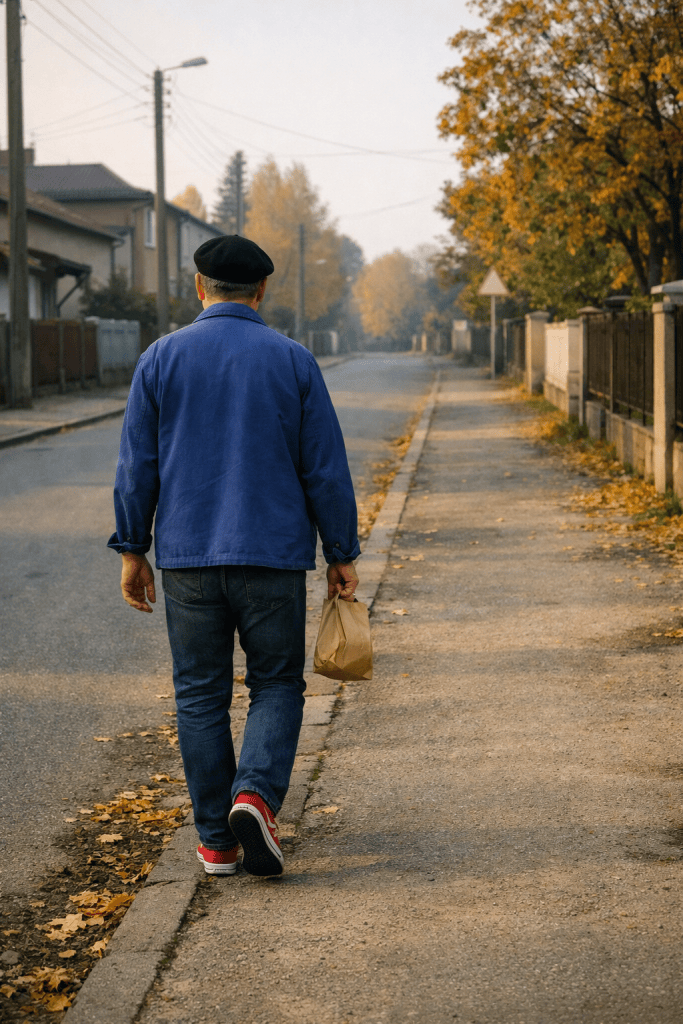
A reflective walk back carrying drożdżówka — every cloud has a silver lining
Winter, Illness, and Rescue Comes from Bytom
Winter came late that year in Łabędy. I even joked about it, how Poland seemed to be holding its breath, waiting for All Souls’ Eve before flipping a switch. But when it arrived, it arrived with intent. One moment I was stepping off trains into mild evenings, the next I was walking out into night air that hit me like a wall. I wasn’t eating properly. I wasn’t asking for help. I was sweating on overheated trains, then wandering into freezing darkness, and my body simply couldn’t keep up.
One night, all of that fell away.
I woke coughing.
At first I tried to suppress it, terrified of disturbing the other residents. The cough grew harsher, deeper, until it shook my whole chest. I lay awake, sweating, dizzy, increasingly unwell. Luckily I had no lessons planned for the next day, or the day after, and the weekend was coming.
I didn’t want to call anyone. I didn’t want to admit I was struggling.
My basic room didn’t even have a kettle. The first-floor room I booked a week in advance was functional: clean toilet, shower, sink. At the end of the landing was a shared kitchen with a kettle and, I think, a toaster.
In the UK we joke about man flu, the exaggerated suffering of a mild cold. This wasn’t that. I knew I needed to hydrate, to eat, to do something. I forced myself down to Biedronka, shivering and sweating at the same time, and bought ibuprofen, bananas, oranges, water, yogurt, and a food I never touched in the UK: a packet of processed tost ser, or toast cheese.
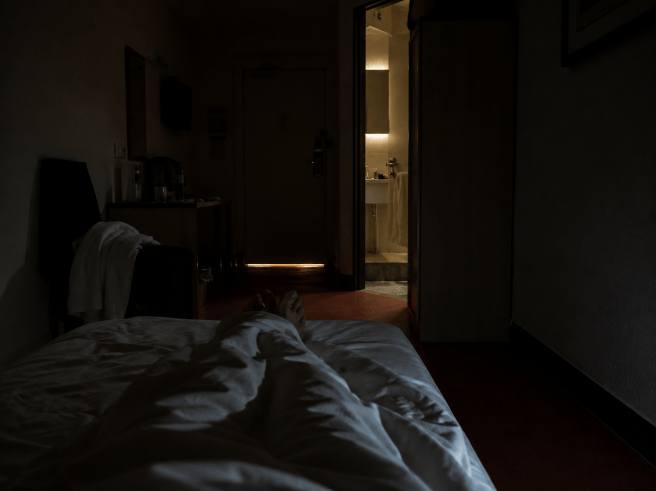
The fluorescent lights of Biedronka were a dizzying blur of foreign labels and sharp, crowded aisles. Back in the quiet safety of the hostel room, the fever raged. A small bedside table lamp offered a sense of comfort, I sat on the edge of the bed, surrounded by a mountain of oranges and a plastic bag of crusty bułki.
I pulled out a slice of Ser Tost. As I peeled back the loud, crinkling plastic, my eyes caught the word printed across the wrapper: SMACZNEGO. Enjoy your meal.
In the heavy silence of a country where I didn’t know exactly who to ask for help, nor even whether I should, I lay back against the pillow, clutched the square of cheese, and whispered back into the dim light:
“Smacznego.”
My Polish friends later became slightly disparaging about my devotion to tost ser, disputing whether it was really cheese at all and treating my affection for those individually wrapped slices as a minor culinary failing. In fairness, one packet I continue to buy years later in the UK proudly declares itself to be “48% cheese,” which probably strengthened their case considerably. Yet this one brand in particular has remained my loyal favourite: the slices with SMACZNEGO printed cheerfully across the plastic, as if offering a heartfelt blessing over something that had only a passing acquaintance with dairy. Even now, my family occasionally catch me standing in the kitchen holding a packet of questionably cheesy cheese, reading that familiar SMACZNEGO and quietly whispering, “Smacznego,” to myself before opening the wrapper. They think I’m slightly odd. They are almost certainly correct.
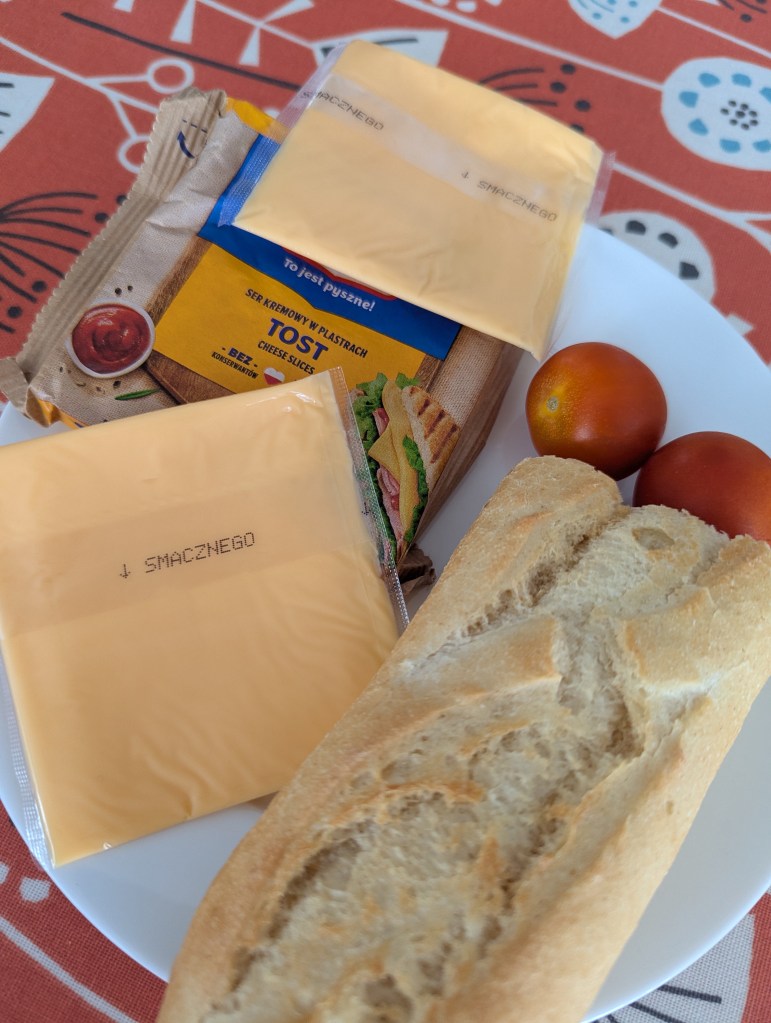
Still eating tost ser in 2026 — smacznego!
But in 2010, and by the weekend, it was clear this wasn’t man flu. I was very, very unwell. Grypa, real flu, had taken hold. I locked myself in my little room, drank as much water as I could manage, took ibuprofen, ate oranges like they were the only food in the world.
I often thought of Jeanette Winterson’s novel Oranges Are Not the Only Fruit — except for me, they were.
The housekeeping ladies became nosy, then concerned. They asked if I needed towels, fresh bedding, anything at all. Beyond that, they left me alone. Eventually I hung a do not disturb sign on the door, not out of rudeness, but fear. Fear of being seen. Fear of being alone in a foreign country with no strength left.
By Sunday I felt a little better, but I have to be honest: I was afraid. Truly afraid.
Then my phone rang.
It was my friend from Bytom. Her family had invited me for Sunday obiad. Could I make it? Was I able to take the train? Did I need collecting from somewhere?
I apologised and explained I was unwell. Immediately I heard concern in her voice, and her mother speaking in a concerned way in the background.
I told her I didn’t feel well enough to travel and that I was grateful, genuinely grateful, that they had thought to invite me.
“OK, Gary, but make sure you drink plenty of fluids, try to eat, take care. I’ll call you tomorrow and check how you are. If you need anything, just let me know.”
We ended the call.
A minute later, the phone rang again.
Then came the words that broke through my fear, my isolation, my stubborn independence:
“Gary, we are coming to you.”
In that moment, everything changed.
I looked around my basic room and tried to tidy it, though there wasn’t much to tidy. I washed my face, got dressed, carried the small amount of rubbish from my waste bin to the shared kitchen bin, opened the windows for fresh air, and waited. I wasn’t actually hungry. I wasn’t feeling strong. I wanted sleep more than anything. But I wanted to be ready.
About an hour later I heard familiar voices on the landing — steady, purposeful footsteps, the kind that belong to people who have come with intent. Then a gentle knock on my door.
I opened it to find my friend and her mother.
I was so happy to see them. Slightly embarrassed, yes, but there was no time to dwell on that. My friend’s mother was a nurse with years of experience, but what she brought that day was more than nursing. It was care of a kind that exceeded any expectation — kindness beyond measure. They had driven from Bytom, almost an hour’s journey in those days, simply because I was unwell and alone.
My friend translated her mother’s words. They had brought food — not just any food, but the food of Polish comfort, Polish healing, Polish Sunday tradition. Rosół, a rich golden chicken broth, still hot inside a thermos flask. And the holy trinity of Silesian obiad: rolada śląska, kluski śląskie, and modra kapusta.
I had no idea how I was going to eat it. I had only a mug and a small side plate. My friend poured the rosół into the mug and passed it to me. I began gently sipping, savouring each mouthful. It was delicious beyond words — the first decent, hot food I had eaten in days. Within minutes I felt a little more like my normal self, a small mercy after days of fear — a moment I didn’t feel completely afraid.
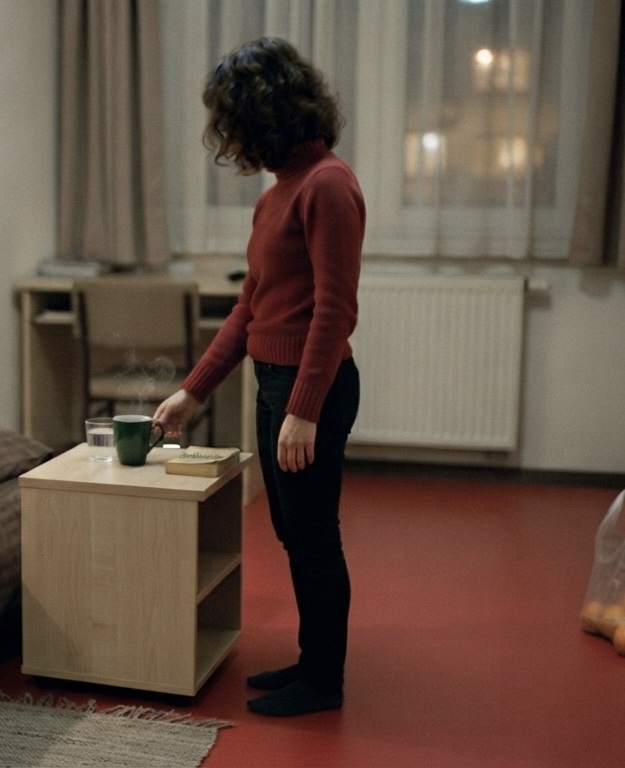
Then my friend laughed — a loud, joyful laugh that cut through the heaviness of the room. She explained that her mother wanted to go to the hotel restaurant kitchen. There would be a microwave, or some other way to heat the obiad properly.
I felt overwhelmed. The soup had already done its work. But my friend said, “Gary… mum won’t take no for an answer. Come on. Just come with us.”
I followed them.
We walked into the restaurant together. My friend’s mother — calm, experienced, and absolutely determined — spoke to the staff with a firmness that made everyone stand a little straighter. I couldn’t understand the words, but I could hear the tone: protective, authoritative, uncompromising.
My friend translated almost apologetically, softening the edges of her mother’s message.
“She says they should be deeply ashamed you were left alone like this.”
The staff’s faces were a picture — startled, sheepish, caught off-guard by a woman who had travelled over an hour to help someone she cared about and was not prepared to tolerate anything less than proper treatment.
She carried it into the kitchen, and when she returned, heat rose from the plate in a soft shimmer. The dumplings released thin spirals of steam. The roulade had relaxed back into tenderness, its sauce warm and glossy again. The red cabbage had regained its scent — sweet, sharp, comforting — the smell of a proper Silesian obiad. It looked like a meal meant for someone who mattered.
I looked at the staff and said the only thing I knew to say at that moment: dziękuję bardzo, and helped myself to a knife and fork from a table.
There was no meal service at that time, so we returned to my room with the plate, still steaming from the restaurant kitchen. I sat down, and my friend’s mother placed the plate in front of me with the quiet authority of someone who had already decided I was going to eat.
I tasted the food — slowly at first, then more steadily. After days of surviving on oranges, bułki and ser tost, mugs of dried soup and kettle water, the first mouthful was almost overwhelming. The roulade rich and savoury, the dumplings soft and yielding, the cabbage bright and gently spiced. It wasn’t just nourishment; it was the first real food my body had recognised in days.
I didn’t feel a sudden surge of strength or any neat, cinematic recovery. It wasn’t like that. But as I ate, the warmth of the food, the presence of two people who refused to leave me alone, the sound of my friend’s voice drifting across the room — it all nudged me back toward myself. Not healthier, not fixed, just more human again. A little steadier. A little less adrift.
Her mother watched me with a troubled kind of patience, as if trying to understand what I had been attempting to endure. She didn’t find anything amusing; she wasn’t there for levity. But there was no judgement in her face, only concern — and that quiet, unwavering concern made the room feel warmer than the food ever could.
So I ate.
And they stayed.
Not hovering, not fussing, not making a spectacle of it — just present.
My friend sat on the chair by the window. Her mother stood with her arms folded gently, watching with the calm focus of a nurse who has seen every shade of human frailty and knows exactly what recovery looks like. My friend laughed once or twice, quietly, relieved to see colour returning to my face. Her mother nodded approvingly, as if ticking off invisible boxes: appetite returning, strength improving, fear easing.
It was such a simple thing — two people watching me while I ate — but it was one of the most profound acts of kindness I had ever experienced. They didn’t rush. They didn’t treat it as an errand. They stayed until the plate was empty, until they were satisfied that I was no longer in danger of slipping back into the weakness that had frightened me.
Only then did they begin to gather their things. Only then did they let the moment end.
When they left, the room felt different. Not larger, not warmer, but somehow safer. The fear that had been sitting in my chest for days loosened its grip. Every mouthful of food I’d eaten carried the unmistakable message: you matter to someone here. I sat on the edge of the bed and listened to the quiet of the hostel — the distant hum of a train passing, the occasional footsteps on the landing, the radiator ticking as it cooled. Ordinary sounds, but they no longer felt hostile. They no longer felt like the soundtrack of isolation.
I have never forgotten that act of kindness. It’s impossible to let it fade into the back rooms of memory; it returns often, unbidden, steady, and unchanged.
That night I lay down, exhausted but no longer afraid, and slept easier for the first time in days.
Work related to my visitor years — a mix of memories in story and verse. 2007-2010
→ First Tastes
→ Elevated Discovery — Katowice
→ Walk & Tram — Katowice: a poem
→ Ôbzdrzōnek przez śniyg — Katowice: a poem
→ Czekając przy torach w śniegu — Katowice: a poem
→ Symbols, Snow and the Train to Wrocław
→ The Grammar of Hospitality

 Ghosts to Carry, Stories to Keep