Snow? Not a problem.
I woke to the sound of movement downstairs — soft, deliberate, domestic. When I pulled back the curtain, I realised why the house felt so different.
The first flakes of snow had begun falling the previous evening during our visit to Katowice, sticking to our coats before tailing us all the way on the journey back to Gliwice. By the time we reached my friend’s home tucked away in her small village, the flurry had turned into a slow, steady, quiet and gentle snowfall,
By morning, the snowfall had finally stopped, leaving behind a world buried in pure, deep white.
Not the decorative British kind that flirts with the ground for ten minutes before causing national paralysis.
Real snow.
Snow with intent.
Outside had been completely transformed overnight. Back home, winter mornings are a damp, apologetic grey. Here, the light was a bright, heavy white that forced its way through the fabric of the curtains, carrying that profound stillness only fresh, heavy snow can produce — an absolute quiet, as if the entire world were holding its breath. Every roof, fence post, and branch carried a thick, sculpted layer of winter, turning the quiet Polish countryside into something straight out of a fairy tale.
Downstairs, the house had already settled into its quiet rhythm: the muffled clink of porcelain, the low hum of Polish morning radio, the soft shuffle of someone already dressed and caffeinated. Outside, the landscape had vanished under a thick, deliberate blanket of snow — the kind that doesn’t merely fall but commits.
I washed, dressed, and made my way down.
“Wrocław trip off then?” I asked, assuming the obvious.
“No worries,” my friend said, barely glancing up from her coffee.
“Winter tyres.”
And that, apparently, was the end of the matter.
Outside sat my friend’s car: a tiny, lightweight Fiat Cinquecento 700, born and bred just down the road at the factory in Tychy. Blanketed completely in its own miniature snowdrift, it looked impossibly small against the landscape — less like a car, more like a geological garden feature. A soft, rounded mound of white with only the faintest suggestion of mirrors and door handles.
My friend had already carved a narrow path from her front steps to the car, a trench of determination through the snow. All that remained was to free the Fiat from its blanket of the driest powder snow I’d ever seen outside the Canadian Rockies.
Of course, I helped — or rather, I tried to help.
She emerged carrying the sort of brush that, in Britain, would be used to clean a stable or sweep a patio.
She handed me a second one — a far smaller, broad, stiff‑bristled hand brush, and wonderfully utilitarian. In Poland, it’s simply standard winter equipment that is kept in the car. My usual British ice scraper suddenly felt like a novelty toy. The snow wasn’t wet or slushy; it was that dry, powdery kind that lifts off in sheets, like brushing flour from a counter top. Roof, bonnet, windscreen, lights, door seams — each surface had its own technique, its own rhythm.
By the time we finished, we looked like aircrew preparing a Sopwith Camel for takeoff. Layers upon layers, scarves wound high, hats pulled low, boots built for tundra. The cold wasn’t biting — it was structural, the kind that shapes how you move, how you dress, how you think.
She climbed into the driver’s seat with the composed seriousness of someone who understood exactly what the road demanded. She sat bolt upright, both hands firmly on the wheel, eyes forward, fully present. If she was nervous, she didn’t show it. If she was confident, she didn’t flaunt it. She simply concentrated.
I settled into the passenger seat, mirroring her posture without meaning to. Upright, alert, trying not to interrupt her focus. The Fiat’s tiny engine buzzed beneath us, a soft mechanical hum swallowed by the heavy snowfall outside.
In Britain, winter, usually meant a quick dash to my car — either without a coat, carrying one or having worn a coat, removing it before getting in — and the screen heater clearing the windscreen in seconds. In Gliwice, we climbed into the Fiat wrapped in layers of heavy clothing, scarves and gloves included, and waited while the heater slowly coaxed warmth into the cabin. Even that small moment made me realise how far from home I really was.
As we eased off her drive and onto the narrow single‑track road, the little Fiat struggled for a moment. I thought, “Right… at least we tried. I wonder if we have a plan B.’” I hadn’t thought of one.”
Travelling on the right side of the road felt strange — a quiet, persistent wrongness tugging at my British instincts — but I kept my thoughts to myself. Every so often, I offered a small, encouraging comment: I genuinely was very impressed.
“Oh, that was good driving.”
“Well done.”
“No worries.”
Little acknowledgements, nothing that might break her concentration.
Meanwhile, the snow on my boots had begun to melt. Slowly, inevitably, it pooled into a small lake trapped by the rubber mat in the foot well. I felt a creeping embarrassment about it — a private shame at my failure to brush myself off properly before getting in. I tried to keep my feet still, as if that might somehow stop the water spreading.
Outside, the village roads were white corridors, the car gliding through them with a kind of determined fragility. She handled each corner with careful precision, easing the Fiat through the snow‑choked streets as though guiding a small boat through ice floes. No frantic movements, no sudden braking — just steady, methodical driving.
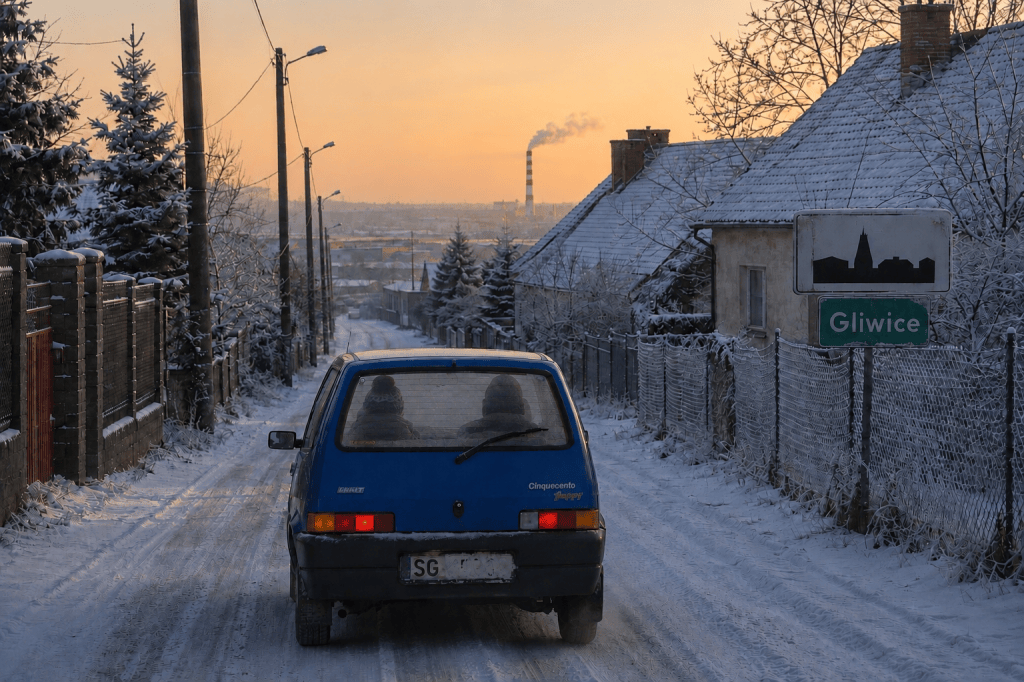
Reaching Gliwice, I was amazed, but after ten minutes of witnessing her driving, not surprised we’d managed to make it. Despite the work done by snow ploughs, the main roads still seemed undrivable by UK standards. Eventually, she eased the Fiat into a tight, snow‑choked side street off Zwycięstwa, navigating the high banks piled up by the ploughs. With a practised flick of the wheel, she guided the car into a narrow parking space that most UK drivers wouldn’t attempt on a dry summer afternoon.
She killed the engine.
Silence — the same muffled quiet as the snowy city outside.
And just like that, the journey was over.
I stepped out into the crisp Polish air, profoundly impressed and entirely safe, and finally letting go of the bag I’d been clutching on my knees.
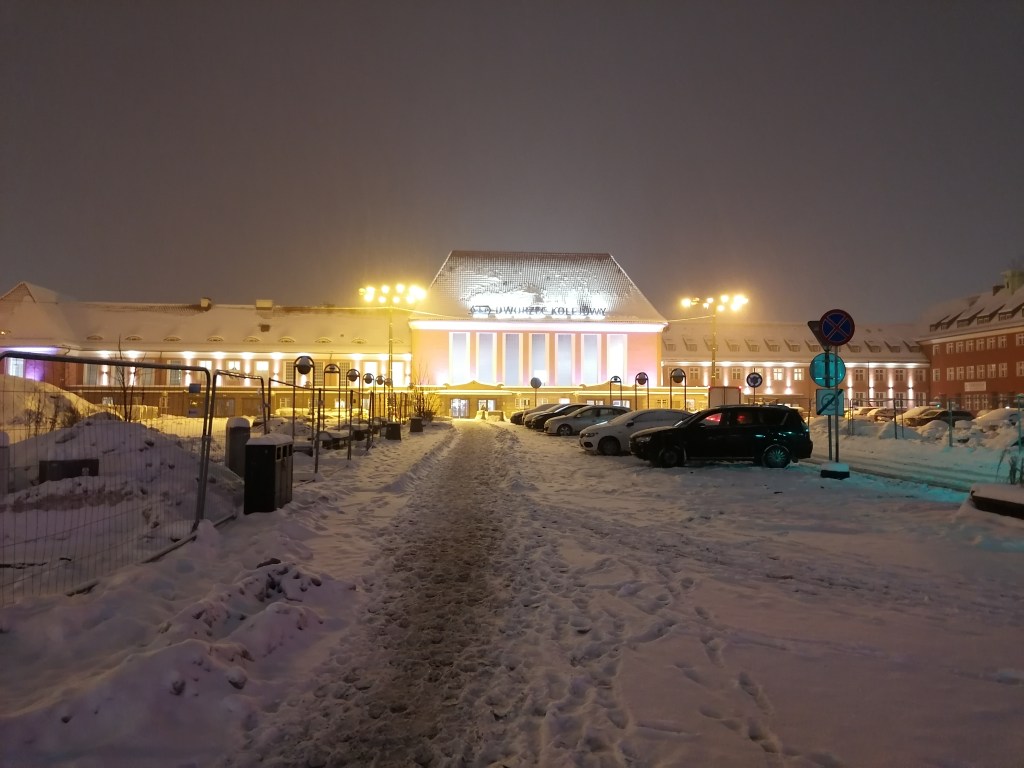
When we reached Gliwice station, the entrance floor was wet with melted snow. I did not know then that this surface, once damp, possessed the frictional properties of polished ice. I would learn that later, on another day, by landing squarely on my backside with considerable force and very little dignity.
But that first morning, I was still innocent.
Years later, I found photographs of the inside of Gliwice station on Wikimedia Commons, taken in 2013. Seeing them felt like opening a sealed room in my own memory.
There was the polished stone floor. The vast mural high above the hall. The long rows of plastic seats. The old departures board. The clock, strangely ordinary for something so important. And that light pouring down from the high windows.
Meanwhile, our other friend was making her own journey through the snow from Bytom. At the time, I had no idea what that really meant. I did not understand the early buses, the tram connections, the waiting in freezing weather, the uncertainty. I only knew we were waiting for her, and I hoped she would make it.
Then she appeared in the ticket hall, cheeks red from the cold, a covering of fresh snow on the hood of her coat, smiling as if crossing half of Silesia in winter were the most ordinary thing in the world.
Looking back, I understand far more than I did then.
She had made a serious effort for me. That kind of friendship reveals itself quietly. No speeches. No drama. Just someone deciding to show up, then doing exactly that.
I remembered standing there as a newcomer, trying to look as though I knew what I was doing. I did not. Not remotely. Everyone else seemed purposeful, fluent, certain. My friends moved easily through the system while I hovered behind them, nodding at moments that felt appropriate.
The station felt enormous then. Not only in size, but emotionally. It was a place full of movement and intention. Everyone appeared to know where they were going. I didn’t. But I didn’t need to. Not yet.
Before the train arrived, we went into the PKP canteen just off the main hall. It was my first experience of that style of Polish railway eatery, and it left an impression.
Behind the counter stood a team of women who appeared to be wearing what looked like white lab coats. Unknown to me at the time, a white coat or smock was classic Polish kitchen workwear. There was a selection of soups and stews on offer which, considering it was still breakfast, surprised me. I hadn’t expected anything quite so substantial at that hour — especially not while slightly hungover.
One of the women, whom I assumed to be the head cook, answered my friends’ questions about what was on the hot plate. I distinctly remember her gently stirring one of the pots, a slight skin having formed on the surface, and telling my two friends what was inside. They paused, checked with each other, and then translated it for me.
It was lung soup.
Real lung soup — I’m sure it contained other ingredients, including some vegetables — a soup offering an authentic nose‑to‑tail eating experience. My friends, however, had suddenly adopted the alert posture of people who fear a British man is about to agree to something out of sheer politeness. I could almost feel them willing me not to nod.
I declined as politely as international diplomacy allowed. Furthermore, I’d never eaten offal in my life — not even as a child — and the idea of starting that journey at second breakfast defeated me.
The head cook looked relatively disappointed, and I felt a small, unexpected flicker of shame, despite having been nothing but courteous.
My friends ordered something safer, and I followed their lead. Buttered toast and coffee. I especially remember the coffee — vividly so. It arrived in a glass, boiling hot, with a thick layer of grounds floating on top like industrial peat.
Determined not to offend local custom, I lifted the glass and attempted to drink it exactly as served. I was rewarded with a mouthful of coffee grounds. My friends burst out laughing.
“Gary, stir it.”
Apparently, this was known to everyone except me.
I stirred cautiously, like a man handling unstable chemicals, and watched the grounds sink to the bottom. Then came the second lesson: never drink the last centimetre.
The railway was educating me already.
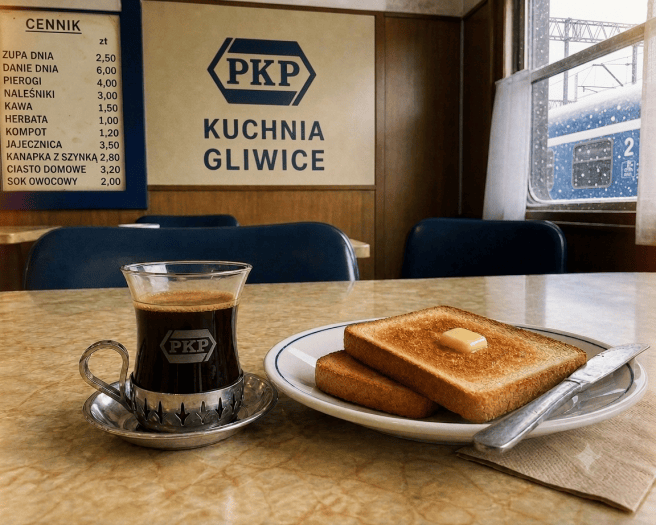
Photo: Gliwice train station in snow (2022) by Abraham, licensed under CC BY‑SA 4.0. Source: Wikimedia Commons.
 Ghosts to Carry, Stories to Keep
Leave a comment