Public transport in Britain was never really my world. I cycled locally, or used a motorcycle or car for most of my adult life. Occasionally I caught the bus into Chester, which did little to improve my opinion of buses. Trains, though, I liked. There was something civilised about them. A seat by the window, the quiet promise of movement, the sense that someone else was handling the difficult parts.
So it still amuses me that my real education in public transport happened not in Britain, but in Poland.
There, buses, trams and trains were not occasional conveniences. They were woven into daily life. In Silesia they formed a kind of circulatory system, carrying people steadily from town to town, district to district, through weather that would have caused a national incident back home.
I could have driven. I was offered the use of a car, and I drove occasionally. But I found myself drawn instead to stations, timetables, ticket windows, and the peculiar freedom of letting the railway decide the route.
In time, I became confident enough to travel from Kraków Airport into the city, then onwards to Gliwice. First class, naturally. Why crawl into competence when you can arrive with style? The trains were often slow, but I never minded. I could sit by the window and watch Silesia pass in long grey-green paragraphs.
But before all that came the visitor years: 2007—2009.
Back then, I understood very little, at least not in the way I thought I did.
I travelled with Polish friends who bought the tickets, found the platforms, translated announcements and quietly ensured I did not board something heading for the far side of Europe. I was still a tourist then, wrapped in other people’s competence.
And yet, even in those early days, something unexpected happened — something that didn’t rely on anyone else’s competence at all, but on a fragment of history I had carried with me since childhood.
I’d like to share a short story first, it seems remarkable despite all the tourist guides I’d bought, I didn’t know about two small signs.
My first full day in Poland had already been extraordinary — a visit to Radiostacja and an unexpected, but fascinating, guided tour of the control room there, and not even my two friends had imagined that might occur. A wander around the Rynek and stop for refreshments in the kawiarnia located inside the Ratusz in Gliwice, and the slight panic of being unable to decipher the signs for the male and female toilets located there. No one had ever mentioned it. Not once. And despite carrying three phrase books like a diligent Boy Scout, not one of them thought to warn me that Polish toilets sometimes used geometric symbols instead of words. I had been very proud of myself to ask in Polish where the toilets were, and had merely followed a pointed finger to the stairs that descended below.
So there I was, increasingly desperate, staring at two doors, neither with symbols which appeared to have any obvious relationship to human anatomy.
A simple circle on one door and an inverted triangle on the second.

Rather than walk back and ask my friends — which would have required admitting I couldn’t even find the correct door — I took a punt on the circle. I knocked and eased it open slowly, ready to retreat if anything inside hinted I’d made a terrible mistake. It was very modern, spotlessly clean, industrial‑style stainless steel and black fixtures — just cubicles — and it didn’t look or feel right.
A quick retreat felt wise.
I knocked on the triangle door, slowly pushed it open, and there it was — the familiar, reassuring outline of male‑oriented fixtures. I let out a quiet, grateful sigh of relief — and with it, the sense of stepping into a place that was both foreign and strangely familiar.
I returned to my friends and told them the whole story. They laughed — loudly, joyfully — the kind of laughter that comes not from mockery but from recognising a classic “first time in Poland” moment. They said they were surprised the Kawiarnia had kept the old geometric symbols at all. It had recently undergone extensive modernisation, and everything else inside was sleek and contemporary. You’d think, they said, that someone would have replaced the triangle and circle with something a little more obvious. I thought it was amazing, unique and very creative. My two friends seemed unable to offer an explanation as to what the symbols were supposed to represent. “Just learn it, Gary — you’ll probably not see it used again” was the best answer they could offer.
I made a note in the back of my go-to phrase book, right next to the page where I’d written down the words for “Pracuję w policji północnej Walii” and “opóźniony” and underlined it twice. In the four years I lived there, I rarely saw those symbols again — but from that day on, I was prepared.
The day ended with us tucked into a small Polish pizza‑chain restaurant, the kind of place I’d grew to adore far more than I expected. The warmth of the room wrapped around us as we shared incredible pizza, the kind that somehow tastes better when you’re laughing with two remarkable friends. In that moment — between the laughter, the clatter of plates, and the soft hum of conversations around us — I felt something shift inside me. I wondered what other adventures were waiting just beyond tomorrow, what pieces of myself I might discover next.
My friends had already decided that the second day of my visit would be a trip to Katowice, but it was the third day—the one they teased with knowing smiles—that would end up sealing something deep within me, something I hadn’t yet found the words for.
Day 3: A Snowy Trip to Wrocław
I woke to the sound of movement downstairs — soft, deliberate, domestic. When I pulled back the curtain, I realised why the house felt so different.
The first flakes of snow had begun falling the previous evening during our visit to Katowice, sticking to our coats before tailing us all the way on the journey back to Gliwice. By the time we reached my friend’s home tucked away in her small village, the flurry had turned into a slow, steady, quiet and gentle snowfall,
By morning, the snowfall had finally stopped, leaving behind a world buried in pure, deep white.
Not the decorative British kind that flirts with the ground for ten minutes before causing national paralysis.
Real snow.
Snow with intent.
Outside had been completely transformed overnight. Back home, winter mornings are a damp, apologetic grey. Here, the light was a bright, heavy white that forced its way through the fabric of the curtains, carrying that profound stillness only fresh, heavy snow can produce — an absolute quiet, as if the entire world were holding its breath. Every roof, fence post, and branch carried a thick, sculpted layer of winter, turning the quiet Polish countryside into something straight out of a fairy tale.
Downstairs, the house had already settled into its quiet rhythm: the muffled clink of porcelain, the low hum of Polish morning radio, the soft shuffle of someone already dressed and caffeinated. Outside, the landscape had vanished under a thick, deliberate blanket of snow — the kind that doesn’t merely fall but commits.
I washed, dressed, and made my way down.
“Wrocław trip off then?” I asked, assuming the obvious.
“No worries,” my friend said, barely glancing up from her coffee.
“Winter tyres.”
And that, apparently, was the end of the matter.
Outside sat my friend’s car: a tiny, lightweight Fiat Cinquecento 700, born and bred just down the road at the factory in Tychy. Blanketed completely in its own miniature snowdrift, it looked impossibly small against the landscape — less like a car, more like a geological garden feature. A soft, rounded mound of white with only the faintest suggestion of mirrors and door handles.
My friend had already carved a narrow path from her front steps to the car, a trench of determination through the snow. All that remained was to free the Fiat from its blanket of the driest powder snow I’d ever seen outside the Canadian Rockies.
Of course I helped — or rather, I tried to help.
She emerged carrying the sort of brush that, in Britain, would be used to clean a stable or sweep a patio.
She handed me a second one — a far smaller, broad, stiff‑bristled handbrush, and wonderfully utilitarian. In Poland, it’s simply standard winter equipment that is kept in the car. My usual British ice scraper suddenly felt like a novelty toy. The snow wasn’t wet or slushy; it was that dry, powdery kind that lifts off in sheets, like brushing flour from a counter top. Roof, bonnet, windscreen, lights, door seams — each surface had its own technique, its own rhythm.
By the time we finished, we looked like aircrew preparing a Sopwith Camel for takeoff. Layers upon layers, scarves wound high, hats pulled low, boots built for tundra. The cold wasn’t biting — it was structural, the kind that shapes how you move, how you dress, how you think.
She climbed into the driver’s seat with the composed seriousness of someone who understood exactly what the road demanded. She sat bolt upright, both hands firmly on the wheel, eyes forward, fully present. If she was nervous, she didn’t show it. If she was confident, she didn’t flaunt it. She simply concentrated.
I settled into the passenger seat, mirroring her posture without meaning to. Upright, alert, trying not to interrupt her focus. The Fiat’s tiny engine buzzed beneath us, a soft mechanical hum swallowed by the heavy snowfall outside.
In Britain, winter, usually meant a quick dash to my car — either without a coat, carrying one or having worn a coat, removing it before getting in — and the screen heater clearing the windscreen in seconds. In Gliwice, we climbed into the Fiat wrapped in layers of heavy clothing, scarves and gloves included, and waited while the heater slowly coaxed warmth into the cabin. Even that small moment made me realise how far from home I really was.
As we eased off her drive and onto the narrow single‑track road, the little Fiat struggled for a moment. I thought, “Right… at least we tried. I wonder if we have a plan B.’” I hadn’t thought of one.”
Travelling on the right side of the road felt strange — a quiet, persistent wrongness tugging at my British instincts — but I kept my thoughts to myself. Every so often, I offered a small, encouraging comment: I genuinely was very impressed.
“Oh, that was good driving.”
“Well done.”
“No worries.”
Little acknowledgements, nothing that might break her concentration.
Meanwhile, the snow on my boots had begun to melt. Slowly, inevitably, it pooled into a small lake trapped by the rubber mat in the footwell. I felt a creeping embarrassment about it — a private shame at my failure to brush myself off properly before getting in. I tried to keep my feet still, as if that might somehow stop the water spreading.
Outside, the village roads were white corridors, the car gliding through them with a kind of determined fragility. She handled each corner with careful precision, easing the Fiat through the snow‑choked streets as though guiding a small boat through ice floes. No frantic movements, no sudden braking — just steady, methodical driving.
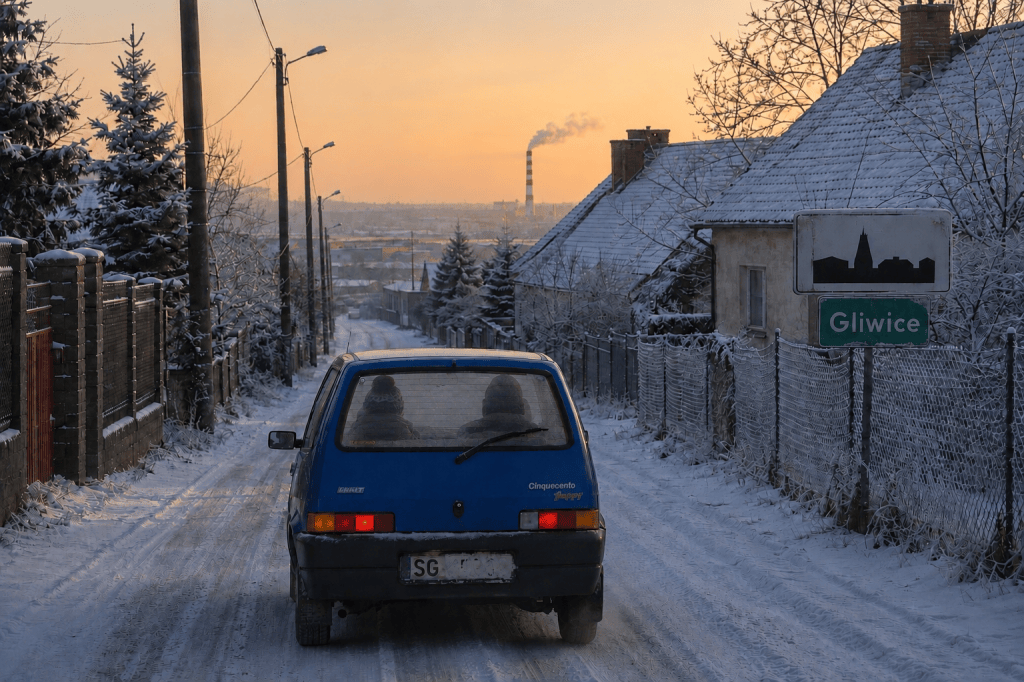
Reaching Gliwice, I was amazed, but after ten minutes of witnessing her driving, not surprised we’d managed to make it. Despite the work done by snow ploughs, the main roads still seemed undriveable by UK standards. Eventually she eased the Fiat into a tight, snow‑choked side street off Victory Street, navigating the high banks piled up by the ploughs. With a practised flick of the wheel, she guided the car into a narrow parking space that most UK drivers wouldn’t attempt on a dry summer afternoon.
She killed the engine.
Silence — the same muffled quiet as the snowy city outside.
And just like that, the journey was over.
I stepped out into the crisp Polish air, profoundly impressed and entirely safe, and finally letting go of the bag I’d been clutching on my knees.
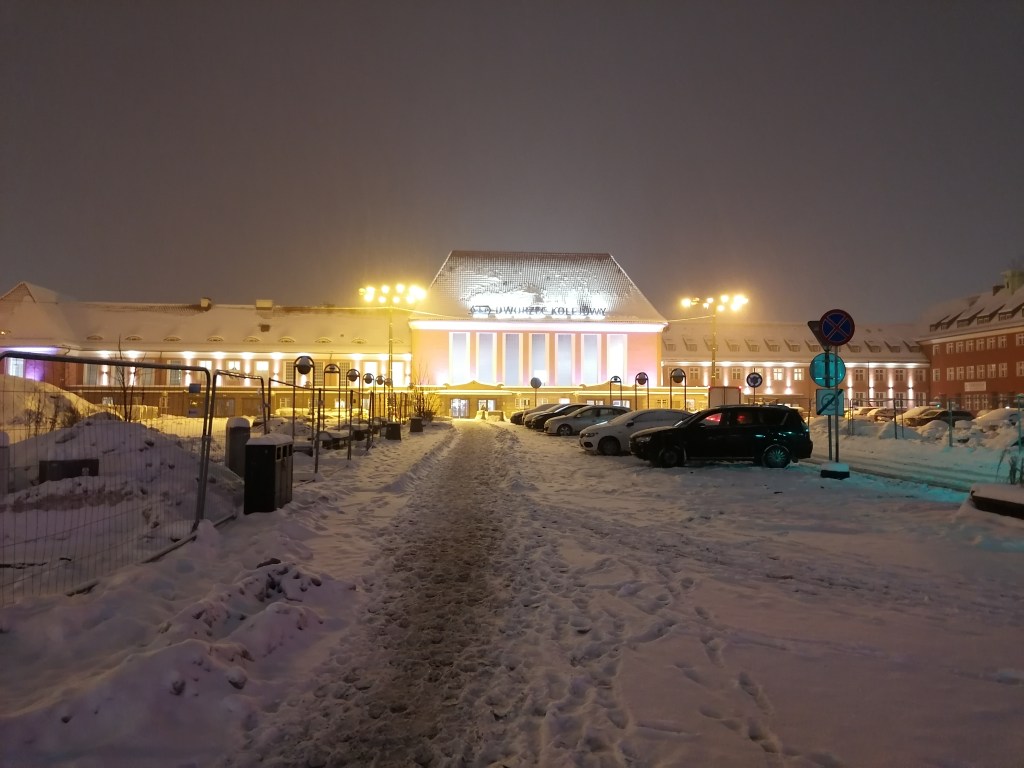
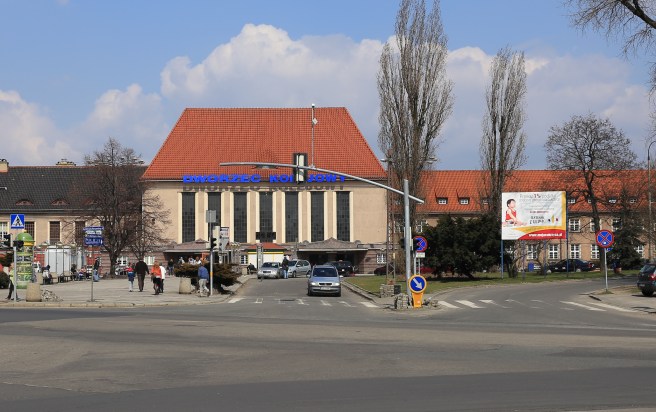
Gliwice railway station: under winter snow.
When we reached Gliwice station, the entrance floor was wet with melted snow. I did not know then that this surface, once damp, possessed the frictional properties of polished ice. I would learn that later, on another day, by landing squarely on my backside with considerable force and very little dignity.
But that first morning, I was still innocent.
Years later, I found photographs of the inside of Gliwice station on Wikimedia Commons, taken in 2013. Seeing them felt like opening a sealed room in my own memory.
There was the polished stone floor. The vast mural high above the hall. The long rows of plastic seats. The old departures board. The clock, strangely ordinary for something so important. And that light pouring down from the high windows.
Meanwhile, our other friend was making her own journey through the snow from Bytom. At the time, I had no idea what that really meant. I did not understand the early buses, the tram connections, the waiting in freezing weather, the uncertainty. I only knew we were waiting for her, and I hoped she would make it.
Then she appeared in the ticket hall, cheeks red from the cold, a covering of fresh snow on the hood of her coat, smiling as if crossing half of Silesia in winter were the most ordinary thing in the world.
Looking back, I understand far more than I did then.
She had made a serious effort for me. That kind of friendship reveals itself quietly. No speeches. No drama. Just someone deciding to show up, then doing exactly that.
I remembered standing there as a newcomer, trying to look as though I knew what I was doing. I did not. Not remotely. Everyone else seemed purposeful, fluent, certain. My friends moved easily through the system while I hovered behind them, nodding at moments that felt appropriate.
The station felt enormous then. Not only in size, but emotionally. It was a place full of movement and intention. Everyone appeared to know where they were going. I didn’t. But I didn’t need to. Not yet.
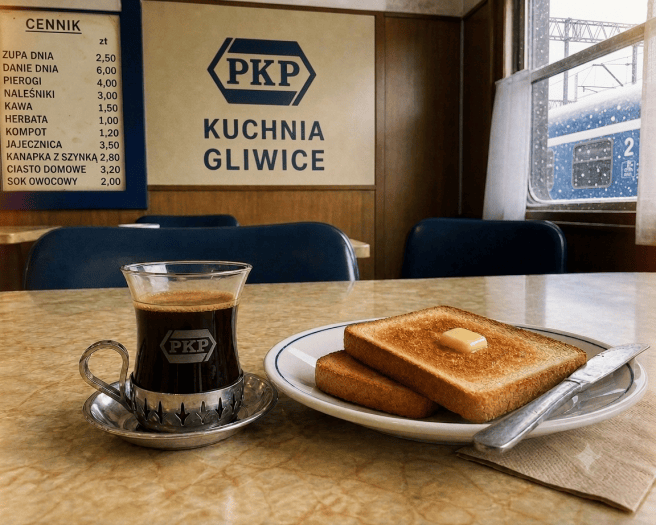
Before the train arrived, we went into the PKP canteen just off the main hall. It was my first experience of that style of Polish railway eatery, and it left an impression.
Behind the counter stood a team of women who appeared to be wearing what looked like white lab coats. Unknown to me at the time, a white coat or smock was classic Polish kitchen workwear. There was a selection of soups and stews on offer which, considering it was still breakfast, surprised me. I hadn’t expected anything quite so substantial at that hour — especially not while slightly hungover.
One of the women, whom I assumed to be the head cook, answered my friends’ questions about what was on the hot plate. I distinctly remember her gently stirring one of the pots, a slight skin having formed on the surface, and telling my two friends what was inside. They paused, checked with each other, and then translated it for me.
It was lung soup.
Real lung soup — I’m sure it contained other ingredients, including some vegetables, the full nose‑to‑tail eating experience. My friends, however, had suddenly adopted the alert posture of people who fear a British man is about to agree to something out of sheer politeness. I could almost feel them willing me not to nod.
I declined as politely as international diplomacy allowed. I’d never eaten offal in my life — not even as a child — and the idea of starting that journey at second breakfast defeated me.
The head cook looked somewhat disappointed, and I felt a small, unexpected flicker of shame, despite having been nothing but courteous.
My friends ordered something safer, and I followed their lead. Buttered toast and coffee. I especially remember the coffee — vividly so. It arrived in a glass, boiling hot, with a thick layer of grounds floating on top like industrial peat.
Determined not to offend local custom, I lifted the glass and attempted to drink it exactly as served. I was rewarded with a mouthful of coffee grounds. My friends burst out laughing.
“Gary, stir it.”
Apparently this was known to everyone except me.
I stirred cautiously, like a man handling unstable chemicals, and watched the grounds sink to the bottom. Then came the second lesson: never drink the last centimetre.
The railway was educating me already.
Soon after, the train arrived.
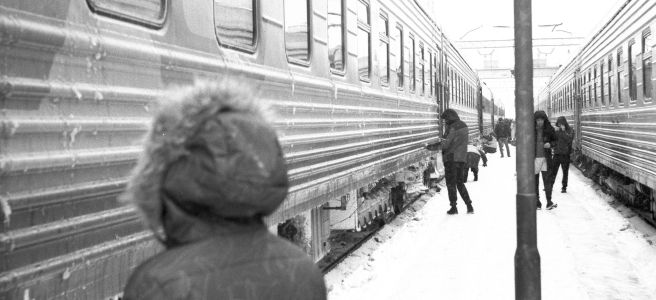
An emerging shape in the whiteness, slow and deliberate, like a creature pushing its way out of a snowdrift. The front was plastered in ice, snow packed into every crevice, the sides streaked white as if it had been travelling through a blizzard for hours.
I was stunned. It didn’t look like public transport. It looked like a survivor. Something out of a European film — a post‑apocalyptic epic where trains still run because they must.
I felt a jolt of awe. A kind of respect. One of my friends had once described being on a train that was forced to stop in deep snow, and how she and the other passengers had to walk through drifts carrying their luggage. She told me that story as we stood waiting for our own delayed train — opóźniony, a word I wrote down in the notes section of my phrasebook the moment I heard it. A rare event, she said, but real enough that it lived in the collective memory. Fingers and toes crossed it wouldn’t happen to us today, but it wasn’t impossible.
I shouldn’t have been surprised to see the train arrive in conditions that back in the UK would have probably ground everything to a halt. But I was. Because this wasn’t the UK. This wasn’t a place where snow meant surrender. This was Silesia — stubborn, practical, quietly heroic.
The doors opened with a groan. Warm air rushed out, fogging my glasses.
And then — the part that felt so strangely European — you had to climb the steps to get inside. Not a smooth, level boarding like at home, but a proper step up into a carriage that felt older, heavier, more real. And it was the moment the adventure began.
Inside the carriage, we found a compartment to ourselves. Once the door had been pulled shut, coats taken off, and we settled into the comfortable seats, it was wonderfully warm in that old railway way, radiators clanking with heroic inefficiency.
The journey to Wrocław felt dreamlike.
Outside, the snow softened everything into silhouettes: fields, factories, trees, villages sliding past in silence. Inside, my friends talked in Polish while I caught the occasional familiar word and pretended progress. One of my friends wore a red sweater — that detail alone is enough to anchor the whole scene in my memory. Her white coat hung up behind her.
Red against white. Warmth against winter. A person against a landscape.
Books and a bottle of iced tea on the small table.
She sat by the window, and the snow outside wasn’t just falling — it was moving sideways, thick and relentless, as if the world beyond the glass had been erased and replaced with a white curtain. The train crawled through it, slow enough that you could feel every curve of the track, every hesitation of the engine. A gentle rocking motion, and beneath it a slow, subdued da‑dum — the wheels sounding half‑lulled by the snow.
Inside, though, it was surreal. Quiet. Cocooned. Almost intimate.
The compartment lights cast a soft yellow glow, and the red of her sweater seemed to absorb it, radiate it. She looked like the only point of colour in a monochrome world.
I sat by the window feeling oddly peaceful, looked after, suspended between places.
A remarkable journey, unhurried, moving at a speed allowed by the weather conditions outside.
Wrocław itself was magical. Snow on the Rynek. Coloured buildings muted by winter light. Coffee and cakes in a café while flakes drifted past the windows. A city that felt elegant, theatrical, and faintly enchanted.
I fell for it immediately.
By the time we reached the Rynek, the day had caught up with me and was now several paces ahead, looking back with mild disappointment. Three days of new experiences, food, drink, history, the cold, the travel, the sheer sensory overload — all of it forming an orderly queue to remind me I was not, in fact, the rugged adventurer I’d imagined on the plane. A new country, a different culture, a language I’d only ever practised safely with friends suddenly alive all around me, a completely unfamiliar way of navigating trains and tickets and timetables. And this was still only halfway through the third day of my visit.

A photo from that moment: the friend who’d travelled from Bytom by bus and tram, having begun her journey a lot earlier than I had; rosy‑cheeked, glowing, beautiful, full of life. And then there’s me beside her, looking more than slightly bewildered, unsure of where I was, and failing to smile for the camera. It still makes me laugh. It’s a very special photograph of a fascinating, slightly surreal trip.
Before leaving the city to catch our return train, we ducked into a Czekoladziarnia to warm up.
Hot chocolate — thick, rich, almost a meal in itself — steaming in front of us. I remember holding the cup in both hands, letting the heat soak into my fingers, watching the snow fall outside the window. Everything felt slowed down, softened, peaceful.

Czekoladziarnia Wrocław 2007
It was a magical day. Simple. Cold. Beautiful.
But what stayed with me most was the journey there. I don’t remember much about the return journey; it was dark outside, and we were all very tired.
Because somewhere between Wrocław station, the early morning at Gliwice, a drive through the snow, a mouthful of coffee grounds, the friend arriving through the snow, and that warm carriage heading west, something had shifted. For the first time, I saw Silesia not as a place I’d landed in by accident, but as a landscape with its own quiet dignity.
I pressed my forehead to the glass and thought: I could stay here.
Poland stopped being simply a place I thought I’d just visit.
I didn’t know then — how could I — that years later I’d be living in Gliwice, taking trains through Silesia as part of my daily life, navigating stations alone, rehearsing Polish phrases, teaching lessons throughout the region, shopping trips to Katowice, and collecting stories that would stay with me forever.
Photo: Gliwice, Dworzec – panoramio by Roton Piotr, licensed under CC BY‑SA 3.0. Source: Wikimedia Commons.
Photo: Gliwice train station in snow (2022) by Abraham, licensed under CC BY‑SA 4.0. Source: Wikimedia Commons.

 Ghosts to Carry, Stories to Keep

