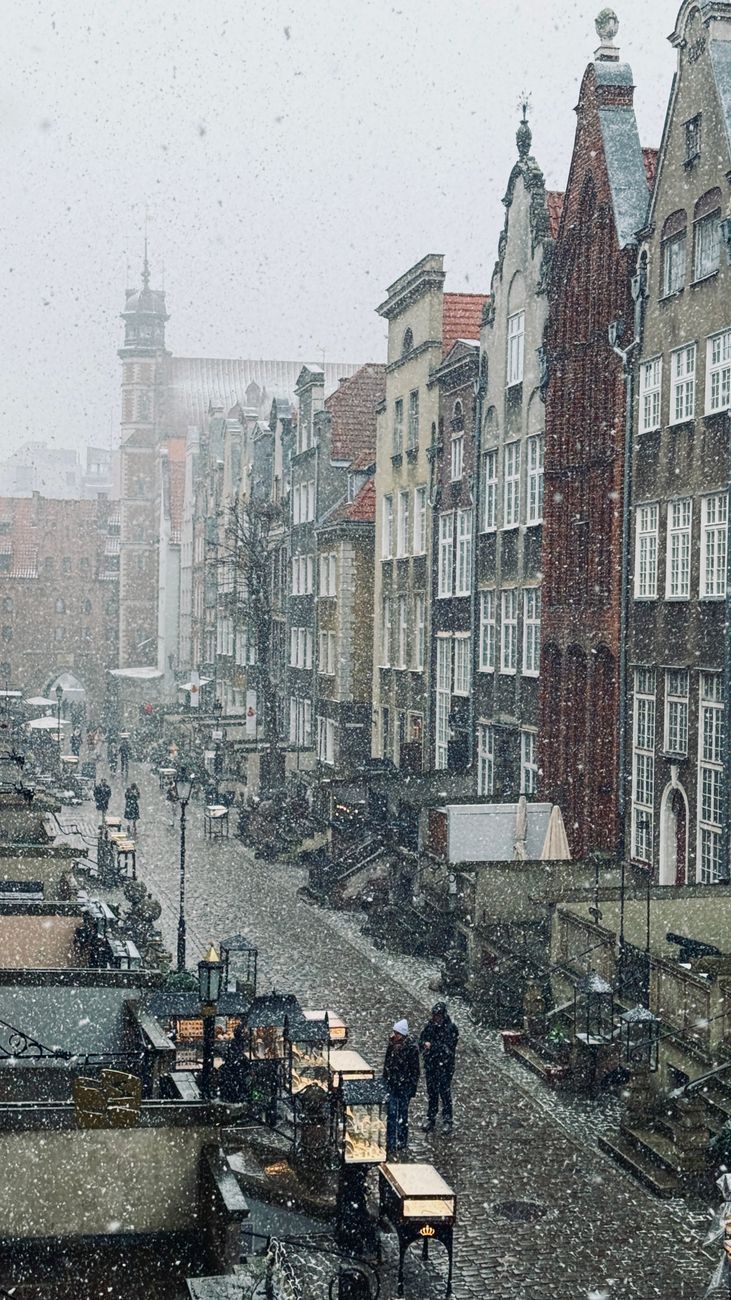
Soon after, the train arrived.
An emerging shape in the whiteness, slow and deliberate, like a creature pushing its way out of a snowdrift. The front was plastered in ice, snow packed into every crevice, the sides streaked white as if it had been travelling through a blizzard for hours.
I was stunned. It didn’t look like public transport. It looked like a survivor. Something out of a European film — a post‑apocalyptic epic where trains still run because they must.
I felt a jolt of awe. A kind of respect. One of my friends had once described being on a train that was forced to stop in deep snow, and how she and the other passengers had to walk through drifts carrying their luggage. She told me that story as we stood waiting for our own delayed train — opóźniony, a word I wrote down in the notes section of my phrasebook the moment I heard it. A rare event, she said, but real enough that it lived in the collective memory. Fingers and toes crossed it wouldn’t happen to us today, but it wasn’t impossible.
I shouldn’t have been surprised to see the train arrive in conditions that back in the UK would have probably ground everything to a halt. But I was. Because this wasn’t the UK. This wasn’t a place where snow meant surrender. This was Silesia — stubborn, practical, quietly heroic.
The doors opened with a groan. Warm air rushed out, fogging my glasses.
And then — the part that felt so strangely European — you had to climb the steps to get inside. Not a smooth, level boarding like at home, but a proper step up into a carriage that felt older, heavier, more real. And it was the moment the adventure began.
Inside the carriage, we found a compartment to ourselves. Once the door had been pulled shut, coats taken off, and we settled into the comfortable seats, it was wonderfully warm in that old railway way, radiators clanking with heroic inefficiency.
The journey to Wrocław felt dreamlike.
Outside, the snow softened everything into silhouettes: fields, factories, trees, villages sliding past in silence. Inside, my friends talked in Polish while I caught the occasional familiar word and pretended progress. One of my friends wore a red sweater — that detail alone is enough to anchor the whole scene in my memory. Her white coat hung up behind her.
Red against white. Warmth against winter. A person against a landscape.
Books and a bottle of iced tea on the small table.
She sat by the window, and the snow outside wasn’t just falling — it was moving sideways, thick and relentless, as if the world beyond the glass had been erased and replaced with a white curtain. The train crawled through it, slow enough that you could feel every curve of the track, every hesitation of the engine. A gentle rocking motion, and beneath it a slow, subdued da‑dum — the wheels sounding half‑lulled by the snow.
Inside, though, it was surreal. Quiet. Cocooned. Almost intimate.
The compartment lights cast a soft yellow glow, and the red of her sweater seemed to absorb it, radiate it. She looked like the only point of colour in a monochrome world.
I sat by the window feeling oddly peaceful, looked after, suspended between places.
A remarkable journey, unhurried, moving at a speed allowed by the weather conditions outside.
Wrocław itself was magical. Snow on the Rynek. Coloured buildings muted by winter light. Coffee and cakes in a café while flakes drifted past the windows. A city that felt elegant, theatrical, and faintly enchanted.
I fell for it immediately.
By the time we reached the Rynek, the day had caught up with me and was now several paces ahead, looking back with mild disappointment. Three days of new experiences, food, drink, history, the cold, the travel, the sheer sensory overload — all of it forming an orderly queue to remind me I was not, in fact, the rugged adventurer I’d imagined on the plane. A new country, a different culture, a language I’d only ever practised safely with friends suddenly alive all around me, a completely unfamiliar way of navigating trains and tickets and timetables. And this was still only halfway through the third day of my visit.
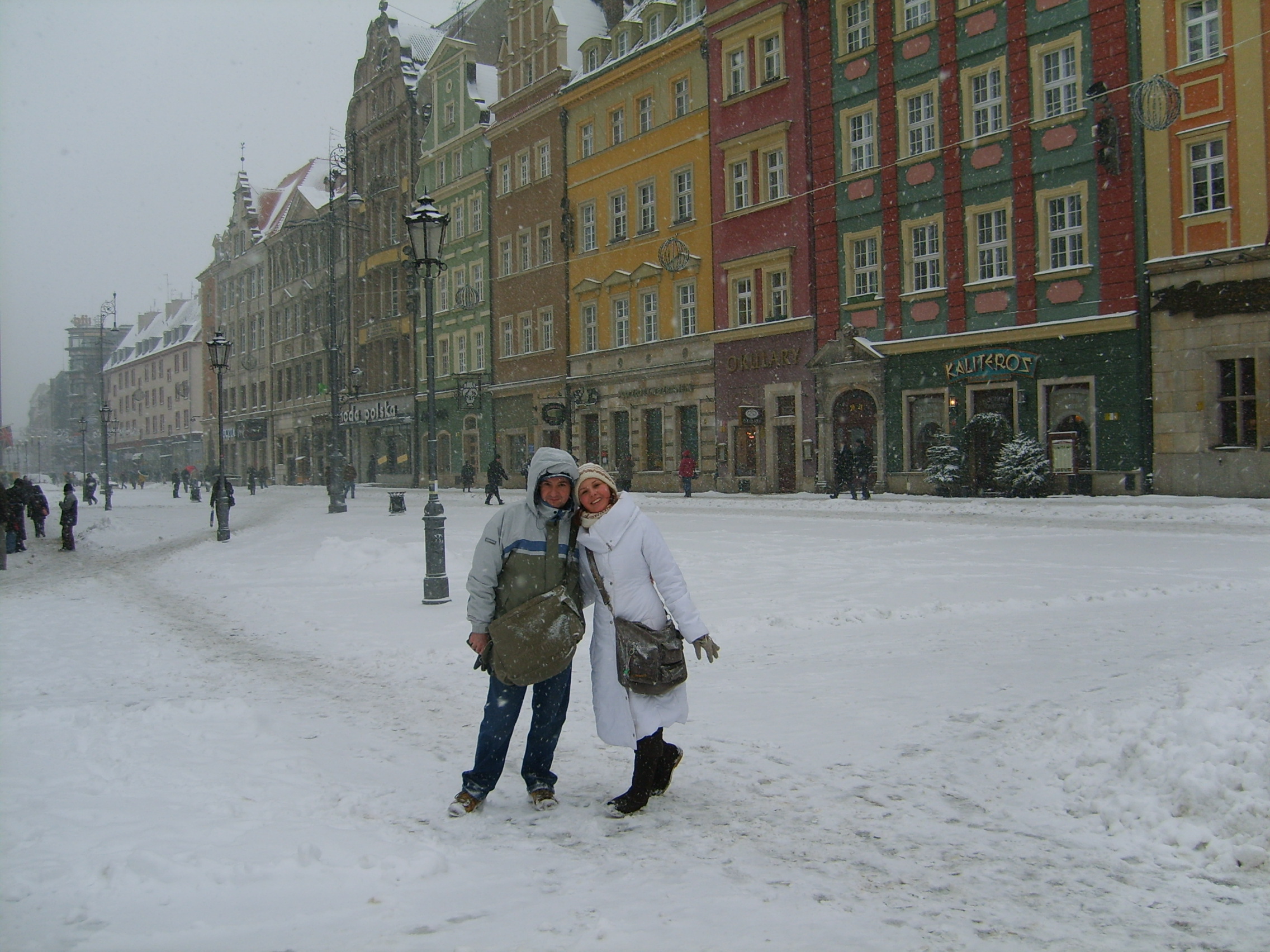
A photo from that moment: the friend who’d travelled from Bytom by bus and tram, having begun her journey a lot earlier than I had; rosy‑cheeked, glowing, beautiful, full of life. And then there’s me beside her, looking more than slightly bewildered, unsure of where I was, and failing to smile for the camera. It still makes me laugh. It’s a special photograph of a fascinating, slightly surreal trip.
Before leaving the city to catch our return train, we ducked into a Czekoladziarnia to warm up.
Hot chocolate — thick, rich, almost a meal in itself — steaming in front of us. I remember holding the cup in both hands, letting the heat soak into my fingers, watching the snow fall outside the window. Everything felt slowed down, softened, peaceful.
It was a magical day. Simple. Cold. Beautiful.
But what stayed with me most was the journey there. I don’t remember much about the return journey; it was dark outside, and we were all exhausted.
Because somewhere between Wrocław station, the early morning at Gliwice, a drive through the snow, a mouthful of coffee grounds, the friend arriving through the snow, and that warm carriage heading west, something had shifted. For the first time, I saw Silesia not as a place I’d landed in accidentally, but as a landscape with its own quiet dignity.
I pressed my forehead to the glass and thought: I could stay here.
Poland stopped being simply a place I thought I’d just visit.
I didn’t know then — how could I — that years later I’d be living in Gliwice, taking trains through Silesia as part of my daily life, navigating stations alone, rehearsing Polish phrases, teaching lessons throughout the region, shopping trips to Katowice, and collecting stories that would stay with me forever.
 Ghosts to Carry, Stories to Keep
Leave a comment