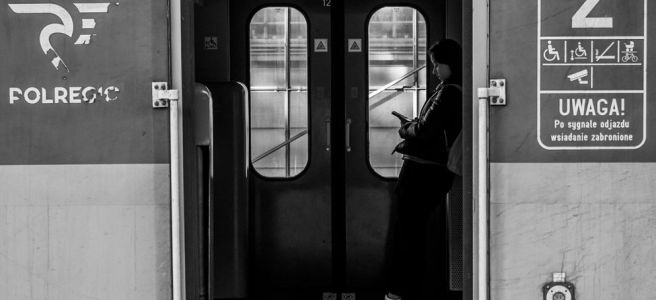
Gliwice Railway Station
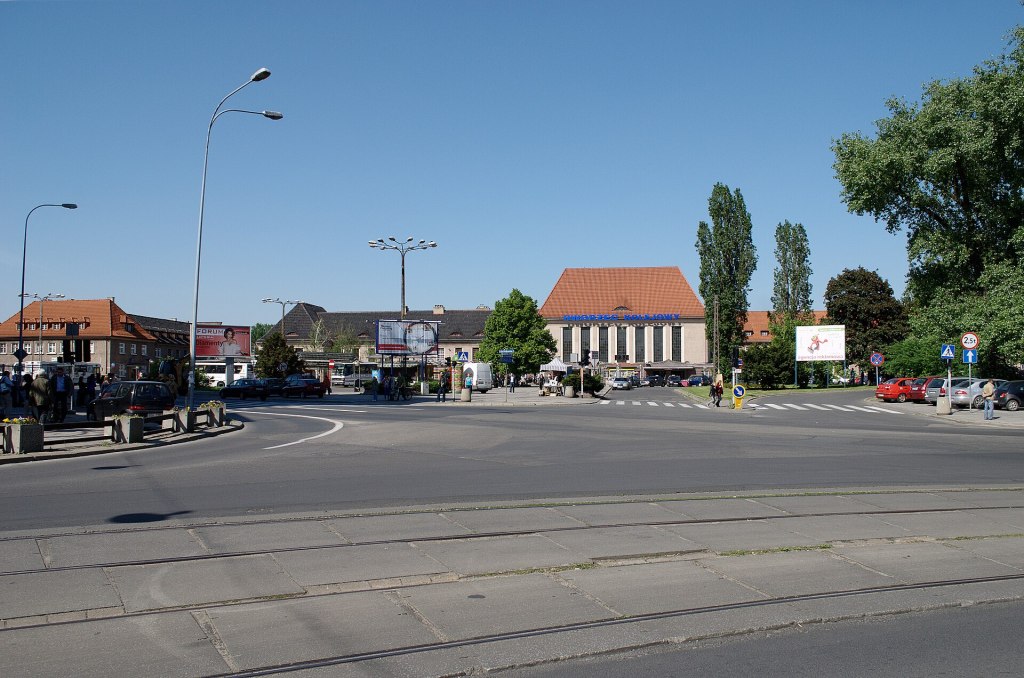
Looking at these Wikimedia photographs — the view of the railway station from across the road, the ticket hall, the tunnel — I realise how little I understood of the place in those early years. I thought I knew the station. I didn’t. Not even close. It became a gradual learning process, one I now have very fond memories of.
I often spent time on that opposite pavement, waiting at the light-controlled crossing, heart thumping because I had less than five minutes to catch the train. Every instinct told me I could run — no traffic anywhere near — but that was one of the first Polish rules I learned properly: you do not cross on red.
In the UK, a red pedestrian light is often treated as advice. If there’s traffic, you wait. If there isn’t, most people will ignore the red and cross. The Highway Code clearly states to wait until you get a green to cross; however, stand there too long on red with an empty road and people start to look at you as if you’ve misunderstood something obvious.
In Poland, it was the opposite. You wait. No traffic? You still wait. Everyone waits.
I once asked my police students about it. Their answer was disarmingly simple:
“Gary… if you were driving, would you stop at a red light?”
Yes, of course.
“Same thing for a pedestrian.”
That settled it.
Zebra crossings were another lesson entirely. In the UK, traffic slows the moment you approach the kerb. In Poland, I learned quickly not to assume anything. Cars didn’t always stop. You could already be on the crossing — halfway across, even — and they’d still pass in front of you or slip behind you, close enough that you felt the air move as they went by. I never quite got used to it. Every crossing felt like a small act of faith, or foolishness, depending on how honest I was being with myself.
Friends warned me to be careful; attitudes were changing, slowly, in theory. In the UK, if a car stops for you, you acknowledge it — a small wave, a nod, something that says thank you. It’s automatic, almost polite to a fault. I carried that habit with me to Poland, where it made absolutely no sense. On the rare occasions a driver did stop, I’d still give the little nod out of instinct, only to realise the traffic coming the other way hadn’t stopped at all and was already expressing its opinion via the horn. My British gratitude was entirely wasted on the wrong car.
Two opposite instincts — and I had to unlearn one while learning the other.
In that first photograph, the controlled crossing is there — left of centre, just behind the group of people waiting. I stood at that exact spot so many times, in snow, rain, sunshine, sometimes early, sometimes with minutes to spare, watching the seconds slip away while the road stayed completely empty.
Inside, the railway station had its own small world.
Now, the queuing system — or the idea of one — had its own way of working. Some of the ticket windows had a small, smooth concrete bollard planted in front of them — a quiet piece of architecture that created its own logic. You chose a kasa biletowa, stood behind whoever was ahead of you, and edged forward in a tidy single-file line. Once that person had finished with the kasjerka — a female ticket clerk, never once a male clerk, as far as I remember — they didn’t step back towards you; they simply moved to the left, slipping past the bollard and out into the hall. The queue dissolved and re-formed in one fluid movement. Simple. Effective. Entirely unspoken. I had never seen a queue regulated quite like it in the UK. It fascinated me.
Older passengers, or those desperate for information, sometimes bypassed the whole arrangement by calling out their questions from behind you, confident in the long-established rules of their own. No one complained. It was simply how things worked.
The big yellow-and-blue timetable boards were a mystery to me — dense blocks of information I could never decipher. I stopped trying. The only board that mattered was the one on the centre-right, the live departures board; ODJAZDY. That was the one I learned to read quickly. Time, destination, platform — that was all I needed. I wasn’t studying the network. I just wanted to get to Kato.
Most days I was travelling to lessons in Katowice. I’d arrive at Gliwice railway station in good time — early — if I could help it. I hated rushing. I’d go straight to the kasa and give the kasjerka my destination, the time, and whatever other details she needed. She’d nod, tap a few keys, then reach for one of those large, stiff cardboard blanks they used back then — tickets that felt more like something you’d keep in a drawer than hand over at a barrier.
She’d feed the blank into the printer with a practised little push, and the machine would come alive with that familiar clattering, the dot-matrix needles hammering the details into the card. Incidentally, one of my favourite words in Polish is terkotanie — clattering sound. A moment later she’d hand it back to me: a freshly printed, perfectly crisp ticket, still warm from the machine, as if it had only just been invented.
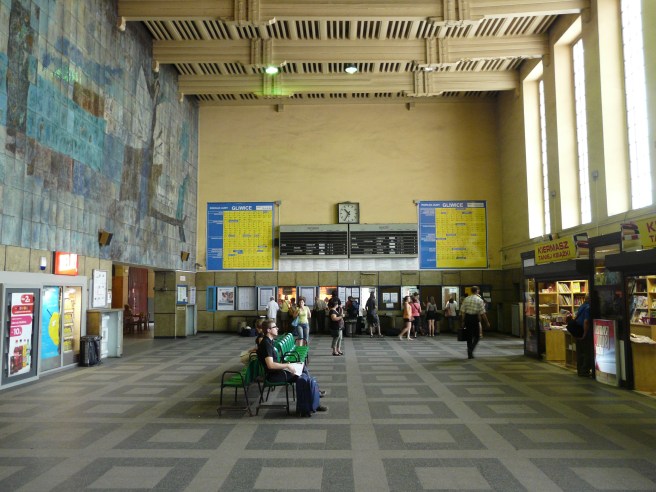
There was the bookstall tucked neatly against the wall, the kind of place where time moved more slowly. I’d pretend to browse, as if I were the sort of man who bought discounted or used books in foreign languages before boarding trains. The man behind the counter always looked as though he’d seen everything twice already.
Then there were the plastic seats — back-to-back rows that discouraged comfort and punished optimism. I tried one once, briefly, before realising they were designed for people who had already given in.
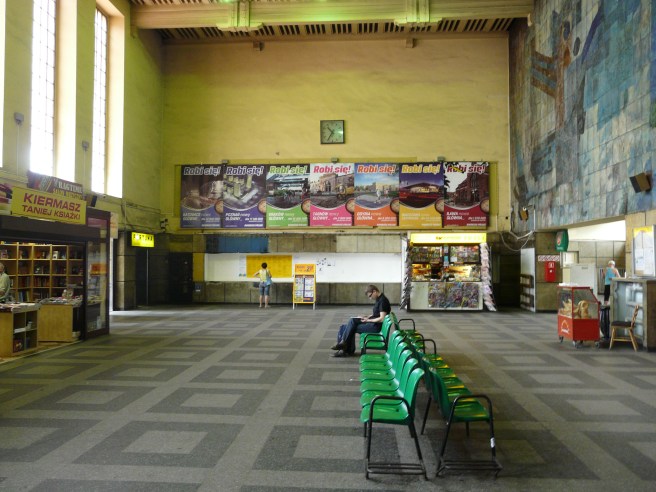
If I was late, though, everything changed. I’d run straight for the train, checking the platform number on the move. In the early days, I struggled to make sense of the signs. More than once I sprinted up the stairs only to realise the train was on the next platform — or the previous one. You couldn’t always see clearly where anything actually was.
If you didn’t have a ticket, you boarded anyway and went looking for the konduktor. It cost a little more, and you were expected to find him rather than sit and wait. Another rule, learned the hard way.
For months, I didn’t even know the tunnel existed — the long, echoing passage beneath the tracks. I discovered it only because a friend, with saintly patience, explained that I didn’t need to walk the long way round to reach the Forum shopping centre. I could simply walk through the station tunnel, following the tiled corridor, and emerge somewhere else entirely.
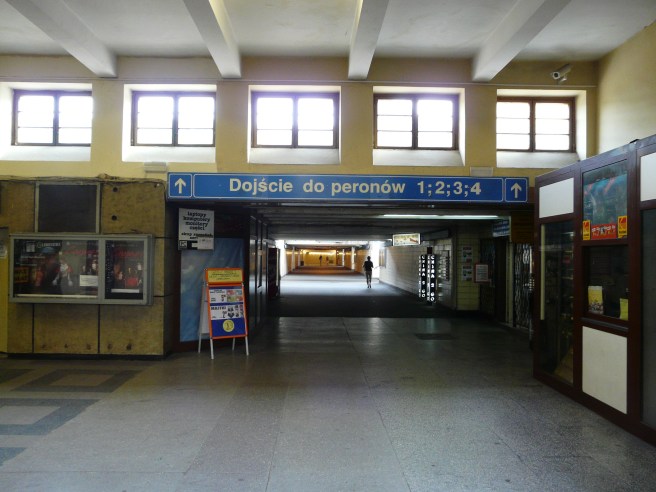
The stairs were steep, cold, and always slightly damp. That was where I first learned the rhythm of Polish commuters — the purposeful descent, the instinctive sidestep, the quiet choreography of people who had been doing this all their lives. Exiting the train was always a buzz; no one hung about. It became a kind of march — purposeful, almost urgent — our footsteps echoing through the tunnel, walking through the hall and outside, dispersing left, right and centre.
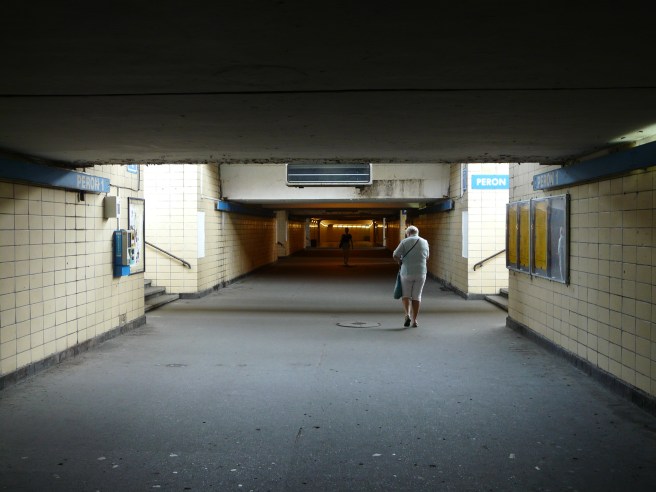
Even now, without looking at the photographs, I can still see the station as it was. The ticket hall, the tunnel, the stairs — all of it fixed in memory more vividly than I’d expect. What surprises me most is that these images were taken in 2013, right in the middle of the years I lived in Gliwice. I can picture myself clearly: buying a ticket, running for a train, returning late — in darkness, in rain, with snow blowing across the platforms. The station felt different at night. That’s when I was slowly beginning to understand it.
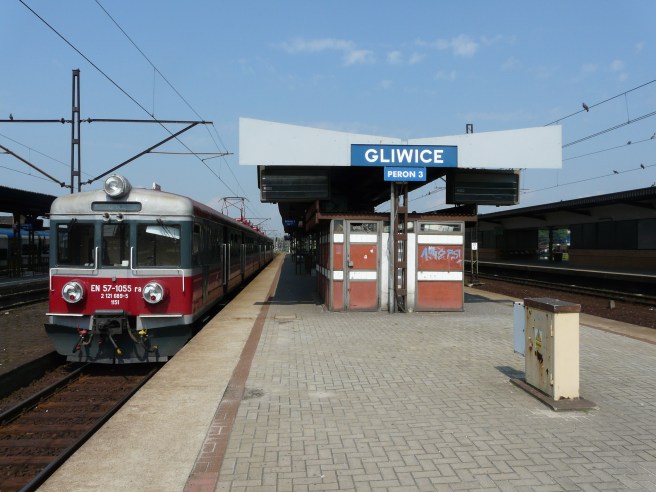
Some of the images on this page were taken by others, long before I ever found them — yet I walked through those same doors, stood under those same timetables, breathed that same dust and the faint metallic warmth of the electric trains.
I passed through that station not long after, unaware that someone had already frozen it in time.
The five views of Gliwice station, all taken on a warm July day in 2013 by Dariusz Sieczkowski, show the building as it was just before everything changed.
I was there in those years — walking across that forecourt, watching the departures board flicker, carrying my own small story through the same hallways his camera captured.
These photographs are theirs. The memories threaded between them are mine.
Jeśli zdarzyło Ci się przechodzić przez dworzec w Gliwicach, podziel się tym, co pamiętasz.
If you travelled through Gliwice station yourself, feel free to share what you remember.
Continue reading this memory — Part 2: The Outbound Journey
Attribution and Links:
- Photo 1 (Gliwice Dworzec kolejowy DSC 9507) by Sławek Skonieczny, Wikimedia Commons (CC BY-SA 4.0).
- Photo 2 (Ticket Hall & Odjazdy) by Dariusz Sieczkowski, Wikimedia Commons (CC BY-SA 4.0).
- Photo 3 (Station Hall Entrance Layout) by Dariusz Sieczkowski, Wikimedia Commons (CC BY-SA 4.0).
- Photo 4 (Tunnel Entrance Stairs) by Dariusz Sieczkowski, Wikimedia Commons (CC BY-SA 4.0).
- Photo 5 (Inside Station Tunnel Corridor) by Dariusz Sieczkowski, Wikimedia Commons (CC BY-SA 4.0).
- Photo 6 (Station Forecourt Exterior) by Dariusz Sieczkowski, Wikimedia Commons (CC BY-SA 4.0).

 Ghosts to Carry, Stories to Keep