It is funny how a single, fleeting moment can hook itself into your memory and refuse to let go. For fifteen years, a specific freezing afternoon in January 2011 has lingered in my mind. I was walking down Ulica Zwycięstwa (Victory Street) in Gliwice, Poland—a grand promenade bustling with life, yet carrying the heavy, layered weight of its own history.
I never expected to write about Gliwice with this kind of tenderness. A decade ago, I was simply living my life: riding a bicycle along the tram tracks—constantly trying to avoid steering into them—and walking down Ulica Zwycięstwa in the bitter Silesian winter. I noticed the architecture, of course, but I didn’t yet understand why it mattered to me.
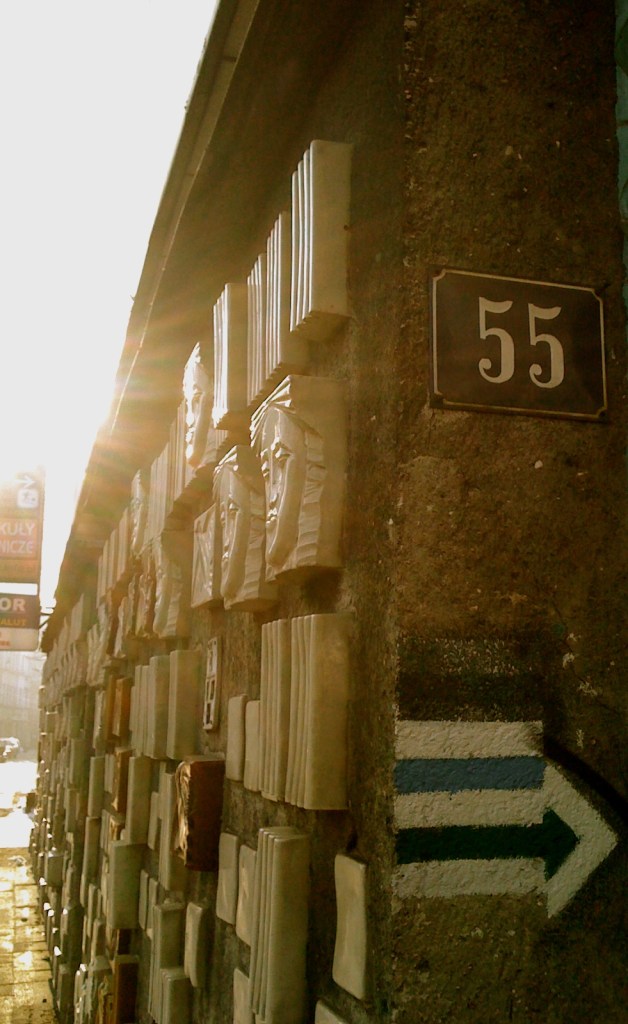
On that biting winter day, as the low afternoon sun streaked across the facades, I stopped dead in my tracks in front of number 55. There was a wall there that seemed to speak in an entirely different language than the grey, functional architecture surrounding it. I pulled out my trusty iPhone3G and took a few photos, capturing a moment in time just before the landscape changed forever.
Faces in Clay, Stories in Silence
Looking back at the photographs now—and matching them against the archives of Gliwice’s urban transformation—the pieces of a long-standing puzzle have finally fallen into place. This building was the former “Sezam” department store. In post-war Poland, cooperative stores like Sezam (named after the magical phrase “Open Sesame”) were symbolic gateways to modern shopping and community life, anchored right on the city’s main promenade.
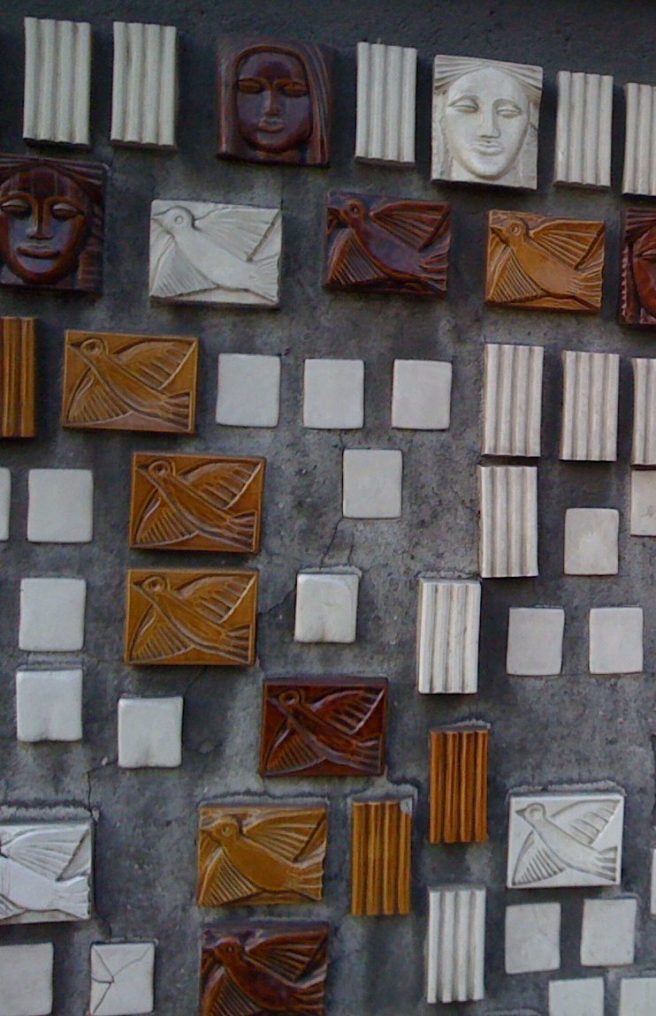
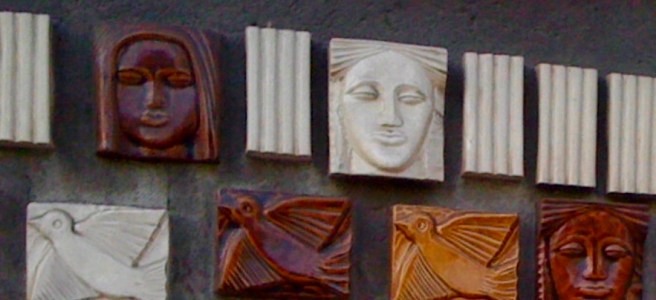
Knowing its true identity completely recontextualises the incredible textures on that wall. Those stylised panels, clay faces, and birds in flight were a brilliant example of mid-century Polish architectural ceramics (ceramika architektoniczna). During the post-war era, artists took the raw, ancient motifs of traditional Polish folk art and sharpened them into sleek, modern geometry. They were commissioned to press a human soul directly into the exterior clay tiles, bringing texture, warmth, and myth to a functional urban landscape.
Even when I stood there in 2011, the elements and the vibrations of the busy street were taking their toll. A few distinct tiles were already missing from the wall, leaving empty concrete voids like missing teeth in a familiar smile.
Signposting a Path at the Crossroads
As I moved closer to the corner of the building, just beneath the dark enamel number 55 plaque, my camera caught another curious detail: a painted arrow pointing to the right, a striking geometric burst of blue, white, and green, set deliberately above a weathered red line.
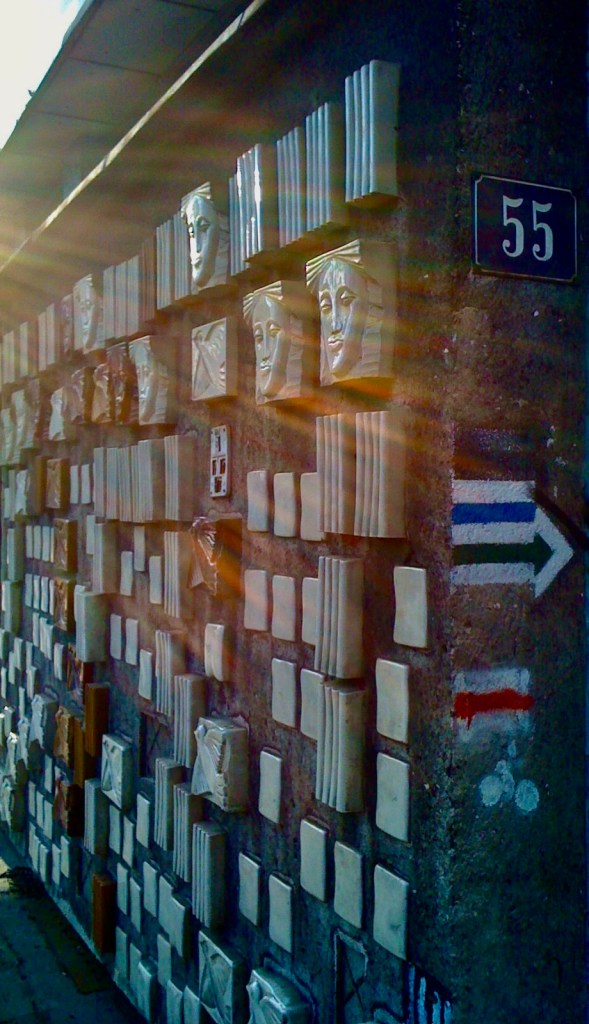
For years, I wondered if this was some sort of civil defence sign, a remnant of ammunition navigation, or a shelter marker. The truth, as it turns out, is far more poetic. It was a classic Polish tourist trail marker (szlak turystyczny).
In Poland, these hand-painted colour codes form a silent, nationwide navigation network managed by the PTTK (Polish Tourism and Sightseeing Society). The solid red rectangle denotes a Szlak główny—a region’s primary, historically significant trail—while the blue and green markings signify overlapping regional and local paths.
Number 55 wasn’t just a building with an artistic face; because of its prominent position on the main artery of the city, it had been chosen as an urban navigation anchor. It stood at a literal crossroads, silently directing hikers and travellers out of the concrete centre and toward the wider Silesian landscape.
Standing there in the cold as an Englishman trying to find my own bearings in a new country, I was staring at a wall explicitly designed to show people how to navigate a journey.
A Twilight Documented
My camera had accidentally captured the twilight of Sezam. Just a couple of years after I took these photographs, the building was prepared for demolition to make way for the massive DTŚ highway tunnel project that completely redrew the map of central Gliwice. Number 55 vanished from the physical world.
But the most profound comfort is knowing that these “ceramic ghosts” did not end up as rubble. Before the wrecking ball swung, local preservationists carefully pried the distinctive decorative tiles from the facade for preservation and relocation within the city.
They were a collective voice from the past, speaking to a bustling street in absolute silence. And though the corner of Zwycięstwa looks entirely different today, I am incredibly grateful to have this small, digital time capsule of the day the wall showed me the way.
Over to You
If you remember walking past the old Sezam building, did you ever stop to look at those clay faces too? How do you feel about this part of the city now that it has changed so drastically?
Do you have memories of the local shops like Mandarynka, or that strange, almost claustrophobic, surreal market tucked away under the bridge nearby?
Comments are open—please share your memories below!
Reszta należy do Was.
Jeśli pamiętasz, jak kiedyś przechodziłeś obok starego budynku Sezam, zatrzymywałeś się, żeby przyjrzeć się tym glinianym twarzom? Jak dziś patrzysz na tę część miasta, skoro zmieniła się tak radykalnie i tamten budynek zniknął z mapy Gliwic?
Masz jakieś wspomnienia związane z lokalnymi sklepami, jak Mandarynka, albo z tym dziwnym, trochę klaustrofobicznym, surrealistycznym targiem ukrytym pod pobliskim mostem?
Komentarze są otwarte — podziel się swoimi wspomnieniami poniżej!

 Ghosts to Carry, Stories to Keep