In 2007 I was invited to stay with the families of two close friends I’d met in the UK. I arrived tired but wide‑awake in the way you get when everything around you is new. My friends met me waving Polish flags, laughing, excited, and soon I found myself in the front passenger seat of her father’s car, heading toward a small village outside Gliwice where I would be staying.
We had already stopped in Bytom to drop off our other friend, and now it was just the three of us — her father driving, my friend resting in the back, and me watching the landscape unfold through the windscreen. I couldn’t speak a great deal of Polish, so I watched instead.
Wide open countryside.
Strip‑farmed fields.
Sudden urban pockets.
Bytom, Zabrze, Gliwice — names I barely knew, places layered like palimpsests.
Old and new pressed together.
Tram tracks.
Concrete blocks.
Neon advertising hoardings so bright they looked American.
One of them was enormous — a full billboard devoted entirely to mayonnaise.
Mayonnaise.
I remember thinking: What kind of country advertises mayonnaise at that scale?
And then immediately: Whatever this place is, it’s not the Britain I left this morning.
Everything was unfamiliar, but not in a frightening way, more in a what-else-am-I-going-to-see way. My friend’s father drove calmly through the dark, and I sat there, absorbing a world that didn’t match anything I thought I knew about Poland.
We had passed through Gliwice and were slipping toward the edge of the city when the tower appeared.
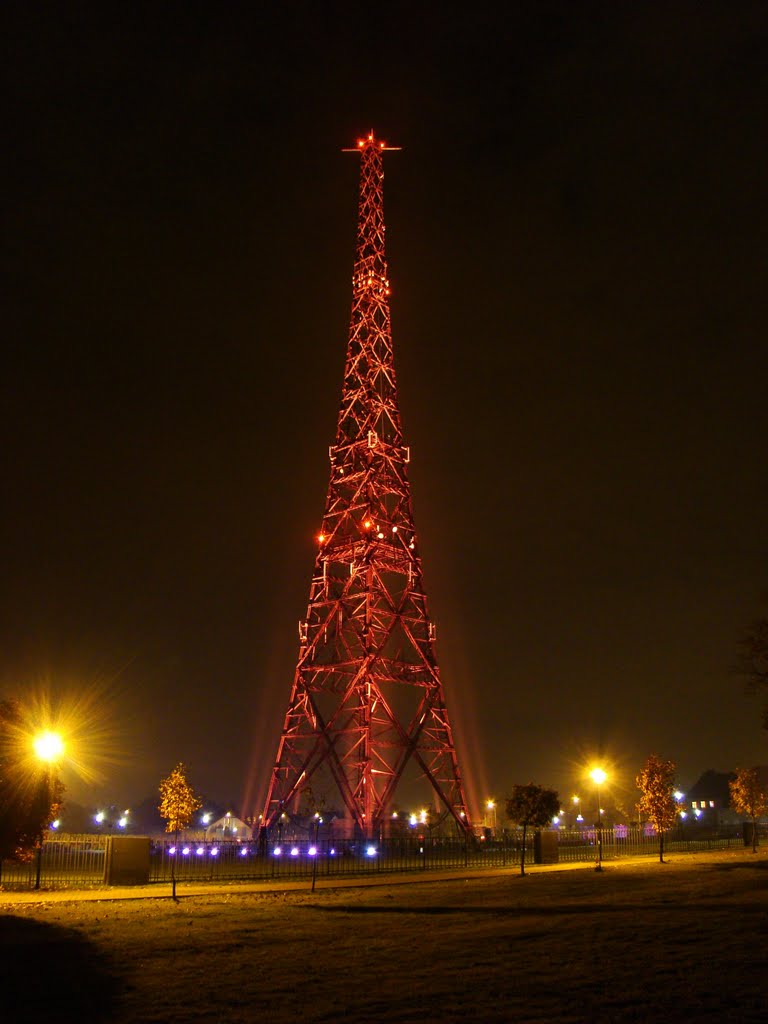
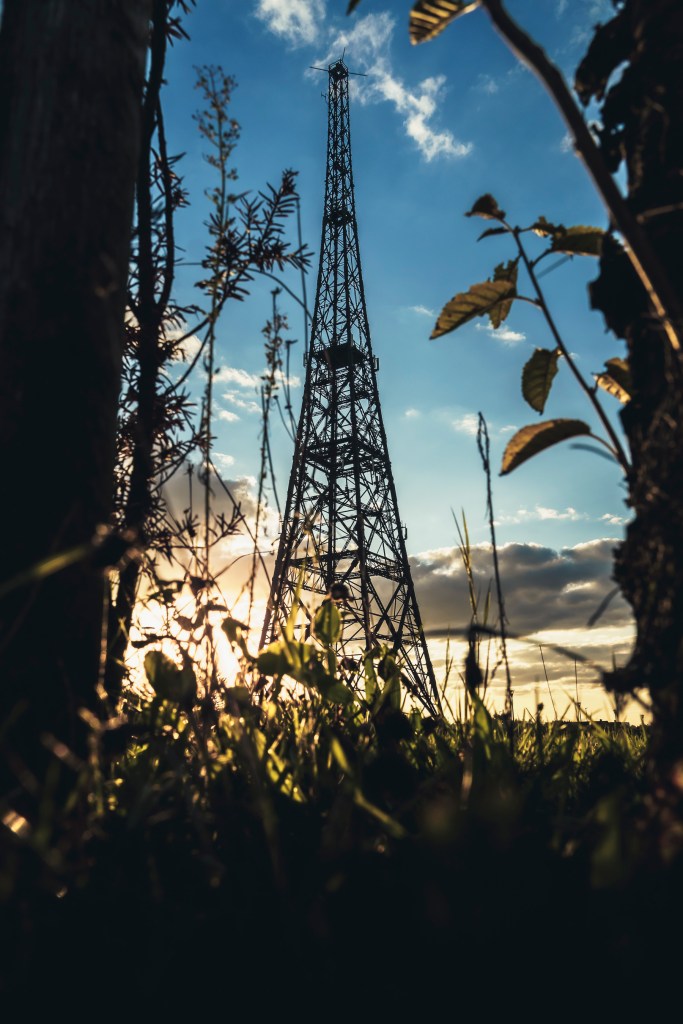
It rose out of the darkness with a kind of solemn presence, its base lit by a soft, steady glow. Red lights blinked high above, slow and patient, like something breathing in the night. The sight caught me completely off guard. It was familiar in a way that reached past thought—straight into memory, into childhood, into the part of me that had once sat at a school desk trying to understand how a war could begin.
I hadn’t expected to feel anything. I hadn’t even known the tower still existed. But the moment I saw it, something inside me tightened. It was as if a page from a history book had stepped out of its flat, printed world and into the road ahead of us.
I heard myself ask, quietly, “Is that the radio station?”
My friend answered from the back seat. Her voice held a small, unmistakable note of surprise—gentle, almost protective, as though she hadn’t realised this place might mean something to me. Her father glanced over, curious. They exchanged a few words behind me, soft and quick, and I felt suddenly aware of the space between us: them in their world, me in mine, and this tower bridging the two for a moment.
I didn’t ask what they said. I didn’t want to disturb whatever had passed between them.
The car moved on, headlights sweeping over the empty road. After a while, I tried to explain—haltingly, almost apologetically—the fragments I remembered. The Gleiwitz Incident — A staged attack. A spark that grew into something terrible. A name that had stayed with me long after the rest of the lesson faded. I asked if we might visit the tower in the coming days.
My friend seemed taken aback. Her father listened to her translation, nodded once, and let the matter rest. Their quiet acceptance made the moment feel even more fragile.
I realised then how carefully they had planned to show me their world, and how unexpectedly I had reached for something from my own distant past—a tower I had only ever known as a grainy photograph in a book. I had come to Poland with a handful of memories, none of them sharp, none of them complete. And now, in the dark, as a passenger in their car, one of those memories had risen out of the night and met me halfway.
It felt like recognition, and loss, and wonder, all at once.
The Visit
The next day was bitterly cold, a day or two before the snow began to fall. We met our friend somewhere in Gliwice and drove out towards the outskirts, and in daylight I was stunned.
The tower was wooden.
I had imagined steel — something industrial, modern, metallic. Instead there it stood: tall, dark, entirely wooden, fenced off with what looked like allotment gardens inside the grounds. No visitors. No obvious signs of staff. Just the tower and a cluster of buildings that looked unmistakably German in their architecture.
The access gates were open.
“Can we go in?” I asked.
My friends looked at each other, shrugged, and seeing the awe on my face, agreed. We walked through the open gates and around the buildings. It felt eerily quiet, as if I had stepped back in time. I remember saying, “Do you understand the significance of this place? Why isn’t it protected more? Preserved?”
They shrugged. One of them said gently, “It’s something we don’t really talk much about, Gary.”
At that moment someone called out.
Not a demand — not “Why are you here?” — but more of a “Can I help you?” Still, it scared the life out of my friends. A man walked over, and a rapid Polish discussion took place, tense at first, then easing, then laughter. My friend explained: he was from a preservation society, someone with an official capacity to maintain the site.
He was clearly unused to visitors.
He was clearly excited that I, an English visitor, was there and interested in the radio station.
To our complete surprise, we were invited inside for a guided tour of the control and broadcasting room.
Inside, the first thing that struck me was the light.
I had imagined a control room to be dark, cramped, intimate — a place of shadows and secrecy. Instead, this one was filled with natural light. Windows ran up both the front and rear walls, tall panes that made the room feel almost airy. The ceiling was higher than I expected, giving the space a strange openness that didn’t match the grim fragment of history I associated with it.
And then there were the details.
Bakelite switches.
Valves.
Gauges.
Strange wheels whose purpose I couldn’t guess.
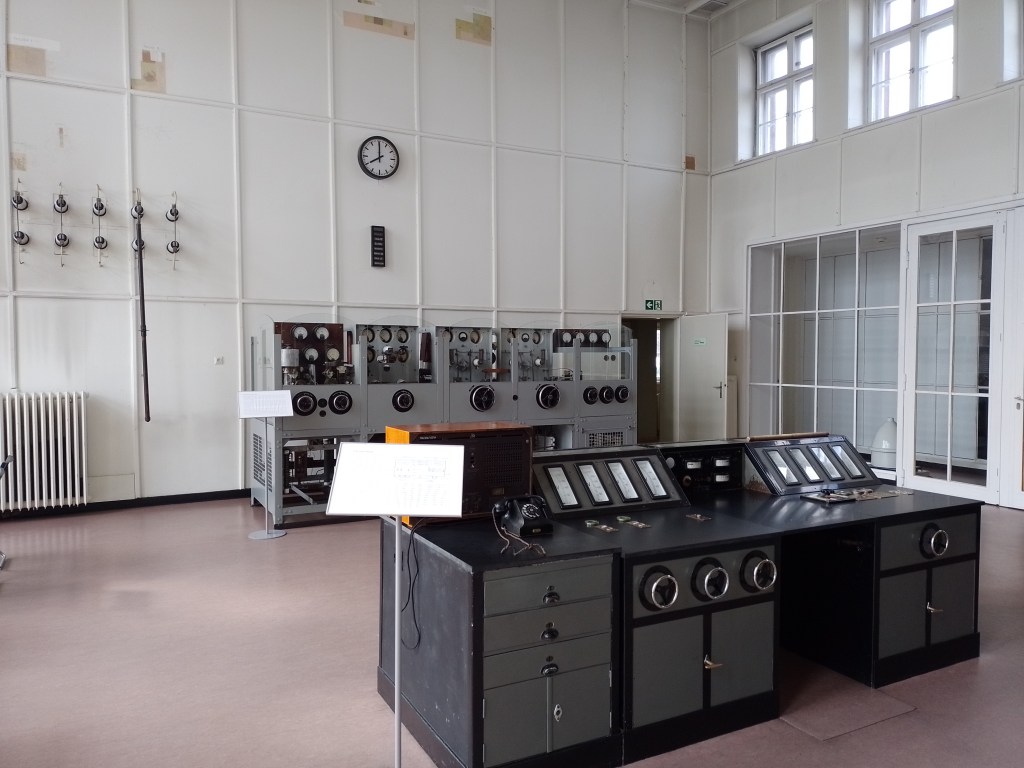
Materials and mechanisms from another era, preserved almost accidentally by time and disuse.
I stood there, trying to take in everything at once. It felt unreal — as if I had stepped into a photograph from a school history book and found it still warm.
Back then I only knew a fragment of the story.
“WW2 began here,” that was the extent of it.
And yet here I was, in 2007, standing in the very room where that fragment had once lived.
Reflection
Years later, sometime in 2011, my friend and I cycled back to Radiostacja.
By then, the site and surrounding area had been beautifully developed into a very pleasant park. The allotments were gone, the buildings restored, the tower carefully preserved. It had become somewhere people could visit, walk, sit, and spend an afternoon.
We sat there in the glorious early summer sunshine and I thought about that first night.
I thought about the tower appearing out of the darkness, the red lights blinking above us, and the strange feeling of recognition I had experienced from the passenger seat of my friend’s father’s car.
I thought about history.
By then I had learned a great deal more about the history of the place, and about Silesia itself. I had begun to understand that the story I had been taught at school was only one layer of a much more complicated history: German Silesia, Polish Silesia, borders that had moved, people who had been moved, identities that had survived political changes and sometimes been forced to change with them.
Sitting there in the sunshine, I tried to imagine that night in 1939.
What had the place felt like?
What had the people there known?
What had they believed was happening?
And how impossible would it have been for them to imagine what would follow?
The sunshine made it difficult to hold the thought for long.
Around me was a park. People walking. Birds. The ordinary sounds of a summer afternoon.
And there was the tower.
The same tower I had first seen as a sudden silhouette in the darkness, when I was still a visitor trying to understand Poland.
Only now I lived here.
That, perhaps, was the strangest part.
→ First Tastes
→ Elevated Discovery — Katowice
→ Walk & Tram — Katowice: a poem
→ Ôbzdrzōnek przez śniyg — Katowice: a poem
→ Czekając przy torach w śniegu — Katowice: a poem
→ Symbols, Snow and the Train to Wrocław
→ The Grammar of Hospitality
Image Credits
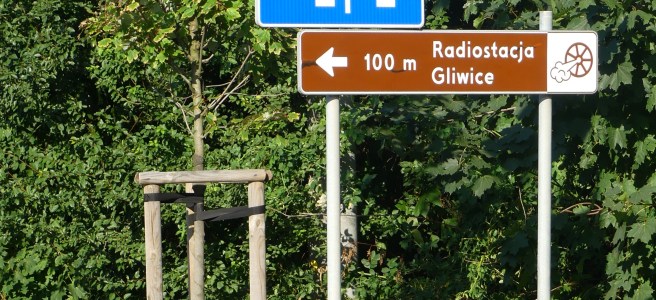
⚬ Signpost to the Gliwice Radio Station Museum – Bärbel Miemietz / Wikimedia Commons / CC BY-SA 4.0
⚬ Radiostacja Gliwicka – Dariusz Kobla / Wikimedia Commons / CC BY-SA 3.0 PL
⚬ Radio Station Gliwice: Transmission Room – Kamil Czaiński / Wikimedia Commons / CC BY-SA 4.0
⚬ Radiostacja Gliwicka at Sunset – Dariusz Kobla / Wikimedia Commons / CC BY-SA 3.0 PL

 Ghosts to Carry, Stories to Keep


