When I first began writing these pieces, I thought obiad would anchor everything — the midday meal, the table, the rituals I learned in Polish homes. But as the memories returned, I realised that food in Silesia spilled out into gardens, orchards, roadside trees, cellars stacked with jars, and the quiet generosity of people who believed that feeding someone was a form of welcome.
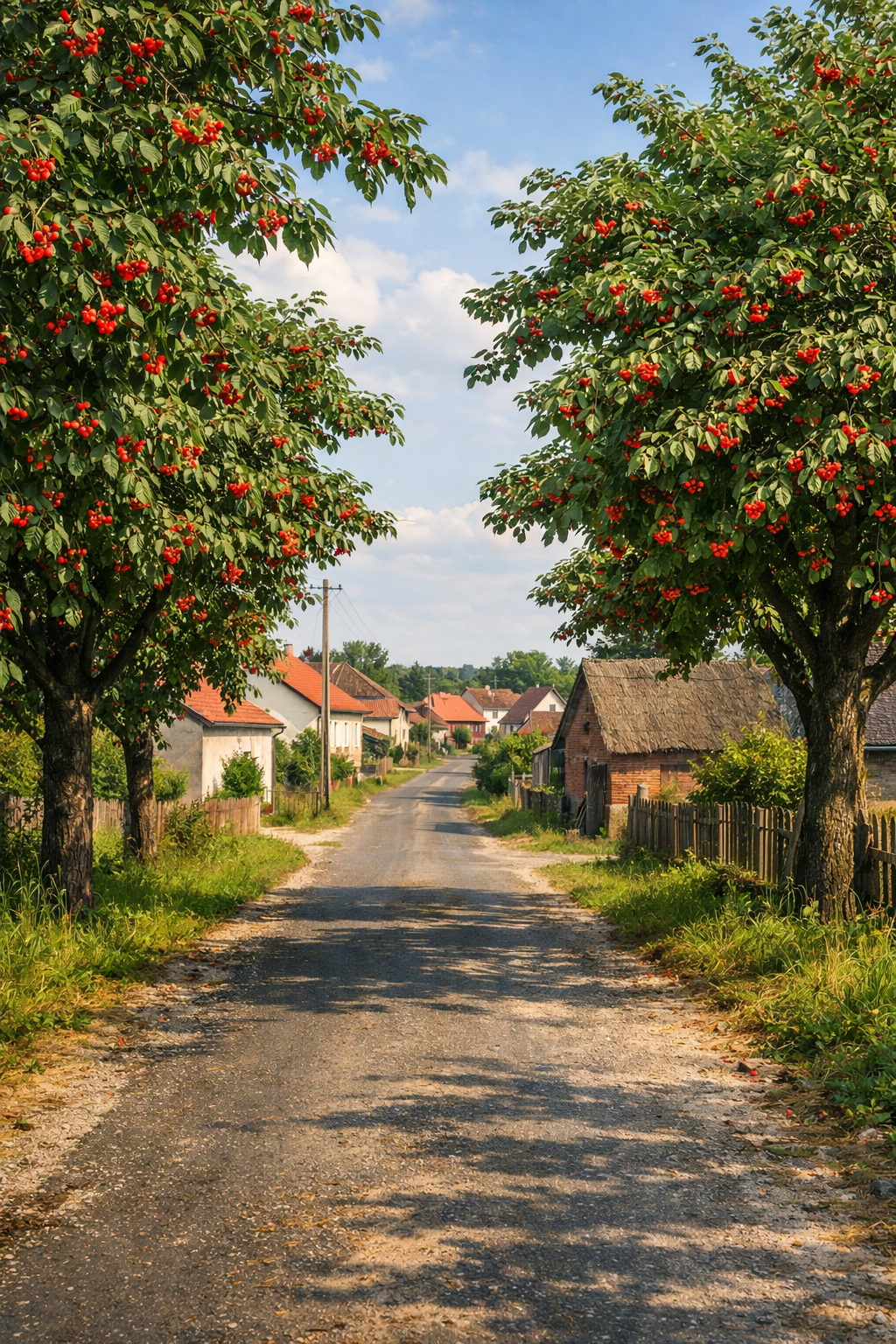
So although this chapter begins outdoors — on a cherry‑lined road, under a netted tree, with a bowl of fruit that startled me — it still belongs to Obiad and Other Meals. These were the “other meals”: the unexpected ones, the ones that taught me as much as any plate set on a table. A glass of kompot, a handful of cherries, a jar opened with a soft pop — they were all part of the same grammar of hospitality. A lesson I learned on my second visit to Poland.
Cherries
I arrived in my friend’s village by a road lined with open fields, scattered trees, and the kinds of buildings I didn’t yet know how to read: some old, some renovated, some strangely modern‑looking, despite clearly having stood there for decades. A beautiful cherry tree stood on the roadside directly outside their home — close enough to feel like part of the garden, though it technically belonged to the street. Its branches were heavy with fruit, the kind of abundance I had only ever seen in photographs. I asked my friend if the tree belonged to her family. She explained — though she wasn’t entirely certain — that she believed that it and others had been planted many years ago “for the community,” part of an old tradition of creating fruit tree avenues. Years later, I discovered this to be true. It felt like the right kind of welcome — generous, unhurried, rooted in the land.
The abundance didn’t stop at the roadside.
Their house sat in a large garden which included another very large cherry tree. It was so big it needed to be netted, a great canopy stretched over it to keep the birds from stripping it bare. I had never seen a cherry tree before, not in real life, not growing. My childhood cherries came from tins of fruit salad, floating in syrup, one red jewel per bowl. My grandmother baked with glacé cherries — too sweet to eat alone, but perfect in a scone, or atop a coconut haystack treat. Even as an adult, cherries meant a small supermarket punnet during a brief British season. Here, they were abundance itself. Even the family pet, a huge but gentle Bernese Mountain Dog, spent its afternoons beneath the tree eating windfalls as they fell. I casually mentioned to my friend that I adored cherries, a rare treat, and I’d never seen them growing on a tree either in a garden or by the roadside before.
Inside the house I moved carefully, shy in borrowed slippers, trying to learn the quiet rules of being a guest. And then her mother placed a bowl on the table: not a polite dish, not a handful, but a harvest. The biggest bowl of cherries I had ever seen. My British instincts panicked at the sight of so much fruit. In my grandmother’s kitchen, a bowl placed in front of you usually came with a task attached: peas to pod, beans to trim, apples to peel. So when my friend’s mother placed this enormous bowl of cherries in front of me and disappeared back into the kitchen, I briefly wondered what work I was supposed to do first.
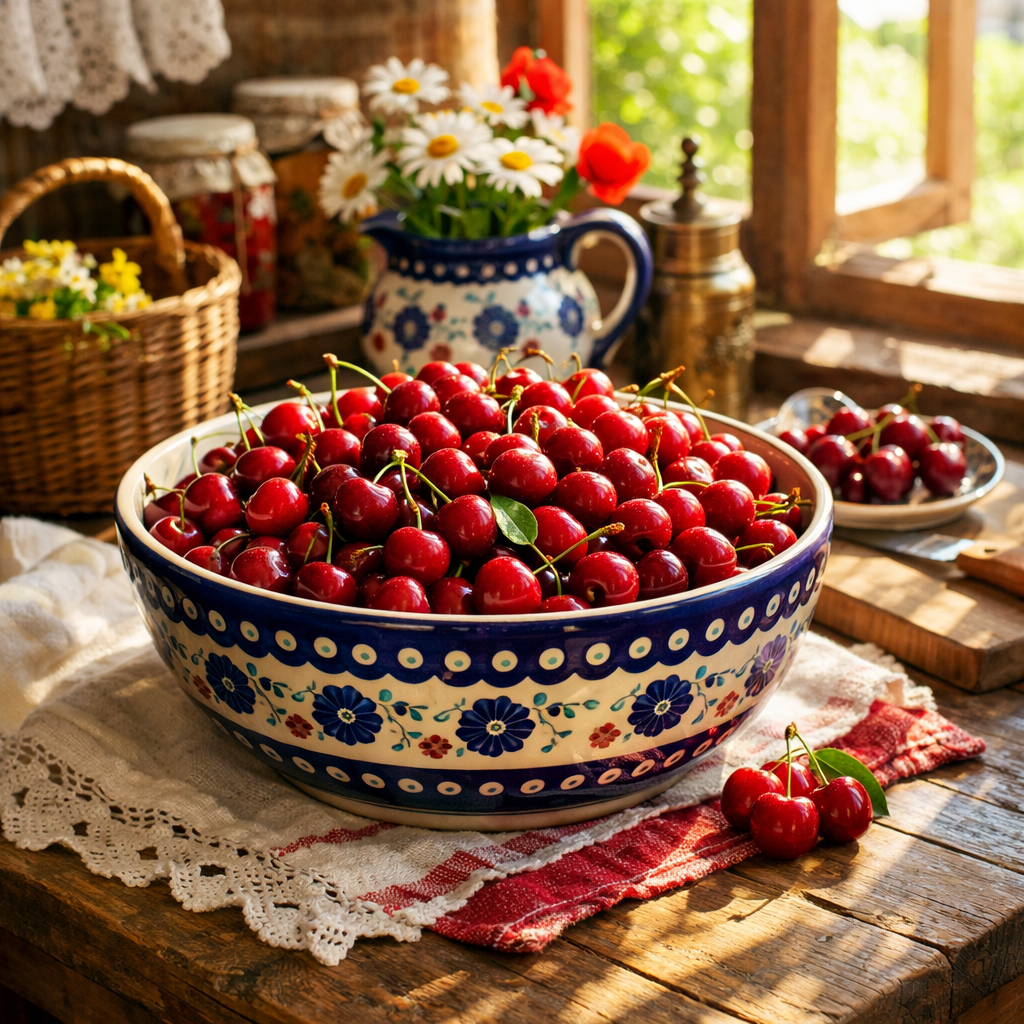
But the explanation was beautifully simple:
“He loves cherries.”
And in that kitchen, that was enough.
And the welcome didn’t end there.
Later, I was shown a large glass jar lifted from the cool dark of the cellar.
“Kompot,” my friend said. “It’s a drink. Very refreshing.”
The liquid was a deep, ruby red — nothing like the artificial syrup I knew from tins. I tilted the jar and poured it into a glass. The scent rose immediately: summer, sugar, sun‑warmed fruit. I took a sip and was startled by how honest it tasted.
Then I noticed the cherries resting at the bottom.
“What about the fruit?” I asked.
My friend looked at me with gentle amusement.
“Oh… eat it.”
As if there was any other choice.
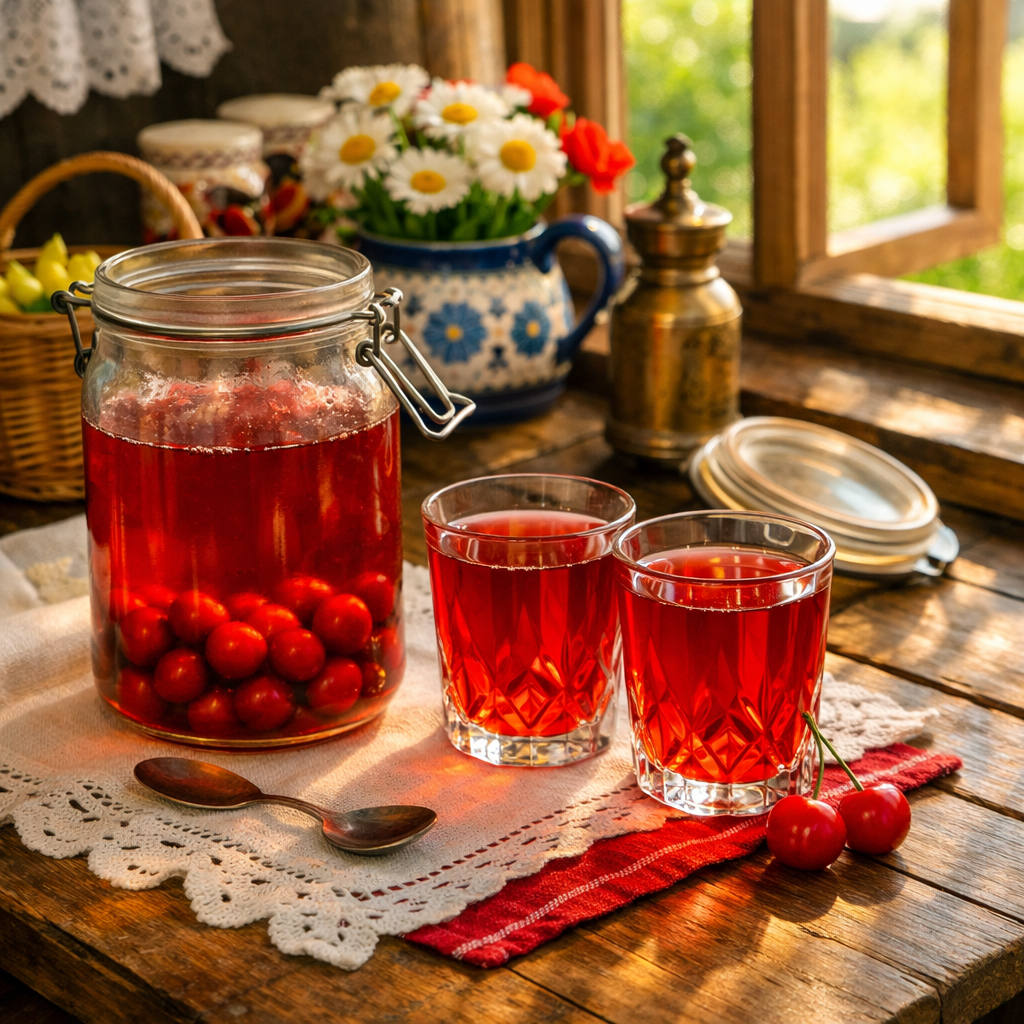
That was the joy of kompot — a two‑part ritual so simple and so delightful it felt like a small revelation. First came the drink, bright and refreshing. Then the spoon, diving down to feast on the soft, plump fruit from the bottom of the glass. In later years I bought commercial jars of kompot; it was good but never as good as that first taste of a homemade version.
Later that evening, I was asked if I would like to see how the cherries were preserved; I was delighted and agreed that I would. I followed my friend and her father, down into the cellar — cool, almost cold, lit by bright, modern lamps that made the space feel more like a quiet extension of the house than anything underground. It didn’t smell damp or musty; if anything, there was a faint wooden warmth to it, the kind of neutral scent that comes from shelves that have held jars for years. Rows upon rows of glass jars lined those shelves: vegetables, pears, pale‑pink gooseberries, and deep crimson cherries that looked less like food and more like small works of patience. They looked like summer held still — colour and sweetness waiting behind glass. Enough for winter. Enough for guests.
My friend’s father chose a jar of cherries, a couple of bottles of beer, and we went back upstairs. The jar’s seal broke with a soft pop — a small, familiar sound releasing a breath of cool air into the warm kitchen. Nothing dramatic. Just a quiet gesture of care, the sort that stays with you precisely because of how ordinary it is.
But Poland wasn’t only orchards, kitchens and cellars — when I stepped away from the quiet rhythm of the village and into the urban rush of Upper Silesia, the landscape fractured into something entirely different.
Stations, Kiosks and First Bites
During these early visits I realised that there was another side of Polish food waiting for me to experience — the Poland of streets, stations, kiosks, and fast‑food windows glowing in the evening. Those first few visits to Poland were a strange mixture of expectation and surprise.
My Polish friends in the UK had never mentioned fast food. Whenever we talked about food, it was always home cooking: soups stirred for hours, kotlety flattened with a rolling pin, pierogi sealed with a thumbprint. They spoke about food the way people speak about family. So I arrived in Poland expecting something… older. More traditional. More “authentically Polish,” whatever that meant to me at the time.
What I didn’t expect — what genuinely stunned me — was the sight of KFC, McDonald’s, Pizza Hut glowing confidently above the streets of Katowice and Gliwice.
And then, right beside the international chains, were the kiosks — the little Polish fast‑food windows selling burgery, zapiekanka, frytki. Strangely, to me, there seemed to be kebab outlets everywhere: kiosks, take-away counters, even restaurants dedicated entirely to kebab.
It was a whole ecosystem of local fast food I’d never heard about because my friends had grown up with it and didn’t think to mention it. They were amused when I asked about milk bars, as if I’d read about them in a guidebook from 1998. Which, in fairness, I probably had.
So there I was — a visitor still trying to understand the country — holding my first zapiekanka, handed to me on a paper tray, steaming in the cold air as I stood outside the concrete walkway of the old Katowice railway station.
It was mushroom and cheese, the classic. A long half‑baguette, toasted until the cheese squeaked, then finished with a confident zig‑zag of ketchup. My friend passed it to me with the kind of pride usually reserved for introducing someone to a national treasure.
I didn’t want to offend her, but I remember thinking — and eventually saying, as gently as I could — “It’s basically a baguette with a topping.”
She laughed, of course. Everyone laughs the first time a foreigner tries to categorise zapiekanka.
But it was good — warm, messy, perfect for standing outside a brutalist train station in a city I barely knew. That was the beginning. Just a zapiekanka eaten under a grey Silesian sky, with trams rattling past and the smell of toasted bread, grilled cheese, fried mushroom and onion drifting from a kiosk.
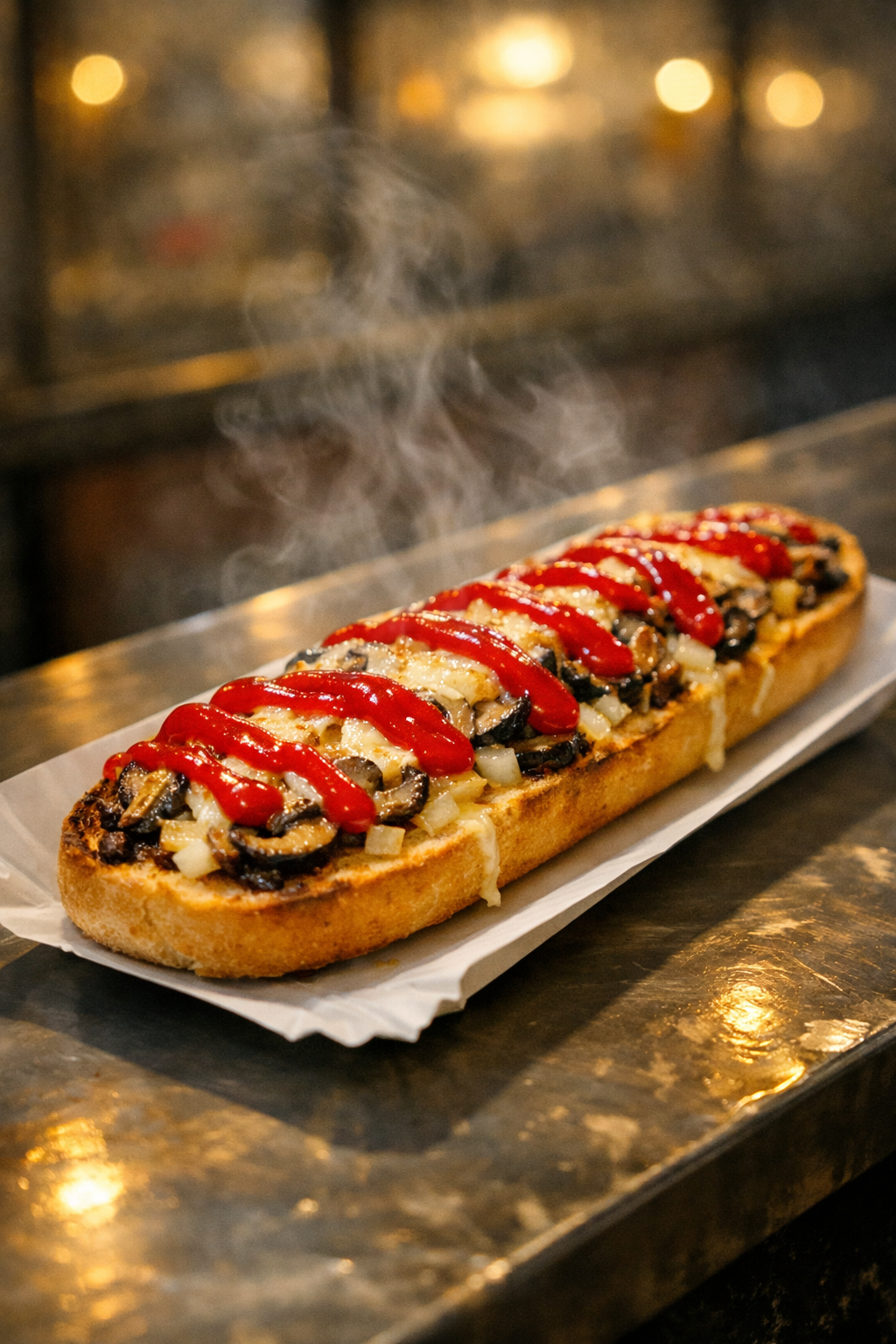
I didn’t know it then, but it was the first thread of curiosity I’d tug at — one bite, one street, one small surprise at a time.
Bar mleczny / Milk Bar, Bytom — 2009
My first milk bar experience wasn’t quite what I expected, though not for the reasons I imagined. Visiting Poland sometime in 2009, I met up with my friend in Bytom. We were wandering along Dworcowa, the city shifting between soot‑blackened buildings and pockets of unexpected charm, when we passed a milk bar. I asked if we could eat there. My friend laughed softly — sure, we can eat here — a laugh that carried both affection and a hint of warning.
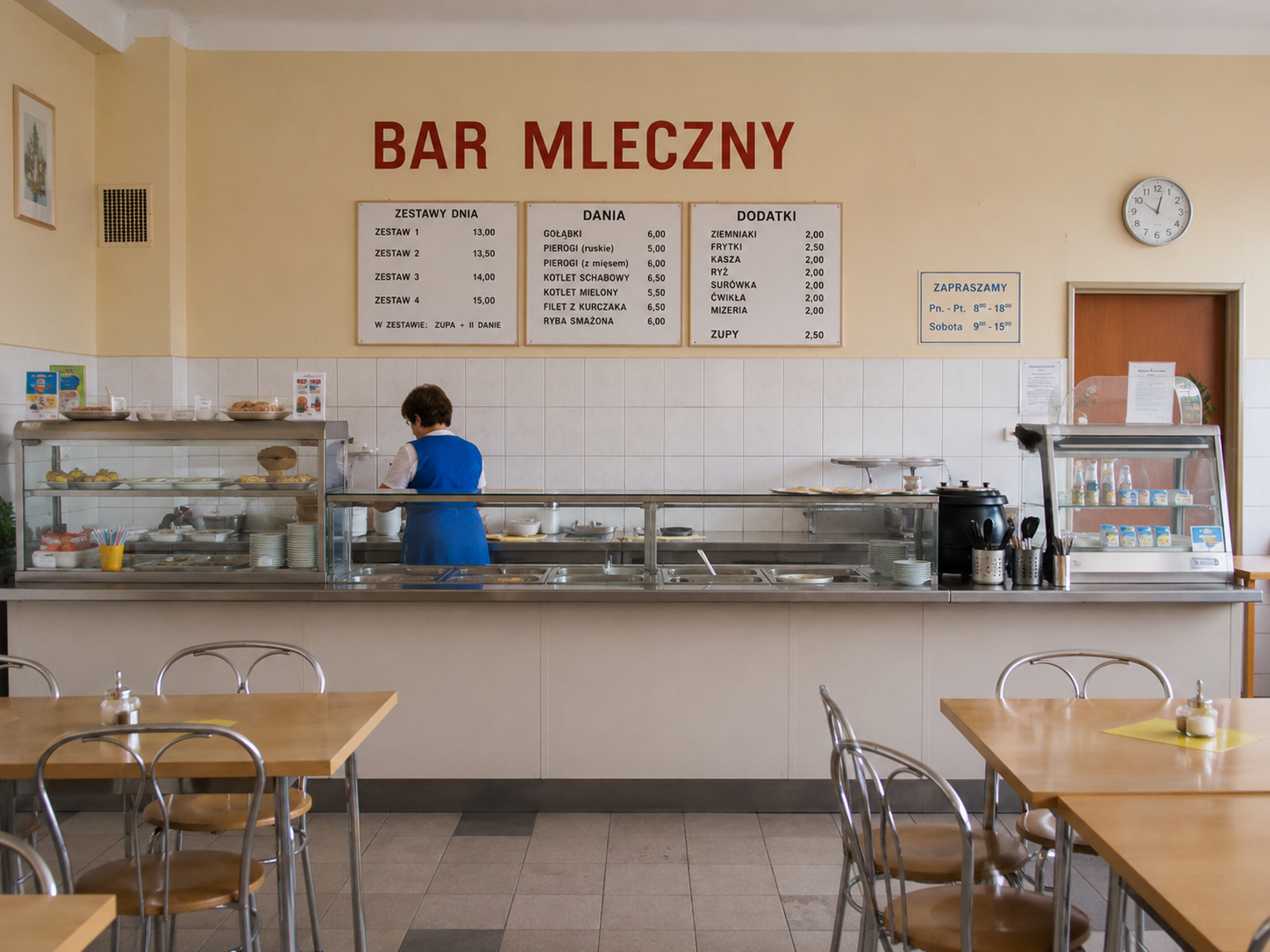
Inside, my expectations were met instantly. The women behind the counter were exactly as I’d been told: strong‑willed, confident, efficient. No nonsense, but not unkind. The room smelled faintly of steam and boiled vegetables, the kind of scent that clings to tiled walls. They were patient as my friend translated the menu, though I felt a little stressed — clearly this was the sort of place where you needed to know exactly what you wanted before you reached the front of the queue. The menu looked as if it had been hanging there since the 1970s, and I chose hastily: fasolka po bretońsku with a bread roll — bułka. I didn’t know it then, but this soup would become my safe harbour in the early days of living in Gliwice, the one thing I felt confident ordering.
The soup was actually a stew — big chunks of meat and white beans, smoky, savoury, velvety — and the bread roll was perfect: crisp, golden‑brown crust, soft and slightly sweet inside. I adored it. My friend ordered pierogi ruskie, a dish beloved by everyone I later met in Poland, though it never quite won me over. I grew to enjoy other types of pierogi, but not this one — much to the shock of friends and students. I recall my friend laughing as I asked if my soup was really a Breton dish. She had no idea. It didn’t matter. This dish was far superior to the baked beans in tomato sauce I knew so well.
As we were eating, the atmosphere shifted. A man approached our table — older, though perhaps only because life had worn him down. He spoke quickly, urgently. I didn’t understand the words, only the tone. My friend did. She leaned in and whispered, “He is asking for money to buy soup.”
I hesitated. She gently declined him, the way locals knew to do, but something in me resisted the idea of turning away. I asked if we could buy him a meal instead. She agreed, seeing what it meant to me. But when she tried to order soup for him, the staff refused — not angrily, but with the weary firmness of people who had already reached their limit. He had already been given soup that morning, she explained. He had been sitting there for hours. They wouldn’t serve him again, and they wouldn’t allow us to buy it for him either.
His distress broke open instantly. He sobbed and pleaded with the women behind the counter, pointing to my friend and me, eventually repeating a single word — zupa… zupa. It wasn’t only hunger; it was hope collapsing right in front of us. The staff gestured for him to leave. My friend tried to explain the situation, but nothing softened the moment.
I felt a deep, helpless sadness.
That was my first milk bar experience. Not the comforting, nostalgic scene I’d imagined, but something far more human — complicated, uncomfortable, unforgettable.
Even now, years later, I can still hear him.
Zupa… zupa…

 Ghosts to Carry, Stories to Keep