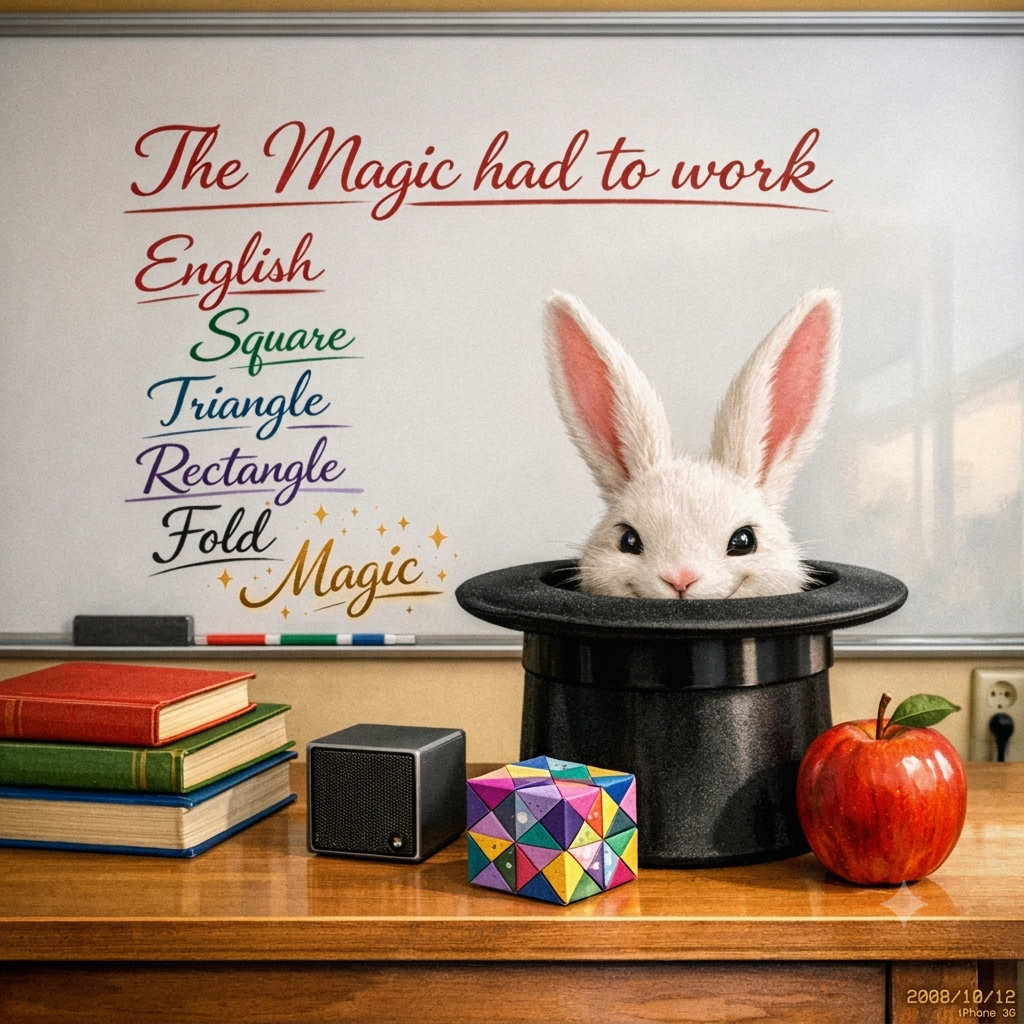
The Magic Had to Work For Everyone
In those final months, after I’d told Britam I would be leaving, I found myself teaching with a strange mixture of sadness, freedom, and creativity. Maybe it was because the pressure had lifted, or because I wanted to leave my students with something memorable. Either way, that’s how I ended up introducing one of the most unexpectedly successful — and unintentionally chaotic — activities I ever taught: an origami exercise.
It sounds ridiculous, but it worked.
Watching, listening, describing, sequencing — all wrapped inside a simple sheet of paper.
I had learned how to make what I can only describe as an origami cube. Flat at first, then — with one gentle puff of air — it opened up into a near‑perfect little cube. Or at least something that aspired to be a cube. Some were cuboid, some were noticeably not, and a few were so structurally disappointing they really should have come with a warning label.
Through trial and error, I learned it required the stiffer type of origami paper to achieve the very best results. I lost count of how many cubes I made during reflective practice runs. At some point I realised I’d essentially become a small‑scale cube manufacturer. They began to fill a large glass bowl, looking strangely decorative — like the world’s least practical fruit.
This had to be a win‑win.
The first time I demonstrated it to a class of twelve to fourteen‑year‑olds, the reaction was instant. The flat shape lifted, blossomed, and suddenly became a cube — and the room erupted. A chorus of oohs and ahs, a few gasps, and one beautifully emphatic “No… suuuper!” — that wonderfully stretched‑out Polish way of expressing delight.
For a moment I felt like a magician.
I would make one first, slowly, narrating each fold. Then I’d hand out paper — sometimes those featuring beautiful traditional origami designs — and guide the class through their own creations. It took no more than twenty minutes, but it was one of the most joyful warm‑ups I ever used. Students carried their finished origami creations out of the classroom like a delicate piece of treasure. I even saw a few being shown off in the corridor with quiet pride.
I don’t remember a single student giving up; some made the odd mistake, which was easily rectified. In those last months, I even carried a couple of pre‑folded pieces in my pocket, just in case a student’s cube refused to cooperate. A quiet swap, no fuss — the magic had to work for everyone.
I’d learned to make what I believed was just a nice decorative object — a cube. That was the beginning and end of it. The fact that it could be used in another way had not entered my thoughts.
I used to enjoy a small moment of mischief. I’d hold up the folded shape — still flat, still mysterious — and ask them what they thought it was. The guesses were wonderfully wild: a hat, a box, a strange envelope — most students stared at it with polite confusion. But once — only once — a lad squinted at the unfinished shape and said, with the confidence of someone discovering fire, “Mr Gary… that’s a water bomb.”
I laughed it off at the time. I genuinely thought he was joking.
“Is it?” I replied. “Well… I don’t think you should try using it like that. Not here, anyway.”
In British terms, I’d describe him and his small cohort of friends as simply the lads — and, without realising it, I’d once worn a blue badge proudly declaring myself one of them. A gizd among gizdy.
The lesson came to an end; the class rushed out, happy to finish and get home. I felt good about how much fun the lesson had been; I was collecting my books and props when I heard a commotion on the landing outside — real chaos: screams, shouts, and the unmistakable sound of a teacher trying to restore order. I popped my head out, fearing the worst.
To my horror — but not, if I’m honest, my surprise — I discovered that four of the lads, including the one who’d proudly identified the “water bomb,” had gone straight into the students’ toilet and filled each of their paper creations to maximum capacity with tap water. They had then burst out onto the landing like a budget version of Royal Marine commandos: choosing targets with military precision — and throwing them with absolutely none.
It was, in its own way, impressive.
Less impressive was the aftermath.
One or two bombs had missed their intended victims entirely, exploding against the walls. Water splashed down the steps, forming a small but ambitious flood on the stairs and landing. I could see two other students wiping water from their clothing and rucksacks, somewhere between outrage and laughter.
And there they were — the lads.
Standing halfway down the stairs, one holding the sad remains of what had once been a perfectly innocent origami cube.
They looked up at me with identical expressions: wide‑eyed, hopeful, and silently pleading.
As if to say: Mr Gary… you made us do it.
More teacher colleagues arrived — this was now rather more serious than I really wanted it to be.
The lads were promptly instructed to wait outside the School Director’s office — a place no student ever wants to be sent. A detail I had somehow managed to forget in the heat of the moment.
Was I to join them too?
Our school cleaner arrived soon after — a kind, funny, deeply patient woman with whom I somehow managed to have regular conversations despite her having no English and my Polish hovering somewhere around survival level. I think her name was Pani Ewa. Time has blurred the certainty, but not the person. What I remember clearly is her warmth and kindness.
Pani Ewa took one look at the flooded stairs, then at me, and pulled an expression of theatrical despair that clearly meant: Excellent. More work. Then she laughed when she saw how worried I was.
All I could really do was shrug my shoulders, say sorry, and offer to mop up the water. She laughed and shook her head. The colleague who had first arrived to restore order burst out laughing too. No matter how much I offered, I wasn’t allowed near any mop or bucket.
A full health and safety alert was declared — rightly so — though not the sort usually triggered by sightings of unlabelled yoghurt or someone reheating a fish dish in the staff microwave.
My close friend had also just finished with her own class, and, hearing the commotion, arrived to see what the fuss was. She shook her head and gave a sympathetic look at Pani Ewa.
“Gary… what exactly were you doing with that group?”
A fair question, delivered with a raised eyebrow and a damp mop nearby.
I apologised, of course. It wasn’t supposed to have ended like that; I didn’t know the cubes could be converted into paper-and-water ammunition, or that they’d actually be used on school premises — after all, I had advised it wasn’t a good idea.
But secretly, I couldn’t help thinking:
They had listened.
They had followed instructions.
They had created something.
And then, being teenagers, they had weaponised it.
It was absurd.
It was harmless.
It was very, very Britam.
As I made my way to the teachers’ room — my work done — I passed the lads, now slightly subdued, still lined up outside the Director’s office where a small crowd of their peers teased them without mercy. It was almost enough to make me feel sorry for them.
Almost.
I half‑expected I would have to face our Director too, perhaps to receive some advice — perhaps to think carefully about what the more spirited younger students might do with such a versatile little object. But no advice or gentle warning ever came. The activity stayed on the timetable, unbanned and unblamed, and the students kept folding cubes with the same enthusiasm — just with slightly less interest in their aerodynamic potential.
Classes finished at 8:20 p.m., and if my friend had been teaching at the same time — which happened often — she’d already have offered me a lift home. We’d meet during the ten‑minute break between lessons, and by the time I finally made it down to the teachers’ room with my usual mountain of books and props, she’d be there chatting to Pani Ewa.
She would always ask about my day, whether I was enjoying life in Poland, whether I was settling in. She never showed a flicker of impatience — if she felt any, she was too gracious to let it show. It was always my friend who eventually said, gently, “We should let Pani Ewa lock up…”
Nothing was rushed. I’d apologise, we’d all smile, and then she’d close the big glass doors behind us and disappear back into the building.
Stepping out into the night air — no matter the weather — always felt strangely refreshing. A small, quiet ending to the day, held together by two women who looked after me more than they probably realised.
And it happened during the same months when everything else in my life felt heavy. Somehow, that small disaster — that ridiculous, soggy moment — reminded me that even as I was preparing to leave, the place hadn’t dimmed. Not really.

Gizd‑friendly budget Biedronka model shown in red. Water or other liquid not supplied.
Supervision strongly recommended.
Something
There’s another memory from those months that still makes me laugh. I once took a photo of one of my livelier groups — twelve‑ to fourteen‑year‑olds in full, unfiltered mode: peace signs, wild grins, the kind of joyful chaos that made every lesson feel like a small festival. I can’t use the photo, of course. Children deserve their privacy, especially now. But in the background, on the whiteboard, you can just make out a single word written in huge letters: SOMETHING.
I remember exactly how it happened. Faced with a room vibrating with energy and absolutely no plan left in my head, I tapped the board and announced, with the confidence of a man bluffing for his life, “Right. How many English words can you make from SOMETHING?”
And somehow, unbelievably, it worked. They fell on it like detectives, shouting out answers, arguing over spellings, turning a single word into a competition that lasted the whole cool‑down. It was pure improvisation — panic disguised as pedagogy — and yet it became one of those small, shining classroom rituals I still think about with ridiculous fondness.
They were, of course, the winning class. They always were. I may have ever so slightly embellished the rival groups’ results from time to time — just enough to keep the momentum alive. The only embellishing I’ve ever done in my writing or my teaching, and entirely in the name of teenage motivation.
They would cheer, punch the air, and look at me with the fierce pride of a team that had conquered Everest using only a whiteboard marker and the word SOMETHING. And I’d stand there, trying not to smile too obviously, thinking: if only they knew how close the other class actually came.
There was still laughter in the rooms I taught in.
Still that strange, bright energy only teenagers can generate.
And for a little while longer, I was still standing in the middle of it — damp stairs, water bombs, origami magic and the endless possibilities of SOMETHING.


Leave a comment