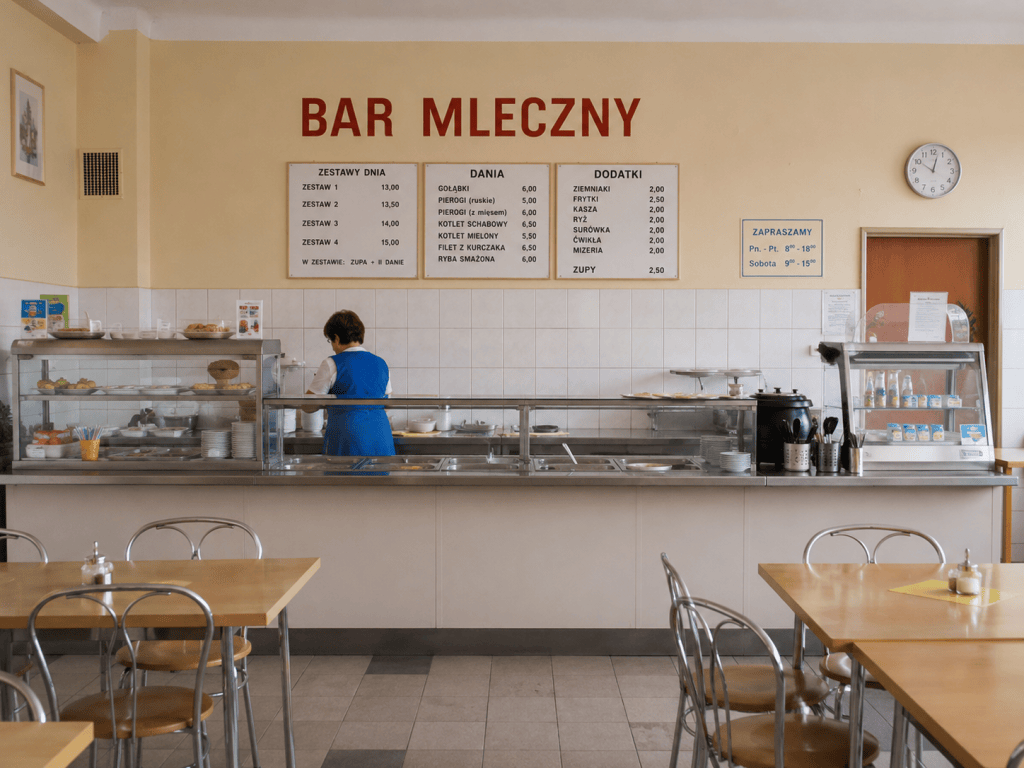
Bytom — 2009
A Note on the Silesian Milk Bar Series
Before moving to Poland, my understanding of a bar mleczny was pieced together from guidebook glossaries and half-remembered UK history. I had a vague notion they might resemble the old Milk Marketing Board cafes from 1960s Britain — sleek milk bars with stainless-steel counters milkshakes, soup and light bites. But a Polish friend explained the real concept to me: state-subsidised canteens offering cheap, hot, traditional meals to anyone who walked through the door.
I was fascinated. What started as a tourist’s curiosity during an early trip in 2009 eventually became a quiet fixture of my life when I eventually moved to work and live in Silesia.
This is the first of three pieces tracing that shift, starting on a soot-blackened street in Bytom.
Zupa… Zupa…
My first milk bar experience wasn’t quite what I expected, though not for the reasons I imagined. Visiting Poland sometime in 2009, I met up with my friend in her home city of Bytom. We were wandering along Dworcowa, the city shifting between soot‑blackened buildings and pockets of unexpected charm, when we passed a milk bar. I asked if we could eat there. My friend laughed softly — sure, we can eat here — a laugh that carried both affection and a hint of warning.
Inside, my expectations were met instantly. The women behind the counter were exactly as I’d been told: strong‑willed, confident, efficient. No nonsense, but not unkind. The room held a thick, unmistakable fog — a signature weave of steam, simmering soups, hot oil, and boiled cabbage. I didn’t realise it then, on that very first visit, but that scent didn’t just hang in the air — it inhabited whatever you wore. In the months and years to come, as milk bars became part of my weekly rhythm, I learned how it seeped deep into any fabric. It didn’t matter if it was a heavy winter coat, a cotton sleeve, or a knitted scarf tucked into your collar. Long after you’d stepped back out onto the street, it remained — a quiet, lingering calling card that gave away exactly where you’d just eaten.
The formidable matriarchs were slightly surprised, but patient as my friend translated the menu, though I felt a little stressed — clearly this was the sort of place where you needed to know exactly what you wanted before you reached the front of the queue. The menu looked as if it had been hanging there since the 1970s, and I chose hastily: fasolka po bretońsku with a bread roll — bułka. I didn’t know it then, but this soup would become my safe harbour in the early days of living in Gliwice, the one thing I felt confident ordering.
The soup was actually a stew — big chunks of meat and white beans, smoky, savoury, velvety — and the bread roll was perfect: crisp, golden‑brown crust, soft and slightly sweet inside. I adored it. My friend ordered pierogi ruskie, a dish beloved by everyone I later met in Poland, though it never quite won me over. I grew to enjoy other types of pierogi, but not this one — much to the shock of friends and students. I recall my friend laughing as I asked if my soup was really a Breton dish. She had no idea. It didn’t matter. This dish was far superior to the baked beans in tomato sauce I knew so well.
As we were eating, the atmosphere shifted. A man approached our table — older, though perhaps only because life had worn him down. He spoke quickly, urgently. I didn’t understand the words, only the tone. My friend did. She leaned in and whispered, “He is asking for money to buy soup.”
I hesitated. She gently declined him, the way locals knew to do, but something in me resisted the idea of turning away. I asked if we could buy him a meal instead. She agreed, seeing what it meant to me. But when she tried to order soup for him, the staff refused — not angrily, but with the weary firmness of people who had already reached their limit. He had already been given soup that morning, she explained. He had been sitting there for hours. They wouldn’t serve him again, and they wouldn’t allow us to buy it for him either.
His distress broke open instantly. He sobbed and pleaded with the women behind the counter, pointing to my friend and me, eventually repeating a single word — zupa… zupa. It wasn’t only hunger; it was hope collapsing right in front of us. The staff gestured for him to leave. My friend tried to explain the situation, but nothing softened the moment.
I felt a deep, helpless sadness.
That was my first milk bar experience. Not the comforting, nostalgic scene I’d imagined, but something far more human — complicated, uncomfortable, unforgettable.
Even now, years later, I can still see his distress, and hear his despair repeating two words.
Zupa… zupa…


Leave a Reply