Winter, Work, and the Cost of Carrying On
In the summer of 2013, I returned to Gliwice needing a new apartment. A friend helped me find a place located closer to the centre — a delightful flat with underfloor heating and a kitchen I genuinely loved. But as winter approached, a deep fatigue began to settle in. The workload felt endless. I wasn’t complaining; I was simply moving forward, doing the job, and trying to meet every expectation I believed existed.
Yet, in the middle of that exhaustion, there were moments that lifted me. Once, a class of teenagers decorated the classroom with banners made from that coarse, grey, school‑issue toilet paper—the kind that dissolves if you look at it too hard. Hearts, flowers, and “We love Gary” were scrawled across the rough paper like a beautiful, budget Valentine’s Day parade. I took it down after the lesson, but I couldn’t bring myself to throw it away. It felt too earnest, too chaotic, and too uniquely them. On other days, I’d walk into a classroom to find notes, smiley faces, or a wobbly sketch of me on my bicycle hastily drawn on the whiteboard.
By Christmas, back in the UK, my family was visibly concerned. I had lost weight and looked entirely spent. I went into Chester for a haircut and arranged to meet my daughter directly afterward. She had recently returned home from university, and I was genuinely looking forward to catching up.
Within minutes of sitting down in the café, she asked — with her usual directness — why I had dyed my hair in strange white patches. I laughed, assuming it was a joke. But she wasn’t smiling. She looked confused and urged me to go to the washroom to look in the mirror.
It felt surreal, sitting in a bustling café discussing my appearance. I caught my reflection in the window and thought it looked normal enough, so I demurred, muttering that I’d check later. But she refused to drop it. Without my glasses during the haircut, I hadn’t noticed anything unusual in the barber’s chair. My hair was graded short, but it looked fine to me.
Resourceful as ever, my daughter pulled out her phone, snapped photos of the sides and back of my head, and slid the screen across the table.
I could instantly see why she was worried.
My hair looked bizarre — marked with patterns like leopard‑fur rosettes, with distinct white patches scattered through my usual brown and grey. I didn’t know what to say. Seeing her worry, I tried to laugh it off as normal ageing, but privately, a quiet concern set in. Why couldn’t I see my own body changing when everyone else could? Had the barber simply stayed silent out of politeness?
When the holidays ended, I returned to Poland — to a place I had grown deeply attached to, a landscape that had quietly settled into my identity. The physical signs were no longer subtle; they were written on my face and in the way people looked at me. But I simply accepted the dramatic speed at which my hair was silvering. I had a relentless schedule and far too many demands to sit around worrying about aesthetics.
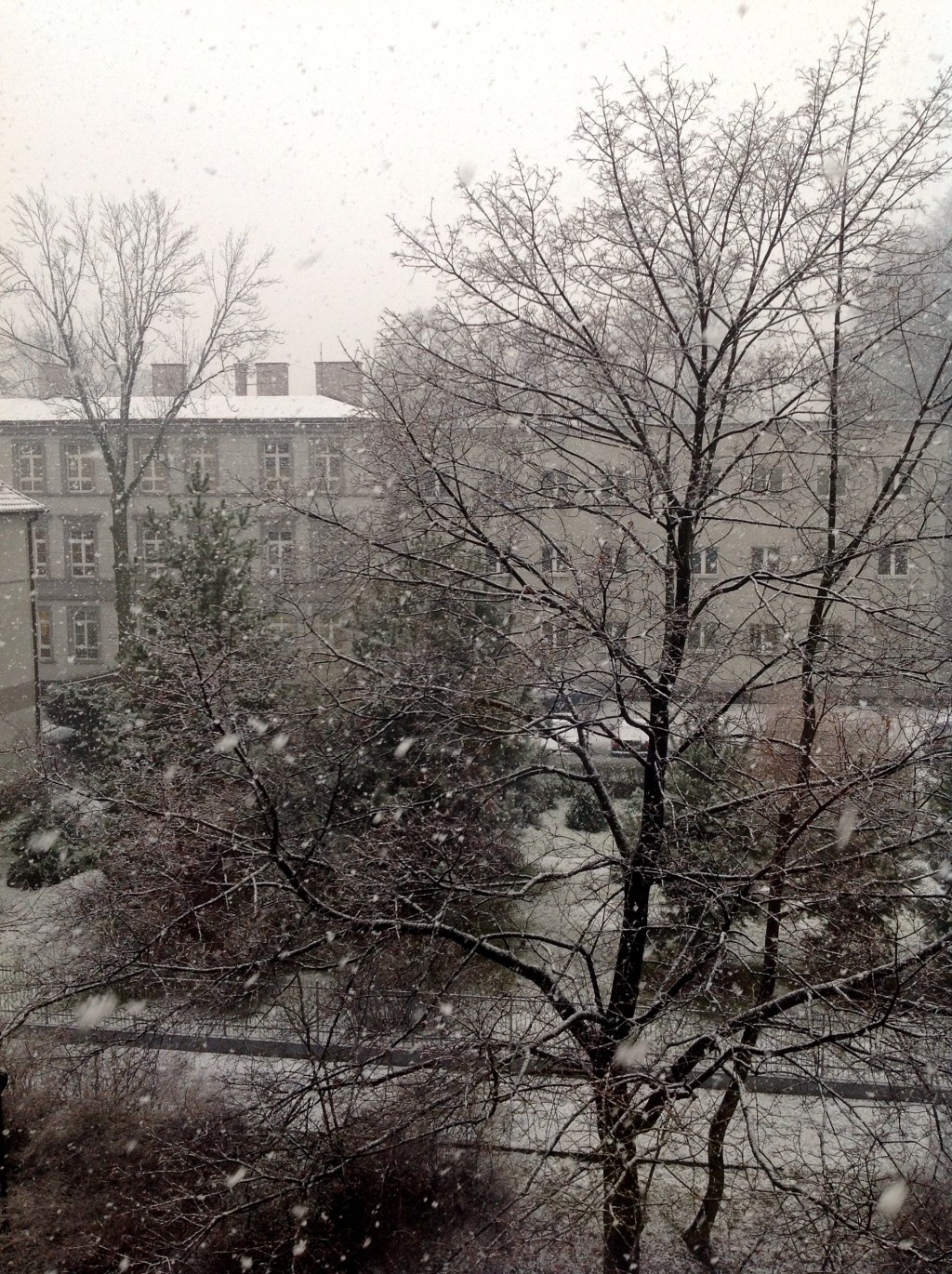
By February, the Silesian winter had deepened. I walked into a classroom of teenagers I hadn’t taught since the autumn term. They were a bright, creative group, and I had been looking forward to seeing them again.
I opened the door.
The chatter stopped instantly—not out of formal discipline, but pure shock. A student whispered to her neighbour in urgent Polish: “What happened to his hair?”
By then, it had turned completely snow-white.

Yes—I did teach wearing a favorite t-shirt and a ‘Kaj my som?’ badge.
A Difficult Decision
By March 2014, I knew I had to return to the UK. The underlying reasons were complex, but the immediate truth was plain: I couldn’t keep running on empty.
I didn’t want to give a month’s notice and suddenly vanish. I wanted to see out the winter–spring term through May and leave properly, but I didn’t know how to break the news. One morning, while preparing a lesson, my phone rang. It was Pani Grażyna. My hands began to tremble as I answered, trying desperately to keep my voice steady.
She wasn’t calling about administration. She was inviting me to lunch with her and her husband — whom I knew well from our private conversation sessions — to personally thank me for my work at the academy.
I managed to accept, my throat tight. She was delighted, asking if we could meet that very day before my afternoon classes. I couldn’t say no. I was being honoured and thanked at the exact moment I was preparing to resign.
The restaurant was quiet and thoughtfully chosen. Both of them were warm, relaxed, and genuinely happy to see me, but within minutes, they could tell something was terribly wrong. I could barely touch my food. I kept asking myself when the right moment would be, only to realise there was no right moment.
And then the words simply spilled out.
I apologised and told them I was leaving, though I promised to stay through the end of May to finish the term properly. An immediate silence fell over the table. They stopped eating. They weren’t angry — they were stunned, concerned, trying to process why a teacher they valued so highly was walking away. I instantly regretted the timing, wishing I had waited, but the words were out. Lunch ended quietly with polite gratitude, another apology, and a hasty reminder to myself that I still had worksheets to photocopy before my afternoon class. Normal tasks, but nothing felt normal any more.
Later that day, I knocked on Pani Grażyna’s office door and was asked to step inside. I wasn’t nervous, just overwhelmingly sad. She looked up at me with immense kindness, approaching me not as an employer dealing with a departing employee, but as someone who genuinely cared about my well-being. She sat me down, looked at my snow-white hair, and offered every accommodation she could think of.
“There will always be a place for you here.”
They wanted me to stay — not merely because they needed a native speaker, but because they didn’t want to lose me. That was the hardest part to swallow.
I wasn’t leaving out of frustration or exhaustion with the job. I was leaving because my body and mind were failing me, and I was trying to shield everyone else from that truth. They were offering me a lifeline at the exact moment I knew I couldn’t take it.
In the end, there was no clean ending to hold on to, no single definitive moment to mark as the last — only a slow dimming of something that had once felt so certain.
I had carried on for as long as humanly possible, through the noise, the relentless work, the laughter, and the subtle warnings I had chosen to ignore. When I finally stopped, it was not because I had reached a destination.
It was because I understood, at last, that I had run out of road.

Sunset on Kozielska, looking out of my apartment window
Next Story:
 Ghosts to Carry, Stories to Keep
Leave a comment