
The Stairwell and Its Quiet Loyalties
Only a short time before, my life in Gliwice had been contained within the sterile, temporary walls of a hotel room. Living out of a suitcase makes you feel like a ghost in a city; you eat out of convenience, you sleep in a bed that isn’t yours, and you exist on the surface of a culture without ever sinking roots into it. Moving into my first apartment on Aleja Majowa was supposed to change that, but on this night, I felt entirely hollow — worn down, lonely, carrying a longing for warmth and belonging.
Leaving the city centre behind, the walk back toward the estate was a straight, freezing trial against the elements. The city seemed to be sleeping, too, muffled under the weight of the snow. There was little traffic, and I have no recollection of passing anyone on the pavements as I made my way home. The only exceptions were the small, predictable pockets of urban friction. Navigating the dreaded “spider” junction pedestrian crossing, a few stray headlights sliced through the dark. And then, as often as not, a few figures lingered outside the glowing sign of the nearby Biedronka — the people who stood in the cold and politely asked for grosze. Their voices were low, small breaths of desperate reality in an otherwise abandoned landscape.
As I pushed the bicycle up ulica Wincentego Styczyńskiego, the path to the estate forced a choice. To access Aleja Majowa, I had to take the cut-through — a small, narrow access road slipping behind the rear of Styczyńskiego and directly onto the blocks of the estate. I always hated walking through that small area in the dark. Tucked away from the main road’s street lights, it was an uneasy, shadowed corridor where the snow muffled the sound of my own footsteps, making the dark feel entirely too close.
Tonight, as I neared my apartment block, the snow began to fall again, soft and large, floating down in feather-like clusters over the asphalt. Fumbling with my key, I was always so happy to finally push open that heavy front door. Stepping across the threshold, the warmth of the ground floor landing was absolute bliss. The radiators on the landing breathed out a soft, dependable heat. It felt like being met by something quietly loyal.
I had been warned that, even when locked, my bike would be stolen if I left it outside or in the basement, and leaving it in the stairwell would be frowned upon — or even result in a warning from the other residents. So began the daily ritual of hauling my bike in and out of the building. Heavy as it was, I swung it onto my shoulder — snow still crusted along the frame — and pushed myself up the stairs.
The Trial of Four Floors
The crossbar of my bike already digging into my shoulder, I began the trial of carrying its cold weight. Every scrape of the tyre or shift of my bag still felt like a broadcast: the newcomer with the big bike is home again. In the pauses between each awkward thud, my mind filled the silence with imagined watchers — neighbours glued to their peepholes behind heavy, vinyl-padded doors as if it were premium television, whispering about who I really might be. Anything but the far less interesting reality — a person trying to carry too much, trying not to disturb anyone, trying to find a place where he didn’t feel like he was taking up the wrong kind of space.
The effort of it was ridiculous — truly Olympic‑level stuff — desperately trying to control my breathing, so I wouldn’t sound like I was dragging half the city up the stairs with me. The bike was heavy enough on its own, but on the days I also had groceries in the pannier, I still don’t know how I managed. Sheer stubbornness, probably. I loved that bike though. It stood out, even drew envious looks, and I was convinced it would be stolen the moment I blinked if I left it anywhere but inside my apartment. So it came with me every time I wanted to use it — day or night, up and down — like some sort of two‑wheeled emotional support animal, no matter how exhausted I was.
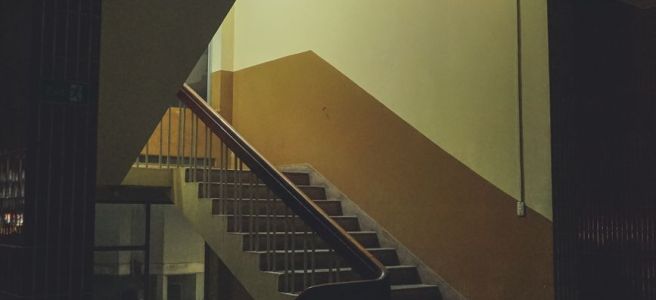
Each movement echoed sharply against the painted wainscoting. The layout offered no straight lines, only a relentless, repetitive rhythm. Lift. Step. Turn. Eight half-flights of speckled terrazzo stairs, broken up by tiny, square landings where I had to awkwardly pivot the long frame of the bike. The whole climb felt like a small, personal trial. Stepping onto the second main landing, an aching had already reached my fingers. By the third, my breath had grown laboured, trapped in the dead, radiator-warmed air of the stairwell. On the fourth, pivoting around the final turn, my legs trembled, both shoulders throbbed, and my fingers felt numb. Reaching the top floor, the quiet of the final landing felt almost ceremonial — a brief moment of stillness under the flat roof. I stood there, caught in that strange mixture of exhaustion and relief that comes from returning to a place that isn’t quite home — but is at least yours. Then I unlocked the door to whatever version of myself I could manage to be.

The Small Rituals of Home
When I stepped inside, the emotion rose up before I could name it. Safe. Warm. Back. Getting into the apartment was another small battle — balancing the bike on its stand on the cramped landing, opening the two locks, nudging the door open, wrestling it through into the tiny hallway — but the effort only sharpened the relief that followed. I was exhausted and so grateful to be home; this safe haven was something I never took for granted.
Still, even with the door shut and locked behind me, my body stayed tense. Boots off. Bag down. Coat and hat hung up. I switched on a small lamp, its glow reflecting off the light-oak herringbone parquet just beyond the doorway. Grabbed a cloth for a quick wipe of the melted slush on the hallway tiles before it could ruin the wood.
I changed into something more casual, something I could move in without thinking, and drifted into the kitchen for a light supper and a cold beer from the refrigerator. Then the laptop came out, music kept low so it barely filled the room. It was already late, far later than I liked, but the day wasn’t over yet — there was still lesson prep waiting for me.
Right beside the main room, the door to the kitchen stood. Opening it revealed a space that was incredibly narrow — a compact galley where everything sat within arm’s reach — but it was blessed with its own window, framing the dark, snow-dusted outlines of the estate outside. And then, the true sound of winter settled over the entire flat — the dry, familiar hiss of the radiator. It leaked out from the thick, vertical metal pipe that sliced straight through my ceiling, a stark line of the building’s industrial spine. The top-floor radiator always trapped the air of the floors below, breathing out a noisy, reliable heat that promised I was finally safe from the biting Polish cold.
Anglik z Dużym Rowerem
I always tried to move as quietly as I could, hyper‑aware of the neighbours hearing the unfamiliar sounds of a new resident dragging winter up the stairs — the newcomer with the very large Dutch bike and an equally oversized bag. They’d seen me around, of course. Polish people are wonderfully polite, but they don’t go in for small talk, and except for my immediate neighbour — who didn’t speak English and with whom I could only exchange the most basic Polish pleasantries — most interactions were limited to nods in the stairwell.
The man I’d rented the apartment from had apparently told half the building who I was and why I was in Poland, which somehow made me feel even more conspicuous. He’d even had a quiet word with the “local guys” as he referred to them. He mentioned he played football on the estate with most of the guys I might see around the blocks. “Don’t worry about them,” he said. “You live in their community now.”
A few nights later, I learned exactly what he meant by those “local lads” whom I clearly identified in my mind as blokersi. I knew what blokersi were. I couldn’t recall how the word had entered my vocabulary — friends, something I’d read, or just overheard gossip about estate subculture. Call it a culture, a subculture, or just a raw way of surviving the concrete landscape; I was under no illusions. Aleja Majowa had its own blokersi.
It was around minus eight degrees, the kind of cold that makes the streets feel abandoned. Before leaving my apartment to walk to the store, I had actually run a quick risk assessment. Should I even make this journey at this time of night? It was around 8 or 9 PM. To play it safe, I chose the longer route to avoid cutting through the dark centre of the estate, even though it added five minutes to the trip. I walked out into the bitterly dry cold air, making my way quickly across the narrow cut-through, and under the bright street lights of ulica Wincentego Styczyńskiego, before turning right onto ulica Generała Władysława Andersa and into the Żabka.
Clutching a flimsy green reklamówka containing a couple of beers and some snacks, I stepped back out into the freezing air. It wasn’t the damp, bone-chilling cold of a British winter; it was a dry, heavy, continental freeze that seemed to lock the whole world in place. The snow on the grassed areas wasn’t slush; it was frozen solid, absorbing what little light there was. The successful walk over had made me bold. I’m going to take the short route back, I thought. I reasoned that in this bitter, biting cold, the interior paths of the estate would be completely empty. There surely couldn’t be any risk, nor anyone out in this weather.
Assured by the freezing silence, I headed into the shortcut. I was wearing a very heavy winter coat, hoodie up, baseball cap pulled low, earphones in — music on — breaking every rule of situational awareness without knowing any of them. I felt stupid. I had retired from the police only months beforehand. I was an ex-cop, a man trained to spot risk, who had moved across Europe to teach English in Silesia. Yet here I was, entirely oblivious. Under the dark, overcast night, the heavy snow that had fallen days earlier still lined the edges of the walkway.
I truly didn’t expect a soul to be outside. But the cold proved to be no deterrent to the neighbourhood. Gathered around a bench near my block, a group of young lads was standing and sitting in the dark. I didn’t even register them until I was almost right on top of them. That was when I saw movement — the heavy chain of a pit bull snapping tight as someone yanked it back, the dog lunging into the space between us.
It was like being in some kind of urban movie. I hadn’t heard the dog, but now, beneath the music in my ears, I did hear voices. I couldn’t tell if they were talking amongst themselves or if the words were directed at me.
My old street coping strategies instantly took over, but adapted for survival: walk with purpose. Don’t pick up the pace, don’t look back, and do not look afraid or overly confident. If they challenged or followed me, my plan was simply to let them see me walk into my block, or try to explain that I lived there — though at that moment, I couldn’t be sure if these were even the guys my landlord had mentioned.
Through my peripheral vision, I saw one of the lads take a swig from a bottle. I readied myself, half-expecting that same bottle to be thrown in my direction. It sounds crazy and paranoid now, but the anticipation of violence was entirely real.
Then came the anti-climax. Instead of a confrontation, one of the lads gave a small nod, almost bored, almost dismissive, and the moment dissolved into the cold air.
Only later did I realise that the nod wasn’t random. My landlord had already spoken to them. I was on their radar, in their neighbourhood, under their informal protection. It was my first quiet lesson on Aleja Majowa: even in the cold, even in the dark, even when I didn’t know the rules, someone had already made sure I would be safe.
A Lesson in Belonging
A few days later, I mentioned the night to my landlord — the cold, the surprise, the pit bull’s chain snapping tight, the way the lads had simply let me pass. He looked troubled, genuinely relieved that nothing had happened. “I’ll check in with them again,” he said. And he meant it.
He was a great guy — young and very funny, yet grounded in a way that made you forget it. He could have been a professional downhill slalom skier if not for an injury. There was nothing pretentious about him. He cared about the apartment, yes, but he also cared about the person living in it.
When the time eventually came for me to move out, he made absolutely sure I had somewhere to go. Not just advice, not just suggestions — an actual apartment, five minutes’ walk away, owned by a friend of his who was about to leave on a round‑the‑world yacht job. That was the thing about the young people I was meeting in Poland. Many were like him — kind, capable, connected, and quietly protective.
Looking back, I realise how much of my experience was anchored in this unassuming corner of the city. It wasn’t the grand monuments or the famous squares that defined my time there, but the everyday spaces — the pathways, the wainscoted stairwells, the light and darkness, the sounds of building pipes, and the unspoken understandings of a neighbourhood.
Aleja Majowa wasn’t just a place to live. It was a place where people made sure I belonged, even before I understood the neighbourhood, even before I learned the rules, even before I knew how to look after myself.
If you’ve ever had a place — a street, a building, an estate — quietly become part of your life, I’d love to hear about it. Feel free to share your own memories or reflections in the comments. Sometimes the smallest corners of a city end up holding the biggest pieces of our story.

 Ghosts to Carry, Stories to Keep