

H.M.S. Bulwark, 1979
The small photograph hangs framed on the wall in my downstairs loo. Visitors to my home who go to use the loo, when they reappear, almost always ask the same question, half‑amused, half‑astonished:
“Is that you in the photo?”
It is. Though the lad in that picture looks impossibly young. I’m standing on the left beside a shipmate on the flight deck of HMS Bulwark, squinting into a blaze of sunshine so bright it seems to flatten every shadow. We’re both in tropical No.1s—white tunics, white trousers, and those damned white canvas shoes that picked up dirt if you so much as looked at them. Keeping that rig clean was a daily battle, and the sun only made the contrast sharper. But that was the uniform, and that was the life.
By the time that shutter clicked, I’d already logged nearly two years in the Fleet Air Arm. Officially, my trade was Naval Airman (Aircraft Handler). On the flight deck, we were “Chockheads”. To the rest of the ship, we were WAFUs — wet and F’n useless. We didn’t mind. In true Navy fashion, anyone outside the Air Arm was a “Fishhead” or a “Codhead”, and we said it with the same grin they used when they called us useless. It was all part of the rhythm of shipboard life.
What the photograph doesn’t show is the road that led me there: basic training, aircraft movement school, firefighting courses, and a first posting to a naval air station. At eighteen, I was made a rescue man on the TACR crash and rescue truck — the first response to any downed aircraft, tasked with cutting aircrew out while the heavy tenders thundered in behind. It didn’t feel dramatic; it was simply the job they trusted me to do.
Then my draft papers for Bulwark arrived. A ship with a duel purpose — a commando carrier and carrying helicopters dedicated to an anti-submarine role. A completely different world. When the ship’s programme showed an upcoming deployment visiting Copenhagen and a full week in Hamburg, the horizon suddenly widened. I was holding a draft for a legendary ship, heading toward whatever waited across the North Sea.
That’s why the photograph stays exactly where it is. Not displayed like a trophy, not hidden away—just quietly waiting for someone to notice. It’s the perfect place to begin, because every story that follows leads back to that moment: bright sunshine, tropical rig, and a young Chockhead on the deck of Bulwark, 1979.
Reasons to be Cheerful: 43
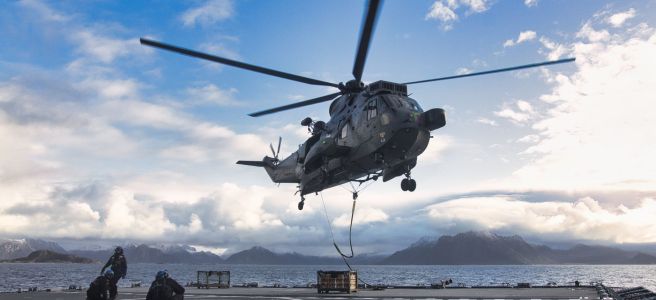
Before the foreign ports, there was the routine of sea time. Days blurred into watches, and watches into meals. I’d stand on the deck watching the “cabs” — Navy slang for helicopters — come up from the hangar on the massive circular lift. A loud bell rang as it moved. The chockhead operating it was dubbed the “lift driver,” though no driving was involved. He’d blow three distinct blasts on his whistle — the last one long and shrill. That was the signal: stand clear, something big and expensive is arriving.
The ground crew swarmed — grubbers, pinkies, greenies, bombheads — moving with the calm, rehearsed choreography born of pure repetition. But one cab in particular, a Sea King bearing the number 43, was always a menace. Her engines hated starting. Raw AVCAT fuel would pour out of the exhausts, baptising the flight deck.
Through the visor of my silver fire-helmet, I’d watch the ground crew for cues. If they stayed calm, I stayed calm. If they twitched, I braced.
Here was the tightrope: if I panicked and hit the extinguisher too soon, I’d wreck a perfectly good engine over a routine flash-over. But if I hesitated and it went up proper, I’d be facing the consequences of being too slow.
The pilot would reach up and hit the igniters: click-click-click, like a stubborn gas hob. Standing there with the heavy carbon dioxide extinguisher, praying she’d catch, I’d half-sing under my breath a line stolen from Ian Dury: “Reasons to be cheerful… 43.”
It stuck. Before long, the ground crew were chanting it too, shaking their heads as the engine coughed, backfired, and finally roared to life. Gallows humour — my own small way of hiding the fact I was terrified.
Even now, if I catch the scent of aviation turbine fuel at a civilian airport, I’m instantly yanked back to that steel deck. Visor down, gloves on, waiting for 43 to behave.
Copenhagen — Salty Old Girl
We hit Copenhagen first. Only a few days alongside, but long enough for Tivoli Gardens and a rød pølse — the famous Danish red hot dog. We moored so close to the Little Mermaid statue I could have thrown a heaving line at her. Walking past, I was surprised by how small she was, coated in that strange green patina bronze gets — not rust, but the colour of weather and salt.
The lads in 2E3 mess decided this was an aesthetic tragedy. A night mission was hatched, armed with rags, a can of WD-40, and a tin of Brasso — of which Bulwark carried enough to polish half of Scandinavia. The plan was to give Denmark’s national symbol a “proper Navy shine.”
Looking back, the international incident would have been magnificent. British ratings caught creeping through Copenhagen harbour at 02:00 to polish a national monument. Thankfully, sanity prevailed.

The Little Mermaid, 2016. Still patient, still weathered, still successfully resisting all offers of Brasso.
I’ve been back to Copenhagen twice since. More tourists now, more selfie sticks, more noise. But every time I look at her, I think of myself — just having turned nineteen — convinced metal polish could fix anything, and I feel that old pull of a conversation left unfinished.
First Night Ashore: Hamburg
I stepped off the gangway in standard civvies: Levis, a Blondie T-shirt, and a leather biker jacket carried casually over my arm to dodge the Master-at-Arms, who strictly banned anything he considered ‘punk rock’ or biker gang attire. He sneered at my shirt, which ironically distracted him from the forbidden leather jacket slung over my arm. I slipped past his gaze and straight into the city.
Hamburg hit me immediately: cold river air, heavy diesel, dockland mud — it felt like home in Sunderland, just vastly expanded. I bought a bratwurst on a paper plate with sharp mustard, washed it down with a cold Sprite, and felt, for the first time, like an independent man exploring the world on his own steam.
While most of the ship’s company seemed to head straight for the neon red-light strip of the Reeperbahn, I drifted into the older quarter of St. Pauli: leaning brickwork, dockside taverns, and old sailors wrapped in pipe smoke. That was where I bought the cap.
Not a cheap tourist trinket, but a genuine Elbsegler — the heavy wool cap worn by Elbe tug captains and harbour pilots. It cost an absurd portion of my pay. I put it on anyway.
Within an hour of returning to the ship, my identity was altered. In the Navy, every lad from the North East is automatically called “George.” But turning up in an authentic German peaked harbour pilot’s cap was too much for my Petty Officer. I was instantly christened “Captain George Chaos.”
Later that week, I bumped into Ray — a fellow “roof‑rat” (flight deck crew) carrying an 8mm cine camera. Ray was small, shy, and permanently nervous, the sort of lad who seemed to apologise simply by existing. But once he relaxed, he was funny in a quiet way, with a twinkle that made you feel like you were in on some private joke he hadn’t quite dared to tell yet.
We ducked into a quiet local dockside bar with no music, only the creak of wooden booths and the low murmur of locals. Behind the bar stood a formidable Frau, carved from the same timber as the bar, utterly unflappable.
“George… this isn’t where we need to be,” Ray whispered, edging closer to me as if I were the only safe object in the room. “And thank Christ you’re not wearing that bloody captain’s hat.”
The Frau barked something in sharp German. Ray jumped. I, armed with three years of schoolboy German vocabulary and my usual talent for overestimating myself, became the flight deck’s unofficial translator. “I think she’s telling us to order a beer or clear out.”
“Beer. Yes. Beer,” Ray said, nodding too quickly, like he was agreeing to a marriage proposal he hadn’t heard properly.
We ordered. And that was when I saw a beer poured in a way I’d never witnessed. Back home, a pint is poured at a neat forty‑five degrees — minimal head, no wastage — and if the foam dares creep over the rim, someone will inevitably ask if you want a chocolate flake in your beer, the old seaside ice‑cream gag every British pub regular knows.
But here, the pour was a ceremony. The Frau let the beer crash straight into the glass, building a towering head that rose like a living thing. She waited, watching it settle with the patience of a harbour pilot judging a tide, then took a wooden spatula — a tool clearly designed for no other purpose — and sliced the foam clean off.
Ray watched the ritual with wide‑eyed fascination, as if he were filming a nature documentary. One beer led to three, three led to schnapps, and within two hours Ray had mastered the local dialect: “Prost!” and “Zwei Bier, bitte!” delivered with the confidence of a born St. Pauli regular.
I only wish I had been wearing my beloved Elbsegler.
An Order to Attend the Ballet
Hamburg’s civic authorities, eager to culturalise the visiting Royal Navy, offered free tickets to local arts events. I put my name down for an art gallery and a brewery tour. Through some cosmic error, I was allocated tickets to the Hamburg Ballet.
I appealed to my Divisional Officer. It was denied.
“George, you’re going. We need bodies in seats.”
“There might be free food after.”
“Look at it this way… it’s an order.”
So, for Queen and Country, no way out. Surely it couldn’t be that bad.
At 18:00, a coach picked us up alongside. Stepping aboard, I realised I was the only junior rating present. Surrounding me was a sea of dark blue: Officers in full No.1 dress uniform. And me — now a nineteen-year-old Naval Airman, scrubbed raw and wedged among them like lost luggage.
At the theatre, I was sandwiched between a sub-lieutenant and a lieutenant, stiff as a board, holding my cap on my knees like a holy relic. The lights went down. The orchestra swelled. Fog rolled across the stage. Out glided a male dancer — not leaping, not spinning, but performing that stylised ballet walk, the long, gliding pas marché that looks like someone taught a marble statue how to move.
For one horrified second, I thought the man was stark naked. My lungs seized. Dear God, what have they sent me to? Then, blessed relief: I realised he was wearing a tight, flesh-toned bodysuit. My nervous system slowly rebooted.
Once I’d recovered from the shock that the dancers weren’t naked, the adrenaline evaporated with alarming speed. The music drifted. The stage lights blurred. My eyelids began their slow, traitorous descent.
I was acutely aware that if I fell asleep, I wouldn’t just embarrass myself — I’d let down the Aircraft Handlers’ Department. The shame would echo through the mess deck for weeks. So I sat there, rigid between two officers, silently chanting the same desperate mantra: Do not fall asleep. Do not fall asleep.
Once more, for Queen and Country, I simply had to stay awake.
When the house lights came up, two older German gentlemen a few rows ahead turned around, spotted a lone sailor sitting rigid amidst a block of senior officers, and gave me a delighted, theatrical wave. I gave a polite, more than slightly awkward, wave back.
By the time I was back on board, I felt slightly cheated I had missed nine-o’clockers — the simple harbour supper that closes the Navy day — but made it back to the mess deck in time for my daily allotment of three small cans of beer. I drank one in stunned silence before Pipe Down whistled over the ship’s tannoy, plunging the compartment into red night-lighting.
The Miracle Phone Box
Near the port stood four modern German phone boxes — sleek, silver, arranged in an immaculate 2×2 grid. Wandering past them one evening, missing home, I decided to try calling my girlfriend back in England.
Calling her carried an extra layer of meaning. Weeks before deployment, I’d met her father, bracing for the standard defensive fatherly interrogation. But when I mentioned I’d been drafted to Bulwark, his face transformed. He had served on her years prior as a Marine Engineer Mechanic — with a very unique role, one of the “badgers” keeping the steam catapults and arrester gear alive, securing aircraft to the catapult. A fascinating job, and given to non-Fleet Air Arm personnel. Instantly, we stopped being a protective father and a nervous suitor. We were simply two men who’d belonged to the same grey steel flight deck.
I closed the phone box door. The seal cut off the noise of Hamburg. I dropped in a 5-Mark coin, dialled, and she answered.
We talked for over two hours. The entire time, I braced for the coin slot to start clanking furiously or the line to dead-drop. It never did. The meter simply froze. Five Deutsche Marks for a two-hour international call.
Halfway through, a municipal service van pulled up. A German worker stepped out, lit a cigarette, and waited with terrifying efficiency. When his cigarette was done, he pulled out bucket and squeegees. He didn’t disturb me. He meticulously cleaned the other three booths first — wiping glass, polishing chrome. Only when those three were spotless did he give a gentle tap on my door.
I ended the call and stepped out. He gave a polite nod, wiped down my booth, and drifted off without a fuss. I headed back toward the dockyard, buoyed by a quiet euphoria that I’d been able to talk with my girlfriend for so long.
Back on board, I bragged to the mess about the broken phone meter. The following night, a shipmate went ashore determined to call his wife for cheap. The trouble was, he couldn’t remember which of the four booths was the faulty one. He guessed, dropped in his coins, dialled home, and watched the meter sit frozen for ninety minutes.
Two WAFUs. Two separate phone booths. One German telecom company accidentally funding the Royal Navy’s romantic lives.
Looking back, it’s strange to think how close we were to the sharp edge of the Cold War — Baltic patrols, NATO alerts, dipping sonar for Soviet subs — while I was running around in a Blondie T-shirt, buying overpriced captain’s caps, and dining on street sausage.
Years later, I started following FC St. Pauli — the football club from those exact Hamburg streets. I’m no grand sports fan, but their chaotic, fierce independence felt like the spirit of the port I met in 1979. My German friends find it hilarious that an old Navy veteran supports St. Pauli. Maybe it is. But it feels right.
Tschüss, Hamburg. You never quite let me go.

 Ghosts to Carry, Stories to Keep