
Myśl w ruchu
Znalezione po latach
A mind in motion
Found after years
Today, in the late light of the room,
a photograph slipped from a folder
and rested against my hand.
I recognised the work —
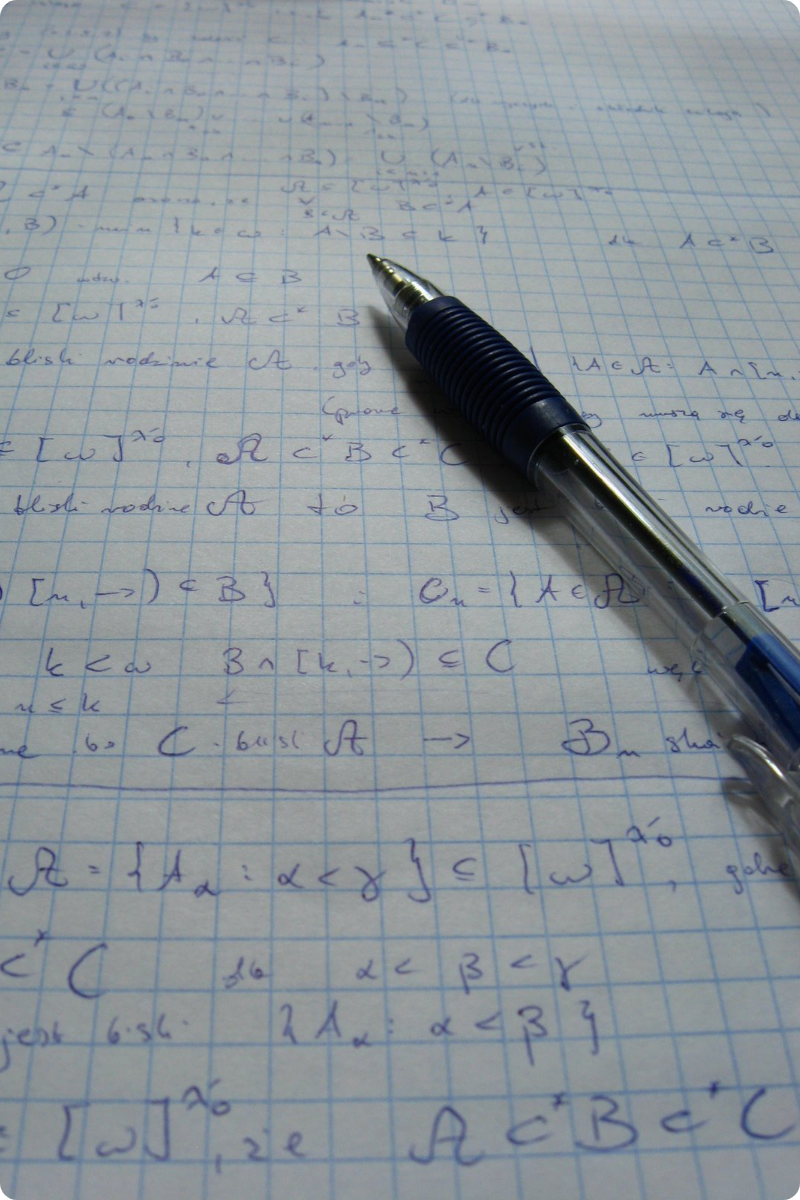
letters, arrows, asterisks, a small constellation of logic
still holding its shape after years.
A ⊆ B — the quiet way one life folds into another.
A ∩ B — the narrow region where our days overlapped.
A \ B — what remains now: the trace without the presence.
And then the marginalia —
faint, drifting across the page,
the soft music of her mind in motion.
jest bliski rodzinie,
written with a firmer hand,
as if the thought carried weight.
a można się doszukać… the ink thinning,
the tail of the letter lifting
like a breath she hadn’t finished taking.
I used to think these notes
were simply work,
the scaffolding of her days.
But tonight I see the tenderness
in the margins — the small encouragements
she offered herself
while crossing from one idea to the next.
In the end, it wasn’t the lemma
or the symbols that stayed,
but the faint indentation of her hand
still pressed into the paper — a quiet,
unguarded trace
of a friend thinking her way forward.
Fotografia przedstawia stronę jej odręcznych notatek z teorii mnogości — fragment pracy odnaleziony po latach i dopiero teraz w pełni zrozumiany.
The photograph shows a page of her handwritten set‑theoretic notes — a fragment of work found after years and only now fully understood.
Reflection
I kept the original image among a small collection from a time and a place that felt both old and new. Everyday challenges I couldn’t yet process, scenes I can laugh about now.
I printed only a few of these photographs; this was one of them. I once planned to frame one or two and hang them in my study — a project that I never finished.
To recently rediscover this photograph of a creative and logical process — almost by accident — filled me with a sense of wonder and curiosity. I was fascinated by symbols and barely noticeable comments, annotations, and the style of writing and its flow across the paper.
Those symbols, and those little snippets of writing, I recently learned are known as marginalia.
The poem is my own interpretation, almost a human equivalent of a lemma: a small supporting structure that lets something larger stand. A stepping stone. My friend was building infinite structures out of sets. Her symbols — technical language combined with her native tongue — fascinate me; she was thinking in two different languages at the same time.
Step by step.
Patiently.
Logically.
Gently correcting herself in Polish.
I have tried to mirror those structures in verse. My own arrangement of words is formed from memory, notation, language, and a delayed understanding.
There is something profoundly fitting here: only now, over a decade later, do I finally understand.
Mathematics itself is about structure enduring through infinity. Understanding the image better now than I did then, I see that there are no limits to how far a quiet page can travel in time.
A Gentle Analogy
If a theorem is a cathedral,
a lemma is the hidden arch to prevent collapse.
No visitor sees it.
Yet, without it, nothing stands.
My friend was working in those hidden arches.
Ten years later, I have finally stepped inside.

 Ghosts to Carry, Stories to Keep
