Let the voices arrive before the story does.
Listen along
This track has lived with me for decades — first on vinyl in the mid‑80s, when I would lift the needle and place it back at the beginning again and again, as if trying to stay inside a world I didn’t yet understand. Only recently did I return to it with fresh ears, and the research that followed revealed something far more complex, and far more human, than I ever expected.
Its text is simple, almost stark: a man addressing a woman named Denka, calling her beautiful, calling her his “first love,” saying she has burned and scalded him, leaving him like a dry log. He is in love with Denka — someone he cannot love.
Beneath those metaphors lies a cultural world where kinship is sacred, and not only by blood.
In traditional Bulgarian village life, a godparent bond created a spiritual lineage as binding as family. To fall in love across that boundary was not merely frowned upon — it was unthinkable. A violation of honour, community, and one’s own moral integrity.
The godparent in this world is not a ceremonial figure. They become spiritual family, and that bond is treated with the same seriousness as blood. The moment a child is baptised, the godparent becomes a second parent; the two households become kin, spiritually joined in a lifelong, binding relationship. This is known as kumstvo (кумство).
The song never tells us exactly who Denka is, and that silence is part of its power. What we do know is that she belongs to the singer through this sacred form of spiritual kinship. Whether she is the daughter of his godparent, a god‑sibling, or someone else within that lineage, the boundary is absolute. His love is real, but it cannot be spoken, pursued, or resolved.
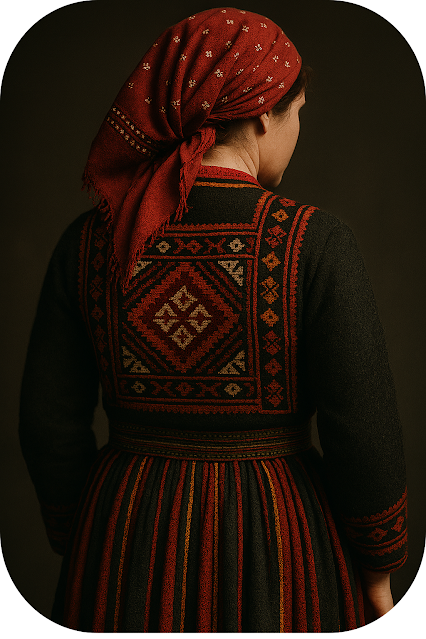
The song becomes the only place where his confession can exist — a vessel for a feeling that is true and impossible at the same time. There is something profoundly human in that tension: the knowledge that a feeling can be both undeniable and forbidden. The music holds that paradox gently, like a soft lantern in the dark.
After a song shaped by a love that could never be spoken aloud, I’ll leave the lantern here — not bright, just enough to mark the threshold.
If you use Apple Music, I hope you enjoyed listening as much as I did sharing. If you don’t subscribe to Apple, I hope you find the track wherever you listen — and perhaps hear the same remarkable sense of voices shaped by landscape, lineage, and longing.

The threshold lantern
If something in this music opens a quiet place in you, you’re welcome to step closer and share a track of your own — a piece that carries its own story, its own weight, its own truth.
Set it here beside the lantern.
Tell me why it stays with you.
I’m listening.

 Ghosts to Carry, Stories to Keep