3 Short Stories to Celebrate.
I’ve come to enjoy a beer in a way I never used to — slowly, deliberately, and with a few odd habits that have settled in over time. It wasn’t part of my youth, and it certainly wasn’t part of my Navy years. Beer arrived later, quietly, without fanfare, like a small ritual that sneaks into your life when you’re not paying attention.
Four o’clock is my hour. Not a rule, just a rhythm. Three o’clock is a pot of tea, four o’clock is beer. One sunny afternoon I was sitting in the front garden with a cold bottle, Lola beside me, when my neighbour — the funny, sweet teacher who projects her voice like she’s still addressing a classroom — called out, “Beer o’clock again!” I sat there for a moment, wondering whether this was a warning or a joke, and decided it was simply true. Beer o’clock. A new phrase for me, but clearly not for her.
I generally don’t drink beer with meals — not a strict rule, and depends upon what I am eating. Beer before food, yes; beer while cooking, even better. Two is my limit. The point is not to get drunk. I’ve been drunk enough in my life to know it’s a waste of a perfectly good day. A slight buzz is acceptable; anything beyond that feels like borrowing trouble.
My tastes have shifted too. The thick, opaque, grapefruit‑shouting pale ales of the last decade have finally worn out their welcome. Perhaps it’s age, or perhaps it’s just clarity asserting itself. These days I reach for German beer — clean, honest, unshowy. A beer that tastes like beer.
So if you raise a glass on International Beer Day, do it gently. Prost, salut, na zdrowie. Enjoy it, but don’t overdo it. You’ll be sorry.
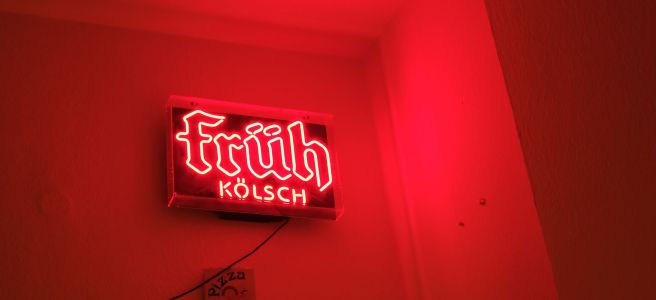
I celebrated International Beer Day with an ice‑cold bottle of Früh Kölsch, a style of beer that is new to me. It was a refreshing, superb beer to while away a little of the afternoon sunshine.
And from here, naturally, the story turns backwards — to the brewery visit, the quiet bar with the coal fire, and the discovery of Czech and Slovak beers that changed everything I felt about enjoying something truly crafted.
The Tyskie Brewery Tour
Somewhere in that visitor phase — when I was still being shown Poland rather than discovering it — one of my close friends invited me to join their family on a tour of the Tyskie Brewery. I said yes immediately. It felt wholesome, cultural, even historic. The kind of thing you’re meant to do when you’re still new to a country and trying not to offend anyone.
The first hour was wonderful.
The old brewery had weight and character. Brick walls that had seen generations. Machinery that looked as if it had been designed by men with moustaches and pocket watches. I was genuinely absorbed. It felt rooted, authentic, and properly Polish.
Then we crossed a threshold — and entered the modern brewery.
It was like stepping into a different century. A vast metallic landscape of canning lines, bottling machines, conveyor belts, safety barriers, and industrial hum. Everything gleamed. Everything moved. Everything repeated itself with mechanical certainty. For the first twenty minutes I tried to follow the guide’s explanations. After that, I simply drifted, nodding at intervals, trying not to look like a man who had lost all sense of time.
Nearly two hours.
Nearly two full hours of stainless steel and bottles.
There was a point — somewhere deep into the industrial section — when my brain simply left. It didn’t announce its departure. It didn’t even leave a note. It just quietly slipped out the back door while I remained standing there, staring at conveyor belts carrying either bottles or cans (I genuinely can’t remember; they’d merged into one hypnotic blur).
The guide recited statistics with the weary precision of someone who had said the same numbers every day for ten years. Output per minute, per hour, per day. Enormous numbers. Impressive numbers. Numbers that meant absolutely nothing to me. I nodded as if absorbing them, but inside I was gone. Utterly out. A polite hostage of stainless steel and social obligation.
And yet — I didn’t dare show it.
I was with my friends’ family. They’d invited me. They were being kind. So I stood there, smiling, performing enthusiasm with the desperation of a man who didn’t want to offend anyone. My inner voice lay flat on the floor whispering, “I’m out,” while my outer voice murmured, “Fascinating… really fascinating.”
By the time we reached the brewery tap, we were a changed group. Even my friend’s father — a man not easily fazed — had settled into his chair with the unmistakable posture of someone who had earned his drink. There was that shared, unspoken moment:
Right. We’ve survived. Now we drink.
And then came the surprise.
Just one beer.
No more than thirty minutes.
And then skedaddle.
We drank our solitary beer with the reverence of monks. Sipped it like medicine. Held onto it as if it were the last pint on earth. And just as we began to settle into the moment, the next tour group appeared at the door, forming like a queue at airport security. The staff gave us that polite, apologetic smile that meant:
“Lovely to have you, but your time is up.”
We stood, gathered ourselves, and filed out — a small procession of people who had been through something together. A shared ordeal. A conveyor‑belt pilgrimage rewarded with one solitary beer.
Looking back, it’s one of the funniest memories of that visitor phase — a perfect blend of hospitality, industrial pride, and gentle absurdity. And it belongs to that early chapter of Poland, before I discovered the quiet bar with the coal fire, before Czech beer, before Koneser, before anything felt like mine.
Czarny Kot
Well before Czech and Slovak beer and finding my own true local, there was Czarny Kot — a small pub tucked away on a side street, just outside the Rynek in Gliwice. I didn’t go that often, but it left a lasting impression.
That first Polish winter was harsh. The cold was deep, the air heavy — the kind that makes your breath feel almost solid. After classes in Katowice, I’d travel back to Gliwice by train, still unsure about the buses and feeling like every street was a new challenge. I often walked along ulica Zwycięstwa, the city centre bathed in that special Silesian winter light: sodium lamps, wet cobbles, and the thick smell of exhaust mixed with cold stone.
One night, the cold seeped into me — not just physically, but emotionally. I wandered around the Rynek, passing bars that seemed too loud, too sure of themselves and too full of people who already knew each other. I was still in that visitor phase where you hover at the edge of places, unsure if you belong.
Then I spotted it: a small pub on a side street, empty except for a man and a blonde-haired woman behind the counter, both looking a bit worn. I peeked through the window. No customers. No noise. Just a quiet room and the glow of an orange coal fire.
When I pushed the door open, I hesitated. For a moment, I thought I’d made a mistake. The fire was real, burning hot behind its glass screen, but the room wasn’t cosy or cheerful the way I’d imagined. The warmth didn’t reach the tables. It was the kind of place where you had to sit almost touching the glass to feel the heat. But the quiet suited me, and I stayed.
It did get better on later visits, but not much. On a scale of one to ten, it was maybe a four or five. The couple behind the bar weren’t rude or dismissive, nor were they particularly warm — just two people enduring slow nights in a quiet bar. But I wasn’t there for cheerfulness or gratitude. I was there to sit quietly, and in that small, faintly cold room, I began to feel okay.
I often wonder what they must have thought of me. Obviously a foreigner, flushed from a brisk walk through the city. A long black parka coat, dusted with a layer of fine, powder-like snow, and beneath the pulled-back hood, a black beret tugged down low — as if I was trying to hide a little from the world. Bags of books and gear hanging off me like I was trying to escape a border crossing, weighed down not just by the winter, but by the strange heaviness of living somewhere new. Not the usual stag-party tourist mispronouncing piwo. Just a man who looked like he had crossed a tundra and chosen their empty bar as his last stop, hoping for a moment of stillness.
They never said much beyond “dobry wieczór and do widzenia“. No questions, no curiosity, no small talk. But sometimes — and this is the strange part — I felt they looked at me with a quiet pity. Not unkind, just perceptive. As if they saw what I didn’t want to admit: that I was slightly homesick, a little lonely, wrapped in my own private weather system and still unsure whether I belonged in the country I had chosen.
The beer — ice cold, absurdly cold — refreshed me in a way that made no sense. Warm body, cold drink. Firelight on brick. Condensation forming on the glass like a private Ice Cold in Alex moment. How strange that something so cold could make me feel so alive.
One night, that loneliness felt heavier than usual. I sat there, staring into the firelight, wishing I’d just gone straight home. I was tired in that deep winter way, when the cold seems to settle inside you. Then my mobile rang. A close friend.
“Where are you?”
“In a pub near the Rynek.”
“Who with?”
“I’m on my own.”
A pause — the kind that carries concern. “What’s the pub called?” I told her, and she didn’t hesitate. “No. I’m nearby. I’m coming to take you home. Stay there. Don’t move.”
Less than ten minutes later she arrived, slightly flustered, clearly worried. She didn’t want a soft drink or even a coffee. She just wanted me out of there. I finished my beer, and she drove me back to my apartment, talking softly, as if she knew I needed gentleness more than anything.
And what stayed with me — what still stays with me — is how it felt for the couple behind the bar to witness it. For them to see that someone cared enough to come for me on a cold night. That I wasn’t just the solitary man in the corner, drifting through their quiet bar like a ghost. It warmed something in me. It mattered. It was a small moment, but it made me feel less adrift.
And then, one day, it was gone. The windows dark. The sign removed. The fire extinguished forever. Another bar opened in the same space—brighter, louder, more modern. But Czarny Kot was something else. Something small, fragile and perfectly timed. A bar that existed exactly when I needed it.
The Physics and Chemistry of Koneser
If Czarny Kot had been the quiet, melancholic anchor of my arrival, what came next was the real awakening.
By the spring of 2012, I had evolved from a timid visitor into a budding local. Which brings us back to ulica Plebańska, a narrow cobbled street just off the Rynek. It was late April, and the bar hadn’t officially opened. The windows were completely covered, hiding every hint of what was taking shape inside.
As my friend and I walked past, we noticed the door standing wide open. The two young owners were outside, stealing a moment of fresh air from the chaos of last-minute renovations. Sensing an opportunity, I didn’t hesitate. I poked my head straight through the doorway.
The sight of us caught them completely off guard. There I was, a loud, wildly enthusiastic Englishman, excitedly talking about a bar that wasn’t even open yet. My friend quickly came to the rescue, translating my chaotic enthusiasm and smoothing everything over with a laugh. In a culture known for its initial reserve, I must have arrived like a small hurricane. Yet from that wonderfully awkward first encounter grew a lasting kindness. They welcomed us inside, and only days later we watched their dream officially open on 1 May 2012.
To understand Koneser, you first had to understand its physics.
The pub was essentially one long room with a single entrance that also served as the exit. As you stepped inside, the main seating area greeted you immediately, dominated by a television mounted high on the wall facing the street. Whenever football was on, this front section became a roaring furnace of excitement. There was no carefully curated soundtrack, only the intoxicating blend of conversation, clinking glasses and the warm, comforting scent of fresh beer and crowded humanity.
Halfway down the right-hand wall stood the bar itself. Behind the counter, the workspace was so tiny it seemed miraculous that anyone could work there at all, let alone dance around each other while changing kegs, pouring beer and warming plates of nachosy z serem. Back in 2012, melted cheese over tortilla chips still felt wonderfully exotic compared with the traditional bowl of peanuts or bag of crisps found in many British pubs.
Running alongside the counter was another small novelty. Proper bar stools. My friend often told me how unusual they were in Poland at the time. Traditional Polish pubs tended to be arranged around separate tables, where groups kept largely to themselves. These stools changed the chemistry of the room. They encouraged conversation with the bartenders, with the stranger beside you, and with anyone else who happened to become part of your evening.
Opposite the bar, tables stretched in an unbroken line along the left-hand wall until they reached the very back of the pub. When Koneser was full, and it often became so packed you could barely move, the layout left only a narrow human corridor through the middle. Anyone heading for the single toilet at the far end had to squeeze, shuffle sideways and politely apologise their way through a sea of locals.
Naturally, I developed a strategy.
I always tried to claim the table closest to the toilet. It hardly sounds glamorous, but in a crowded pub with only one toilet it was a position of enormous tactical importance. From that table I knew the precise moment the lock clicked open, giving me an advantage that still makes me smile.
It was around that strategic little table that many of my happiest memories were made.
Koneser’s real genius wasn’t simply the two young owners. It was the beer. Long before Poland’s craft beer revolution gathered pace, they regularly drove across the nearby Czech border to collect unpasteurised kegs from small regional breweries that the major distributors ignored.
My favourite, without question, was Holba Šerák, a jasny leżak brewed with mountain spring water. It poured a rich honey gold, carried a satisfying malt sweetness, and finished with the clean, crisp bite of Saaz hops. I loved it.
My friend, meanwhile, always chose the dark Czech beer. Usually a černé pivo such as Litovel or Merlin, it poured almost black yet drank with the surprising lightness and crispness of a pale lager. Sitting beneath the low lights at the back of the pub, she would glance at my glowing golden pint, then at her own dark glass, before laughing openly at my choice of what she teasingly called “sweet” beer.
It was a lovely reversal of expectations. The rugged Englishman happily drinking the sweeter golden lager, while the Polish woman confidently worked her way through the dark beer.
Around us, the room carried on exactly as it always did. The football flickered on the distant television. Conversations rose and fell in waves. Somewhere behind the bar another plate of nachosy z serem emerged beneath melted cheese. And at our little table, tucked away at the very back of a long, crowded room in southern Poland, I realised something quietly important.
I wasn’t visiting any more.
I belonged.

 Ghosts to Carry, Stories to Keep