On tiny lifelines, a smoothie hat, and remembering how the laughter used to sound.
A small work written on the 10th October 2026.
Today is World Mental Health Day 2026. Rather than write about the heavy weight of things, I wanted to share a story about a tiny knitted smoothie hat, an origami book, and a friendship that built a bridge across the dark when I needed it most. I hope it brings a little light to your reader today.
A Short Story about Bunny and Chuchus
I keep a small handmade book inside a tiny knitted hat.
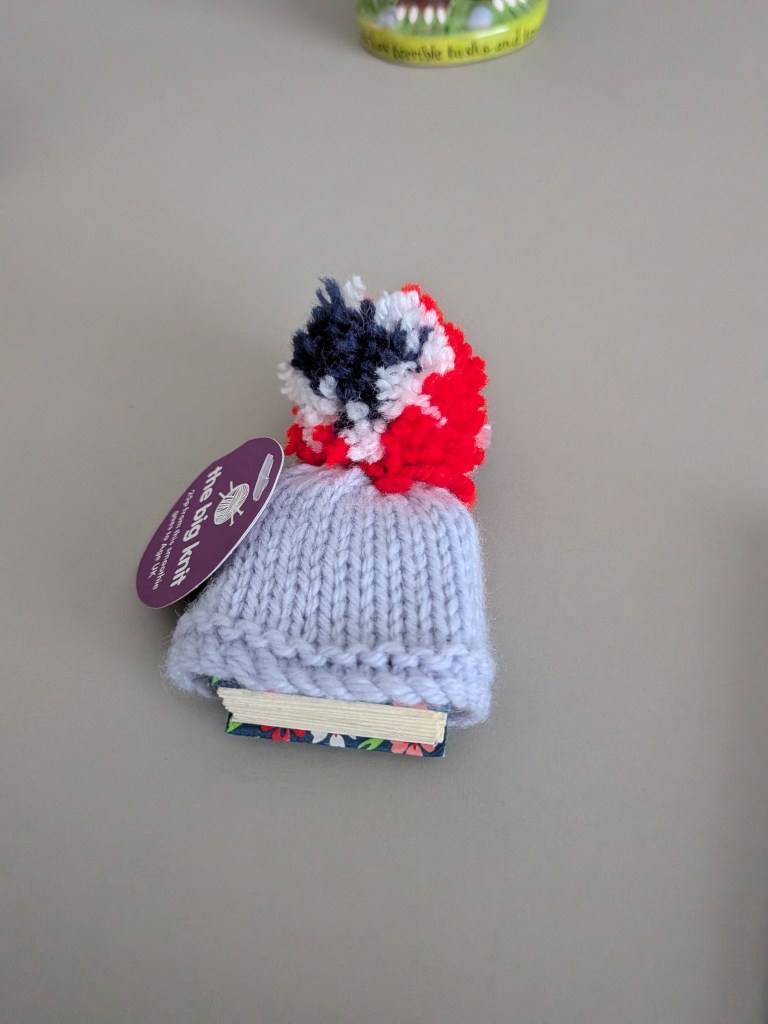
The book is an origami fold, precise and thumb-sized, bound in a vibrant floral cover of blues and red blossoms. The hat was never made for books; it originally sat on top of a smoothie bottle as part of The Big Knit, a fundraising campaign where volunteers outfitted small bottles of fruit smoothies in woollen beanies to raise twenty-five pence for Age UK. I couldn’t stomach the smoothie, but I continued to buy the smoothie to donate, collect and keep the hats.
Several seem to have vanished over the years; I still have maybe three or four left. Recently, my granddaughter Lottie pointed out that perching a woollen cap on a Gruffalo money box was entirely inappropriate. Gruffalos, she explained with immense patience, do not wear hats. It was difficult to argue with her logic. I agreed that Lottie could keep the hat to do with whatever she pleases.
The beanie book protector is pale grey with a red, white, and blue bobble, its original cardboard label still tucked against the wool.
Inside lives the book.
The title page reads The Story of Bunny and Chuchus, written carefully in red ink.
I hadn’t opened it in years. When I turned the pages today, I found photographic prints so small I still don’t know how they were made — scarcely larger than a fingernail, yet as sharp as the day they were printed.
The first shows a younger version of me in a t-shirt emblazoned with the words Trouble Maker. Thirteen years ago, though I look years older than I actually was: the visible residue of a life quietly collapsing around me while I walked blindly through the wreckage.
On the third page, an arrow points toward the logo of a language school where I taught English in the Silesian city of Bytom.
Everything started here →, the caption reads.
I laughed aloud. For years I had sworn up and down that the story began in Zabrze. The tiny book knew better.
As I turned the pages, more memories appeared. Tiny fragments of a life I had almost forgotten. Not the big moments, but the little ones — the moments that seemed entirely ordinary at the time.
One memory arrived accompanied by an image of a fridge magnet I’d been gifted. It features a cheerful 1930s-looking doctor in a white coat and beneath him the words:
Bier ist gut, sagt der Arzt!
One afternoon, sitting in my kitchen, I remember staring at it and asking Bunny: “Sorry, what’s an Arzt?” “Arse?” she replied. “No, Arzt.”
By this point we were both completely confused. I pointed to the magnet, and she burst out laughing.
“It’s German. Doctor.”
I was genuinely stunned. “Not Doktorrrr?” I always tried to trill that phonetic r. “Nie. Arzt.”
To this day, I can hear her laughing.

I suspect I am one of the few people in the world who finds that exchange memorable, but that is how friendship works. A conversation about a fridge magnet somehow survives for many years while more important things disappear completely.
The tiny book is full of moments like that. A coffee shop logo. My Dutch bicycle outside my favourite kawiarnia. Even the phrase “going out on the lash”, which Bunny found hilarious because she had never heard it before. (We did, in fact, go out on the lash — the logo of a Katowice new wave bar we frequented is right there on the page.)
It’s not the big moments. It’s the little ones. The sort of moments that matter more than you realise until somebody takes the trouble to preserve them.
The micro-book was only a fraction of it. There was a whole custom-built notebook she sent alongside it, populated with prompts, games, and quiet anchors — like eight deliberate suggestions on how to stay curious when the world feels like it’s narrowing to a pinhole. Those weren’t just quirky gifts; they were a lifeline crafted by someone who knew precisely how to build a bridge across the dark, using paper, ink, and play.
All these years later, Bunny and Chuchus were still waiting quietly inside a piece of fundraising knitwear.
Thirteen years on, the coffee cools in the cup, and the room is very quiet. She isn’t here to ask about the next chapter, but the ink hasn’t faded.
Some stories don’t need a neat resolution; they just need someone to open the cover, turn the page, and remember how the laughter used to sound.
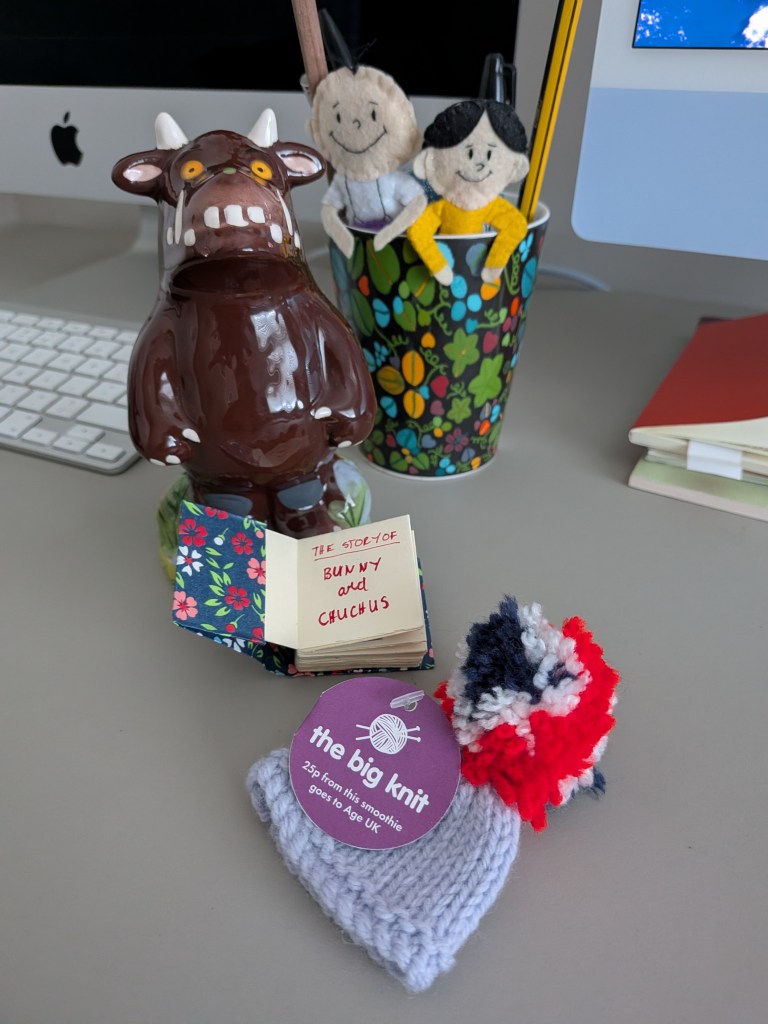
In the quiet spaces or the loud ones, Bunny and Chuchus — forever finding the humor, forever laughing together.


Leave a Reply