“Uwaga, pasażerowie! Pociąg REGIO spółki Przewozy Regionalne z toru pierwszego przy peronie pierwszym odjedzie do stacji Katowice.”
“Pociąg jedzie przez stacje: Zabrze, Ruda Śląska, Ruda Chebzie, Świętochłowice oraz Chorzów Batory.”
“Prosimy zachować ostrożność i nie zbliżać się do krawędzi peronu. Życzymy Państwu przyjemnej podróży.”
The heavy pneumatic doors slammed shut with a sharp air-hiss and a metallic thud. Beneath the wooden-patterned floorboards, the compressor hummed its steady, low vibration, underlying the hurried footsteps of latecomers rushing down the aisle — slightly out of breath, carrying with them a sudden draft of cold, fresh outside air as they searched for a seat. Then came the conductor’s sharp whistle from the platform, an answering blast from the driver’s cab, and the heavy electric motors groaned, pulling us out of Gliwice.
Looking back now, it feels almost impossible that the railway world I knew in Silesia existed barely a decade ago.
Those cracked platforms and dim lamps, the old EN57s rattling through the night — all of it has been swept away by a wave of modernisation so complete that it feels like stepping into another century.
The shift is startling.
Stations that once smelled of cold concrete and diesel have become bright, glass‑and‑steel spaces. Underpasses are clean and lit; the tracks themselves have been rebuilt, straightened, and modernised. The whole landscape feels as though someone has quietly replaced it while no one was looking.
And the trains — the new Koleje Śląskie ELF units look like something from the future. Smooth, silent, aerodynamic — they glide where the old units clattered. They belong to a Poland that is confident, modern, and moving forward at speed.
Yet when I see them now, it’s difficult to reconcile them with the world I travelled through: the world of dark platforms, confusing signage, and the quiet kindness of a conductor who bent the rules to help a lost foreigner.
That older railway — the one I knew — has vanished.
But it lives on in these stories.
Maybe it was the combination of things: living abroad for the first time, a language I was still learning to hear, a culture I was slowly growing into, and a landscape that revealed itself at the speed of a train.
In the UK, the railway is a sealed‑off artery — fenced, guarded, warning signs everywhere. But in Silesia, the tracks were simply there. Running past allotments, factories, villages, fields.
Life happening inches from the rails. That unfenced world is part of why Silesia got under my skin. It let me watch life raw and unfiltered.
For years, I called anything to do with railways PKP. I think everyone did. I grew to love the railways so much that I still refer to all of it — every journey, every delay, every unexpected adventure — as my PKP adventures.
It didn’t matter that half the trains weren’t technically PKP at all. By then the name had stuck.
PKP became a kind of affectionate shorthand for the whole glorious ecosystem: the regional trains that stopped at every lamp post, the semi‑fast ones that pretended to be fast, the genuinely fast ones that felt like a reward for good behaviour, and the stations that all insisted on introducing themselves as PKP Something‑or‑Other.
It was easier, funnier, and somehow truer to just call the whole experience PKP — a single, sprawling, slightly chaotic universe that had adopted me whether I understood it or not.
Only later did I learn that the trains I rode were Przewozy Regionalne; in 2011, Silesia changed again, handing its routes to Koleje Śląskie. I had arrived in the middle of a transition — not just in the railway system, but in my own life. No wonder everything felt confusing.
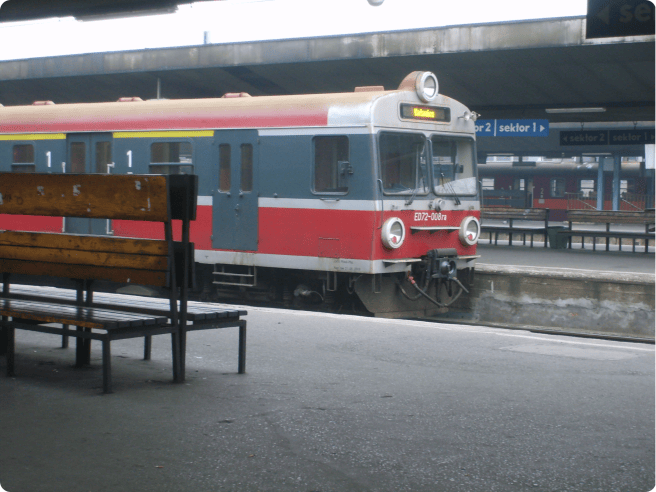
The type of train I used more than any other is classified as an EN57 EMU — Electric Multiple Unit — a long, stubborn slab of metal with heavy sliding doors that shut with the finality of a vault.
The windows opened only a few inches, just enough to let in a slice of weather: winter grit, summer heat, the smell of coal stoves from villages you barely saw.
Inside, the carriage had its own microclimate — warm, dry, faintly oily — a lived‑in atmosphere that clung to your clothes long after you stepped off.
To reach it, you had to pull open the heavy internal manual door that separated the draughty vestibule from the seating compartment. In the early days of learning how to travel on the Polish railways, I often found myself standing in the entryway, looking through the glass at the passengers inside, longingly wishing I had the courage to step through and join them.
Whatever the season, whatever the crowd, the EN57 was reliably itself: well‑travelled, a little battered, stubborn in the way of something that has survived by refusing to hurry. It didn’t pretend to be modern or sleek or impressive. It simply got on with the job, carrying whoever turned up, wherever they needed to go, with a kind of gruff, unassuming loyalty.
And somehow, it was endlessly absorbing. I was never bored on it, not once.
Even boarding an EN57 felt distinctive because of the train’s age, design, and the physicality of the process. The high steps, opening and closing the stubborn manual internal doors, and the general hustle and bustle around the entryways — all of it formed part of the ritual, something I learned to navigate in heat, snow, rain, or the thick humidity of a packed carriage.
When I took these images on a sunny, warm Sunday in October 2010, the light had that mid‑afternoon sharpness that makes even a level crossing look like it’s auditioning for a film.
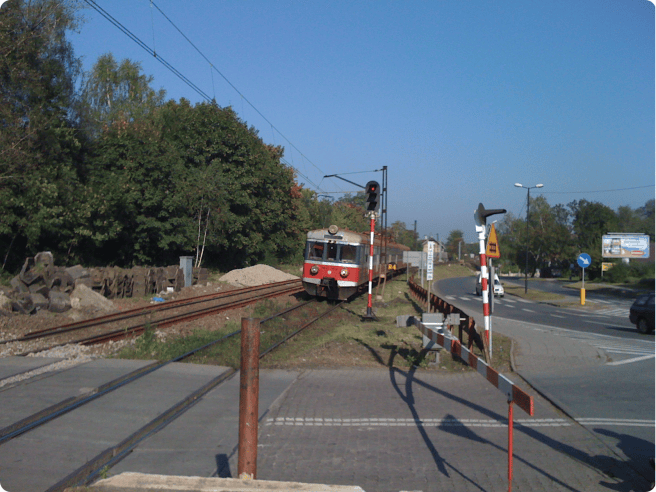
I was halfway across the road when the barrier began to drop — smooth, deliberate, as if someone had finally decided to give my day a bit of structure. I lifted my phone and took a couple of photos, quietly impressed that I was outdoors at all.
I didn’t know where the train was going until it drifted past with a tired electric hum, the carriages dusty from a long, hot summer and rust showing along the upper panels, the wheels murmuring over the tracks as it eased itself towards the platform — or what looked enough like a platform that I didn’t think to question it.
The same platform I’d end up leaping onto from a moving train a few weeks later, though at the time I still believed myself to be a sensible adult.
Only when the last carriage slid into place did I spot the destination board at the rear: Gliwice.
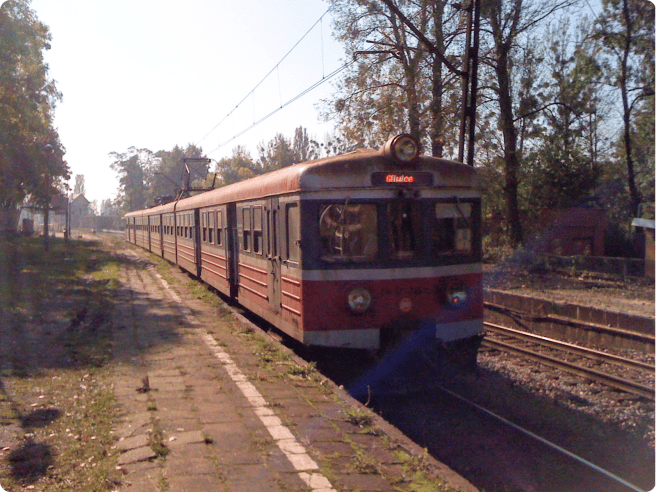
Back then, still unsure how to use public transport without causing an incident, I didn’t duck under the barrier, run up and try to board. I simply stood there, letting the train — and the opportunity — glide away with the calm assurance of someone who had absolutely no idea what they were doing.
What I hadn’t realised — and really should have — was just how far it was to walk from Łabędy to Gliwice.
The afternoon light had that washed‑out, late‑day glow, the kind that makes distances look deceptively manageable. By the time I finally limped into Mickiewicz Park to meet a friend, my brand‑new Converse had shredded both heels with the enthusiasm of a cheese grater.
Every step felt like a close-up of a bad decision.
I tried to look composed — shoulders back, casual nod, nothing to see here — but there’s only so much dignity you can project when you’re quietly bleeding into your own shoes.
My friend took one look at me, abandoned any pretence of offering, and insisted on driving me back into Łabędy, even managing to find an apteka open so I could buy plasters for what were, by then, two small crime scenes masquerading as heels.

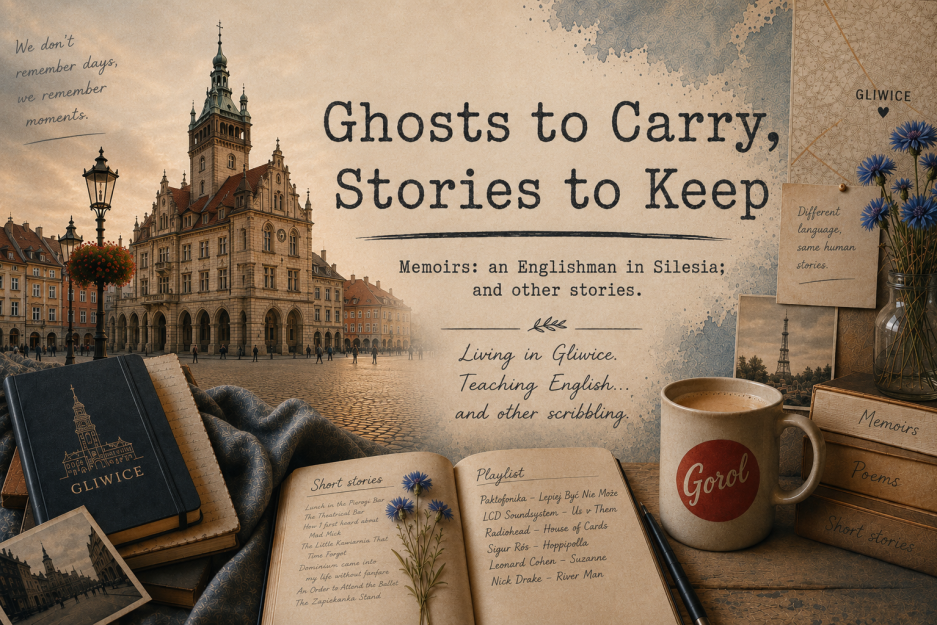
 Ghosts to Carry, Stories to Keep