Sauna on a Train
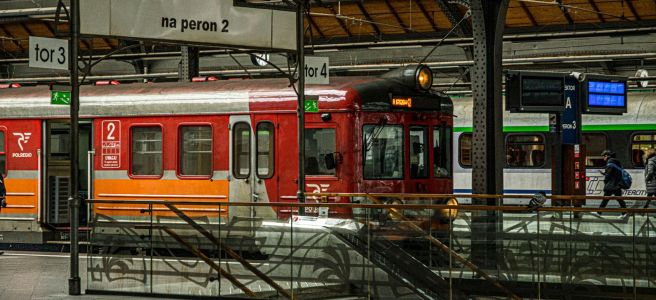
One winter evening, travelling back from Katowice, I boarded the train and took up my usual position in the vestibule.
This was before I had properly adapted, before I understood the unspoken rules of Polish commuting.
I stood there half-lost in thought, staring through the little window in the sliding door, when I noticed something extraordinary:
An entire row of empty seats.
On a busy train.
In rush hour.
A miracle.
I slid open the compartment door and was immediately hit by a wall of heat so intense my glasses fogged over at once. It felt less like public transport and more like entering a mobile sauna.
Still, grateful for my apparent good fortune, I sat down with a sigh of relief.
It took perhaps two minutes to understand why nobody else had.
The heater beneath the seat was not merely warm. It was operating at some magnificent Soviet-era level of industrial overheating—the sort of heat designed either to survive Siberia or slowly liquefy passengers from the ankles upward.
Naturally, I attempted to endure it using the full strength of the British stiff upper lip.
I sat there pretending everything was perfectly normal, as though spontaneous combustion was simply part of the commuting experience.
Five minutes later I was back on my feet, coat half-open, cheeks glowing like roasted apples.
The other passengers watched with that wonderfully Polish expression that mixed curiosity, amusement, and a strange kind of respect.
Not because I had succeeded.
But because I had at least tried.
Lexicon
A friend had invited me to accompany her to the university campus in Katowice, where she was lecturing in mathematics.
For reasons, I can no longer recall, we were travelling in the baggage compartment of an EN57 train.
It was a strange, isolated little space tucked away at the very end of the unit, far from the crush and noise of the main carriages — the kind of hidden room you discover once and never find again.
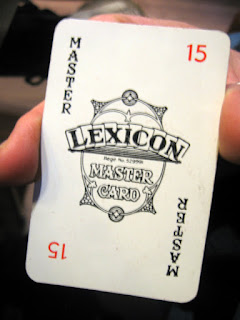
I always carried a deck of Lexicon cards with me, and we’d settled into a game. My friend loved it. Despite English being her second or third language, she usually defeated me with alarming ease.
We were quietly laughing over an absurd combination of letters when two young men stepped into the compartment.
They stood opposite us, their heavy winter jackets bulging with concealed beer cans which they periodically pulled out for heavy swigs.
My friend’s expression tightened. Her eyes darted toward the door, calculating escape routes.
Even the conductor poked his head inside, took one look at the two men, and promptly retreated, sliding the door shut behind him.
We were entirely on our own.
“Maybe we should move,” she whispered. She tried to sound calm, but the tremor in her voice was obvious.
Old instincts stirred—the kind I thought I’d left behind with my previous career. I wasn’t frightened, but I was alert in that deep, automatic way that comes from years of managing situations capable of turning ugly.
My friend, gentle and unused to confrontation, was becoming more anxious by the second. Her fear was enough to flip a switch in me.
Before we could stand, the smaller, stockier of the two lads stepped forward. Confident. Slightly aggressive.
He had that distinctively short summer buzzcut — a severe, grade-two crop that blurred the line between practical heatwave styling and a harder, blokersi aesthetic.
He pointed a finger at the cards and barked something in Polish. I had no idea what he was asking, only that he was focused on the English letters.
My friend answered politely, explaining the word game, but his tone changed as she spoke. Sharper now. More demanding. Hovering right on the edge of a threat.
That was enough.
I stood up.
I felt my friend tense beside me, terrified that my sudden movement would trigger a flash of violence. I looked directly into his eyes, reaching for the only Polish words I possessed that might hold the room steady:
“Spoko… Spokojnie.”
A strange stillness settled over the compartment. Outside, the train clattered relentlessly through the Silesian dark, but inside, everything went dead silent.
The second lad hung back, watching. My mind raced through irrational physical strategies, preparing to shield her if he lunged.
Then, suddenly, the lad laughed. Loudly.
The immediate threat evaporated, replaced by a bizarre confusion. He spoke rapidly to my friend, who turned to me with a look of utter disbelief.
“Gary… he wants to play with us. He says he knows English.”
I sat back down slowly, my adrenaline still pumping.
“Deal him in,” I said quietly. “And whatever he plays, he wins. Agreed?”
She nodded gravely.
So we played.
The lad remained standing the entire time, swaying with the aggressive rhythm of the train, displaying that peculiar teenage mixture of bravado and intense curiosity. Even as the room softened, I couldn’t fully relax. A thin wire of tension remained.
We had simply reached an unspoken truce: we weren’t leaving, and they weren’t backing down.
He would study his cards with intense concentration, then slam them onto the small table using combinations of letters that would have made my English students weep.
Every single time, my friend would study the nonsense jumble with absolute seriousness before announcing:
“Yes… perfect. You win again.”
He beamed. His friend beamed. We applauded like idiots.
I still have no idea what any of his ‘words’ were supposed to mean, but he won every round. Triumphantly. Joyfully.
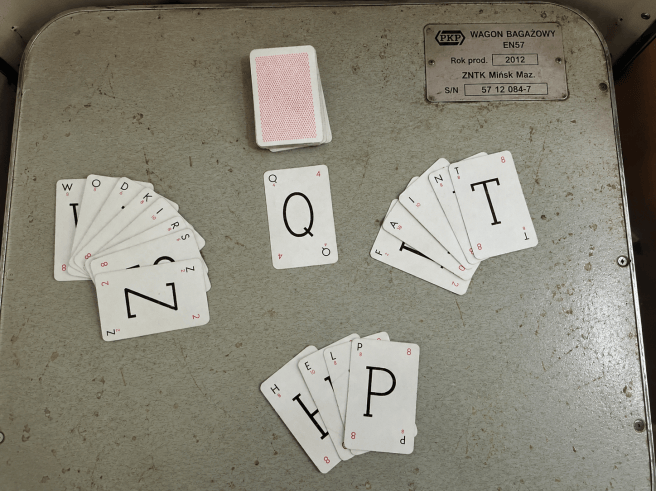
FAINT and HELP — but the well-known English word WODKIRSZ wins the game.
When the train finally pulled into Zabrze, the two of them burst out onto the platform, laughing and full of triumphant confidence.
My friend and I simply looked at each other — half relieved, half amused, and both slightly shaken.
When I had stood up to face him, my friend later admitted she thought I was in real danger. Maybe I was.
But in that isolated baggage car, all I cared about was making sure she wasn’t.

 Ghosts to Carry, Stories to Keep