Looking back now, it feels almost impossible that the railway world I knew in Silesia existed barely a decade ago. Those cracked platforms and dim lamps, the old EN57s rattling through the night — all of it has been swept away by a wave of modernisation so complete that it feels like stepping into another century.
The shift is startling.
Stations that once smelled of cold concrete and diesel have become bright, glass‑and‑steel spaces. Underpasses are clean and lit; the tracks themselves have been rebuilt, straightened, electrified, modernised. The whole landscape feels as though someone has quietly replaced it while no one was looking.
And the trains… the new Koleje Śląskie ELF units look like something from the future. Smooth, silent, aerodynamic — they glide where the old units clattered. They belong to a Poland that is confident, modern, and moving forward at speed.
Yet when I see them now, it’s difficult to reconcile them with the world I travelled through: the world of dark platforms, confusing signage, and the quiet kindness of a conductor who bent the rules to help a lost foreigner.
That older railway — the one I knew — has vanished.
But it lives on in these stories.

Maybe it was the combination of things: living abroad for the first time, a language I was still learning to hear, a culture I was slowly growing into, and a landscape that revealed itself at the speed of a train.
In the UK, the railway is a sealed‑off artery — fenced, guarded, warning signs everywhere. But in Silesia, the tracks were simply there. Running past allotments, factories, villages, fields. Life happening inches from the rails. That unfenced world is part of why Silesia got under my skin. It let me watch life raw and unfiltered.
For years I called anything to do with railways PKP. I think everyone did. I grew to love the railways so much that I still refer to all of it — every journey, every delay, every unexpected adventure — as my PKP adventures. It didn’t matter that half the trains weren’t technically PKP at all. By then the name had stuck. PKP became a kind of affectionate shorthand for the whole glorious ecosystem: the regional trains that stopped at every lamp post, the semi‑fast ones that pretended to be fast, the genuinely fast ones that felt like a reward for good behaviour, and the stations that all insisted on introducing themselves as PKP Something‑or‑Other.
It was easier, funnier, and somehow truer to just call the whole experience PKP — a single, sprawling, slightly chaotic universe that had adopted me whether I understood it or not.
Only later did I learn that the trains I rode were Przewozy Regionalne; in 2011, Silesia changed again, handing its routes to Koleje Śląskie. I had arrived in the middle of a transition — not just in the railway system, but in my own life. No wonder everything felt confusing.
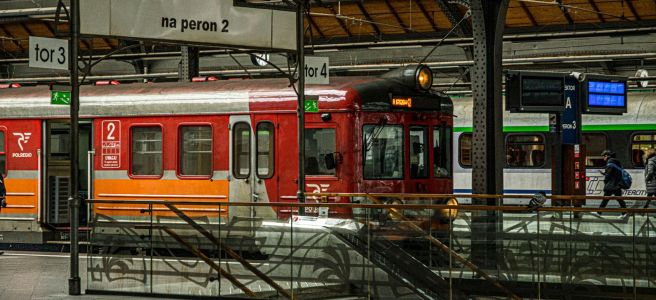
The type of train I used more than any other is classified as an EN57 EMU — Electric Multiple Unit — a long, stubborn slab of metal with heavy sliding doors that shut with the finality of a vault. The windows opened only a few inches, just enough to let in a slice of weather: winter grit, summer heat, the smell of coal stoves from villages you barely saw. Inside, the carriage had its own microclimate — warm, dry, faintly oily — a lived‑in atmosphere that clings to your clothes long after you stepped off.
Whatever the season, whatever the crowd, the EN57 was reliably itself: well‑travelled, a little battered, stubborn in the way of something that has survived by refusing to hurry. It didn’t pretend to be modern or sleek or impressive. It simply got on with the job, carrying whoever turned up, wherever they needed to go, with a kind of gruff, unassuming loyalty.
And somehow, endlessly absorbing. I was never bored on it, not once.

Even boarding an EN57 felt distinctive because of the train’s age, design, and the physicality of the process. The high steps, stubborn manual doors, and the general hustle and bustle around the entryways—all of it formed part of the ritual, something I learned to navigate in heat, snow, rain, or the thick humidity of a packed carriage.
These trains had already carried thousands of stories long before mine ever began.
Somehow, they carried mine too.

When I took these images on a sunny, warm Sunday in October 2010, the light had that mid‑afternoon sharpness that makes even a level crossing look like it’s auditioning for a film. I was halfway across the road when the barrier began to drop — smooth, deliberate, as if someone had finally decided to give my day a bit of structure. I lifted my phone and took a couple of photos, quietly impressed that I was outdoors at all.
I didn’t know where the train was going until it drifted past with a tired electric hum, the carriages dusty from a long, hot summer and rust showing along the upper panels, the wheels murmuring over the tracks as it eased itself towards the platform — or what looked enough like a platform that I didn’t think to question it. The same platform I’d end up leaping onto from a moving train a few weeks later, though at the time I still believed myself to be a sensible adult. Only when the last carriage slid into place did I spot the destination board at the rear: Gliwice.
Back then, still unsure how to use public transport without causing an incident, I didn’t duck under the barrier, run up and try to board. I simply stood there, letting the train — and the opportunity — glide away with the calm assurance of someone who had absolutely no idea what they were doing.
What I hadn’t realised — and really should have — was just how far it was to walk from Łabędy to Gliwice. The afternoon light had that washed‑out, late‑day glow, the kind that makes distances look deceptively manageable. By the time I finally limped into Mickiewicz Park to meet a friend, my brand‑new Converse had shredded both heels with the enthusiasm of a cheese grater. Every step felt like a close‑up of a bad decision.
I tried to look composed — shoulders back, casual nod, nothing to see here — but there’s only so much dignity you can project when you’re quietly bleeding into your own shoes. My friend took one look at me, abandoned any pretence of offering, and insisted on driving me back into Łabędy, even managing to find an apteka open so I could buy plasters for what were, by then, two small crime scenes masquerading as heels.
Sauna on a Train
One winter evening, travelling back from Katowice, I boarded the train and took up my usual position in the vestibule. This was before I had properly adapted, before I understood the unspoken rules of Polish commuting.
I stood there half-lost in thought, staring through the little window in the sliding door, when I noticed something extraordinary:
An entire row of empty seats.
On a busy train.
In rush hour.
A miracle.
I slid open the compartment door and was immediately hit by a wall of heat so intense my glasses fogged over at once. It felt less like public transport and more like entering a mobile sauna.
Still, grateful for my apparent good fortune, I sat down with a sigh of relief.
It took perhaps two minutes to understand why nobody else had.
The heater beneath the seat was not merely warm. It was operating at some magnificent Soviet-era level of industrial overheating, the sort of heat designed either to survive Siberia or slowly liquefy passengers from the ankles upward.
Naturally, I attempted to endure it using the full strength of the British stiff upper lip. I sat there pretending everything was perfectly normal, as though spontaneous combustion was simply part of the commuting experience.
Five minutes later I was back on my feet, coat half-open, cheeks glowing like roasted apples.
The other passengers watched with that wonderfully Polish expression that mixed curiosity, amusement, and a strange kind of respect.
Not because I had succeeded.
But because I had at least tried.
Lexicon

A friend had invited me to accompany her to the university campus in Katowice, where she was lecturing in mathematics. For reasons I can no longer recall, we were travelling in the baggage compartment of an EN57 train. It was a strange, isolated little space tucked away at the very end of the unit, far from the crush and noise of the main carriages—the kind of hidden room you discover once and never find again.
I always carried a deck of Lexicon cards with me, and we’d settled into a game.
My friend loved it. Despite English being her second or third language, she usually defeated me with alarming ease.
We were quietly laughing over an absurd combination of letters when two young men stepped into the compartment. They stood opposite us, their heavy winter jackets bulging with concealed beer cans which they periodically pulled out for heavy swigs.
My friend’s expression tightened. Her eyes darted toward the door, calculating escape routes. Even the conductor poked his head inside, took one look at the two men, and promptly retreated, sliding the door shut behind him.
We were entirely on our own.“Maybe we should move,” she whispered. She tried to sound calm, but the tremor in her voice was obvious.
Old instincts stirred—the kind I thought I’d left behind with my previous career. I wasn’t frightened, but I was alert in that deep, automatic way that comes from years of managing situations capable of turning ugly. My friend, gentle and unused to confrontation, was becoming more anxious by the second. Her fear was enough to flip a switch in me.
Before we could stand, the smaller, stockier of the two lads stepped forward. Confident. Slightly aggressive. He had that distinctively short summer buzzcut — a severe, grade-two crop that blurred the line between practical heatwave styling and a harder, blokersi aesthetic. He pointed a finger at the cards and barked something in Polish. I had no idea what he was asking, only that he was focused on the English letters.
My friend answered politely, explaining the word game, but his tone changed as she spoke. Sharper now. More demanding. Hovering right on the edge of a threat.
That was enough.
I stood up.
I felt my friend tense beside me, terrified that my sudden movement would trigger a flash of violence. I looked directly into his eyes, reaching for the only Polish words I possessed that might hold the room steady:
“Spoko… Spokojnie.”
A strange stillness settled over the compartment. Outside, the train clattered relentlessly through the Silesian dark, but inside, everything went dead silent. The second lad hung back, watching.
My mind raced through irrational physical strategies, preparing to shield her if he lunged.
Then, suddenly, the lad laughed. Loudly.
The immediate threat evaporated, replaced by a bizarre confusion. He spoke rapidly to my friend, who turned to me with a look of utter disbelief.
“Gary… he wants to play with us. He says he knows English.”
I sat back down slowly, my adrenaline still pumping.
“Deal him in,” I said quietly. “And whatever he plays, he wins. Agreed?”
She nodded gravely.
So we played.
The lad remained standing the entire time, swaying with the aggressive rhythm of the train, displaying that peculiar teenage mixture of bravado and intense curiosity. Even as the room softened, I couldn’t fully relax. A thin wire of tension remained. We had simply reached an unspoken truce: we weren’t leaving, and they weren’t backing down.
He would study his cards with intense concentration, then slam them onto the small table using combinations of letters that would have made my English students weep. Every single time, my friend would study the nonsense jumble with absolute seriousness before announcing:
“Yes… very good. You win again.”
He beamed. His friend beamed. We applauded like idiots. I still have no idea what any of his ‘words’ were supposed to mean, but he won every round. Triumphantly. Joyfully.

When the train finally pulled into Zabrze, the two of them burst out onto the platform, laughing and full of triumphant confidence. My friend and I simply looked at each other — half relieved, half amused, and both slightly shaken.
When I had stood up to face him, my friend later admitted she thought I was in real danger. Maybe I was. But in that isolated baggage car, all I cared about was making sure she wasn’t.
In The Middle
A quiet Sunday morning, October 2013. A message from a friend suggesting we meet somewhere closer to Katowice, cycle around the outskirts, then grab some lunch. Perfect. We agreed to meet on the train — she’d board at Chorzów Batory; I’d get on at Gliwice.
I cycled down to the station in the warm morning light. Beautiful, calm, almost empty. As I approached, I noticed several police cars and a couple of those personnel carriers they use for riot units. Odd, but everything outside seemed quiet enough. I pushed my bike into the ticket hall. Still quiet. No officers, no commotion. I bought my ticket from the kasjerka, who behaved as if it were any other Sunday.
Down in the subway, the departure board showed a train to Katowice leaving in a few minutes. Perfect timing. I’d get on, call my friend, and tell her I was on my way. Ahead of me, an elderly lady in a heavy coat and headscarf — despite the warm weather — was making her way toward the stairs to Platform 1. She carried a bag full of leafy vegetables, the kind of bag that looks heavier than she is. I followed her around the corner.
That’s when I saw them.
Two police officers, halfway up the stairs, in full riot gear: helmets, visors down, body armour, shields, and — as well as their sidearms — each carrying what I recognised as a tactical shotgun.
I froze. The old lady was already remonstrating with them, clearly unhappy about being told she couldn’t pass. I had no idea what was happening. I’d grown used to seeing Polish police with pistols, and I’d seen riot police in Kraków on Cracovia and Wisła Kraków derby day — the so‑called “Holy War” — but this was different.
This was quiet Sunday morning in Gliwice different.
One of the officers directed a sharp command at me. I didn’t understand the exact words, but I didn’t need to — the authority was obvious, and I stayed rooted to the bottom of the steps. Looking at the shotguns, my brain automatically assumed the worst. I figured I had stumbled into an active firearms operation, or possibly a public order exercise. The old lady, however, was having none of it. After a moment, one officer shrugged and waved her through. She marched past them with the determination of someone who has potatoes to peel and no time for nonsense.
I thought, Well, if babcia can go up there, so can I. I hoisted my bike and followed. The officers didn’t stop me.
On the platform, more riot police. All in full gear. A newer train was waiting, the one I needed — I saw the huge bicycle symbol on the door; the new ELF trains made it impossible to miss — so I headed straight for it with the confidence of someone who knows exactly where they belong. What I didn’t know was that the police had chosen the same carriage for entirely different reasons. I pressed the button, the door opened, and I rolled my bike inside.
Straight into the back of a police shield wall.
The vestibule was wide, bright, and spotlessly new, but five riot officers stood shoulder to shoulder, their interlocking shields completely blocking the aisle. The doors hissed shut behind me, trapping me in the yellow-trimmed entryway. One officer turned her head slightly, giving me a glare that said: What on earth are you doing here?
Every survival instinct should have told me to hit the door release button, step backward, and get off. But I hesitated. In that split second of confusion, my brain couldn’t reconcile the clean, modern bike compartment with an actual ongoing police operation.
Stranded in the open space, I pointed foolishly past the shields toward the empty bike racks as if I genuinely intended to walk through them. To my astonishment, two officers shifted just enough for me to squeeze past with my bicycle. Their shields slammed shut behind me like a gate.
Beyond the clear plastic of the shields sat a group of about ten hungover Górnik Zabrze football hooligans, occupying the seats on both sides of the aisle, including the folding seats located beaneth the bicycle racks. They smelled strongly of stale alcohol and defeat.
Any hope of hanging my bike on the rack evaporated. I was now standing directly in the dead zone between a line of police shields and a group of very fed‑up hooligans.
As an ex-British police officer who had served on Police Support Units, carrying shields and working as a tactical medic, my brain short-circuited. We would never, under any circumstances, allow a member of the public to breach a containment line, let alone wander into a hostile sector with a cobbled-together single-speed bike. Yet here I was, trapped in the middle of a tactical failure.
I panicked. Was my scarf the wrong colours? The lads stared at me. The police stared at me.
Then, a bizarre, heavy silence settled over the compartment. It was the kind of absolute quiet that happens when your body tunes into a threat and filters out the world. Somewhere in the front of the compartment, but out of my view, the muffled, low murmurs of someone arguing with the officers drifted through, underscored by the faint, rhythmic ticking of the train’s electric generator. But inside the dead zone, nobody moved. I gripped my handlebars, trying to project the calm, casual aura of a man who always travels inside a police containment unit on a Sunday morning.
After a few minutes, the conductor arrived from the opposite, flanked by two more officers…
He looked exasperated and exhausted. From the conversation — what little I understood — it was clear the hooligans had no tickets and were refusing to pay. Finding themselves on Piast Gliwice turf might have made them think twice about getting off the train; I will never know, but after five or ten minutes, some left quietly. Four or five remained, stubborn and defiant.
Then my phone rang. I instinctively checked it and saw my friend calling.
I took the call and whispered in English: “Not now. Sorry. Situation here. Will explain later.” Every head turned. The hooligans stared. The conductor stared. The police stared. I could almost see the thought forming: Ah. He’s English. That explains everything.
Eventually, the conductor told the remaining hooligans the train wasn’t going anywhere until they got off. After a minute, one of them muttered something, stood up, and signalled to the others. They shuffled out, cursing.
The police followed them. I finally hung my bike on the rack and sat down. I called my friend back and explained the delay.
Her response: “Only you, Gary. This could only happen to you.”

The rest of the day drifted by in that easy, companionable way good days often do — a slow cycle around the outskirts of Katowice, the heat rising off the pavements, the city feeling strangely soft around the edges. By the time we pedalled up to Silesia City Centre, we were both a little sun‑tired and quietly pleased with ourselves, as if we’d earned the right to secure the bikes together with both cable locks and wander off without a care. Two responsible adults. Two firmly locked bikes. Nothing could possibly go wrong.
When we came back, the bikes were gone.
I froze. My brain attempted a reboot. For a moment I just stared at the empty rail, waiting for the scene to rearrange itself into something sensible — perhaps the bikes would fade back into existence like a badly rendered video game asset. They did not. The space where they’d been was simply… blank. A neat, rectangular absence, as if someone had tidied reality.
We looked at each other — that small, helpless look you share when you both know something has gone wrong but neither of you wants to be the first to say it. Then the penny dropped: theft. Obviously. What else could it be? It felt almost personal, as if Katowice itself had decided to mug us.
My friend was devastated; she practically sprinted to the information desk to report the bikes stolen, arriving with the energy of someone who fully expected sirens, a manhunt, and possibly a helicopter.
The twist came quickly. The bikes hadn’t been stolen at all — security had taken them, cutting through our cable locks with the solemnity of a surgical team. Apparently the spot we’d chosen was off‑limits. Not “slightly discouraged.” Not “preferably avoid.” No — forbidden. Capital‑F Forbidden.
Once we had the bikes back, we returned to the rail and finally saw it: a tiny metal sign with a red X over a bicycle, positioned at exactly the height required to be invisible to anyone taller than a small child or shorter than a particularly observant dog. No wonder we’d missed it.
Later, cycling away, the whole thing settled into its proper place — not a disaster, not even an inconvenience really, just one of those small, absurd moments that lodge themselves in memory because of who you were with and how the day felt.
Police, football hooligans, the “theft” of our bikes that turned out to be health‑and‑safety enforcement — all in one day.
What a day.
The Szkloki Girls
On a cold, wet March afternoon, I sat by the window of a crowded EN57 train rattling back from Katowice. I had my headphones on, listening to a mix of Polish hip‑hop a friend had made for me, periodically wiping condensation from the glass to watch for the landmarks that meant I was nearly home.
When the train rolled into Ruda Śląska, the couple opposite me stood up, slid the door open, and left, pulling it shut with the soft thud of people who had done this a thousand times. Seconds later, the train squealed to a stop—a long, metallic complaint shivering through the carriage. Footsteps scuffed along the corridor, a brief murmur of voices, and the door slid back open.
In they burst. Four teenage girls, all elbows and energy, arriving with the kinetic presence that always precedes a crowd of adolescents. Skinny jeans worn pale at the knees, trainers scuffed grey, puffer jackets uneven from winters that outnumbered their birthdays. They carried the unmistakable scent of a wet afternoon—the damp exhale of school corridors and coats shrugged off after a long walk in the cold. Their clothes steamed faintly in the compartment’s heat, releasing a lived-in warmth that was immediate and utterly alive.
The bench seats opposite me were empty, and they collapsed into them, squeezing together until our knees almost touched. Old Polish train compartments never allowed for polite distance. They whispered, giggled, and nudged each other. I wiped a patch of condensation from the window and pretended to look out—the international sign for I’m not listening, while absolutely listening.
After a few minutes under their collective gaze, I reached into my bag and pulled out a packet of Silesian Szkloki, a hard rhubarb boiled sweet. As I unwrapped it—a tiny sound that instantly activated their radar—one nudged another. A suppressed laugh followed. A look that said: go on, ask him.
Just as I was about to pocket the bag, the smallest of them—a stick-thin girl with the clear authority of a leader—asked: “Można… jednego…?”
Could we… have one…?
I shrugged and offered her the bag. A slight hesitation, then she reached in. I held it out to the next, then the next. The fourth girl shook her head. She looked uncomfortable, tired, and deeply invested in distancing herself from the exuberance of her friends. It wasn’t rudeness; she just seemed to want to dissociate entirely from the spectacle.
A few minutes later, the leader spoke to me again. I didn’t catch the words over the music. My fellow passengers were already glaring, clearly irritated by the girls’ unembarrassed confidence.
I removed my headphones completely and blurted out a flat, direct: “Co?”
The compartment exploded. Shoulders, hair, and elbows flew everywhere as the girls dissolved into performative laughter. The tired girl didn’t flinch at my bluntness, nor did she join the mocking roar. Instead, she just shoved her friend’s shoulder, a weary gesture that said: you started this, you deal with him.
The leader asked what I was listening to. I passed the headphones across. They leaned in, four heads forming a perfect teenage constellation, hair brushing my sleeve. Even the tired girl dropped her head into the circle, listening with the sudden seriousness of people auditioning for a role in my life.
One nodded. “Fajne…”
They appeared totally mystified by my choice of music. More whispering followed. Perhaps they thought I was Polish, despite an appearance that usually marked me as an outsider. They seemed slightly unsure of themselves now.
I slipped my headphones back on and sat back, suddenly aware of the space — of them, of the irritated passengers, of how the whole thing looked. Lacking the fluency to navigate the interaction further, I did the safest thing I could think of: I took out my notebook and pretended to write. I doodled loops and nonsense lines, anything to look occupied and give the moment space to settle.
It did settle, naturally, the way teenagers sense when the fun has reached its limit. Their energy softened. When we pulled into Zabrze, they burst out as quickly as they’d arrived, drifting off into the cold and leaving the carriage a little emptier, a little quieter, as if the air itself was settling after a brief storm.
I still don’t know why I remember them so clearly. Maybe because they were the first Polish youngsters who treated me not as a foreigner, but simply as a person. Maybe because they were brave enough to ask. Or maybe because, for a few stops, they filled that rattling old train with something bright, chaotic, human, and gone too quickly.
The Mooning Trio
A warm Saturday morning in June. The kind of morning where the sun settles on your face through the train window and makes everything feel softer. I was on my way to Katowice to meet friends for lunch, half‑daydreaming, half‑watching the landscape roll by.
Somewhere between Gliwice and Zabrze, I saw them.
Three girls standing on a small hill to the right of the tracks. Teenagers, silhouettes sharp against the sky, close enough to see clearly, but far enough to feel like part of the scenery. They stood together, perfectly still, as if waiting for something. I thought maybe they were going to wave. They didn’t exactly wave.
In perfect unison, they turned around, pulled down their trousers, and presented their bare bottoms to our passing train.
Just like that. No hesitation. No shame. No giggling. A single, choreographed act of mischief. And then they were gone — jumped out of sight beyond the hill, the train rolled on, and the moment vanished behind us.
No mirage. No hallucination. Just three mischievous girls who decided that a passing train deserved a performance.
I smiled, shook my head. What else could I do? Then I leaned back, let the sun warm my face, and let the absurdity of it settle into memory.
It was such a small thing, but it stayed with me — a reminder that life, especially in Silesia, had a habit of surprising me in ways I could never predict.
Postscript: EU07-067
It was 9 March 2014, at 09:42, waiting on the platform at Gliwice station.The early-spring sky was a soft, pale blue towards the horizon—bright but biting cold, the sort of morning where the light looks warmer than it feels.And there, in that thin, quiet air, a PKP EU07 locomotive eased away from the platform. Pantograph raised against the overhead wires, its heavy electric whine gathered strength, a mechanical hum vibrating through the concrete like a half-forgotten memory.It rolled past with the massive, unassuming assurance of an industrial workhorse that had outlived fashions and timetables alike, hauling its immaculate coaches and the BAR car into the distance. A relic of iron and current, simply getting on with the job.
Watching it now, I can almost feel that morning again — the light, the cold, the sense of time slipping by in small, unremarkable ways.

 Ghosts to Carry, Stories to Keep