Ôbzdrzōnek przez śniyg
For more than a moment I stood there.
The bright modern shopping centre seemed almost insignificant
as my eyes widened in shock and awe.
The preserved pithead — KWK Kleofas —
rising where I least expected it,
my friends saying nothing,
letting me discover it myself.
I saw through the eyes of those before me —
men who knew the weight of the work,
the danger buried under their feet,
the kind my grandparents prayed
their blood and kin would escape.
I’d lived with such monuments,
watched their wheels turn in memory,
but seeing this one held and honoured here,
beside the mall’s bright glass,
was simple and complex at once —
as if history had turned its face toward mine
and waited for me to understand.
We stayed for hours — a meal, a beer or two —
the cold beyond the doors forgotten.
When we stepped outside,
the cold hit differently,
sharp on faces and hands.
Through it, Kleofas rose again —
steel and shadow lit from below,
no longer a shock but a recognition.
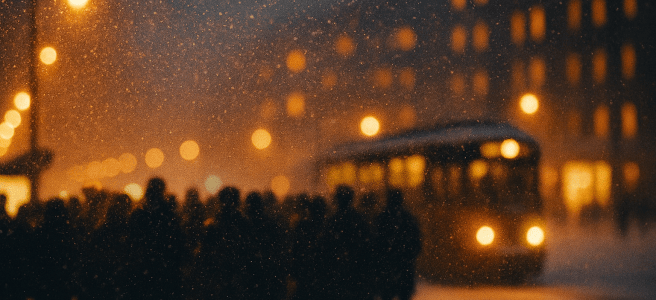
We walked toward the tram stop,
the cold settling into our coats,
snow gathering on our sleeves.
People stood in clusters,
faces turned toward the tracks,
waiting for something to arrive.
I felt the quiet between us —
not silence, but a space opening,
a pause before a truth
I hadn’t yet learned to name.
Footnote:
In Silesia, coal mines were traditionally given formal names — sometimes honouring local figures, sometimes imposed by the state. These names became part of the identity of the miners and their communities, carried with pride across generations. “Kleofas” is the name restored after 1990, replacing the communist‑era “Gottwald,” and is the name remembered by those who lived and worked around it.

 Ghosts to Carry, Stories to Keep